The part of your personal statement you’re sweating over the most is not the part program directors actually reread. The “origin story” and the flowery conclusion? Skimmed. The one paragraph they go back to—sometimes twice, sometimes three times—is the paragraph where you finally tell them what you want and who you are as a resident, not as a tragic premed who loved their grandma.
Let me be more precise.
There is a predictable moment, usually somewhere in the middle or toward the end of a strong statement, where the applicant shifts from storytelling to signaling. That’s the paragraph PDs lean in for. It’s where they look for three things:
- How you think about the specialty as real work, not fantasy.
- What you will be like in their program at 2 a.m. when everyone’s tired.
- Whether you understand the difference between this specialty and “generic doctoring” and can name, in concrete terms, how you fit.
You get that paragraph wrong, and I’ve watched PDs literally stop reading and say, “Ok, nothing special.” You get it right, and I’ve heard, “Read that part again,” before they flag you as “interview” even with average scores.
Let me walk you through exactly what that paragraph is, what PDs are hunting for line by line, and how to write it so it actually moves your file from “okay” to “we should meet this one.”
What PDs Actually Do With Your Personal Statement
Before we dissect the paragraph, you need to understand the context. Because most applicants have a fantasy about this.
Here’s what actually happens behind the door you never see.
On a typical busy afternoon, your PD or associate PD is sitting in an office with:
- A spreadsheet of applications
- ERAS PDFs open in three windows
- A clinic or OR schedule breathing down their neck
They open your personal statement not with curiosity, but with a question:
“Is there anything here that makes me change my default impression from the rest of the file?”
Scores, clerkship grades, school prestige, letters—that’s the base. The personal statement is a modifier. It pushes you up or down, sometimes just a little, sometimes a lot, but almost never from 0 to 100.
Most PDs read like this:
- They check the first few lines. If it’s unbearable—cliché, grandiose, wildly off-tone—they skim harder.
- They jump their eyes down the page, unconsciously looking for the moment you stop performing and start talking concretely.
- When they hit your “future resident” paragraph, they slow down. Some actually lean back in their chair. I’ve watched this.
I sat in an internal medicine file review once where the PD at a mid-tier university program in the Midwest said this out loud:
“Ok, that’s all fluff. Where do they tell me what they actually want to do?”
Then she found the paragraph I’m talking about, read it carefully, and said, “Good. Put them on the maybe-plus list.”
That’s the power of this one chunk of text.
The Paragraph PDs Reread: What It Is
Let’s name it so you know what you’re building.
This is your “Professional Identity & Fit” paragraph.
It usually sits in one of two places: either paragraph three or paragraph four, after your origin story and one or two clinical anecdotes.
It does three jobs at once:
- States what kind of physician you’re becoming within that specialty
- Describes how you function on a team and handle work (not just feelings)
- Signals what you’re looking for in a training environment in a way that doesn’t sound like shopping for amenities
If you do it right, PDs finish that paragraph with a sentence in their head that sounds like:
“I know exactly who this person will be as a PGY-1 here.”
That sentence gets you interviews.
What PDs Look For Inside That Paragraph
Let’s open it up and go line by line.
1. Do you understand the work, not just the vibe?
This is where most personal statements fail. They gush about “longitudinal relationships” in IM or “the privilege of being at the beginning of life” in OB/GYN. PDs have heard those clichés since before you were in high school.
They want to see you name the actual daily realities of the specialty and still want it.
For example, in surgery:
“I’m drawn to the structured, high-stakes team environment of the OR, but equally to the unglamorous continuity—post-op checks, managing complications, and the meticulous communication that keeps a service running safely.”
That sentence tells a surgical PD three things:
You know surgery is not just dramatic cases. You understand the grind. And you value the unsexy but critical parts. That’s gold.
Compare that to: “I love the mix of clinic and OR and the ability to work with my hands.”
That could be ortho, plastics, ENT, gen surg, even some GI. It tells them nothing about your understanding.
In pediatrics:
“I enjoy the intellectual work of building a differential with limited history and less predictable physiology, and I’m comfortable investing the extra time it takes to earn a child’s and family’s trust.”
Translation to the PD: you know kids don’t just act like tiny adults and that you’ll tolerate the slower pace and emotional labor.
PDs reread these lines because they want to be sure they’re not projecting. They want to see if you accidentally said something tone-deaf the second time through.
2. How do you behave in the trenches?
Here’s the truth: PDs do not care how impressive you are on your best day. They care about your baseline when you are sleep-deprived, behind on notes, and the attending is in a mood.
This paragraph is where you show them you know you’re signing up for work.
Not in some generic “I’m a hard worker” way. They want specifics.
Internal medicine applicant:
“On my sub-internship, I found I was most useful when I anticipated the team’s needs—pre-charting, updating lists, and closing documentation loops so my seniors could focus on complex decision-making.”
That’s concrete. It shows you think like a resident, not a premed chasing the best story.
Emergency medicine:
“I’ve learned I’m most effective in fast-paced settings when I stay slightly ahead of myself—organizing the board, re-triaging in my head, and communicating early when I’m approaching my cognitive limits.”
That tells them you recognize the cognitive load and have a strategy, not bravado.
PDs reread these because they’re asking: “Will this person lighten or increase my residents’ load?” Your answer lives in these details.
What Great “Reread” Paragraphs Look Like (And Why)
Let me give you a composite example from different specialties. These are modeled on real statements that sparked comments in committee like, “Read that third paragraph again.”
Example: Internal Medicine
“As I’ve grown through my clerkships, I’ve found the part of internal medicine that fits me best is the slow, iterative problem-solving on the wards. I like being the one who knows the patient’s story well enough to see when ‘something’s off’ before it’s documented. On my sub-internship, I gravitated toward the organizational work that keeps a team functioning—pre-rounding thoroughly, keeping a clean one-liner and problem list, and circling back with nurses to close the loop on plans. I want a residency that will push me to think independently early while still holding me to a high standard of thoroughness, especially in complex inpatient care.”
What does an IM PD see?
- You like the process and the continuity, not just the diagnosis high
- You understand team logistics
- You want intellectual pressure, not just a cushy lifestyle
They reread to verify that you really are describing their bread and butter. If they run an inpatient-heavy, academically serious program, this paragraph will ring true.
Example: General Surgery
“The parts of surgery that keep pulling me back are not only the operative moments, but the sense of responsibility for a patient’s course from consult to clinic follow-up. I like the structure and rhythm of a busy service—rounding efficiently, making clear plans, and adjusting when the floor realities do not match the perfect order set. On my sub-internship, I noticed I was calmest and most useful during chaotic call nights, when I could take ownership of small tasks, communicate clearly, and ask for help early. I’m looking for a program that expects me to work hard, gives direct feedback, and values residents who show up for each other even when everyone is stretched.”
A surgical PD is scanning for code words:
- “Ownership of a patient’s course” – good, understands responsibility
- “Floor realities do not match the perfect order set” – has seen the gap between textbook and practice
- “Ask for help early” – less likely to be unsafe cowboy
That’s why they reread. To see if you contradict yourself, or if this really is your natural language.
Example: Psychiatry
“What draws me most to psychiatry is the careful, longitudinal work of building a narrative with patients who often arrive without one they trust. I enjoy sitting with ambiguity and resisting the urge to close a case too quickly, especially when histories do not line up neatly. During my psychiatry clerkship, I found I was at my best when I stayed curious during difficult interactions, debriefed with the team, and translated plans into language patients and families could actually use. I hope to train in a program that values psychotherapy alongside psychopharmacology and will challenge me to grow both as a diagnostician and as a consistent, reliable presence for patients.”
Psych PDs are attuned to:
- Comfort with ambiguity
- Patience
- Insight into countertransference, not just “I like to listen”
They’ll reread to check that you’re not romanticizing trauma or simplifying complex dynamics.
The Structure Behind the Magic
You don’t need to guess your way through this. There’s a fairly reliable template that works across specialties.
Think of the paragraph as three moves:
Clarify what part of the specialty you’re drawn to as actual work
Use language about processes, not just values.Describe how you function on a team or service in specific, observable terms
What do others see you doing on a good day?Name the kind of training environment you’re seeking in a way that signals fit
Not “I want you because you’re prestigious,” but “I want X because I intend to become Y.”
If you want a skeleton to hang your own words on, it sounds roughly like this:
“As I’ve progressed through [clerkship/sub-I/elective], I’ve found that what fits me best in [specialty] is [specific work/process]. I enjoy [how you think/operate] and have been most effective when [concrete team behavior]. I’m looking for a residency that [training environment traits] so that I can grow into a [type of physician identity].”
Fill that in with real experience and genuine language, and you’ve got the paragraph PDs read twice.
What PDs Hate in This Paragraph (Red Flags You Don’t See)
Let me be blunt about the mistakes that quietly kill you. I’ve watched PDs’ faces tighten when they hit these.
1. The Shopping List Tone
“I’m looking for a program with strong research, early operative exposure, diverse pathology, and a supportive culture.”
That sentence appears in a hundred variations every year. It means nothing. Every program thinks it offers all those things.
To a PD it reads as:
“I have no actual idea what I need; I’m listing buzzwords I saw on your website.”
Better is: “I’m looking for a residency where residents are trusted with graduated responsibility early, within a culture where feedback is direct and frequent.”
Now you’re talking training philosophy, not brochure bullet points.
2. Lifestyle Code Words in Competitive Fields
If you’re applying to derm, ophtho, radiology, anesthesia—anything perceived as “lifestyle”—you have to be careful.
PDs get viscerally allergic to lines like:
- “I value work-life balance”
- “I’m seeking a career that allows time for family and outside interests”
They have heard this used as code for “I will do the bare minimum.” Is that fair? Not always. Is it reality? Yes.
You can communicate the same thing safely:
“I want a career that will let me bring sustained attention and energy to my patients over decades, which for me means training in a culture that supports long-term well-being and collegiality.”
Same desire. Much more palatable.
3. Abstract Self-Praise
“I am a natural leader.”
“I am known for my empathy.”
“I am always the hardest worker.”
These lines are where PDs roll their eyes and scan down. They know if that’s true from your letters and your CV. Coming from you, it reads as insecure.
Flip it to behavior:
- “I often found myself taking responsibility for organizing the team’s plan on rounds.”
- “Patients and families often stayed with me longer than scheduled because they felt heard.”
Let others’ behavior toward you do the bragging.
How This Paragraph Interacts With The Rest of Your File
Here’s something almost nobody tells you: PDs use this paragraph as a decoder for the rest of your application.
They read it, then reinterpret your letters and experiences through it.
A concrete example.
At a large academic IM program I’ve worked with, we were reviewing an applicant with solid but not stellar stats: mid-230s Step 2, mid-tier med school, some research. On first pass, they were “maybe.”
Then we hit their “identity & fit” paragraph. It was about loving inpatient medicine, being the one who kept the list tight, and actively seeking out feedback on presentations. The PD scrolled back up, reread a lukewarm-sounding letter from a sub-I attending, and suddenly the phrases “receptive to feedback” and “strong team member” meant more.
He literally said: “You know what, this is a worker. Interview.”
You cannot fake that with generic prose. But when it’s aligned—when your paragraph matches what your letters hint at—it amplifies you.
The reverse is true too. A paragraph that screams “academic physician-scientist in the making” attached to a CV with zero real research and no letter from a PI makes you look delusional.
Table: What Different Specialties Want To Hear In That Paragraph
To make this concrete, here’s how that key paragraph shifts slightly by specialty.
| Specialty | Core Signals in the Reread Paragraph |
|---|---|
| Internal Medicine | Enjoys complexity, longitudinal responsibility, team logistics |
| General Surgery | Ownership, resilience, comfort with hierarchy and feedback |
| Pediatrics | Patience, family engagement, tolerance for slower pace |
| Psychiatry | Comfort with ambiguity, reflective capacity, narrative thinking |
| Emergency Med | Situational awareness, calm in chaos, team communication |
| Anesthesiology | Vigilance, precision, team player with surgeons & staff |
If your paragraph doesn’t clearly align with what your chosen field actually values, you’re losing points for no reason.
A Simple Process to Build Your Own Reread Paragraph
Let’s make this actionable.

| Step | Description |
|---|---|
| Step 1 | Recall Clinical Moments |
| Step 2 | Identify What You Enjoyed |
| Step 3 | Extract Work Processes You Liked |
| Step 4 | Describe Your Team Behaviors |
| Step 5 | Match With Specialty Culture |
| Step 6 | Write 1 Paragraph Draft |
| Step 7 | Cut Buzzwords & Vague Praise |
| Step 8 | Align With Letters & CV |
Do this quickly:
- List 3–4 specific days or shifts in your chosen specialty where you left thinking, “I could do this for a long time.”
- For each, ask: What exactly was I doing that I liked? Not “helping people,” but “building a differential with my senior,” “running the list,” “counseling a worried parent,” “closing skin,” “turning chaos into a plan.”
- Circle the ones that show up more than once. That’s your core work preference.
- Now ask: On teams, what role do I naturally slide into? Organizer, explainer, quiet grinder, emotional anchor, early-warning system, question-asker?
- Combine these into 5–7 sentences that:
- Name the work you like
- Show how you behave
- State what kind of training environment will sharpen those traits
Then, ruthless editing. Strip out:
- “I am passionate…”
- “I have always wanted to…”
- “I believe that…”
Replace with: “I enjoy,” “I’ve found,” “I tend to,” “I want to train where…”
And then, the final check: could this same paragraph effectively sit in a personal statement for a different specialty with only the specialty name changed? If yes, it’s not specific enough. Go back and sharpen.
Quick Visual: What PD Attention Looks Like
Here’s roughly how PD attention tends to distribute across your statement.
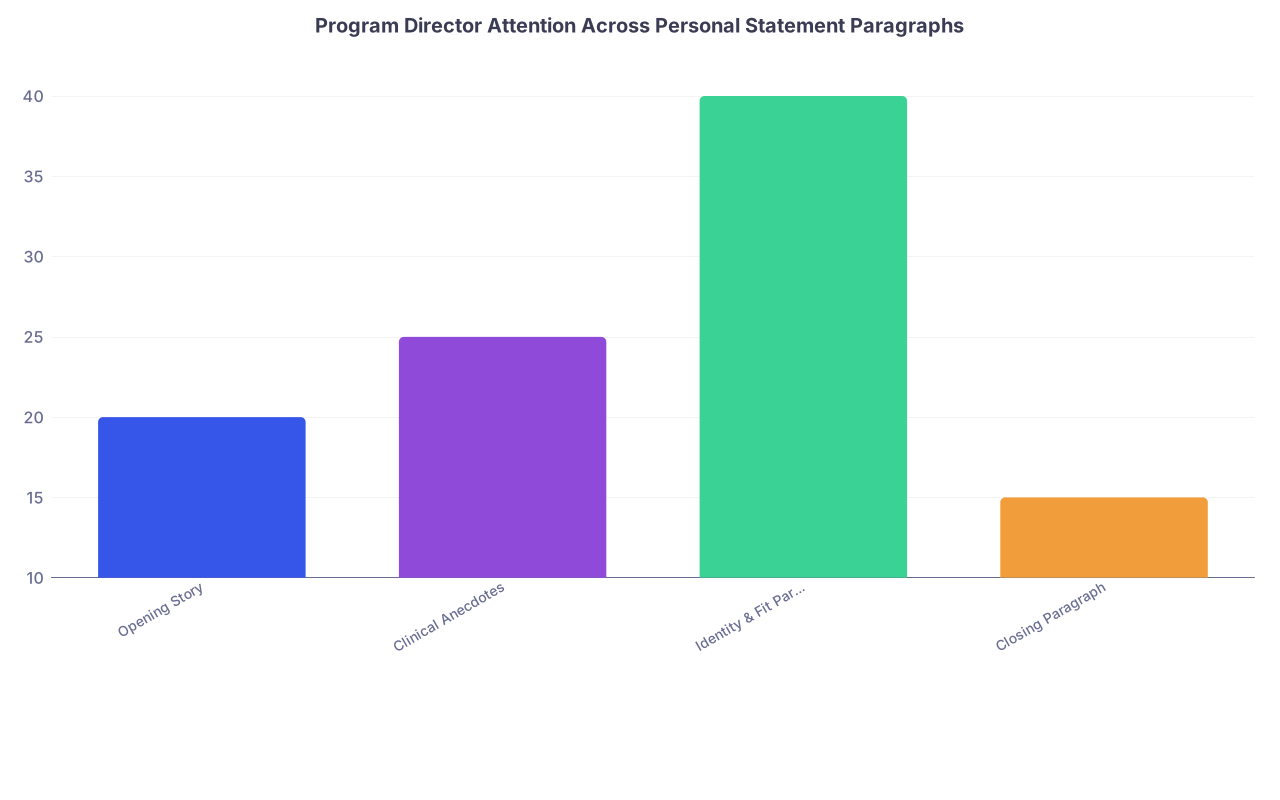
| Category | Value |
|---|---|
| Opening Story | 20 |
| Clinical Anecdotes | 25 |
| Identity & Fit Paragraph | 40 |
| Closing Paragraph | 15 |
That 40% chunk in the “Identity & Fit” zone is what we’ve been talking about. It’s the only part they systematically reread when they’re on the fence.
FAQ – The Things You’re Probably Still Wondering
1. Where exactly should this paragraph go in my personal statement?
Put it after you’ve already established why you’re drawn to the specialty with at least one clinical example. For most people that’s paragraph three or four. If you put it too early, it sounds abstract. Too late, and they’re already mentally checked out. Middle to late-middle is the sweet spot.
2. Can I mention specific program features in this paragraph to show I’m interested in them?
Not in a generic personal statement that goes to all programs. Do not say, “I’m especially interested in your program’s X” in the main PS. That looks sloppy when it goes to 80 places. You can, however, describe the type of environment they offer—“safety-net hospital,” “resident-run clinic,” “strong critical care exposure”—in terms broad enough to be true for multiple programs.
3. My experiences are pretty average. Can this paragraph still help me stand out?
Yes. I’ve watched very average applicants get bumped up because their paragraph made one thing clear: “This person is going to be low-maintenance and useful on day one.” You do that by being concrete about the mundane work you like and the way you show up for teams. PDs are not hunting for superheroes; they are hunting for reliable, self-aware workers. This is the paragraph where you prove you’re one of them.
Key takeaways:
The paragraph PDs reread is the one where you stop telling your life story and start showing, in concrete terms, what you’re like as a resident and what kind of training you’re seeking. Make it specific to the real work of your specialty, grounded in observable behavior on teams, and aligned with the culture of the programs you’re targeting. If you get that one paragraph right, the rest of your statement just has to stay out of the way.