Do PDs Really Read Every Personal Statement? What Actually Happens
Most residency program directors are not reading your personal statement start to finish. And the ones who say they do are usually remembering their best intentions, not their actual behavior at 11:30 p.m. with 200 apps left.
Let’s kill the fantasy version first: the wise PD, sitting with tea, thoughtfully reading each statement like a graduate thesis, underlining insightful sentences. That’s brochure medicine. Not real life.
In real life, personal statements are heavily skimmmed, strategically used, and frequently ignored—depending on the stage, the specialty, and whether your file is already a yes, a no, or a maybe.
You’re not writing a novel for a devoted audience. You’re writing a 30–60 second signal for a tired, overloaded, pattern-recognizing human who has seen thousands of these.
Let’s walk through what actually happens.
How Many Statements Could They Even Read?
Start with the math. It’s brutal.
Plenty of mid-tier IM or FM programs receive 2,000–4,000 applications. Competitive specialties (derm, ortho, rads, plastics) receive fewer in absolute numbers but have even less tolerance for “holistic” reading when Step scores and class rank already narrow the field.
Now look at time. Say a PD decides to give every personal statement 3 full minutes. Not realistic, but be generous.
3 minutes × 2,000 applications = 6,000 minutes
6,000 minutes = 100 hours
That’s 100 hours of uninterrupted, perfectly efficient reading.
Nobody with a full-time clinical and administrative job is doing 100 hours of personal-statement reading in a season. Spread over a month, that’s 25 hours/week on top of everything else.
What actually happens: triage.
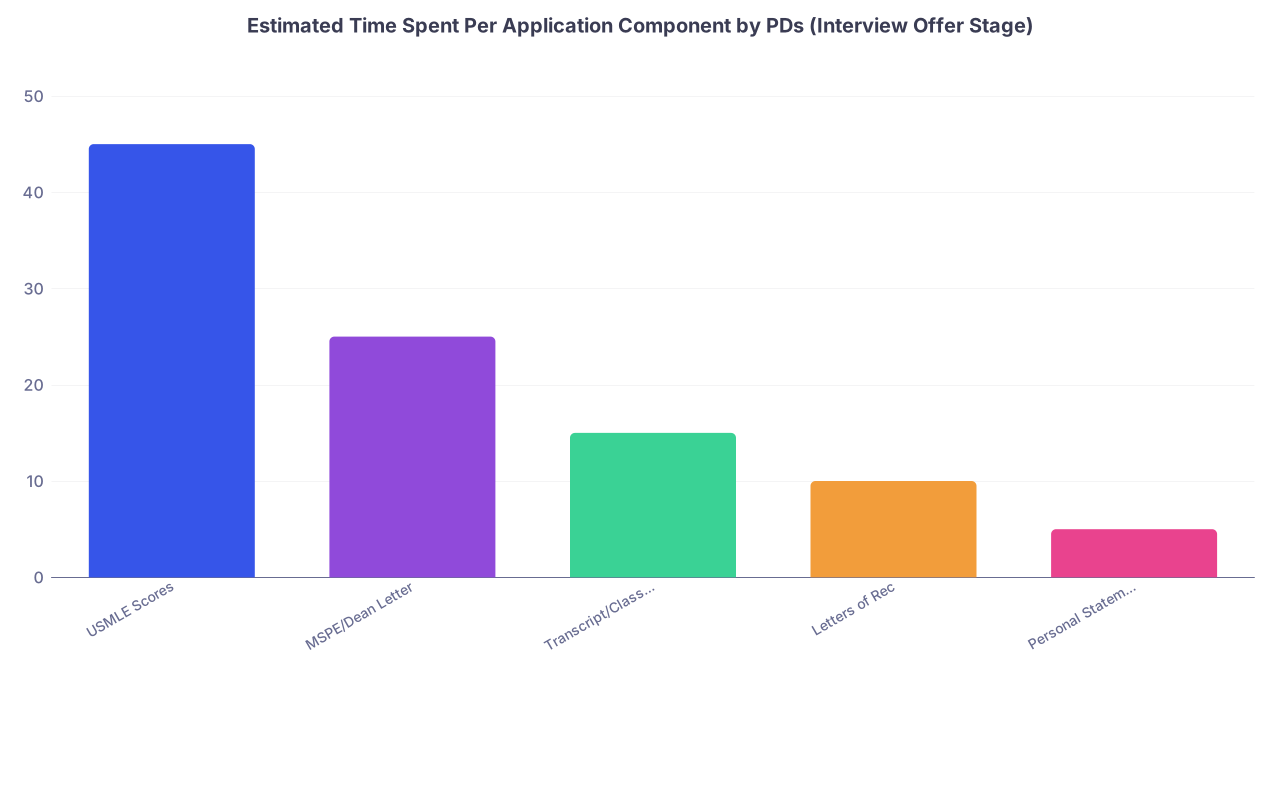
| Category | Value |
|---|---|
| USMLE Scores | 45 |
| MSPE/Dean Letter | 25 |
| Transcript/Class Rank | 15 |
| Letters of Rec | 10 |
| Personal Statement | 5 |
That’s not a literal time log; it’s how directors behave. Scores and the MSPE do the heavy lifting. The personal statement is usually last in the food chain.
The Real Screening Order: Where the Statement Fits
Program directors and selection committees usually follow some version of this flow, whether they admit it or not.

| Step | Description |
|---|---|
| Step 1 | All Applications |
| Step 2 | Auto or Near-Auto Reject |
| Step 3 | Transcript, School, MSPE |
| Step 4 | Letters of Recommendation |
| Step 5 | Borderline or Question Marks? |
| Step 6 | Invite Without PS |
| Step 7 | Read or Skim Personal Statement |
| Step 8 | Final Invite/Reject Decision |
| Step 9 | Score/Filter Cutoffs Met? |
| Step 10 | In Competitive Range? |
| Step 11 | Strong/Match Specialty? |
Notice the key point: for clearly strong or clearly weak applicants, the personal statement often is not determinative. Sometimes not even opened before the interview offer is issued.
The personal statement tends to matter most when:
- You’re on the bubble.
- There’s a mismatch or unexplained issue in your file (score drop, leave of absence, change of specialty).
- Your letters and scores are fine but generic, and they’re looking for any reason to say yes or no.
So no, they’re not “carefully reading every word of every statement.” They’re using it as a tool when they need extra signal.
What PDs Actually Use the Statement For
Here’s where the myth really breaks. The personal statement is not a general essay contest. It’s a problem-solving tool for PDs. It answers a few specific questions.
1. Is this person applying to us for a real reason or shotgun-ing?
Programs are tired of being “I would be honored to train at your esteemed institution” #47 of 120. PDs know you’re mass-applying. They still want some indication you understand what their program even is.
They scan for:
- Geographic ties (family nearby, med school in same region).
- Very specific program features (e.g., “your large refugee population and global health track” not “your strong curriculum”).
- Specialty commitment (less: “I like medicine.” More: “I worked with [subspecialty mentor], did [X project], and want [Y career outcome].”).
If the statement reads like a generic template where you changed the specialty name, it gets mentally filed as “no extra credit.”
2. Are there red flags in personality or judgment?
This is underappreciated. A mediocre story is fine. A statement that screams “difficult colleague,” “poor boundaries,” or “I think residency is about my personal growth arc” is dangerous.
I’ve seen faculty toss an otherwise okay application because of:
- Weird oversharing (detailed romantic or family drama dragging multiple paragraphs).
- Aggressive victim narrative where everything is someone else’s fault.
- Spiritual or political monologues that edge into proselytizing or ranting.
- Grandiosity (“I will redefine neurosurgery,” as a MS4 with one poster and a shadowing experience).
So PDs often skim your PS not to fall in love with you—but to make sure you’re not going to be a nightmare.
3. Does it fix something confusing in the file?
You failed Step 1, took a leave, switched from surgery to psych, or disappeared from research for a year. If you do not address it anywhere else, PDs look to the personal statement to see if you understand your own story.
They want:
- Acknowledge → Brief context → Clear evidence of change or stability now.
- No long justifications. No finger-pointing. No sob-story audition.
Done well, this can move you from “probably no” to “okay, let’s give them a look.”
How Much Do They Read? The Pattern Is Ugly but Predictable
People hate hearing this, but I’ve watched it happen in real time on application review days.
The most common reading patterns:
- First paragraph only. If it starts with a cliché (“The first time I held a stethoscope…”) eyes glaze over and they jump to the end or exit.
- First paragraph plus quick scan for specialty justification and any mention of their program/location.
- Jump straight to the middle or end if they’re specifically looking for an explanation (gap, failure, specialty switch).
- During interviews, they sometimes re-open it and read more deeply for a few candidates they’re particularly interested in—or to prep questions.
Does anyone read all of them fully?
A few programs try. Small, community-based programs with fewer applicants, or very niche fellowships, sometimes do claim (and actually manage) to read every statement. But they’re the minority and still constrained by time.
The reality across many programs:
- A good chunk of statements for “auto-interview” candidates: barely read at all pre-interview.
- Most “probably no” candidates: PS unread or skimmed to confirm the “no.”
- “Maybe” candidates and any applicant with something odd in the file: statement gets real attention—but usually still just a few minutes.
So yes, your personal statement might be carefully read. But usually only if something in the rest of your application forces them to slow down.
Where the Statement Quietly Does Matter More
There are scenarios where the personal statement moves from “background noise” to “deciding factor.”
1. Mid-tier but selective programs
Think of a solid university IM program with ~1500–2500 applicants for 20–30 spots. They are drowning in fully qualified people.
Once they’ve screened on:
- Scores
- MSPE
- Transcript
- Letters
They’re left with a large “interviewable” bucket. That’s where the statement helps break ties.
Make no mistake: they’re not ranking prose style. They’re watching for:
- Clear alignment with their strengths (e.g., “I want a career in academic hospital medicine, with emphasis on QI and med ed” at a program known for exactly that).
- Evidence you know something actually specific about the program.
- Professional, grounded tone.
Is this fair? Not really. But when they have 200 people who look identical on paper, softer signals like this start to matter.
2. Non-traditional, IMG, or career-change applicants
If your path isn’t straight, the personal statement can either save you or sink you.
For IMGs with non-elite schools and mid-range scores, PDs are asking:
- Do you understand U.S. training culture?
- Are you realistic and aware of where you fit?
- Do you write coherent English that doesn’t look ghostwritten?
When a PD reads an IMG statement that is:
- Simple, clear, and not over-flowered,
- Specific about why this specialty and this system,
- Honest about trajectory without melodrama,
…it stands out in a very good way because they’ve seen a lot of formulaic, consultant-written fluff.
3. When ranking after interviews
Another place applicants underestimate: post-interview discussions.
On rank meeting day, programs sometimes pull up the personal statement to:
- Break ties when everyone likes two candidates equally.
- Recheck someone’s backstory.
- Resolve concerns if impressions during the interview don’t match the file.
At that stage, the statement may be read more deeply than during the initial screen. Not for everyone, but definitely for some.
What This Means for How You Should Write
Now for the part most people get wrong. Knowing they’re not reading every word, some applicants lower their standards. Big mistake. Others swing the opposite way and write overwrought essays trying to be “unique.” Also wrong.
You write a strong personal statement not because you expect it to be lovingly read by all, but because:
- You do not know which 30–60 seconds they will see.
- You cannot predict whether you’ll be a “maybe.”
- A few bad sentences can hurt you faster than a few good sentences can help.
So stop writing like you’re submitting to The New Yorker. Start writing like you’re helping a tired PD quickly check three boxes:
- This person is normal and professional.
- This person understands and truly wants this specialty.
- This person has at least some coherent reason to be interested in our kind of program or setting.
That’s it. You’re not writing the Great American Essay. You’re avoiding landmines and sending clear, specific signals.
| Stage | Relative Importance | Typical Use Case |
|---|---|---|
| Initial Screen (Scores/MSPE) | Low | Mostly ignored unless red flag |
| Pre-Interview "Maybe" Decisions | Moderate–High | Tie-breaker, context for outliers |
| Interview Preparation | Moderate | Source of questions, understanding story |
| Rank List Discussions | Moderate | Clarifying fit, resolving mixed impressions |
The Data vs The Myth
There are survey data from NRMP and specialty organizations about what PDs say matters, and personal statements usually land in the mid-range: not at the top, not trivial either. That fits what we see in practice.
But don’t confuse “ranked below scores and MSPE” with “irrelevant.” The personal statement is an asymmetric tool:
- A fantastic PS rarely converts a weak file into an interview.
- A horrifying or wildly off-putting PS absolutely can kill an otherwise strong application.
- A clean, specific, competent PS quietly supports you in the situations where it counts: the gray zones.
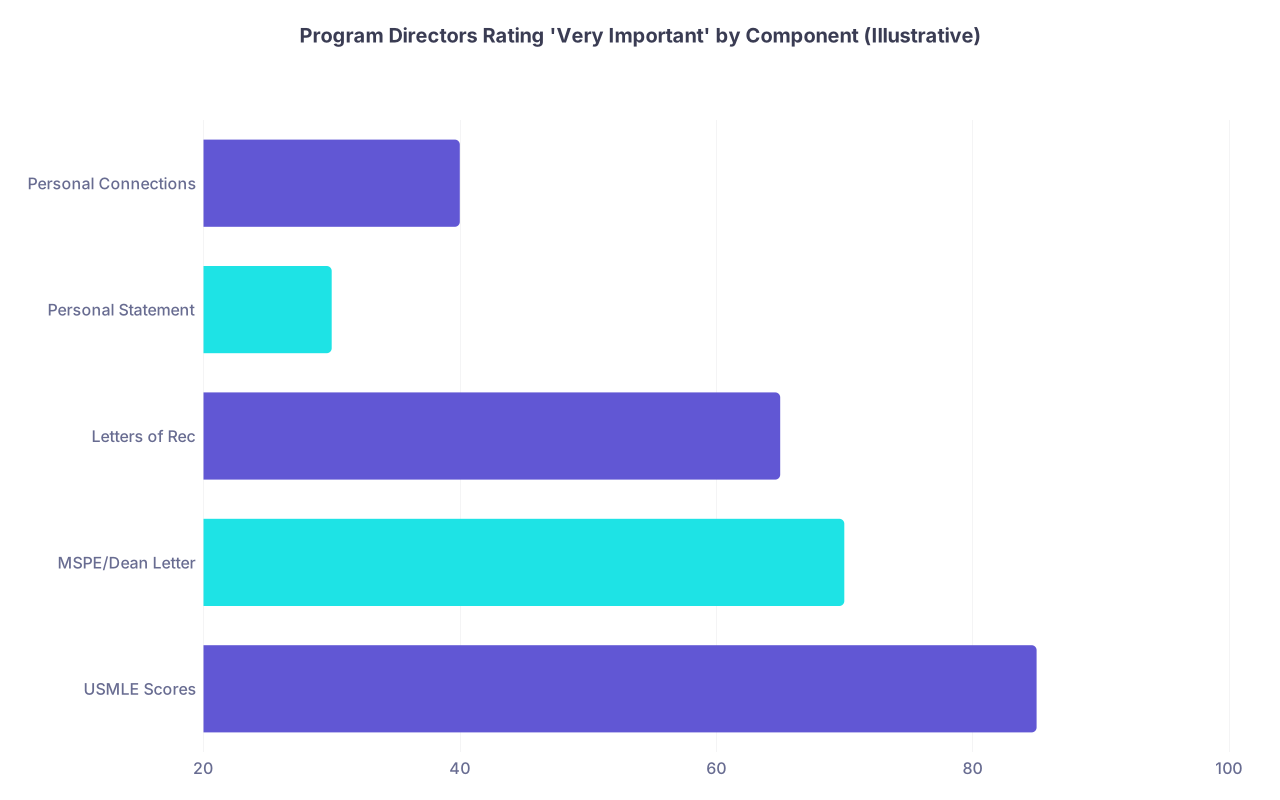
| Category | Value |
|---|---|
| USMLE Scores | 85 |
| MSPE/Dean Letter | 70 |
| Letters of Rec | 65 |
| Personal Statement | 30 |
| Personal Connections | 40 |
Are these exact percentages? No. But they’re directionally aligned with PD survey reports over the last decade. Scores and MSPE dominate. Personal statements sit in the “sometimes important, very important for a subset” tier.
What Actually Matters For You
Let me strip it down to what you should take away, not the comforting fiction you might prefer.
- Most PDs do not carefully read every personal statement. Many are skimmed; some not opened pre-interview.
- The personal statement matters most in borderline and confusing cases, and in post-interview decisions. It’s a tie-breaker and a red-flag detector, not a primary screen.
- Your goal is not to be “epic and unforgettable.” Your goal is to be coherent, specialty-specific, and normal, with no landmines, clear alignment, and a story that makes sense in 60 seconds or less.
Write for the reality of how PDs behave, not the idealized version they describe at info sessions.