The personal statement is not your golden ticket. Scores are.
That is not what most advising offices tell you, but it is what the data – and program director behavior – actually show.
Let me be precise: the personal statement almost never rescues a weak application, but it absolutely can sink a strong one. It also matters very differently at different stages: screening vs ranking vs “tie-breaker” decisions.
If you understand that, you stop wasting time trying to write the “most inspiring story ever told” and start writing a clean, risk-free, strategically boring statement that does its actual job.
What Programs Really Use To Screen You
The biggest myth: “They look at applications holistically from the beginning.”
No, they do not. Not in the way students imagine.
Across NRMP Program Director Surveys for the last decade, the top initial screen factors are always the same:
- USMLE/COMLEX scores (Step 1 when it was scored, now heavily Step 2 CK)
- Failed attempts on any Step
- Clerkship grades / class rank / MSPE signals
- Home/away rotation performance
- Visa requirement (for IMGs)
- Sometimes school reputation or “known quantity” schools
The personal statement is not at the top of the list for granting interviews. It shows up consistently as “important,” but not in the top handful of screeners.
Here is how the factors usually stack for getting an interview:
| Factor | Typical Importance Rank* |
|---|---|
| Step 2 CK / COMLEX Level 2 | 1–2 |
| Clerkship grades / MSPE | 1–3 |
| Step failures | 1–3 (negative filter) |
| Letters of recommendation | 3–5 |
| Personal statement | 6–10 |
*Across multiple NRMP Program Director Surveys and specialty-specific surveys.
You know what that means in practice?
Many programs never read your personal statement before deciding whether to invite you. They filter by scores and red flags, sort by some combination of metrics and institutional familiarity, and only then bother opening essays for a subset of applicants.
If your Step 2 CK is 270 and your clinical grades are excellent, your personal statement could be… fine. Not brilliant. Not cinematic. And you’d still get a lot of interviews.
Flip side: if your Step 2 CK is 208 and you barely passed multiple rotations, your personal statement won’t magically override those hard numbers.
To visualize how much mental real estate each component occupies for gatekeepers:
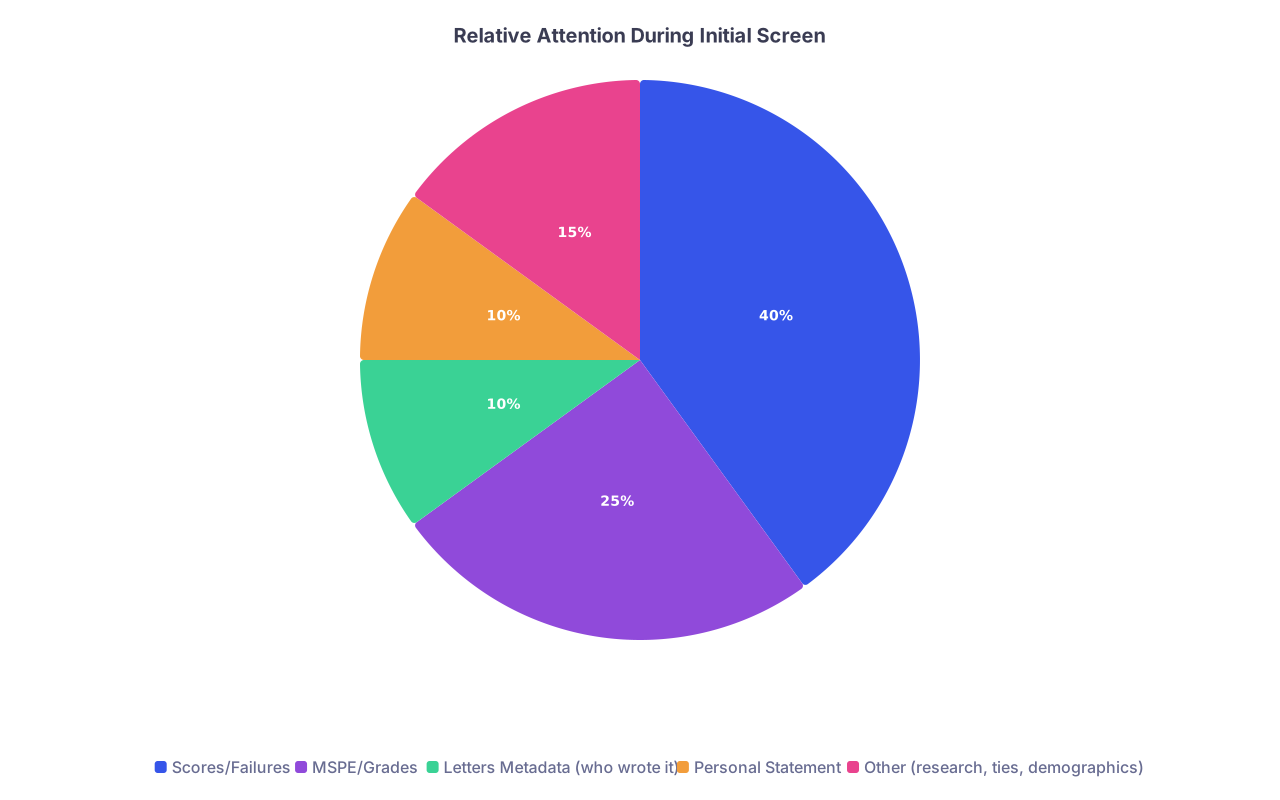
| Category | Value |
|---|---|
| Scores/Failures | 40 |
| MSPE/Grades | 25 |
| Letters Metadata (who wrote it) | 10 |
| Personal Statement | 10 |
| Other (research, ties, demographics) | 15 |
Are the exact percentages universal? Of course not. But the pattern is accurate: numbers and the MSPE dominate the first pass.
Where the Personal Statement Actually Starts to Matter
Now the twist: once you clear the initial score/grades filter and land in the “interview pile,” the personal statement jumps in relative importance.
Not because it now becomes a magical story-telling competition, but because it becomes one of the few tools programs have to:
- Screen for professionalism and judgment
- Clarify red flags
- Understand specialty commitment
- Look for deal-breakers (eg, clear misalignment with specialty or program type)
- Differentiate similar applicants in later decisions
Think of it as a quality control and tie-breaker tool, not a primary selection engine.
The 3 Jobs of a Residency Personal Statement
If you want a practical model, the personal statement has three real-world jobs:
Do not raise concerns.
No arrogance. No boundary issues. No weird “I’m actually above this specialty” vibe. No unprofessional oversharing.
If your essay triggers, “This feels off,” you go in the “Probably not” pile even with a 260.Provide a coherent, believable story of specialty choice.
Programs read thousands of “I love internal medicine because of the continuity of care” paragraphs. That’s fine. They’re not grading creativity. They’re scanning for:- Does this person actually understand what this field is?
- Does their narrative match their experiences and letters?
- Do they sound realistic about the work?
Offer selective hooks for interviews and ranking.
Something specific but grounded: palliative interest backed by an actual elective; QI interest with a small project; rural background relevant to a community program.
Hooks do not substitute for weak metrics. They make a solid applicant stick in someone’s mind.
Notice what’s missing: “be the most inspiring applicant of all.” That’s a premed fantasy.
How Much It Matters vs Scores, By Scenario
Let’s do what almost no one does and translate this into practical weight in different situations.
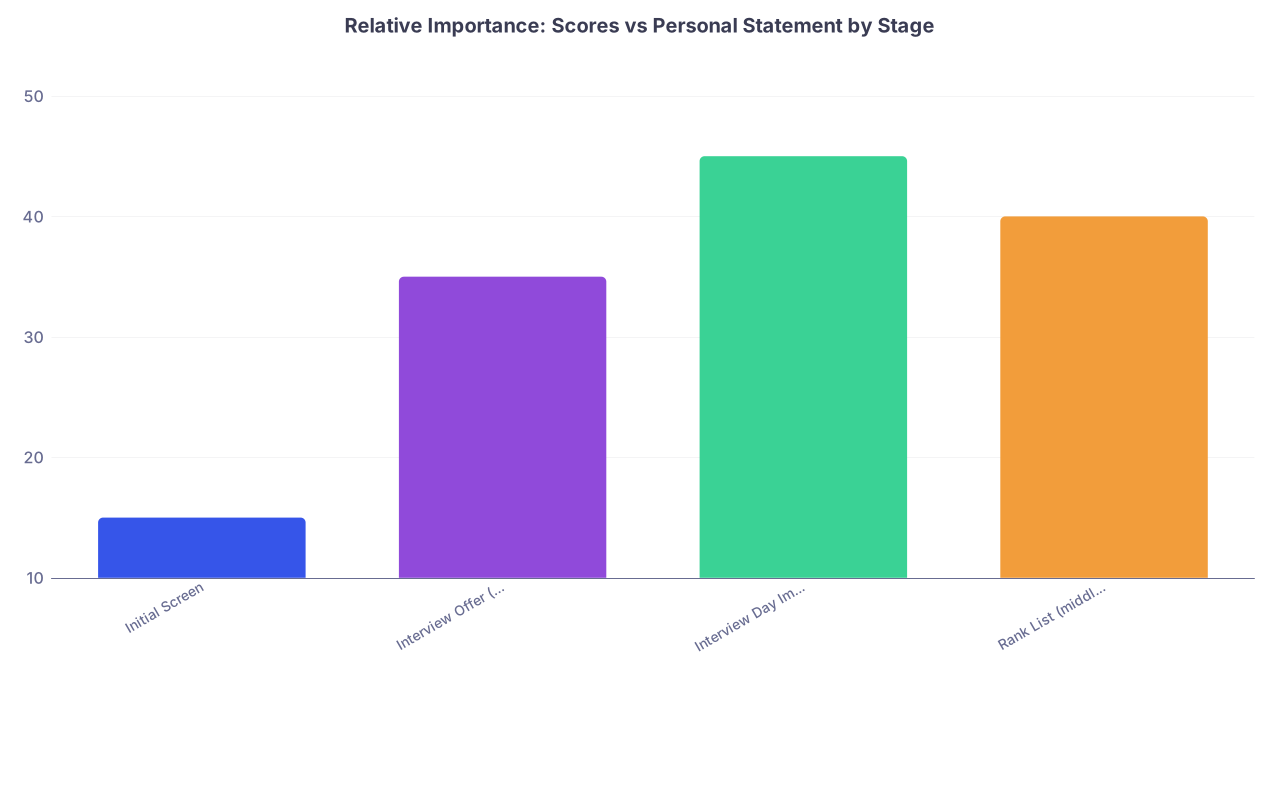
| Category | Value |
|---|---|
| Initial Screen | 15 |
| Interview Offer (borderline file) | 35 |
| Interview Day Impressions | 45 |
| Rank List (middle of list) | 40 |
Here, I’m treating “100” as the total importance and focusing just on scores for the bar values. Smaller bar = more room for non-score factors like PS, letters, interviews.
Interpretation:
- Initial Screen – Scores dominate. Personal statement is background noise or not even read.
- Borderline Interview – When someone is right on the edge, the PS can matter more. A clear, grounded narrative and no red flags can push them into “okay, let’s meet them.”
- Interview Day / Impressions – Now scores recede. Letters, personal statement, and your live performance carry more weight.
- Ranking Middle of the Pack – For the big block of “would be fine here” applicants, personality fit, PS, and letters often separate #8 vs #23 on the rank list.
Is the PS ever more important than scores? For getting an interview, almost never. For exact rank order inside the large middle group, absolutely yes.
Concrete Example: Two Internal Medicine Applicants
Both apply to a mid-tier academic IM program.
Applicant A: Step 2 CK 255, solid MSPE, decent IM letters. Personal statement: well-organized, nothing special, standard “I enjoy solving diagnostic puzzles and longitudinal care.” No weirdness.
Applicant B: Step 2 CK 239, similar MSPE, strong letters. Personal statement: detailed IM narrative, clear interest in underserved populations, integrates a specific local population they’ve worked with that matches the program’s catchment, references a known faculty’s research appropriately (not creepy fan mode).
What happens?
- Both clear the score screen easily.
- Both get interviews.
- On the rank list, Applicant B is very likely to be ranked higher than Applicant A by some faculty, despite the lower score, because the statement + interview created a stronger impression of “fit” and purpose.
Scores opened the door. Personal statement (plus interview) decided who stood closer to the front of the line.
The Harsh Reality: The Personal Statement as a Liability
Here’s the part advisors sugarcoat: the personal statement is more dangerous than it is powerful.
It rarely transforms your chances upward. It can absolutely push them downward.
I’ve seen programs do this:
- Strong file, competitive scores, then PS shows:
- Thinly veiled specialty shopping (“I considered derm, radiology, and ortho but…” in an IM or FM statement).
- Over-sharing mental health history without framing stability and insight.
- Casual trashing of another specialty or previous institution.
- “My trauma made me a better person” essays that shift focus to the writer’s unresolved stuff, not professional growth.
You know what happens next? Knocks them from “definitely interview” to “eh, maybe if we have spots,” or off the list entirely if the file isn’t stellar.
Programs are risk-averse. The statement is their window into whether you’re going to be a stable, professional colleague. If you plant any doubt, your great score doesn’t always save you.
Specialty Differences: Where the PS Moves the Needle More
Yes, there are differences by specialty.
Fields that lean heavily on interpersonal skills and long-term relationships (FM, Psych, Peds, Med-Peds, sometimes IM) often put a bit more weight on the statement. Procedure-heavy or ultra-competitive specialties (Derm, Ortho, Rad Onc) still look at it, but the score cutoff culture is more brutal.
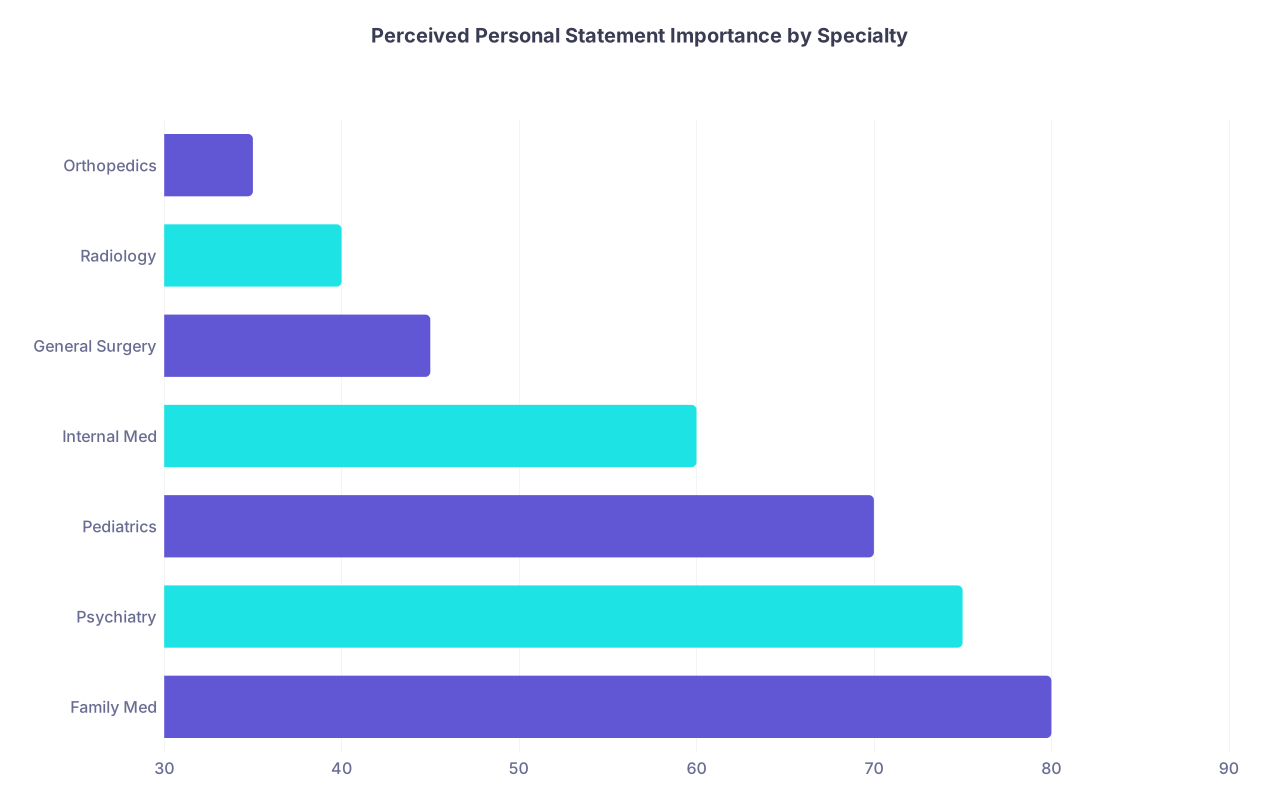
| Category | Value |
|---|---|
| Family Med | 80 |
| Psychiatry | 75 |
| Pediatrics | 70 |
| Internal Med | 60 |
| General Surgery | 45 |
| Radiology | 40 |
| Orthopedics | 35 |
These “importance” scores are relative impressions based on PD surveys and experience reading hundreds of specialty-specific discussions. The pattern is what matters:
- Higher weight: FM, Psych, Peds – more attention to narrative, empathy, communication.
- Middle: IM – it matters, but plays second to letters and MSPE.
- Lower: Surgical / image-heavy specialties – still read, but mostly as a professionalism and sanity check.
Even in “high-weight” specialties, though, the PS does not offset very low scores enough to radically change your odds. It mainly separates the large middle band.
How Much Time You Should Actually Spend
Here’s where I’m going to go against the “This is the most important essay of your life” nonsense.
For almost everyone:
- 2–3 focused weeks with on-and-off work is plenty.
- Maybe 8–12 serious revision sessions total.
- Aim for “clean, coherent, professionally human,” not “Nobel Prize speech.”
Meanwhile, Step 2 CK prep, audition rotation performance, and targeted letters are orders of magnitude more impactful.
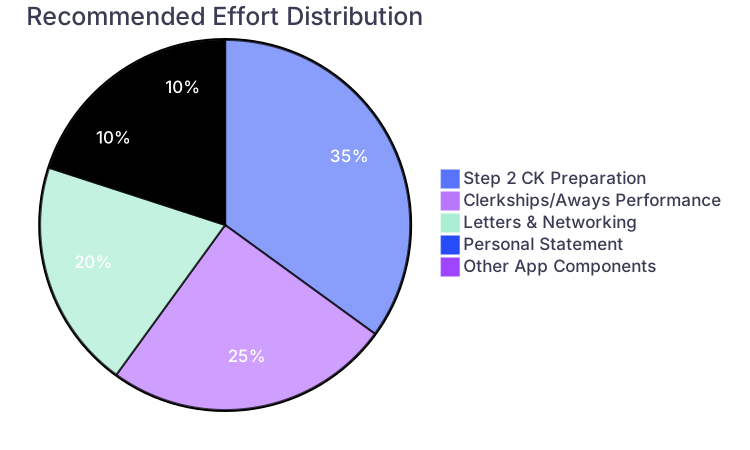
Could you spend 60 hours wordsmithing every sentence? Sure. Will that meaningfully increase your match probability beyond “strong, clear, no red flags”? Almost never.
What a High-Yield Personal Statement Actually Looks Like
Stripped of the mythology, a high-yield residency personal statement is:
- 3/4 to 1 page of:
- A concise opening that says why this specialty without drama.
- 1–2 specific clinical experiences that show how you behave and think.
- A brief, honest description of your interests in the field (teaching, QI, specific populations) that actually matches your CV.
- A closing that sounds like a responsible, grounded future resident.
Signals you send that programs actually care about:
- You understand the day-to-day reality of the field.
- You’re not using this specialty as a backup while clearly lusting after something else.
- You have at least some professional self-awareness.
- You aren’t going to explode or burn out in a way that harms the team.
You’re not trying to “win” some imaginary creative writing contest. You’re passing a professionalism and coherence check, and then offering subtle reasons to remember you.
Scores vs Statement: Final Reality Check
Let’s put it in brutally simple terms.
If we pretend “match success” is driven by four main levers — scores, clinical performance/MSPE, letters, and personal statement — a realistic weighting for most core specialties looks something like this:
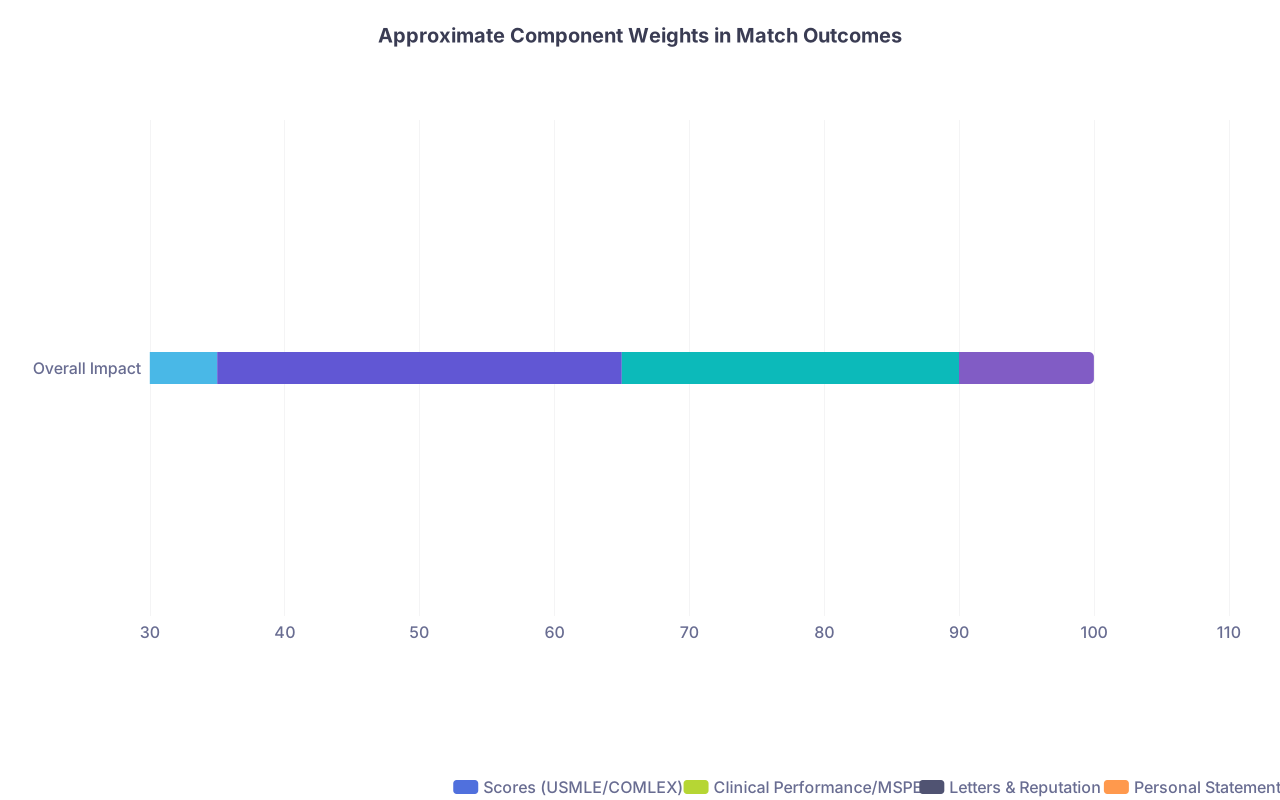
| Category | Scores (USMLE/COMLEX) | Clinical Performance/MSPE | Letters & Reputation | Personal Statement |
|---|---|---|---|---|
| Overall Impact | 35 | 30 | 25 | 10 |
Does this vary by program and specialty? Of course. But you’re not going to find a world where the personal statement quietly beats out your Step 2 CK.
So when someone tells you, “The personal statement can make up for low scores,” translate that into the real version:
- “A good personal statement can prevent your already borderline application from being discarded for soft reasons.”
- “A strong, coherent narrative can help you win tie-breaks against similar applicants with similar metrics.”
- “An awful personal statement can absolutely sabotage you, no matter your scores.”
Years from now, you will not remember your exact adjectives in paragraph three. You will remember whether you treated the personal statement for what it is: a small but very real lever that cannot replace your scores, but can either protect or poison everything they made possible.