Shorter isn’t better. Better is better.
The cult of the “short, punchy” residency personal statement is one of the more persistent bad ideas I see applicants repeat every year. Someone on Reddit says “keep it under 500 words or they won’t read it,” a chief resident at a pre-interview dinner says “I only skim them anyway,” and suddenly everyone is gutting anything that looks like nuance or reflection.
Let me be blunt: programs are not ranking you based on winning the minimalist word-count Olympics. They are ranking you based on whether you sound like a thoughtful, self-aware, reasonably mature future colleague. That usually takes more than 300 words and less than a manifesto.
You are not applying to Twitter. You’re applying to residency.
Let’s separate the myths from what actually happens on the other side of ERAS.
The Hard Limits: What the Systems Actually Allow
Before we even get into myths, let’s anchor in reality.
For ERAS residency personal statements, the true constraint is character count, not “word count vibes.” Historically, the system has allowed about 28,000 characters with spaces (that’s roughly 4–5 single-spaced pages). The conventional wisdom has drifted to something like “keep it to one page when printed using 12-point Times New Roman,” which usually translates to around 650–850 words.
Key point: the system does not chop your statement at 500 words. Or auto-reject you for 900. There is no secret “ideal” length coded into ERAS.
Here’s how typical “good” statements actually land in practice:
| Quality Level | Word Count Range | Pages (12-pt, single spaced) |
|---|---|---|
| Too short / superficial | 250–450 | ~0.5–0.75 |
| Solid / competitive | 600–900 | ~1.0–1.25 |
| Risky long-winded | 1000–1300 | ~1.5–2.0 |
Where do most successful applicants fall? That 600–900 range. Enough space to actually say something, not enough to put the reader to sleep.
The obsession with “shorter is better” is not coming from the platform’s constraints. It’s coming from fear and hearsay.
Myth #1: “Programs Don’t Read Them, So Keep It Super Short”
This one is half-true, which makes it especially dangerous.
Yes, some faculty barely skim your personal statement. I’ve sat in ranking meetings where an attending openly said, “I don’t read those; I just look at letters and scores.” But there is always someone else at that same table who does read them and who will absolutely say things like:
- “This statement is actually pretty thoughtful.”
- “They clearly understand the specialty.”
- “This one is generic; they could be applying to anything.”
- “This feels weirdly immature.”
And that “someone else” is often the program director, APD, or core faculty.
Here’s what data and real-life behavior actually look like:
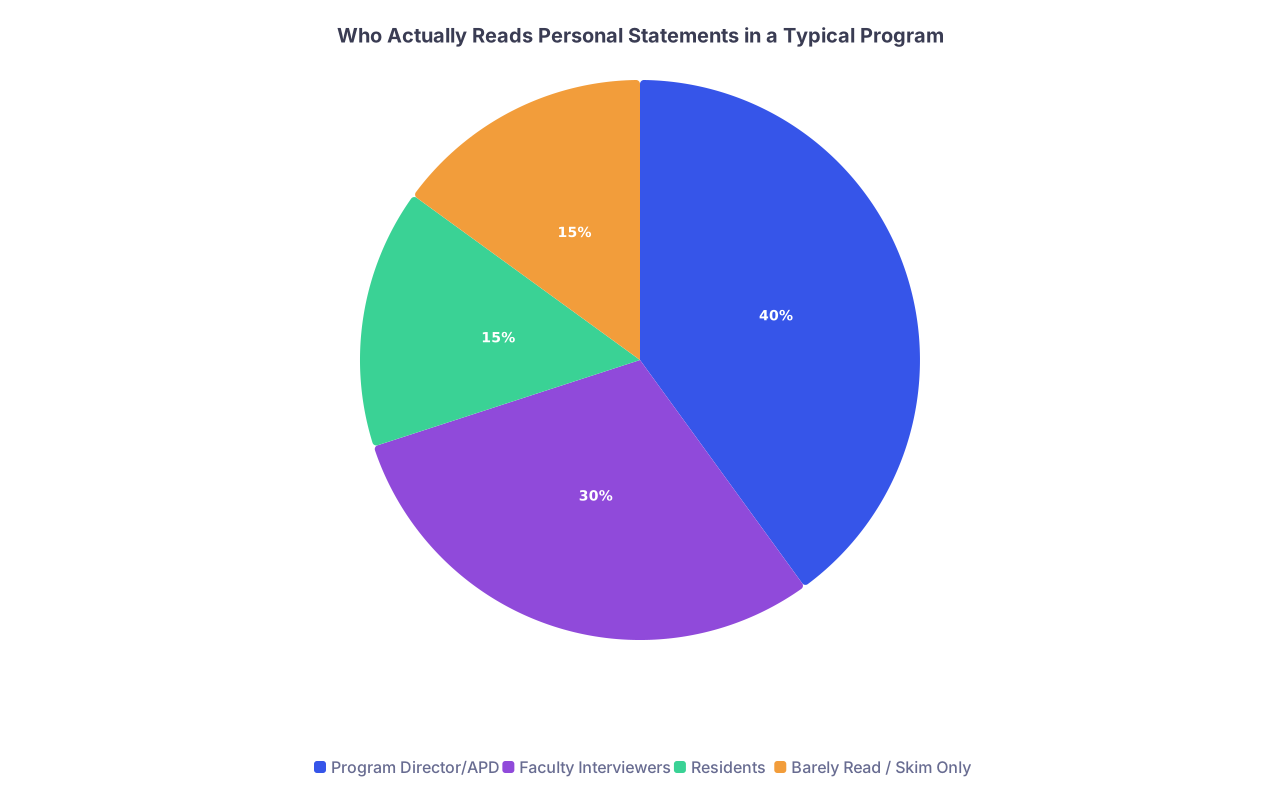
| Category | Value |
|---|---|
| Program Director/APD | 40 |
| Faculty Interviewers | 30 |
| Residents | 15 |
| Barely Read / Skim Only | 15 |
In other words: enough people read them closely enough that treating your statement like a checkbox is lazy and risky.
What the “I barely read them” crowd is actually telling you (without realizing it) is this:
- Bad statements can hurt you.
- Great statements may not save a weak application, but they do break ties.
- Mediocre statements do nothing. They drown in the pile.
A too-short, superficial, “just get it done” essay is squarely in that last category. It does not help you stand out. It just confirms you did the minimum.
Myth #2: “Shorter = More Respectful of Their Time”
This sounds reasonable. It’s also wrong in the way that cheap, corporate “efficiency” thinking is wrong.
Program directors are not counting your words. They’re scanning for signal.
What actually wastes time is:
- Reading a hyper-generic 350-word essay that could have been written by ChatGPT v1.
- Reading 400 words of “I’ve always wanted to help people” with zero evidence.
- Reading something so thin that the interviewer has nothing useful to ask you about.
I’ve watched interviewers prep between cases. They scroll the ERAS page. They glance at your CV, your photo, your letters. Then they open your personal statement and look for a few anchor points: a story, a theme, a clear reason for the specialty, something memorable.
When the statement is 300 bland words, you force them to walk into the interview with no material. That doesn’t respect their time. It makes their job harder.
A tightly written 750-word statement that:
- Explains why this specialty, through a specific lens
- Shows how you think when things go wrong
- Gives 1–2 concrete, grounded examples
- Leaves them with 2–3 obvious follow-up questions
…is far more respectful than a “mercifully short” paragraph that tells them nothing they couldn’t guess from your CV.
Respect their time by giving them high-density information in clear prose. Not by starving them of data.
Myth #3: “Longer Statements Look Desperate”
No. Bloated, meandering statements look desperate.
Word count is not the problem. Lack of editorial discipline is.
There’s a huge difference between:
- A 950-word statement that uses almost every sentence to develop your motivations, show your growth, and tie it all to the specialty
versus
- A 650-word statement that spends half its real estate on a cliché patient story that could belong to anyone and the other half on a vague “I’m excited to join a dynamic team.”
Residents absolutely roll their eyes at the second one. Not because of the length, but because of the content-to-fluff ratio.
Here’s the honest breakdown:
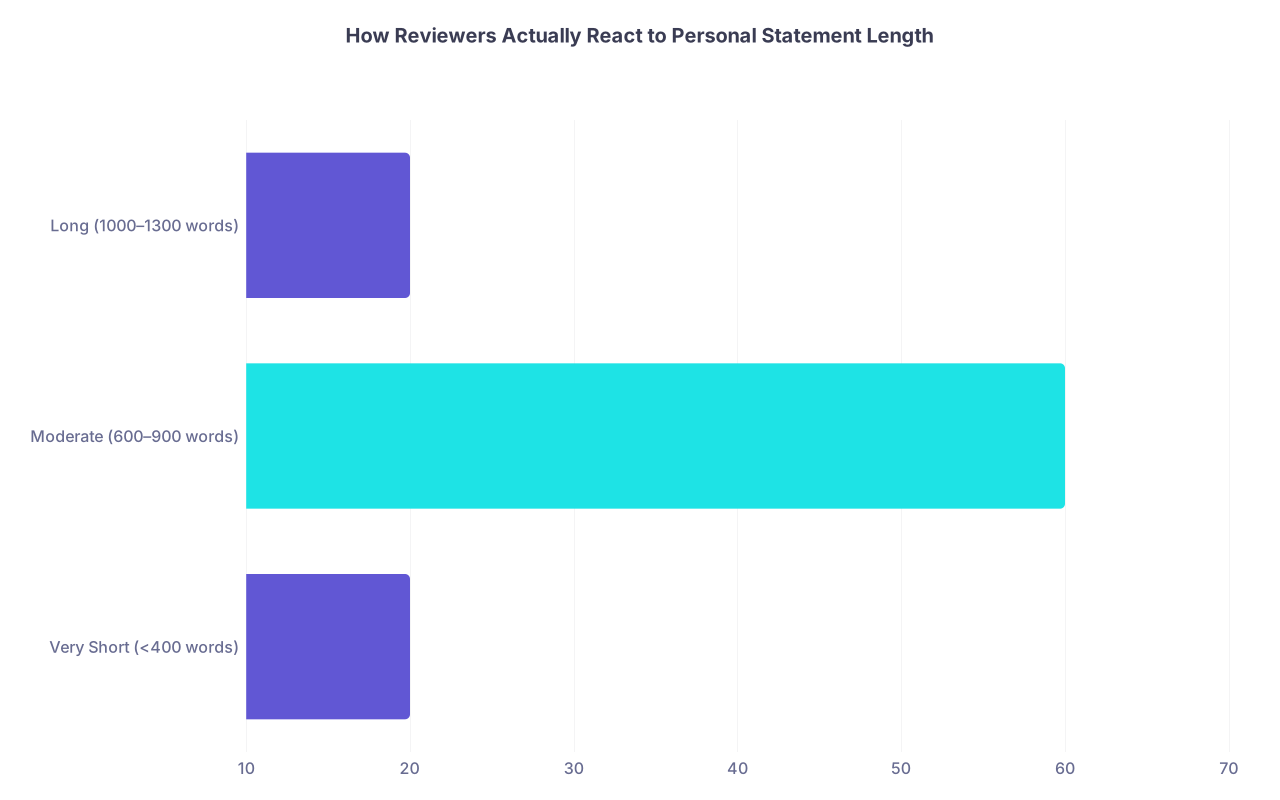
| Category | Value |
|---|---|
| Very Short (<400 words) | 20 |
| Moderate (600–900 words) | 60 |
| Long (1000–1300 words) | 20 |
Those numbers aren’t “acceptance likelihood.” They’re my rough approximation of positive reviewer sentiment from years of seeing actual reactions:
- Very short: “Did they rush this?” “Feels like they didn’t care.” Occasionally “refreshing” if it’s unusually sharp, but that’s rare.
- Moderate: “Looks normal.” Content becomes the deciding factor, which is what you want.
- Long: “This better be good.” Sometimes it is. Often it’s not, and people get annoyed.
Desperation is not measured in words. It’s measured in how hard you strain to impress, how many adjectives you stack, how much you say without saying anything. You can sound desperate in 300 words. You can sound grounded and confident in 950.
Myth #4: “If It Fits on One Page, It’s Fine”
This is the lazy cousin of “shorter is better.”
“One page” has become this weird magical thinking benchmark, like it’s been handed down on stone tablets by the NRMP. It hasn’t. It’s just a reasonable heuristic someone made up to stop people from sending 3-page essays.
Here’s the harsh truth: “Fits on one page” does nothing for you if:
- The content is generic.
- The structure is a messy timeline of your life.
- The writing is flat, vague, or cliché.
I’ve read one-page statements that felt painfully long. I’ve read “slightly over a page” statements that felt lean and purposeful.
What the one-page rule is trying (badly) to enforce is this: Edit yourself. Don’t ramble. Don’t rehash your CV in prose form. Don’t describe every rotation you ever did.
The better rule is: No dead sentences. If a line doesn’t either:
- Reveal something about how you think
- Demonstrate a meaningful action or decision
- Tie your experiences to your future in that specialty
…it probably needs to go.
Think of your statement as a constrained story, not a page-length compliance exercise.
What Strong Programs Actually Want From a Statement
Let me flip this around and tell you what competitive programs really pay attention to. Because this is where word count becomes a tool, not a prison.
They’re scanning for four things:
Clarity of specialty choice.
Why this field and not another? “I like variety” is not enough. “I thought I wanted surgery until I realized I only cared about clinic days” is a lot more honest and useful.Pattern of behavior under stress or uncertainty.
You don’t need trauma porn. You need one or two situations where readers can watch you think, adapt, and grow.Fit with the culture of residency.
Are you reflective? Blame-shifting? Collegial? Humble but not self-erasing? They’re looking between the lines for how you’ll be at 2 a.m. after three admissions and one angry family member.Evidence you actually understand what residents do.
Not hero fantasies. Realistic, grounded comments that show you’ve seen the grind and you’re still in.
None of that is reliably communicated in 250 words unless you are a freakishly good writer. Most medical trainees are not. That’s not an insult; your training has systematically beaten narrative writing out of you.
So you need some space. Enough to:
- Set up one anchor story or moment
- Reflect on it beyond “this was inspiring”
- Connect it to how you now see your future role
That’s usually 2–3 paragraphs in the middle of a 700–900-word essay.
What Actually Happens When Your Statement Is Too Short
I’ve heard this exact conversation:
Attending: “Anything interesting in their personal statement?”
Resident: “Nah, just like 3 sentences about wanting to help underserved patients.”
Attending: “So nothing.”
Resident: “Yeah, nothing.”
That’s how a 300-word “efficient” statement gets treated. As “nothing.”
Here’s the practical impact of being too short:
- You forfeit control of your narrative. Interviewers rely on what’s already in your file. If there’s a red flag or a weird gap, and you don’t address it, they’ll just speculate.
- You give up easy tie-breaker points. When two applicants are similar on paper, someone in the room will say, “I got a better sense of X than Y.” That “sense” usually comes from the statement.
- You look disengaged. Especially in competitive specialties, a too-short statement for radiology, derm, ortho, ENT, etc. will make people quietly question how badly you actually want it.
It’s not that being short gets you rejected. It’s that it erases a cheap, legal advantage: context.
The Smart Way to Think About Word Count
Forget “shorter is better.” Use this instead:
- Below ~500 words: You’re probably under-explaining. High risk of sounding generic, rushed, or shallow. You need a very high signal-to-noise ratio to get away with this.
- ~600–900 words: The sweet spot for most applicants. Enough room to tell one real story, give some reflection, and avoid redundancy.
- ~1000–1200+ words: Proceed with caution. Can work if you’re an above-average writer and every paragraph does real work. But you’re fighting reader fatigue.
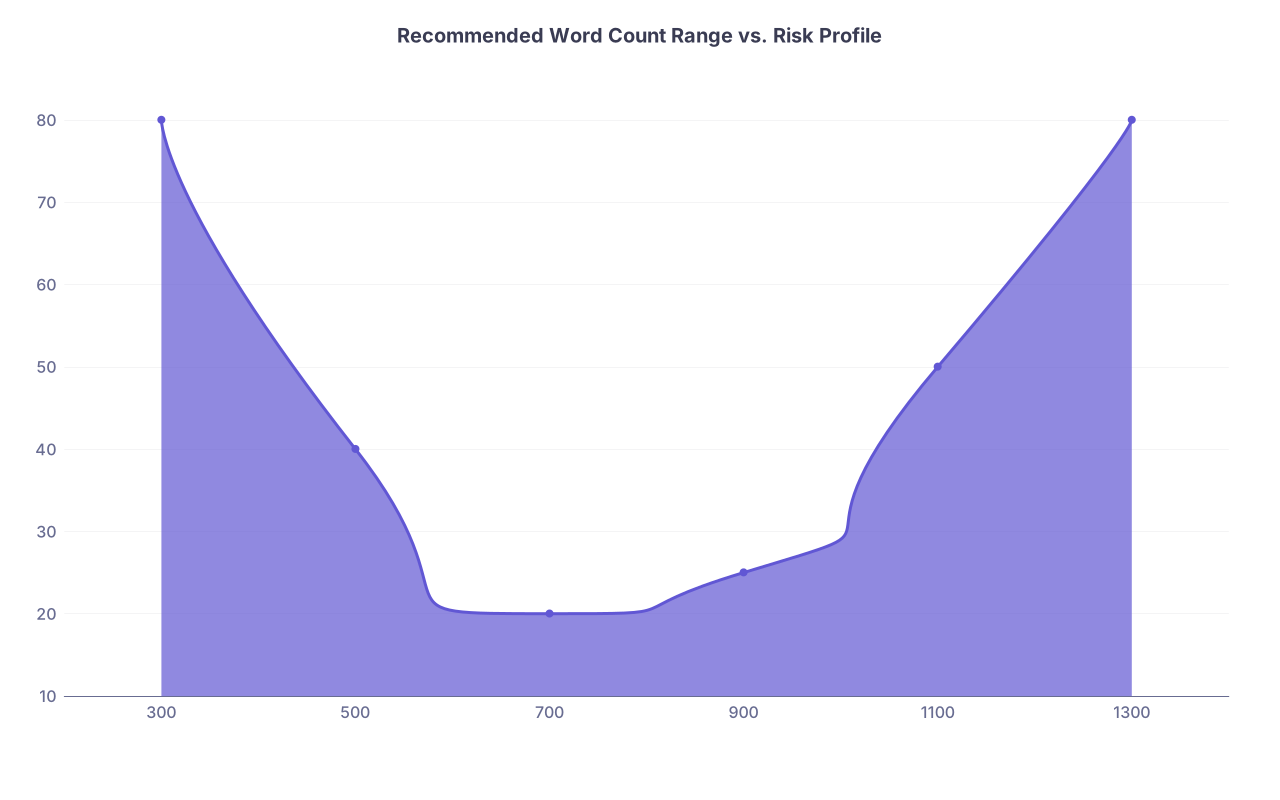
| Category | Value |
|---|---|
| 300 | 80 |
| 500 | 40 |
| 700 | 20 |
| 900 | 25 |
| 1100 | 50 |
| 1300 | 80 |
Treat that line as “risk of annoying or underwhelming the reader.” Lowest in the 600–900 range. Much higher at either extreme.
A Practical Editing Checklist That Ignores the Hype
If you want something concrete, here’s how I’d actually approach length when editing. Not as gospel, but as a sanity check.
Draft without obsessing about word count first. Then ask:
Do I have at least one specific, non-cliché experience that only I could have written about?
If not, you probably need more words to drill down. Not fewer.Can I cut any sentence without losing meaning?
If yes, do it. Keep cutting until anything more would create real confusion or loss of nuance.Does each paragraph have a job?
If two paragraphs are both “I love this specialty,” condense.Could someone reasonably remember 1–2 things about me after reading this once?
If the answer is no, word count is not your problem. Content is.
Once it’s tight and purposeful, then you look at the number. If you’re sitting around 650–900 words, you’re almost certainly fine.
The Bottom Line: Stop Worshiping the Counter
Let me strip this down to what actually matters.
First: There is no bonus for being ultra-short. Programs don’t hand out gold stars for 350-word essays. Too short more often looks careless than efficient.
Second: Most strong residency personal statements land in the 600–900 word range, not because it’s magical, but because that’s how much room it usually takes to show you’re a reflective adult with a real reason for choosing this specialty.
Third: Your real goal isn’t “short.” It’s high signal, low fluff. Use as many words as you truly need to accomplish that—and then stop.
Better is better. Not shorter.