
The obsession with the “one life‑changing patient” story has ruined more residency personal statements than any bad grammar ever has.
You know exactly the trope I am talking about. You met a patient. They were incredibly sick, or incredibly inspiring, or somehow both. Something about that encounter “changed everything,” made you “realize” your calling, and you “knew in that moment” you were destined for [insert specialty].
Program directors read that same story hundreds of times every cycle. Different names, same script.
And here’s the part almost nobody tells you: there is no evidence that a single dramatic patient vignette meaningfully improves your chances of matching. If anything, overusing that narrative makes you blend into the pile of forgettable essays that all sound the same by page three of the file review.
Let’s strip this down to what actually helps you and what’s pure mythology.
What the Data (and PDs) Actually Say About Personal Statements
When you talk to program directors off the record, the comments are blunt.
“I skip to the last paragraph to see if they say anything different.”
“If the first line is a dramatic patient story, I already know how the next three paragraphs go.”
“I’m not building a Hallmark movie. I’m hiring colleagues.”
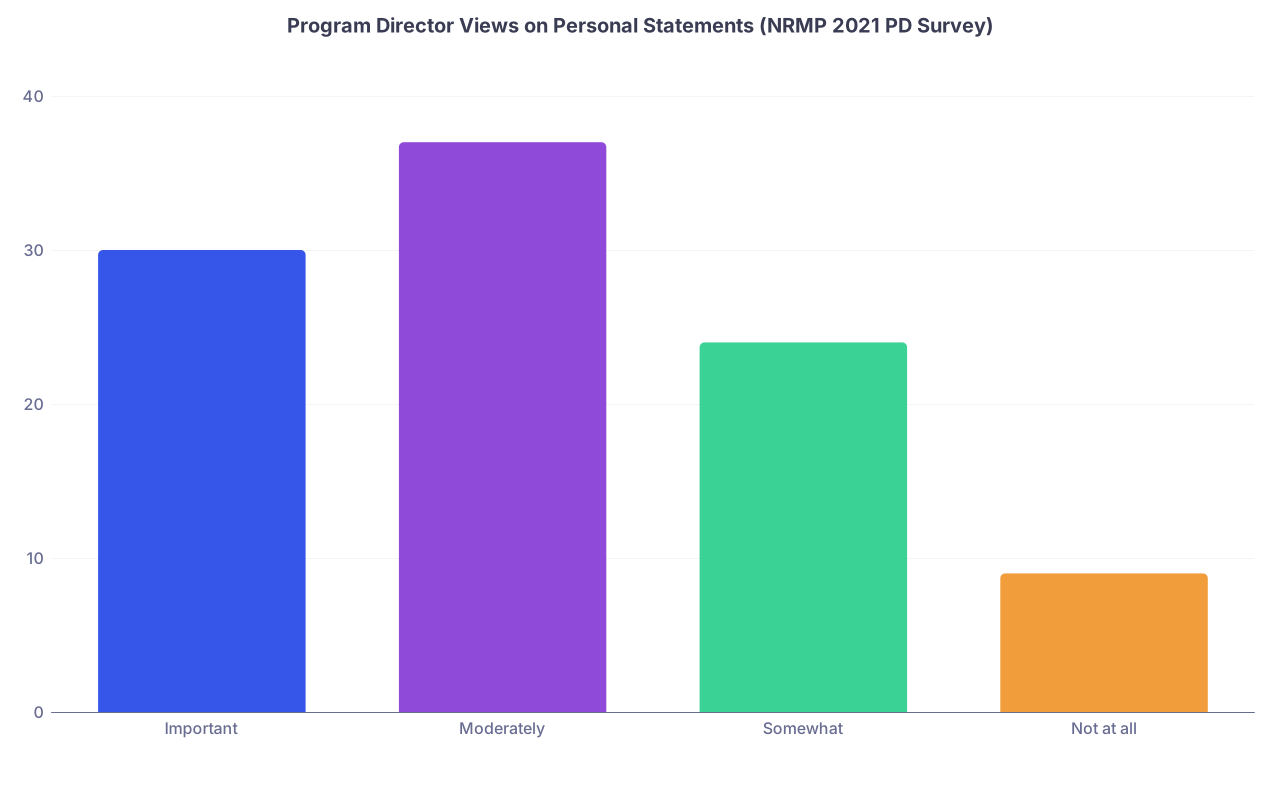
On the record, the numbers line up with that attitude.
| Category | Value |
|---|---|
| Important | 30 |
| Moderately | 37 |
| Somewhat | 24 |
| Not at all | 9 |
Only about a third of program directors rate the personal statement as “very important” in deciding whom to interview. For many, it’s a tie‑breaker or a red‑flag detector, not a golden ticket. And within that limited role, they’re scanning for fit, professionalism, and red flags. Not a cinematic story arc.
When PDs are surveyed or interviewed about what they don’t like, the “single life‑changing patient” narrative comes up constantly:
- It often feels emotionally exaggerated or contrived.
- It focuses on the patient more than on the applicant’s growth and decisions.
- It implies that your commitment to a specialty hinges on one anecdote instead of a sustained pattern of engagement.
The irony: the story structure that premed advisors hammered into you for med school applications is now the fastest route to sounding unoriginal in residency applications.
Why the “Life-Changing Patient” Trope Is So Overused
There’s a reason everyone gravitates to this kind of story. Three, actually.
First, it’s what you’ve been taught. Undergrad advisors, premed blogs, and med school application consultants pushed the “start with a patient vignette” formula like it was gospel. Back then, you were trying to prove you understood medicine is about people. Fine. Crude, but fine.
Second, it feels like “real medicine.” You can vividly recall the tearful family meeting, the complex management, the code that almost failed. So it feels deep. Emotion hits you harder than a line about QI or chart review.
Third, it’s easy. A single patient story gives you a ready-made beginning, middle, and end. You do not have to think very hard about your trajectory, your decisions, or your evidence of fit. You just ride the emotional momentum.
The problem is that PDs have seen this play before. Thousands of times. It was original around 1998.
When fifty different applicants each describe the patient who made them realize they wanted to do internal medicine, what do you think that does to credibility? Your “life-changing” moment becomes statistical noise.
The Real Problem: It Distorts How You Present Your Motivation
The worst part about the “one patient changed everything” narrative is not that it’s cliché.
It’s that it misrepresents how people actually choose specialties.
Ask real residents how they chose general surgery, EM, psych, IM, peds, radiology. You’ll hear things like:
- “I liked the people on my team more than on other rotations.”
- “I enjoyed the clinic days instead of dreading them.”
- “I want to manage complexity over time, not quick hits in the ED.”
- “I can tolerate the call schedule but could never do OB nights again.”
- “I like procedures, but not all day, every day.”
These are patterns. Repeated experiences. Trade‑offs. Gravitating toward certain environments and types of problems.
Reducing that to “then I met Mrs. X in the ICU, and everything became clear” is both dishonest and unhelpful. It makes you sound naïve about how careers really form. It suggests you might change your mind again the next time a memorable patient crosses your path.
Residency selection committees are trying to predict: if we train this person for three or more years, are they going to show up, grow, and not implode?
“One dramatic day” doesn’t speak to that. A sustained record of choices does.
What Actually Differentiates a Strong Personal Statement
Let me be blunt: your personal statement is not the hero of your application. Your scores, transcript, letters, and MSPE do the heavy lifting.
Your statement mainly has three realistic jobs:
- Prove that you understand the specialty you’re applying to.
- Show that your interest in it is durable and grounded in repeated experiences.
- Give a sense of who you are as a colleague and learner.
No part of that job description requires a single life‑altering patient.
If you want to stand out in a way that does not make experienced readers roll their eyes, you need to shift from “one peak emotion” to “clear trajectory.” Your story is not about one case. It is about a pattern of behavior.
That means you highlight:
- How your view of the specialty evolved over time.
- What specific aspects of the work energize you day to day.
- What you have actually done to test and commit to this path.

A PD isn’t thinking, “Wow, touching patient story.” They’re thinking, “Does this person get what this job is actually like, and do they seem like they’ll do it well?”
The Patient Story Isn’t Forbidden — It’s Just Misused
Now, I’m not saying you can never mention a patient.
The myth is not “never talk about patients.” The myth is that your personal statement must center on one “life‑changing” patient to be powerful.
You can reference patient encounters in a way that actually helps you instead of turning into soap opera. The key test is this: if I removed the patient from the story, would there still be a meaningful point about you?
Watch how this shifts:
Weak, trope‑heavy version:
“I will never forget Mr. K, a 56-year-old man with decompensated cirrhosis. As I sat with him and held his hand, I realized internal medicine was the field where I could form deep connections and guide patients through complex illnesses. In that moment, I knew I wanted to become an internist.”
That could be anyone. At any school. In any year. Reading that, you learn almost nothing about the applicant beyond “has been on an inpatient medicine rotation.”
Stronger, grounded version:
“On my third week of medicine, I admitted a man with decompensated cirrhosis who had already been hospitalized three times that year. I listened as my senior explained our plan not just to stabilize him, but to get him plugged into hepatology follow-up, home health, and social work. That was the first time I saw internal medicine as more than ‘fixing the acute problem.’ Over the next year, I kept seeking out patients whose care depended on coordination and long-term planning, on wards and in clinic. I realized those were the days I went home tired but satisfied.”
Notice the difference. The patient is a reference point. Not the climax of a movie. The story is about the applicant’s pattern of choices and interests. You can almost see their behavior over time.
That’s the kind of narrative that actually signals fit.
Evidence of Fit Beats Evidence of Feelings
You’ll hear applicants talk about “making the reader feel something.” That’s imported from college essay culture and social media, not from how hiring decisions are made in medicine.
Feelings are cheap. Everyone felt something when they watched a patient die for the first time. That’s called being a human with a pulse.
What PDs need to see is evidence. That you know what you’re signing up for. That you’ve shown up consistently where this specialty lives.
Here’s what that might look like in practice, across a few different dimensions:
| Common Approach (Weak) | Stronger Alternative (Evidence-Based) |
|---|---|
| “One patient changed my life.” | “Across multiple rotations, I kept seeking…” |
| Focus on feelings during one event | Focus on repeated behaviors and choices |
| Generic adjectives (“meaningful”) | Concrete tasks and responsibilities |
| Patient is the protagonist | Applicant’s growth is the protagonist |
| Vague “I knew in that moment” claim | Clear next steps taken after insight |
If your statement reads like you’re auditioning for a tear‑jerker, you’ve probably overcorrected toward emotion and away from evidence.
If it reads like a short, coherent account of why you belong in this specific line of work — supported by your actual track record — you’re closer to what an experienced PD hopes to see.
The Time Trap: Overwriting the One Story, Underbuilding the Rest
Here’s another practical problem with the “life‑changing patient” myth: it warps how you allocate your writing time.
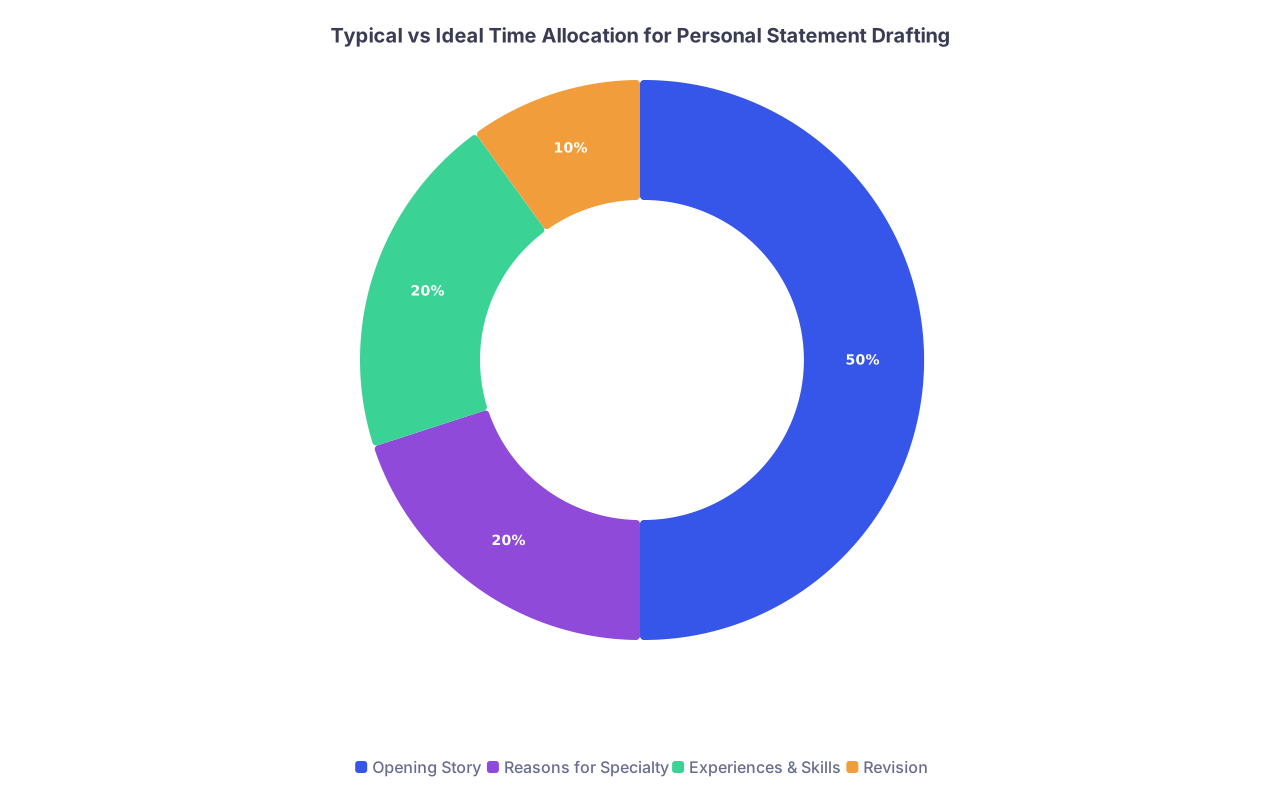
I’ve watched students spend weeks trying to perfect the first 2–3 paragraphs about “that one patient,” tweaking adjectives, rearranging sentences, trying to make it more moving. Meanwhile:
- Their explanation of why they chose this specialty is one bland paragraph.
- Their discussion of what they’re like as a learner and team member is an afterthought.
- Their final paragraph is generic boilerplate about “lifelong learning” and “serving the community.”
They’re polishing the wrong part.
| Category | Value |
|---|---|
| Opening Story | 50 |
| Reasons for Specialty | 20 |
| Experiences & Skills | 20 |
| Revision | 10 |
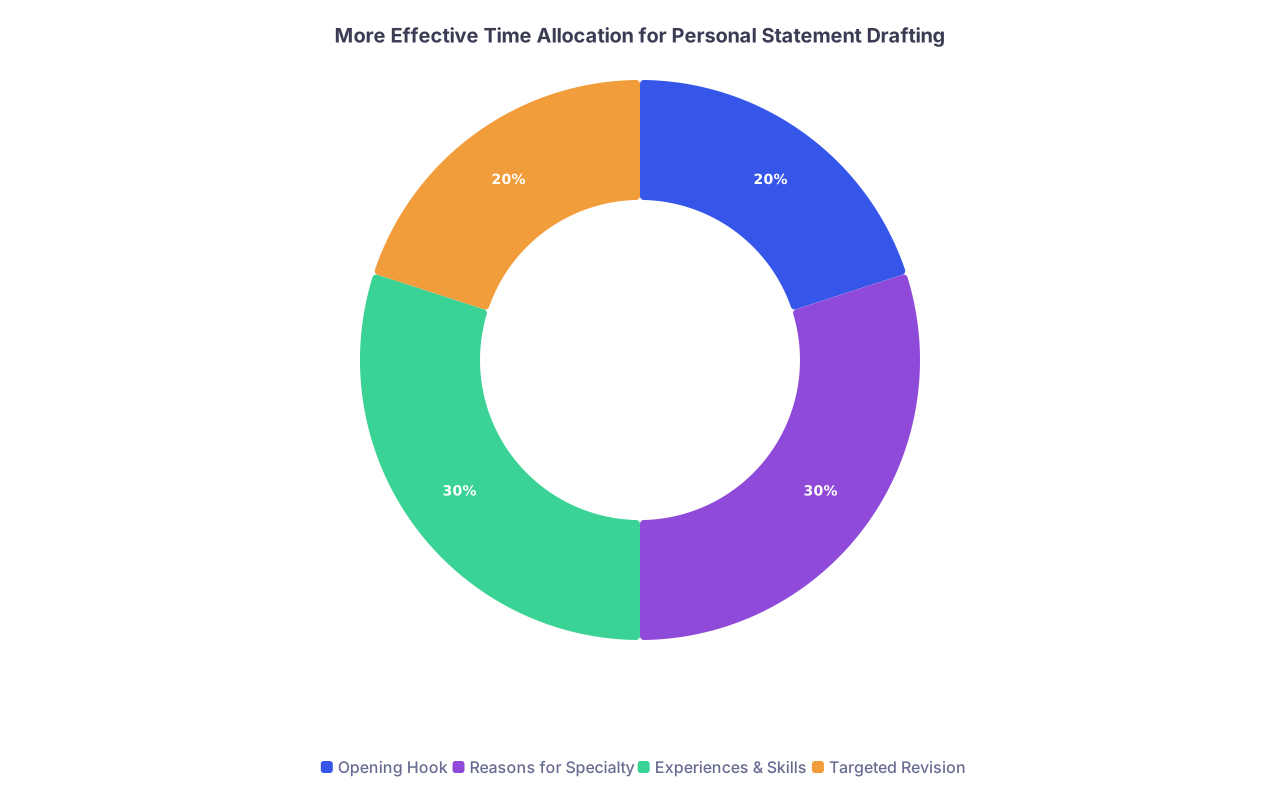
Now contrast that with an approach where you treat your statement as a short argument rather than a novella.
| Category | Value |
|---|---|
| Opening Hook | 20 |
| Reasons for Specialty | 30 |
| Experiences & Skills | 30 |
| Targeted Revision | 20 |
The point is not to worship these exact percentages. The point is that over‑investing in a single story usually means under‑developing the parts of your statement that actually answer the question: “Why you, for this training, in this field?”
What a Strong, Non-Tropey Statement Actually Looks Like
Let’s walk through the spine of a solid residency personal statement that does not lean on the “life‑changing patient” myth.
No, this is not a template. It’s a pattern.
- A clean, specific opening that anchors your interest in the specialty without melodrama.
- A short account of how your interest developed across multiple experiences.
- Concrete examples of what parts of the work you enjoy and where you’ve already contributed.
- A clear, honest sense of what kind of resident you’ll be and what you’re looking for in a program.
- A closing that shows maturity and forward orientation rather than trying to be profound.
You can mention patients in any of those sections. The difference is that they’re supporting actors. They are not the entire plot.
I’ve seen stellar statements that opened with something as simple as:
- “I like being the person everyone calls when a plan stops working.” (EM applicant)
- “The first thing I loved about psychiatry wasn’t the therapy. It was the pace of the conversations.” (Psych applicant)
- “Every time I rotated off surgery, I missed the OR more than I expected.” (GS applicant)
No one died. No miraculous diagnosis. No life‑altering epiphany. Just a clear, honest hook grounded in lived experience.
Those statements worked because, paragraph after paragraph, they backed up the opening line with specifics. Rotations. Responsibilities. Projects. Mentors. Mistakes learned from. Not a single over‑polished story.

How to Use Patient Stories Without Falling into the Trap
If you’re attached to a particular patient encounter — and many of you are, for good reasons — you can still use it. You just have to strip away the mythic framing.
A few practical rules:
- Do not claim it “changed everything.” Let it illustrate something you had already been gravitating toward, or pushed you one step further along a path you were on.
- Move quickly from what happened to what you did next in the weeks or months that followed. That is where your credibility lives.
- Keep the medical details lean. PDs don’t need to be impressed by your recall of lab values. They need to see judgment, reflection, and behavior.
- If you removed that one case, your statement should still make sense. If it collapses without it, you’ve leaned too hard on the trope.
When you write, ask yourself a brutal question: is this paragraph telling the reader something new about who I am as a future resident, or is it just trying to make them feel something?
If it’s mostly the latter, cut or compress it.
Stop Chasing the “Perfect Story” and Start Building a Coherent Self
The myth of the single “life‑changing patient” story is ultimately about laziness disguised as drama. It’s a shortcut. It lets you avoid the harder work of articulating who you are in this profession, with all the boring, unglamorous repetition and growth that entailed.
Residency programs are not looking for the protagonist of a medical drama. They’re looking for someone they can hand a pager to at 3 a.m. and trust that, over three or four years, this person will grow into a reliable, thoughtful colleague.
You do not prove that with one night in the ICU.
You prove it with a pattern. Of choices, of responsibilities, of how you talk about the work and the people doing it.
Years from now, you will barely remember the paragraph you agonized over about that one patient. But you will be living, every day, the story you’re trying to convince programs you’re ready for now — and that story is built out of hundreds of small decisions, not a single epic moment.