Your residency personal statement does not need a car crash, a code blue, or a dead grandparent. In fact, the more your statement leans on trauma drama, the more it usually blends into the pile.
Let me be blunt: the “life-changing tragedy” essay is wildly overrated. Programs are not handing out interviews because you almost died on a hiking trip and “realized life is fragile.” They are trying to answer a much less cinematic question:
If I put this person in my program at 2 a.m. on a terrible call night, what am I actually getting?
That’s it. Not: “Could this be a Netflix episode?”
More: “Will this person be competent, sane, and not a menace to nurses or patients?”
The Big Myth: “I Need a Huge Emotional Origin Story”
The most pervasive bad advice in personal statement land:
“You need a powerful story to hook the reader.”
Sounds nice. Sells editing packages. But it’s half-true at best, and often just wrong.
What program directors and faculty actually say when surveyed (and in the hallways when you are not around):
- They skim hundreds of statements. Most are interchangeable.
- They remember clarity, maturity, and fit with the specialty.
- They roll their eyes at over-the-top drama and cliché stories.
- They get worried when emotional content seems unprocessed or performative.
There’s also actual data. Multiple NRMP and program director surveys across specialties show:
- Personal statements are “important,” but not for tragedy points.
- They’re used to:
- Screen out people with red flags (unprofessionalism, bitterness, poor communication).
- Clarify interest in the specialty and sometimes specific program type.
- Fill in gaps: what drives you, what you’re like as a learner/colleague.
Nobody is scoring:
“Near-death experience: 10/10. Generic interest: 2/10. Invite.”
If anything, the traumatic “origin story” can hurt you when:
- It dominates the essay and leaves no room for who you are as a resident.
- It sounds like you’re using suffering—yours or others’—as emotional decoration.
- It raises concern about unresolved trauma or emotional instability.
What Strong Personal Statements Actually Have in Common
The good ones aren’t all heart-wrenching. Many are boring on paper. But they work.
They tend to share a few real traits:
- A clear, believable “why this specialty”
- Concrete examples of how you behave in clinical environments
- Evidence you understand the real job, not just the glamorous version
- A voice that sounds like… a person. Not a brochure.
Notice what’s missing: “One huge defining moment.”
Most physicians did not have a single thunderbolt event. It’s usually accumulation: rotations, mentors, the kind of thinking they enjoy, the patient interactions that feel natural.
Let’s break this down in more detail.
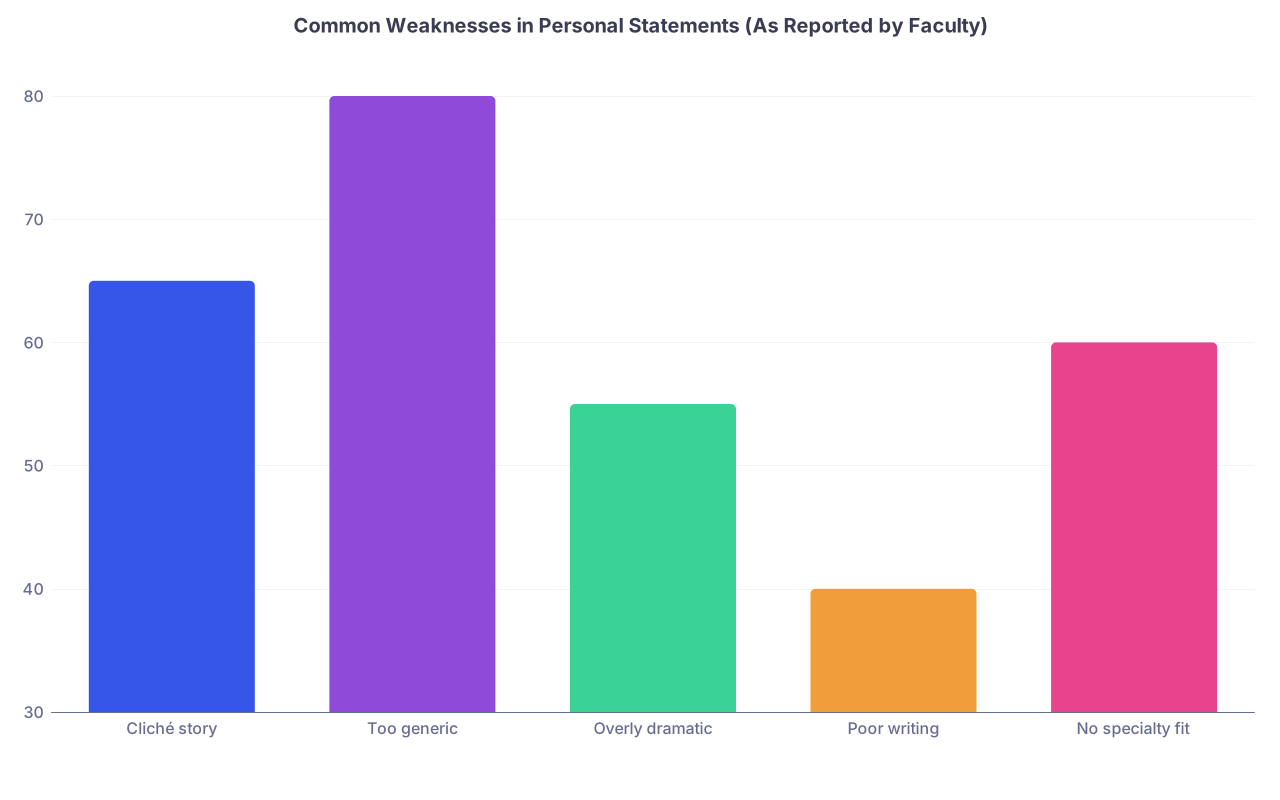
| Category | Value |
|---|---|
| Cliché story | 65 |
| Too generic | 80 |
| Overly dramatic | 55 |
| Poor writing | 40 |
| No specialty fit | 60 |
(Those percentages aren’t from a single canonical paper but mirror what multiple faculty panels and PD commentaries report consistently: generic > dramatic > cliché, over and over.)
Why Dramatic Stories Backfire More Than You Think
I’ve read a lot of statements that start like this:
“The monitor flatlined. I stared at the patient I had come to know so well over the past three days…”
You know what most overworked faculty readers think at line two?
“Please don’t do the flatline thing.”
Here’s why the “dramatic” opening is often a problem:
1. It’s almost always cliché
Everyone thinks their story is unique. Then you read 400 essays in a season.
Pattern recognition kicks in:
- “Ever since I was a child…”
- “Losing my [family member] to [disease] showed me…”
- “The moment I held the retractor in the OR, I knew…”
- “The room fell silent as the code team rushed in…”
These are templates. Faculty have seen them for years. You’re not unique because you had a sick relative or saw someone die on rotation. You’re a medical trainee. Of course you’ve seen that.
2. It often centers you in someone else’s suffering
You’d be surprised how uncomfortable it can feel to read:
“As my patient’s mother sobbed, I realized my true calling.”
That line is about you. Not her. Not the family. Not what you did.
Programs are noticing this more and more.
There’s a growing push in medical education against “using” patients’ trauma as narrative fuel. If your story is essentially: “Someone else’s worst day gave me a career epiphany,” tread very carefully.
3. It raises mental health questions if handled poorly
You’re allowed to have trauma. Many doctors do.
But residency programs are also thinking: can this person function under stress?
If you describe:
- Unprocessed grief
- Ongoing severe anxiety/PTSD
- Being “devastated” and “unable to function” repeatedly
…without any frame of growth, treatment, or stability, some readers will worry about whether residency will break you. They might not say it out loud. But they will think it.
The point is not to hide your humanity. It is to show you’re ready for residency, not currently in crisis.
4. It eats word count and gives little real information
You have ~650–850 words (depending on platform and specialty) to do several jobs:
- Explain why this specialty
- Convey your strengths
- Hint at your trajectory and goals
- Not sound like a robot
A long story about a single patient often fails that test. You end up spending 70% of the essay on description… and 30% on anything actually about you as a resident.
So What Should You Focus On?
Let me flip the script. Here’s what most faculty actually want your statement to do:
- Make your interest in the specialty feel inevitable, not random
- Show you understand the work: the pace, the patient population, the cognitive style
- Provide evidence of:
- Clinical maturity
- Teamwork
- Resilience without melodrama
- Indicate your general direction: academic? community? underserved? researchy?
That’s it. If you can do those four things clearly, you’re already in the top tier of statements.

Example of an Actually Effective (and Non-Dramatic) Angle
Take internal medicine. A solid “why IM” angle might look like:
- You like longitudinal relationships and complex problem-solving.
- On rotations, you found yourself wanting to “own” the whole patient, not just a procedure.
- You enjoyed coordinating with consultants, managing uncertainty, explaining plans.
- You’ve taken on roles that show follow-through: QI project, continuity clinic engagement, teaching interns.
You can show that with specific vignettes and observations:
- A time you managed a complicated heart failure admission over several days and what you learned about responsibility.
- How you discovered you enjoy the cognitive puzzle of syncope workups more than the adrenaline of rapid responses.
- Feedback you consistently get from attendings (“reliable follow-up,” “thorough,” “good with families”).
None of that is flashy. All of that is useful to a program director.
The Data Reality: How Much Does the Personal Statement Even Matter?
You’re probably wondering: if I do not manufacture an epic story, am I sunk?
No.
Look at what program directors repeatedly report (NRMP Program Director Survey, multiple years). On factors for granting interviews, the personal statement sits:
- Below: USMLE/COMLEX scores, clerkship grades, SLOEs/department letters, professionalism issues
- Roughly alongside: perceived interest in the program, research fit (for competitive fields), extracurriculars
| Factor | Typical Priority Tier |
|---|---|
| Board scores | Very High |
| Letters of recommendation | Very High |
| Clerkship/rotation performance | Very High |
| Personal statement | Moderate |
| Research experience | Moderate |
So what does the statement really do?
- Break ties between comparable applicants
- Explain context (career change, leave of absence, lower scores with recovery)
- Sink you if it’s bad (unprofessional, arrogant, off-putting, or incoherent)
- Occasionally push you over the line if it’s especially aligned and thoughtful
Notice: nowhere in that list is “award extra points for trauma.”
If You Do Have a Serious Personal Story
I am not saying: “Never mention anything emotional.” That’s childish advice.
Plenty of people are drawn to oncology, ICU, palliative, OB, psychiatry, etc. because of profound personal or family experiences. Those can be powerful, if handled like a professional, not a screenwriter.
Some rules of thumb if you choose to include it:
The story is a frame, not the whole essay
One tight paragraph, maybe two. Then shift to: what you did, what you learned, and how it shows up in your current work.Protect privacy and dignity
Less “my mom’s agonizing screams” and more “supporting my mother through chemotherapy exposed me to…”Emphasize growth and insight over suffering
Programs care what this experience changed about:- How you communicate
- How you think about prognosis
- How you show up for anxious families
Make sure you’re not bleeding on the page
If you still cry whenever you talk about it, it probably should not anchor your statement. Use something you can discuss calmly in an interview.

| Step | Description |
|---|---|
| Step 1 | Do I have a personal trauma story? |
| Step 2 | Probably skip or mention briefly |
| Step 3 | Do NOT include as main focus |
| Step 4 | Include briefly, then pivot to current clinical self |
| Step 5 | Is it central to my specialty choice? |
| Step 6 | Can I discuss it calmly and professionally? |
| Step 7 | Does it show growth and insight? |
What to Write About Instead (That Actually Works)
Here’s the contrarian part: the safest “boring” content is often the most effective.
You can build a strong statement around:
- A specific pattern of feedback you’ve received and how you leaned into it
- A mentor’s influence and what they modeled about your specialty
- A tension you resolved: you thought you were going into one specialty, then realized another fit better, with clear clinical examples
- A concrete project (QI, research, curriculum) that changed how you think about patient care
Focus on:
Patterns, not isolated moments
Instead of: “One unforgettable night in the ICU”
Try: “Over several months in the ICU, I noticed I was drawn to…”Behaviors, not feelings alone
Not just “I felt inspired.” What did you do? How did you respond? How did you change your practice?Trajectory, not static biography
Show evolution: “I entered third year thinking I’d be a surgeon; by the end of the year, after [x, y, z experiences], I realized I prefer the diagnostic and longitudinal aspects of internal medicine.”
A Simple, Drama-Free Structure That Works
You do not need a “hook.” You need clarity. Here’s a straightforward structure that outperforms 80% of what programs see:
Opening: Where you are now with this specialty
Two to four sentences that say, in adult language, why you’re drawn to it. No childhood dreams. No flatlines.Middle Part 1: Key clinical experiences that shaped this interest
1–2 vignettes, anchored in behaviors and insights, not tragedy.Middle Part 2: Who you are as a learner and colleague
Concrete traits backed by evidence:- “I am detail-oriented” → example
- “I communicate clearly with families” → example
- “I enjoy teaching” → example
Closing: Where you’re heading
A few sentences on the kind of training and career you’re aiming for. Academic vs community, patient population interests, maybe research or teaching inclination.
No twist ending required.
Quick Red-Flag Checklist
If your current draft has any of these, fix it:
- You open with a code, death, or violent accident.
- More words describe someone else’s suffering than your actual work.
- You use phrases like “since I can remember” or “I have always wanted to be a doctor.”
- You describe specialty stereotypes (“surgery is for doers; medicine is for thinkers”) like a premed YouTube channel.
- Your trauma is described in such raw detail that you’d hesitate to read it aloud to a room of attendings.
If that stung, good. That means you know exactly what to revise.
Years from now, you will not remember the exact sentences of your personal statement. Programs will not either. What will stick—for you and for them—is whether your writing honestly reflected the kind of physician you’re becoming, instead of the most dramatic thing that ever happened to you.
Write for that future version of yourself, not for a fake Netflix pilot.
FAQ (Exactly 5 Questions)
1. Will my personal statement hurt me if it’s just “normal” and not emotional?
Not if it is clear, specific, and professional. A “normal” statement that shows maturity, insight, and good fit is far better than a dramatic one that feels cliché or unstable. Programs are not scoring you on emotional intensity; they are screening for red flags and looking for evidence you’ll be a solid resident.
2. Can I mention a family member’s illness as part of why I chose my specialty?
Yes, briefly. Make it a launching point, not the centerpiece. One short paragraph on the experience, then shift quickly to how it informed your clinical interests, communication style, or values. Avoid graphic details and do not “mine” their suffering for effect.
3. How personal is too personal when discussing mental health?
If you discuss your own mental health, you must show stability and growth. Vague references like “a dark time” or detailed accounts of ongoing severe symptoms without clear treatment and functioning will worry programs. Focus on what you learned and how you function now, not on the rawness of the struggle.
4. Do program directors actually read every personal statement?
Most read them quickly, often after they’ve already looked at scores, letters, and transcripts. Some skim; some read more closely for borderline applicants. The statement rarely “wins” an interview by itself, but it absolutely can lose one if it raises concerns about professionalism, judgment, or fit.
5. Should I tailor my personal statement to each individual program?
For most specialties: no, not line by line. Write one strong core statement for the specialty. If you’re applying to a small number of very different program types (for example, academic vs rural community), minor tweaks can make sense. But generic name-dropping (“Your excellent program…”) is a waste of time. Focus on the kind of work and training you want; the right programs will recognize themselves in that description.