It’s 10:47 p.m. A program director has their fourth tab of ERAS open, lukewarm coffee next to the keyboard, and a spreadsheet of applicants on the side. They click your application. Step scores, fine. Letters, fine. Transcript, fine. Then they open your personal statement.
By the second sentence, they know.
This is the same statement they’ve read 300 times this season. Different name, different school, same template. And whether anyone tells you this or not, the decision they make in the next 45 seconds is often brutal and fast.
Let me tell you what actually goes through their heads when they hit one of those generic statements that feels copied from a Reddit template or a commercial editing service.
The First 20 Seconds: The Silent Triage
Here’s the dirty little secret: most faculty do not read every personal statement closely. They skim. They’re scanning for signals: red flags, authenticity, and something—anything—distinctive enough to make you worth discussing at the ranking meeting.
The internal monologue sounds like this:
“Opening line… cliché. ‘I first realized I wanted to go into internal medicine when…’ Okay, seen this.”
“Paragraph two… your grandmother. Of course.”
“Medical school paragraph… generic ‘I love continuity of care and teamwork.’ Zero detail.”
At this point, one of three things happens in their head:
- Neutral discard – “Fine applicant, nothing special here. Statement doesn’t help, doesn’t hurt. Scores and letters decide.”
- Mild negative – “This feels manufactured. Over-edited. I do not trust what they’re saying.” You drop a bit in their mental ranking compared with someone equally qualified who felt more real.
- Subtle red flag – “This person either doesn’t know this specialty or doesn’t care enough to make a real effort.” Now your statement is actively hurting you.
Nobody documents that thought process. They just move on and click the next application.
The Patterns That Scream “Generic” To Faculty
You think you’re being thoughtful and polished. They think: “I have already read this 40 times today.”
Here are the patterns that set off that reaction almost instantly.
1. The Prefabricated Origin Story
Faculty are numb to the standard “this is when I knew” stories. The ones that show up again and again:
- “As a child, I watched my [relative] struggle with [illness]. This inspired me to become a physician.”
- “On my third-year rotation, I met a patient who changed my life…”
- “I have always been fascinated by the intersection of science and the human condition.”
The problem isn’t that these never happen. It’s that in written form they all sound the same, and 95% of them are vague. Faculty know what happened: you felt you needed a dramatic epiphany moment to justify your specialty choice.
What they actually think when they see this:
- “This story could belong to anyone. If I can swap your name with 50 other applicants and nothing changes, you haven’t told me anything.”
- “They’re writing what they think I want to hear, not what’s real.”
- “If this is the most specific example they can come up with, maybe they weren’t very engaged clinically.”
They’re not moved. They’re suspicious.
2. The Buzzword Salad
You know the one:
“I value teamwork, compassion, evidence-based medicine, lifelong learning, and patient-centered care.”
This sentence (or some slight variation) is in at least a third of statements in competitive specialties. I’ve seen PDs literally point at the screen and say, “Buzzword bingo.”
What they think:
- “You just listed every generic virtue in medicine and told me nothing about you.”
- “If you actually cared about these things, you’d show me one example instead of listing the whole set.”
- “This is either AI-written, service-polished, or heavily ‘committee-edited’ into blandness.”
They’re not impressed you hit all the “good doctor traits.” They’re annoyed you wasted space saying nothing.
3. The Rotations Paragraph That Could Be Anyone’s
Another classic: a paragraph that goes something like:
“On my internal medicine rotation, I enjoyed managing complex patients with multiple comorbidities. I appreciated the continuity of care, the opportunity to work with a multidisciplinary team, and the diagnostic reasoning required. I also valued my time in clinic, where I developed relationships with patients and their families.”
You think: this is accurate, I did enjoy those things.
They think: “So did everyone else who applied. Next.”
Here’s the internal faculty logic:
- “If they actually had a meaningful experience, there would be at least one concrete, weirdly specific detail. A patient. A moment. A mistake. A conversation with an attending that stuck.”
- “Vagueness = filler = no insight into how they actually function on a team.”
You’re not being rejected for liking “continuity of care.” You’re being mentally downgraded for being indistinguishable from 200 others who wrote the same thing.
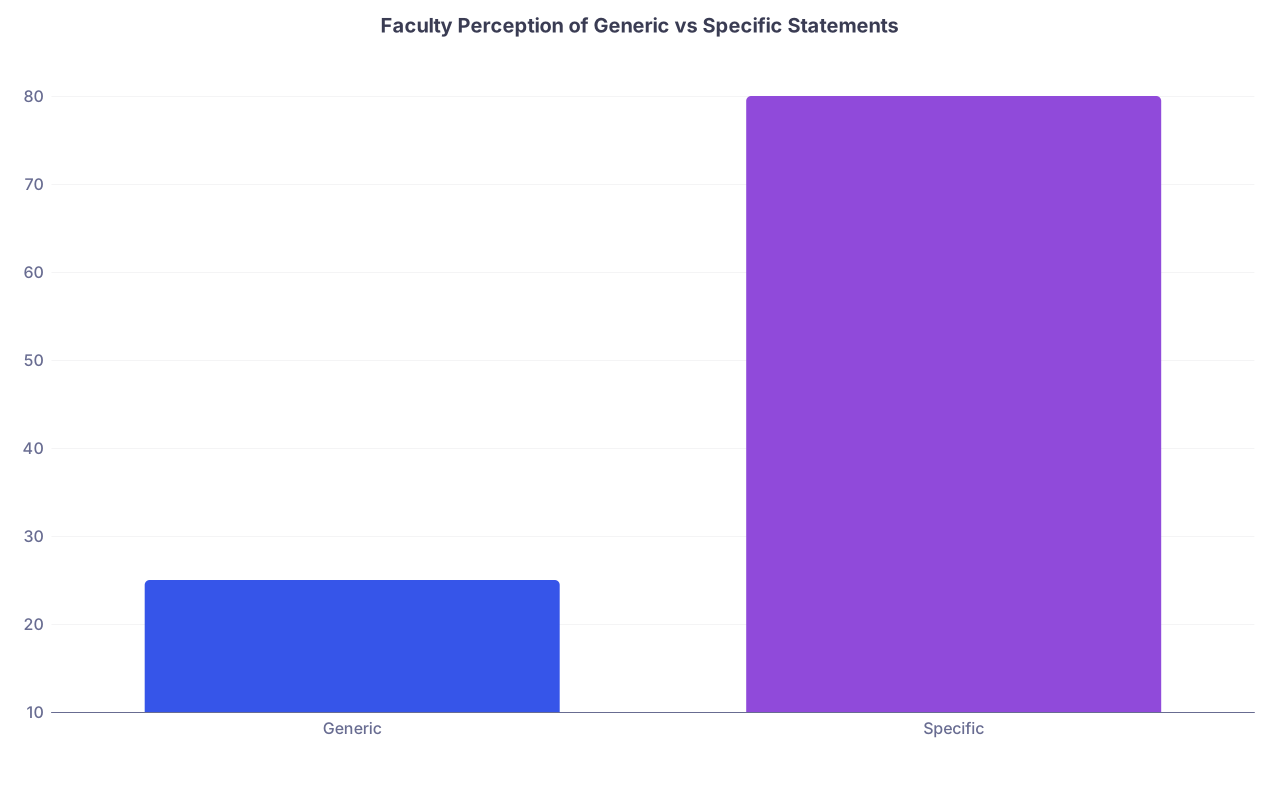
| Category | Value |
|---|---|
| Generic | 25 |
| Specific | 80 |
What Faculty Quietly Infer From a Generic Statement
This is the part nobody says out loud on applicant webinars.
Program directors and faculty use your personal statement less as a “tell me your dreams” essay and more as a personality and effort detector. They’re reading between the lines.
When they see a generic statement, here’s what they quietly conclude.
“You didn’t care enough to do real work here.”
They will not say this to your face, but they absolutely think it.
Effort leaves fingerprints. Specifics. Odd details. A clear voice. When everything is perfectly polished but emotionally flat, they assume:
- You reused a template from your school’s advising office.
- You over-relied on a commercial editing service that scrubbed all individuality.
- You copied phrases from classmates or online examples.
To them, your statement is proof you’re playing defense. Doing the minimum needed to not look bad, rather than actually trying to stand out.
“You don’t know yourself very well.”
Faculty have read personal statements from attendings, fellows, residents, even colleagues. They know what genuine self-reflection looks like.
Generic writers avoid risk. They avoid owning mistakes. They avoid saying, “I struggled with X but grew in Y way.” Instead, they float on the surface.
Faculty interpret that as:
- Limited insight into your own strengths/weaknesses.
- Limited ability to learn from failure.
- Limited emotional maturity.
Nobody phrases it that starkly in a meeting, but I’ve heard versions like: “I just don’t get a sense of who this person is” or “They seem fine but a little bland.”
Which, in a competitive rank meeting, might as well be a death sentence.
“You’re not actually that committed to this specialty.”
There’s a very specific phrase I’ve heard from PDs looking at generic statements:
“If you took this exact statement and changed the specialty name, would it still work?”
If the answer is yes, they mentally dock you.
Because what it says is: you like being a doctor, sure. But you haven’t thought deeply about why this field and why this kind of life. That matters to them because they’ve seen what happens when someone picks a specialty they’re not fully committed to: burnout, poor morale, or a resident who’s halfway out the door.
You thought a generic “I love medicine and helping people” statement was safe. They read it as: “This person would be just as happy in three other specialties.”

How Program Directors Actually Use the Personal Statement
Here’s another behind-the-scenes truth: your personal statement rarely saves a truly weak application. But it absolutely can:
- Make a borderline applicant worth an interview.
- Push a mid-pack applicant higher on the rank list.
- Kill enthusiasm for an otherwise strong applicant.
I’ve sat in meetings where this happens:
Two applicants. Same Step scores. Similar schools. Comparable research. Very similar letters. Someone will ask, “Does anyone remember anything about them?” And often the only differentiator is:
- “She’s the one who wrote about being the only Spanish speaker in that rural ED and realizing how translation changed the whole admission.”
- “He’s the one who reflected on mismanaging that post-op patient’s pain and how it changed how he presents in rounds.”
Or:
- “He had that completely generic statement. Nothing there. Anyone work with him?”
Silence.
“Okay then.”
You do not want to be the applicant that elicits silence.
What a “Non-Generic” Statement Looks Like to Faculty
Let me be blunt: a strong statement is not about “beautiful writing.” Faculty are not English professors. They don’t care if you’re poetic.
What wakes them up is:
- Specificity.
- Ownership.
- A clear, human voice.
When they see that, their internal monologue shifts from “Next” to “Okay, this one’s worth a closer look.”
Specificity: The Anti-Generic Weapon
A non-generic statement almost always has:
- One or two specific clinical moments, named in enough detail that they’re clearly real.
- Distinctive choices that couldn’t be randomly generated.
For example, instead of:
“I learned the importance of communication on my surgery rotation.”
Something like:
“On my first call night as a sub-I in surgery, I watched my senior spend an extra five minutes drawing a crude diagram of the bowel for a terrified patient who’d already signed the consent form. It slowed us down, but it also changed the entire tone of the night.”
Faculty read that and think: “Okay, this person was actually there. They noticed something real. They’re paying attention.”
Ownership: The Thing Generic Writers Avoid
Generic statements almost never show vulnerability. They’re terrified of saying anything that could be misread as weakness.
Strong statements sometimes include:
- A mistake you made and what you learned.
- A time you were overwhelmed and how you adjusted.
- A piece of hard feedback that hit you and changed how you work.
Faculty do not want a trauma dump. They don’t want melodrama. But they respect someone who can say, “I got something wrong, here’s what I did about it, and here’s how I think about it now.”
When they see that, the thought is: “This is someone I can actually teach.”
Voice: The Thing Editing Services Often Destroy
I’ve read dozens of statements before and after “professional editing.” The most common casualty is voice. The odd turns of phrase, the little asides, the rhythm that sounds like a real person thinking—all gone. Replaced by generic, perfectly polite, utterly lifeless language.
Faculty can tell.
When a statement sounds like something your attending might write in a grant or a brochure, they assume:
- Over-edited.
- Less authentic.
- Possibly not your own words.
When it sounds like a thoughtful, reasonably articulate human—not a brochure—they relax. You feel more trustworthy.
| Feature | Generic Statement Reaction | Distinctive Statement Reaction |
|---|---|---|
| Opening paragraph | “Seen this a thousand times.” | “Okay, this is different. Keep reading.” |
| Clinical examples | “Could be anyone’s rotation.” | “This person was really there.” |
| Voice/tone | “Feels edited/sterile.” | “I believe this is who they are.” |
| Impact on ranking | “Neutral or slight negative.” | “Makes them easier to advocate for.” |
How Faculty React When They Suspect Your Statement Isn’t Really Yours
This part no one wants to talk about, but it’s happening more every year with AI and heavy editing.
Faculty have become hyperalert to statements that sound… manufactured. The tip-offs:
- Perfect grammar, highly polished phrasing, but zero personal idiosyncrasy.
- Overuse of generic “values” and “themes.”
- The exact same writing style as half a dozen other applicants from your school.
What they actually say:
- “This feels like it was written by committee.”
- “This doesn’t sound like a medical student.”
- “I’ll be curious to see how they talk on interview day.”
And here’s the kicker: if your interview persona doesn’t match the polished, quasi-professional writer from your statement, the cognitive dissonance hurts you. I’ve heard this post-interview:
“On paper, I expected a much more reflective person. In person, they were fine but pretty superficial.”
Translation: they think someone else did the heavy reflective lifting for you.
Use help. Get feedback. But do not outsource your brain. Faculty can’t always prove it, but they absolutely feel it.
How To Keep Faculty From Mentally Labeling You “Generic”
You’re not going to fix this with a single clever anecdote. That’s not the point. The point is to stop triggering their generic-alarm in the first two paragraphs.
Three concrete principles:
Anchor your interest in the specialty to specific experiences, not abstract values.
Not “I love longitudinal care.” Instead: “I keep a running list of my continuity patients in my phone with tiny one-line notes about what I’m watching for at each visit.”Use one or two detailed moments that only you could write.
A real conversation. A mistake that still bothers you. A night you seriously questioned whether you were cut out for this and what you did after.Sound like yourself on a good day, not like an AAMC brochure.
If you would never say “my journey has been profoundly formative” out loud, don’t write it. That’s how you slowly drain all authenticity out of your statement.
If a tired faculty member at 10:47 p.m. reads your first paragraph and thinks, “Oh good, something a little different,” you’ve already beaten half the field.