
The worst residency personal statements read like legal defenses of your past mistakes.
Let me be blunt: you should not explain every red flag in your personal statement. In fact, if you use your personal statement to litigate your entire ERAS application, you’re wasting the most valuable narrative space you have.
You’re writing for program directors and selection committee members who are skimming hundreds of these. They do not want a tour of every problem you’ve ever had. They want one thing: a clear, convincing story that you’d be a good resident on their team.
Here’s how to decide what to explain, what to ignore, and where to put the explanations when you do need them.
What Counts as a “Red Flag” in Residency Applications?
Before deciding what to explain, it helps to know what program directors actually classify as a red flag. This isn’t guesswork; it’s consistently reflected in PD surveys and real-world discussions.
- USMLE/COMLEX failures or large score drop-offs
- Course failures or repeated years
- Serious professionalism issues (probation, suspensions, formal reports)
- Major unexplained gaps in training or employment
- Significant pattern of late withdrawals/leaves of absence
- Criminal charges, DUIs, or serious conduct issues
Borderline or “soft” concerns (often contextual, not always true red flags):
- One low clerkship evaluation among otherwise solid ones
- Step 1 in the low 200s but passing, with stronger Step 2
- Switching specialties once
- Modest research or non-linear path
Here’s how PDs tend to weight these:
| Issue Type | Typical PD Concern Level |
|---|---|
| USMLE/COMLEX failure | High |
| Academic probation/repeat year | High |
| Formal professionalism violation | High |
| Large unexplained gap (>6 months) | Moderate–High |
| Switch in specialty once | Low–Moderate |
| One low rotation evaluation | Low |
Now, the key question: where and how to address them.
Core Rule: The Personal Statement Is Not Your Damage-Control Essay
Your personal statement has three primary jobs:
- Show who you are as a person and future colleague
- Explain why this specialty and how you got here
- Demonstrate insight, maturity, and fit with residency training
Damage control is, at best, a supporting job.
If your statement spends more than ~20–25% of its content on red flags, you’ve probably gone too far. It starts reading like an apology letter instead of a confident narrative.
General rule I use when reviewing real applications:
- One serious red flag? Briefly and strategically address it.
- Multiple red flags? Pick the most serious or most confusing one for brief PS discussion, and use other areas (MSPE, advisor letter, ERAS experiences) for additional context.
- Soft red flags? Often better to let your later performance (Step 2, strong MS4 rotations, solid letters) speak for you rather than foreground them.
So no, you should not explain every red flag in your personal statement. You’ll sink your own application.
When You Should Address a Red Flag in Your Personal Statement
There are a few situations where it’s smart—sometimes necessary—to address a concern directly in your statement.
1. When the red flag is severe and unavoidable
Examples:
- Step 1 or Step 2 failure
- Repeat of a medical school year
- Formal professionalism probation
- A year-long unexplained gap in training
If the concern is big enough that PDs will immediately notice and question it, leaving it completely unaddressed makes you look either unaware or evasive. Neither is good.
Your goal here is not to “erase” the issue. That’s impossible. Your goal is to:
- Show insight (you understand what went wrong)
- Show ownership (no finger-pointing)
- Show change (what you did about it and evidence that it worked)
And do it efficiently.
Example structure (2–4 sentences, max 6):
“During my second year, I failed Step 1 on my first attempt. At the time, I underestimated the depth of content review needed and tried to balance dedicated studying with several extracurricular commitments. I met with our learning specialist, reorganized my study approach, and repeated the exam after three months of focused preparation, improving by over 40 points and passing comfortably. Since then, I have passed all further exams on the first attempt and consistently performed at or above the class average in my clinical rotations.”
Short, specific, accountable. Then move on.
2. When the context reshapes how the red flag is perceived
Sometimes what looks like a red flag in isolation is quite different with brief context.
Examples:
- A term of lower grades during a close family member’s critical illness
- A leave of absence for your own serious health issue that’s now resolved
- A major life event that clearly disrupted performance but led to growth
You’re not playing the victim card here. You’re clarifying the story.
Wrong way: “I failed because life was unfair.”
Right way: “This happened. Here’s what changed. Here’s who I am now.”
3. When it connects directly to your motivation or growth
Occasionally, a “red flag” moment is actually central to your narrative.
- Burnout and a leave of absence leads you to restructure your life, develop sustainable habits, and become passionate about resident wellness.
- An academic setback forces you to develop new study systems that now help you mentor struggling classmates.
- A professionalism warning early in med school leads to intentional work on communication skills and self-awareness that your later evaluations praise.
If you go this route, the red flag should be the starting point, not the headline. The real focus is: “Here is how I changed, and here’s how that makes me a safer, more reliable resident now.”
When You Should Not Use Your Personal Statement for Red Flags
Here’s where applicants go wrong.
1. Cataloguing every minor issue
You do not need to:
- Explain why your Step 1 is 218 instead of 240
- Apologize for an early “Pass” on a rotation when most are “Honors”
- Justify why you switched from surgery to anesthesia once
- Talk about every B- you got in pre-clinicals
Program directors aren’t hunting for perfection. They’re hunting for patterns and risk. Over-explaining small issues makes them look bigger.
If you aren’t sure if an issue qualifies as a red flag or just “not perfect,” default to not foregrounding it in the PS. Let your overall record and letters speak.
2. Re-litigating things already clearly documented elsewhere
If your MSPE, dean’s letter, or an official school statement already explains:
- A leave of absence
- Academic probation with reasons
- A professionalism remediation process
You usually don’t need a second, longer version in your personal statement. At most, you can reference it briefly and pivot to what you learned.
Something like:
“The circumstances around my leave of absence are described in the MSPE. Returning to training, I worked closely with faculty and our learning specialist to build more reliable systems for time management and support. The result has been consistent strong performance in my clinical years and a much more sustainable approach to my work.”
That’s it. Do not rewrite the whole story.
3. Turning your statement into a defensive essay
If more than one paragraph sounds like:
- “I want to clarify…”
- “I know this might look concerning, but…”
- “Although my record is not perfect…”
You’ve probably crossed the line.
Readers start to feel like they’re trapped in a meeting with someone trying to preemptively answer every criticism. It’s exhausting. And it crowds out what they actually care about: what you’d be like to work with.
How to Strategically Address a Red Flag (Without Letting It Take Over)
Think of this as a quick framework you can follow.

| Step | Description |
|---|---|
| Step 1 | Identify Issue |
| Step 2 | Do Not Address in PS |
| Step 3 | Brief Mention Only |
| Step 4 | Short, Direct Explanation |
| Step 5 | Show Insight & Change |
| Step 6 | Shift Back to Strengths |
| Step 7 | Serious Red Flag? |
| Step 8 | Explained Elsewhere? |
Concrete writing guidelines:
Put the red flag explanation in the middle, not the opening and not the final paragraph.
- Opening: who you are + why the specialty
- Second/third paragraph: include brief explanation if needed
- Final: your strengths, fit, and what you offer programs
Keep it tight. Four sentences is usually plenty:
- What happened (1 sentence)
- Your responsibility/insight (1 sentence)
- What you did to address it (1–2 sentences)
- Evidence it worked (1 sentence, often blended)
Use neutral, factual language. Avoid drama.
- “I failed Step 1 on my first attempt”
- Not: “I was devastated when I was unfairly assessed”
End the paragraph on forward momentum.
- Example: “…Since then, I have consistently scored above the national mean on subject exams and received strong feedback on my clinical performance.”
Think of it as stitching a tear: clean, precise repair. Not embroidery.
Other Places to Handle Red Flags (So Your PS Can Breathe)
Your personal statement isn’t the only tool you have.
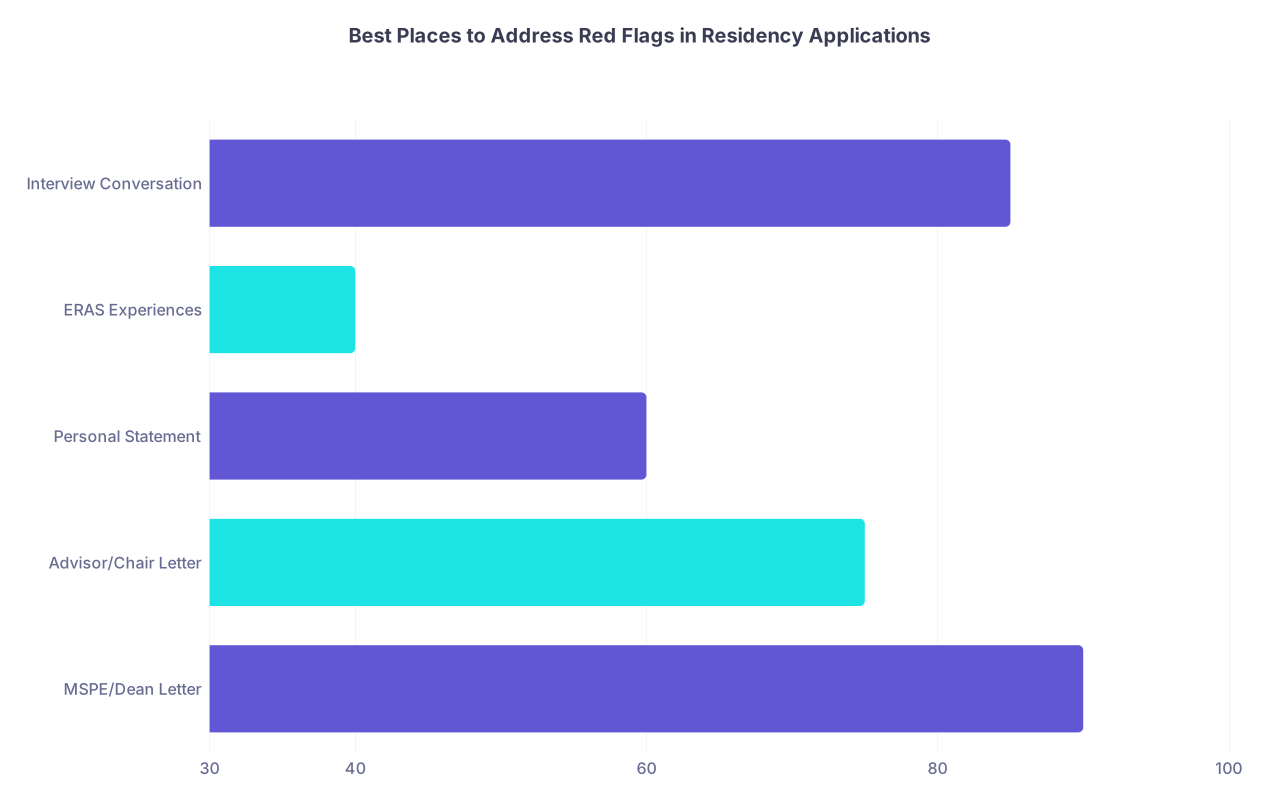
Here’s how the other components can help:
| Category | Value |
|---|---|
| MSPE/Dean Letter | 90 |
| Advisor/Chair Letter | 75 |
| Personal Statement | 60 |
| ERAS Experiences | 40 |
| Interview Conversation | 85 |
Roughly how often I prefer each venue (out of 100) to handle significant concerns, based on what I’ve seen work:
- MSPE/Dean’s Letter: Great for formal academic/professional issues with institutional context.
- Advisor/Chair Letter: Powerful for “this happened but I vouch for them” narratives.
- Personal Statement: Selective use, for things deeply tied to your story or that lack any other context.
- ERAS Experiences: Good for showing what you did next (tutoring, extra work, leadership) rather than explaining the red flag directly.
- Interviews: Often the best place for nuance, especially if you can demonstrate change with how you talk about it.
If your school offers an “advisory statement” or addendum attached to the MSPE, use it. That’s where extended explanations belong.
Examples: What To Do vs What To Avoid
Here are a few quick contrasts.
Example 1: USMLE Failure
Bad:
“I know program directors might worry about my Step 1 failure. I want to assure you that I am a hard worker and that this doesn’t reflect my true abilities…”
This is vague and defensive.
Better:
“I failed Step 1 on my first attempt. At that time, I relied too heavily on passive learning and underestimated how much dedicated time I needed. I changed my approach by meeting regularly with our academic support team, building a detailed study schedule, and focusing on active question-based learning. On my second attempt I improved my score by 43 points and passed, and I later scored 240 on Step 2.”
Short. Concrete. Shows a trajectory.
Example 2: Leave of Absence for Mental Health
Bad:
“Due to personal difficulties I needed time away from school, but I am stronger now and ready for residency.”
Too vague, no evidence, sounds like hand-waving.
Better (assuming MSPE already covers basics):
“During my pre-clinical years, I took a one-semester leave of absence for a depressive episode, which is described in my MSPE. Working with my physician, therapist, and dean’s office, I developed a sustainable treatment and support plan. Since returning, I’ve completed all clerkships on time, taken on leadership in our psychiatry interest group, and learned firsthand the importance of attending to my own mental health so I can reliably care for patients.”
This acknowledges, doesn’t over-share, and points to stability.
Quick Checklist: Should This Go in My Personal Statement?
Ask yourself these questions:
- Will a program director definitely notice this and wonder what happened?
- Is there no clear, formal explanation elsewhere in my file?
- Can I explain it in under one short paragraph with clear growth?
- Will my explanation make me look more mature, not more defensive?
- Does my statement still spend at least 75% of its space on who I am now and why I fit this specialty?
If the answer to 1 and 2 is “no,” skip it.
If the answer to 3–5 is “no,” rethink how you’re explaining it—or use a different venue.
FAQs
1. Should I ever open my personal statement with a red flag explanation?
Almost never. Opening with “I failed Step 1…” or “I was placed on probation…” anchors the reader’s whole perception around your worst moment. Start with who you are and why this specialty. Address the red flag later, briefly, if needed.
2. What if I have multiple significant red flags?
You still do not write a confessional essay. Choose the biggest or least self-explanatory issue for a concise PS explanation. Let your MSPE, advisor letters, and interview handle the rest. Your statement must still primarily argue for your strengths and fit, not catalog your problems.
3. Do I need to apologize outright in the statement?
You need to show ownership, not self-flagellation. A simple, factual acknowledgment with clear responsibility (“I did not manage my time effectively…”) works better than dramatic apologies. Program directors care more about whether you learned and changed than how sorry you sound.
4. How specific should I be about mental health or personal crises?
Specific enough to be honest, vague enough to protect your privacy and avoid triggering bias. “Depressive episode,” “serious family illness,” or “medical leave for a now-resolved condition” is usually sufficient. The emphasis should be on stability, treatment, and performance since then.
5. My scores are low but I never failed. Is that a red flag I should explain?
Usually no. Low-but-passing scores, especially with an upward trend or a stronger Step 2, are not classic red flags. Show your clinical strengths, reliability, and work ethic through your narrative and experiences. Over-explaining modest scores can draw unnecessary attention.
6. Should I use the ERAS “additional information” section for red flag explanations instead?
If your school allows or encourages it, that can be a better place for a brief factual note, especially for things that don’t fit naturally into your PS narrative. But do not paste a long emotional essay there either. Two to four clear, factual sentences are plenty.
7. How do I know if my explanation sounds defensive?
Read it out loud and ask: does this sound like I’m arguing with an invisible critic? Phrases like “I want to assure you,” “I hope you understand,” “this doesn’t reflect who I am” are classic defensive markers. Replace them with simple, concrete facts about what happened and what’s different now.
Key takeaways:
Do not turn your personal statement into a red-flag manifesto. Address only the biggest, most confusing issues briefly and with clear ownership and growth. Then spend the rest of your space doing what the best statements do—showing that you’re someone they’ll be glad to have on their team at 3 a.m.