
The language in most residency personal statements is way too stiff—and that hurts more applicants than it helps.
Let me be blunt: if your personal statement reads like a committee memo instead of a human being talking, you’re doing it wrong. But if it reads like a casual text, that’s wrong too. You’re aiming for professional but natural. Think “smart attending you respect, talking to you in their office,” not “legal contract” and not “group chat.”
Here’s how formal your residency personal statement actually should be—and how to hit the right level without overthinking every sentence.
The Core Rule: Professional, Not Pretentious
Your residency personal statement should use professional, polished, plain English.
That means:
- No slang.
- No texting abbreviations.
- No cursing.
- No trying to sound like a Victorian novelist.
If you wouldn’t say it on a residency interview day, don’t write it. But also: if you can’t imagine ever saying it out loud because it sounds robotic or absurdly fancy, don’t write that either.
Bad example (too formal / stiff):
“It has long been my aspiration to engage in the rigorous pursuit of excellence in the field of internal medicine.”
Better:
“I’m drawn to internal medicine because I like solving complex problems while building long-term relationships with patients.”
See the difference? Same idea. One sounds like a parody of academia. The other sounds like a thoughtful person you’d actually want on your team.
The Formality Scale: Where Your Statement Should Land
Let’s put this on a spectrum from 1 to 5.
1 – Texting your friend
2 – Casual email to a friendly attending
3 – Polished email to a PD or chair
4 – Journal-style formal writing
5 – Legal contract / policy document
Your residency personal statement should sit at a 2.5–3.
- You’re allowed to use “I” and “my.”
- You’re allowed to write how you actually speak—just cleaner.
- You’re not trying to impress with vocabulary. You’re trying to be clear.
What you’re not doing:
- Writing like a scientific paper (that’s a 4).
- Writing like a Reddit post (that’s a 1–2).
Specific Language Choices: What’s In, What’s Out
Contractions: Yes, You Can Use Them
You’re allowed to write:
- I’m, I’ve, I’d, don’t, can’t, won’t
These sound more natural and don’t hurt professionalism if the rest of your tone is appropriate.
Acceptable:
“I’m drawn to emergency medicine because…”
Overly stiff:
“I am drawn to emergency medicine because…”
Are you banned from writing “I am”? Of course not. Just don’t force every “I am” and “do not” because you think it looks smarter. It doesn’t. It just reads awkward.
Vocabulary: Stop Trying to Sound Impressive
If you’re reaching for words you never use in real conversation, stop. Using “ameliorate,” “innumerable,” “innately fascinated,” “multifaceted tapestry,” or “the human condition” doesn’t make you sound wiser. It makes you sound like you tried to pad your essay with a thesaurus.
Swap these:
“I aspire to ameliorate health disparities”
→ “I want to help reduce health disparities”“This indelible encounter profoundly impacted me”
→ “That encounter stayed with me”“I’ve been fascinated by the intricacies of the human body since childhood”
→ “I’ve been curious about how the body works since I was a kid”
Plain language is not “too simple.” It’s readable. Readers are skimming dozens of these. Clear beats fancy every single time.
Slang, Humor, and Jokes: Use Carefully (If At All)
You’re not writing stand-up. Humor is risky because it often falls flat on paper and lands differently across generations and cultures.
Generally avoid:
- Slang: “I was totally blown away,” “it was insane,” “I was shook.”
- Internet speak: “low-key,” “high-key,” “literally dying,” “that rotation was wild.”
- Memes or pop culture references.
A tiny bit of lightness is fine if it still sounds professional:
Acceptable:
“I quickly learned that nothing in the ICU goes as planned.”
Too casual:
“The ICU was absolutely wild—nothing ever went according to plan and it was kind of hilarious.”
Rule of thumb: if you’d be nervous saying it in a PD’s office, don’t write it.
Structure vs. Tone: Formal Organization, Human Voice
You do want a fairly traditional structure. That’s where the “formal” part belongs.
Typical structure:
- Opening: a brief, focused story or statement that sets up who you are and why the specialty.
- Middle: 2–3 paragraphs connecting your experiences to traits that fit the specialty (clinical, research, teaching, leadership).
- Closing: what you’re looking for in a program and who you’ll be as a resident.
But inside that structure, your voice should be human.
Too formal opening:
“My journey through medical school has been a multifaceted and rewarding experience that has ultimately culminated in my decision to pursue pediatrics.”
Better:
“Halfway through my pediatrics rotation, I realized I was looking forward to clinic days more than anything else in third year.”
The second sounds like a person remembering an actual moment. That’s what you’re aiming for.
Examples: Same Content, Different Formality
Let’s look at a concrete comparison.
Too formal:
“The diversity of pathology and the intellectual rigor inherent in internal medicine have compelled me to pursue this specialty. Through my clerkship, I have honed my analytical abilities and clinical acumen, allowing me to approach complex patients with methodical precision.”
Balanced:
“I like internal medicine because it forces me to think. During my medicine clerkship, I enjoyed working through complex patients and figuring out what actually fit the story. Over time, I became more comfortable organizing my thoughts, prioritizing problems, and making decisions even when the diagnosis wasn’t obvious.”
Too casual:
“I love medicine because the cases are super interesting and I get to nerd out on figuring out what’s going on. During my rotation, I really leveled up my skills and got pretty good at handling complicated patients.”
Who sounds like someone you’d trust at 2 a.m.? The middle one.
Style Rules That Actually Matter
Here’s where you should focus your energy instead of obsessing about sounding “formal enough.”
1. Be Specific, Not Generic
Generic:
“I am passionate about family medicine because it will allow me to build long-term relationships and care for the whole person.”
Specific:
“On my family medicine rotation, I followed a patient with poorly controlled diabetes for three months. I watched my attending adjust medications, troubleshoot why he wasn’t checking his sugars, and slowly build enough trust that he started sharing the financial and family stress behind his ‘noncompliance.’ That kind of longitudinal relationship is what draws me to family medicine.”
Specific stories do more for professionalism than fancy words.
2. Avoid Clichés Even If They Sound Formal
Common, overused lines:
- “Ever since I can remember…”
- “I have always wanted to be a doctor…”
- “Medicine combines my love of science and helping people…”
- “I was fascinated by the resilience of the human spirit…”
- “This experience solidified my desire to become a [specialty].”
These are technically “formal” but empty. They add nothing. Replace them with concrete experiences and straightforward reflection.
3. Keep Sentences Under Control
Residency reviewers are tired.
If your sentences run three lines long with multiple commas and clauses, they’ll skim. And when people skim, your essay goes into the mental “generic” pile.
Aim for:
- Mostly short to medium sentences.
- Occasional longer one for rhythm, if it’s clear.
Bad (too dense):
“During my sub-internship, I had the privilege of caring for an elderly patient with decompensated heart failure, and through repeated family meetings, complex medication adjustments, and coordination with multiple consultants, I came to appreciate the multifactorial challenges inherent in managing chronic illness in vulnerable populations.”
Better:
“During my sub-internship, I cared for an elderly patient with decompensated heart failure. Over two weeks, we held repeated family meetings, adjusted medications daily, and coordinated with multiple consultants. That experience showed me how complex it is to manage chronic illness in vulnerable patients—and how rewarding it can be when it works.”
Same content. Less exhausting to read.
How Formal Are Other Applicants, Really?
Here’s the reality: most of your competition is too formal and too bland. Their statements sound similar and forgettable.
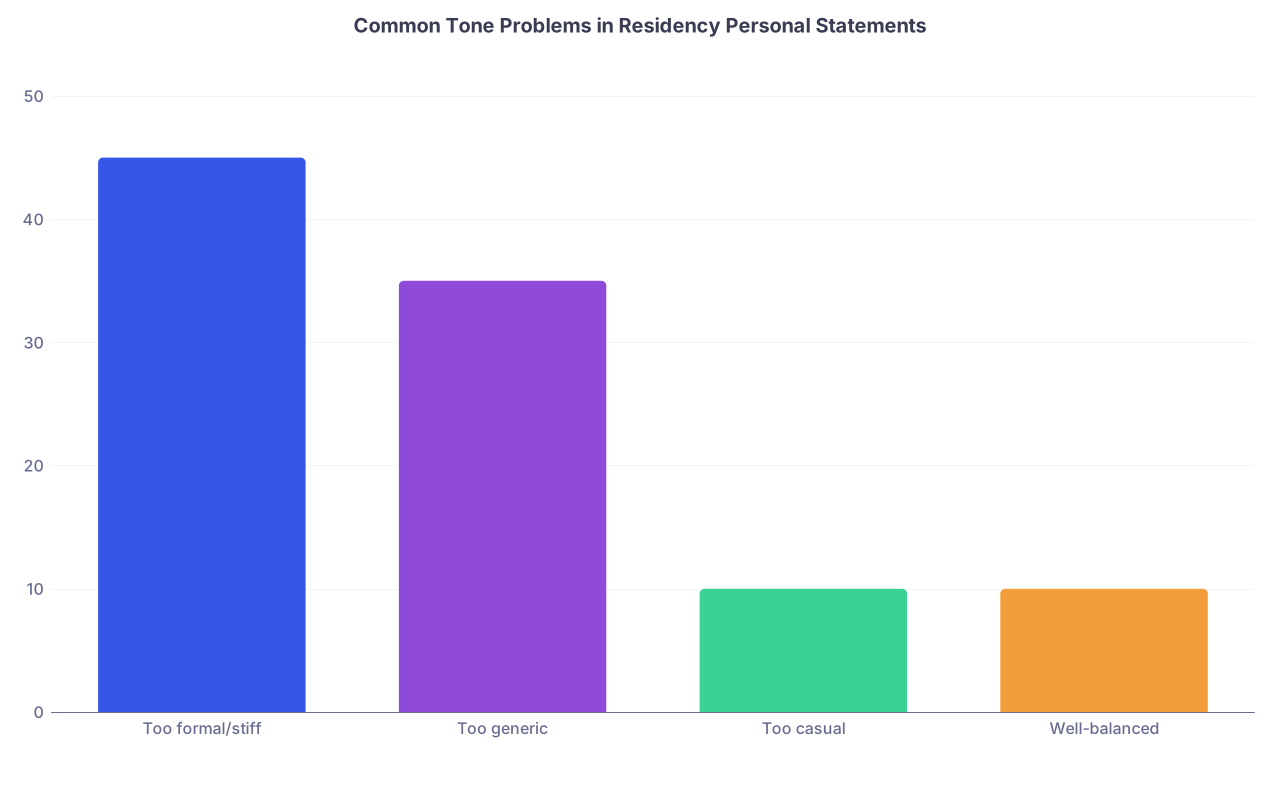
| Category | Value |
|---|---|
| Too formal/stiff | 45 |
| Too generic | 35 |
| Too casual | 10 |
| Well-balanced | 10 |
So if you:
- Use clear, direct language,
- Sound like a real, thoughtful person,
- Keep the structure professional,
…you’re already in the top tier for tone.
Quick Tone Checklist (Use This Before You Submit)
Read your statement out loud and ask:
Does this sound like how I’d talk to a program director in an interview?
- If yes → good.
- If I sound stiffer on paper than I would in person → loosen the language slightly.
Am I using any words I’d never say out loud?
- If yes → replace with simpler synonyms.
Are there any jokes, slang, or pop culture references?
- If yes → probably delete.
Did I write this to impress or to communicate?
- Shift toward clarity over cleverness.
Could someone who knows me read this and say, “Yep, that sounds like you—but cleaned up”?
- That’s your target.
Formality by Section: Where to Dial Up or Down
You can shift the formality slightly depending on what you’re talking about.
| Section | Suggested Formality (1–5) | Notes |
|---|---|---|
| Opening anecdote | 2.5–3 | Natural but polished |
| Clinical experience body | 3 | Clear, straightforward |
| Research/leadership | 3–3.5 | Slightly more formal is fine |
| Why this specialty | 3 | Personal but professional |
| What you want in a program | 3 | Direct, specific |
You don’t need to obsess over the numbers. Point is: keep everything in that middle band. Don’t suddenly switch to journal-speak in the research paragraph or casual storytelling in the last line.
A Simple Rewrite Exercise
If your draft feels too formal, do this:
- Take one paragraph.
- Record yourself explaining that same content out loud to a friend who’s also in medicine.
- Transcribe what you said.
- Clean it up—fix grammar, tighten sentences, remove fillers.
That version will almost always be closer to the right tone than your original “I’m trying to sound impressive” draft.
FAQ: Formality in Residency Personal Statements
1. Can I start with a quote or dramatic hook?
You can, but you probably shouldn’t. Famous quotes and overly dramatic openings (“The code blue pager went off…”) feel forced and cliché. A simple, specific story from your own experience is better—and sounds more authentic without needing to turn up the drama or formality.
2. Is it okay to mention personal hardship or mental health?
Yes, but describe it in steady, straightforward language. Avoid very emotional, raw, or graphic descriptions. Keep the focus on what you learned and how you function now. The tone should be calm and reflective, not like a therapy session transcript.
3. Should I use technical jargon to sound knowledgeable?
Use normal clinical language (sepsis, heart failure, bronchiolitis) without overloading the paragraph. Don’t dump acronyms or rare diagnoses just to sound advanced. You’re writing for physicians, but this is not a case report and you’re not scoring points for vocabulary density.
4. How different should my tone be between specialties?
Not very. A surgery personal statement doesn’t need to be militarily stiff, and a pediatrics one doesn’t need to be cutesy. The content changes—what you highlight, what you value—but the underlying tone (professional, clear, human) should be the same across specialties.
5. Is it okay to show emotion or vulnerability?
Yes—if you keep the language grounded. Saying “I was frustrated when…” or “I felt proud when…” is fine. Writing in a melodramatic way (“I was utterly devastated to my core…”) isn’t. The more intense the event, the calmer and more controlled your wording should be.
Bottom line: Aim for professional but natural. Clear, specific language beats fancy words. If your statement sounds like a thoughtful version of how you’d talk to a program director in person, your level of formality is exactly where it should be.