
Most applicants mention specific programs in their personal statements for the wrong reasons—and it usually backfires.
Let me be direct: for 90% of applicants, name-dropping specific programs in a residency personal statement is a bad idea. Not because programs hate flattery. They don’t. But because it creates more risk than benefit and often makes your statement unusable across applications.
There are a few narrow situations where it’s smart and strategic. Most people aren’t in those situations and try to force it anyway.
Here’s how to know which side you’re on—and exactly what to do.
The Short Answer
Should you mention specific programs in your residency personal statement?
Most of the time: No, don’t name specific programs.
You should:
- Keep your ERAS personal statement program-agnostic
- Make it clear what kind of program you’re looking for instead of naming names
- Use other parts of your application (signals, geographic preferences, emails, interviews) to show interest in specific programs
You should only mention a specific program when:
- You are writing a separate, customized statement for a very small number of programs (and you’re extremely careful with it), or
- A program explicitly asks for a program-specific statement (rare), or
- You’re doing a separate specialty-specific personal statement for a different specialty or a “designated preliminary” year—not to name programs, but to target the type of training
Now let’s unpack why this matters.
Why Naming Programs in Your Main Statement Is Usually a Mistake
I’ve seen all the versions of this:
“I would be honored to train at [Prestige General Hospital].”
“The three + [City] programs are my top choice, including [X Program].”
“I believe [Program Name] is the ideal place for my training.”
Here’s why this usually hurts you more than it helps.
1. Your statement must work for every program you apply to
Your ERAS personal statement is not a cover letter to one place. It’s a document that goes to 30–80+ programs in a specialty. You don’t control which specific humans read it.
If you put this in your main statement:
“I am particularly interested in the XYZ Internal Medicine Residency at ABC University…”
Then what exactly are you expecting the other 60 programs to feel when they read it?
It reads as either:
- You aren’t really interested in them
- You forgot to edit your statement
- You’re just using canned praise with a find/replace
None of those options help you.
Programs want to feel like they could be your genuine, thoughtful choice. Don’t hand them a paragraph proving they’re not.
2. The copy-paste disaster is very real
Every application cycle, programs trade stories about these:
- “Thrilled to apply to your program at [Wrong Hospital Name].”
- “I’m especially excited about your Baltimore program” (message sent to a program in Chicago).
- Swapped specialty: radiology statement sent to IM.
People do notice this. They might still rank you if the rest of the app is strong, but you’ve taken a self-inflicted hit for zero real gain.
If you try to customize one personal statement for 20+ programs and swap out lines with their names, you’re begging for this kind of mistake.
3. Flattery doesn’t move the needle like you think
Programs don’t rank applicants higher because they say:
- “Your program is my top choice”
- “I would be honored to train at your prestigious institution”
- “Your program’s dedication to excellence resonates with me”
Everyone writes this. It just blends into background noise.
What does move the needle?
- Clear fit with the specialty
- Evidence you understand the work and lifestyle
- Concrete experiences that match the program’s strengths (without name-dropping it)
- Professionalism and maturity
You can show all of that without ever naming the program.
The One Big Exception: A Separate, Truly Customized Statement
There’s one scenario where mentioning a specific program can help:
You create a completely separate personal statement, labeled for that one program (or very small group of programs), and you upload and assign it only to them.
Even then, you need to follow some rules.
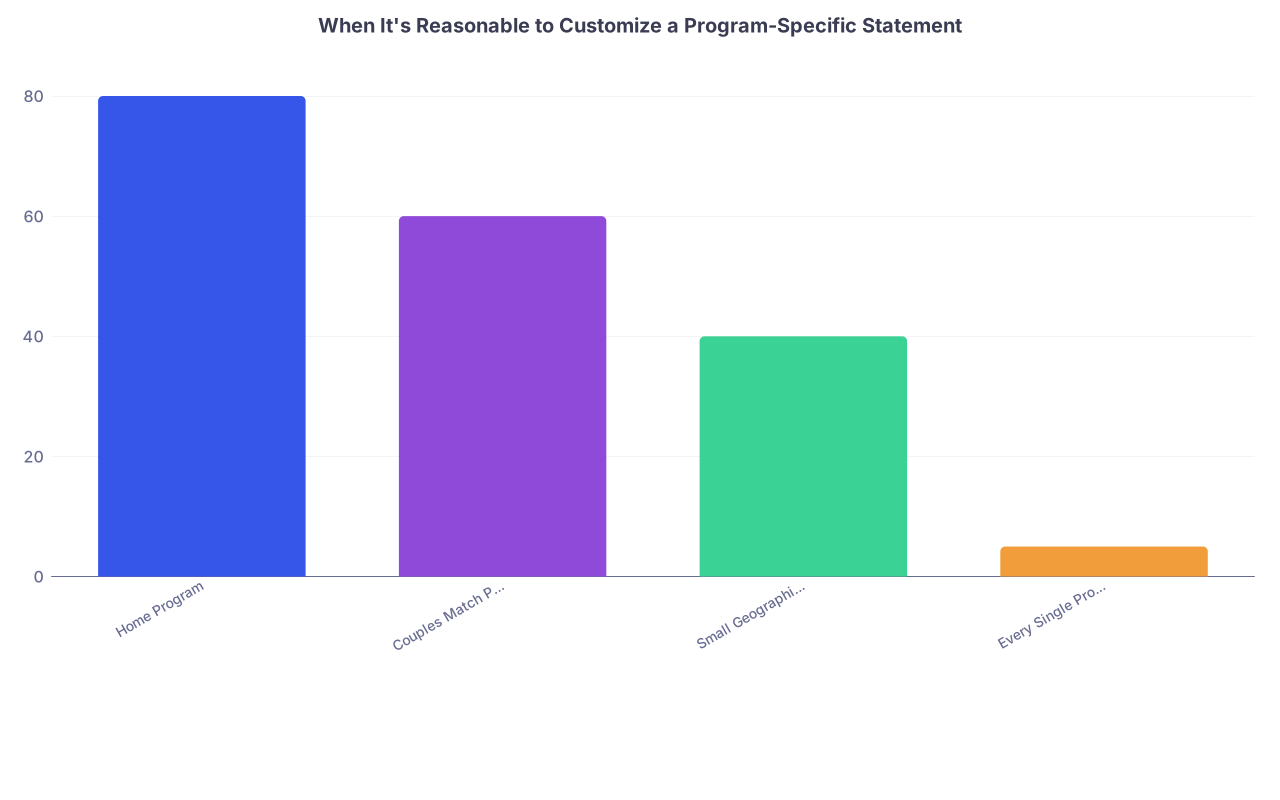
| Category | Value |
|---|---|
| Home Program | 80 |
| Couples Match Priority | 60 |
| Small Geographic List | 40 |
| Every Single Program | 5 |
Those numbers aren’t exact data, but they reflect reality: customizing for your home program or top 1–3 realistic choices is rational; trying to do unique versions for everyone is fantasy.
What a good program-specific paragraph looks like
Bad version (what I see all the time):
“Your world-renowned research, diverse patient population, and strong teaching faculty make [Program] my top choice.”
You could paste this into any program’s file. Meaningless.
Better version:
“During my sub-internship at [Program], I saw what it meant to have genuine resident autonomy backed by strong support. I remember presenting a complex CHF admission to Dr. Smith on wards; instead of taking over, he asked me to walk him through my plan and then helped me refine it. That combination of responsibility and teaching is exactly how I want to train.”
Here, you’re:
- Referencing a real, specific experience
- Showing you’ve actually been there
- Tying what you observed to how you learn
That’s useful context, not empty flattery.
But again: this paragraph belongs in a separate statement assigned only to that program.
How to Show “Program Fit” Without Naming a Program
This is what most people are actually trying to do. They want to show programs: “I’d fit well with you.”
You don’t need to name them. You need to describe the type of program you’re looking for.
Think like this:
Instead of:
“I am excited about [State University] because of its strong community focus and underserved populations.”
Write something like:
“I’m looking for a program where I’ll see a high volume of bread-and-butter internal medicine in an underserved patient population, with enough subspecialty exposure to prepare me for a fellowship in cardiology. I prefer a program where residents are in the hospital and clinics more than they’re in a conference room, but still have reliable teaching on rounds and structured didactics.”
Now any program that matches that description thinks, “That’s us.”
And programs that don’t match think, “Not the best fit,” which is actually fine. You don’t win by forcing everyone to like you; you win by getting interviews from places that align with what you want.
Things you can describe instead of naming:
- Academic vs community vs hybrid programs
- Patient populations (underserved, urban, rural, veterans)
- Balance of autonomy vs supervision
- Interest in research, QI, med ed, global health, etc.
- Lifestyle and call structure style (within reason)
- Plan for fellowship vs primary care vs hospitalist vs undefined
Programs are very good at reading between the lines.
Where To Mention Specific Programs Instead Of the PS
You still want to show serious interest in certain programs. Good. Just don’t force it into the main statement.
Use these channels:
1. Signals and preference features (when available)
In some specialties, you can send “signals” or indicate preferences in ERAS. That’s the official, high-yield way to say, “You’re at the top of my list.”
Use them. Thoughtfully.
2. Supplemental questions / essays
If a program gives you a text box that literally says:
“Why are you interested in our program?”
That’s where you should talk specifically about them. That’s exactly what that box is for.
Use concrete examples:
- Rotations you did there
- People you met
- Program features you’ve actually looked into (tracks, curricula)
- How their structure matches your goals
3. Pre-interview or post-interview communication (when appropriate)
Some programs accept emails expressing strong interest or “number one” ranking (check their policy). That’s where the “this is my top choice” language belongs—not in the universal personal statement.
Corner Cases: When Program Names Might Belong
Let’s cover the weird situations, because applicants get confused here.

| Step | Description |
|---|---|
| Step 1 | Writing Residency Personal Statement |
| Step 2 | Do NOT name specific programs |
| Step 3 | You MAY name that program |
| Step 4 | Carefully name those programs |
| Step 5 | No need to name programs, focus on type |
| Step 6 | Main ERAS PS? |
| Step 7 | Special Prompt or Custom PS? |
1. Home program
You might be tempted to say:
“The [Your Med School] IM program is my top choice.”
Don’t put this in your main PS.
If you make a separate statement for them only, sure, you can mention them. But you can also say this at meet-and-greets, in emails (if appropriate), or on your rank list. The PS is not the only tool.
2. Preliminary or transitional year
For prelim or TY personal statements, your focus is:
- What kind of foundation you want
- How it fits your long-term specialty
Even here, you generally don’t need to name specific prelim programs. Describe the training environment you want and your goals.
3. Dual applications (e.g., IM and neurology)
You absolutely should have different statements for different specialties.
But that’s about the field, not the program. Your neurology PS should explain why neuro; your IM PS should explain why IM. Neither needs to list program names.
How To Fix a Draft That Already Names Programs
If you’ve already written “I want to train at [Program] because…” throughout your statement, don’t panic. You can salvage it.
Here’s how to clean it up:
- Strip every program name out of the document. No exceptions.
- For each sentence that used to say “your program,” rewrite it as a program type or training environment.
- Keep any concrete experiences and replace the explicit program reference with a brief, neutral description.
Example cleanup:
Original:
“During my sub-internship at the XYZ Internal Medicine Residency, I saw how dedicated the faculty at XYZ are to resident education.”
Fixed:
“During my sub-internship at a large academic internal medicine program, I saw how dedicated the faculty were to resident education. On one ward month, my attending would sit with us after rounds and have us redo one note per day until it was clear and concise—that kind of detailed feedback accelerated my growth.”
The story stays. The program-specific flattery goes.
A Quick Comparison: What You Think You’re Doing vs What Programs Actually See
| What You Intend | What Programs Usually See |
|---|---|
| “Showing strong interest” | Generic flattery they’ve read all day |
| “Standing out as committed to them” | One of 50 people calling them top choice |
| “Signaling I’d rank them highly” | Questionable professionalism / naivete |
| “Customizing my application” | Increased risk of copy-paste errors |
Practical Takeaways
If you remember nothing else, remember this:
Your main ERAS personal statement is a global document. Write it like any program in your specialty should be able to read it and think, “This could be one of our people.”
Show fit by describing the training environment and career path you want, not by name-dropping individual programs.
Save program-specific language for:
- Separate, carefully assigned custom statements
- Program-specific prompts
- Signals and appropriate communication channels
Most applicants overestimate how much “I love your program” language helps and underestimate how much one sloppy copy-paste can hurt.
FAQ (Exactly 6 Questions)
1. Can I write separate personal statements for different programs?
You can, but you probably shouldn’t do it for more than a tiny number—think 1–3 truly special programs. Each one must be uploaded as a separate personal statement in ERAS and carefully assigned only to that program. For everyone else, use one strong, generic-but-specific-to-the-specialty statement. If you try to customize 20+, you’ll almost certainly introduce errors without gaining much.
2. What if a program is genuinely my number one choice?
Don’t put “number one choice” language in your universal personal statement. If the program accepts post-interview communication, that’s where you say, “You’re my top choice, and I’ll rank you first.” You can also show strong interest through signals (if available), attending their info sessions, and having thoughtful questions that show you’ve actually read about them.
3. Do programs ever reject people just for naming the wrong program in their PS?
Some do. Some don’t. But here’s the point: it never helps you to risk it. At best, they ignore it and move on. At worst, it creates doubt about your attention to detail and professionalism. You’re trying to make their decision easy. Don’t give them easy reasons to say no.
4. How specific should I be about what kind of program I want?
Specific enough that you sound like a real person with real preferences, but not so narrow that you rule out half your list. For example, saying “I’m interested in a mid-sized or large academic program with strong subspecialty exposure and underserved populations” is fine. Saying “I only want to work in one of three major coastal cities” is asking to get filtered out.
5. What if I rotated at a program—can I mention it by name?
You can mention the rotation and what you learned in general terms without naming the program. If you really want to say the name, do it in a separate, program-specific statement assigned only to that program. Otherwise, just say “during an away rotation at a large academic hospital” and focus on the experience itself.
6. Should I ever say “your program” in my personal statement?
Not in the main ERAS personal statement. “Your program” makes it read like a cover letter, which it isn’t. The PS is about you, your path to the specialty, and what kind of training you want. Save “your program” language for program-specific prompts, emails (when appropriate), or custom statements that go to exactly one program.
Key points:
- Don’t name specific programs in your main ERAS personal statement; describe the type of program you want instead.
- Use separate, carefully targeted communications (signals, prompts, custom PS for 1–3 places) to show specific interest.
- Avoid copy-paste flattery—focus on concrete experiences and clear, honest preferences about how and where you want to train.