It’s September. You just realized you need to apply to both categorical and preliminary spots, and now ERAS is asking for a personal statement for each. You’ve already sweated over one statement for your main specialty. The question in your head:
“Can I just use the same personal statement for preliminary and categorical programs… or is that going to screw me?”
Here’s the answer you’re actually looking for, not the vague “it depends” version.
The Short Answer: When You Can Reuse, and When You Should Not
If you remember nothing else, remember this:
- If your preliminary year is clearly a stepping stone to that exact same specialty (e.g., prelim medicine before categorical neurology, prelim surgery before categorical radiology), you can use almost the same personal statement with minor edits.
- If you’re applying to categorical in one specialty and prelim in a very different field (e.g., categorical derm + prelim surgery or medicine), then using the exact same statement with no changes is lazy and obvious. And yes, programs notice.
So:
Is it technically okay to upload the same essay? ERAS won’t stop you.
Is it strategically smart in most cases? No, not without at least targeted edits.
Let’s break this by scenario.
Common Scenarios: What You Should Actually Do
I’ll walk through the most common configurations and tell you straight what works.
| Scenario | Reuse Same PS? |
|---|---|
| Categorical + linked prelim in same field (e.g., IM + TY) | Mostly yes, with tweaks |
| Categorical specialty + prelim IM for advanced specialty | Yes, with clear explanation |
| Categorical specialty + random prelim surgery/IM spots | No, write a short tailored version |
| SOAP or very broad applications | Separate, clearly retargeted PS |
| Transitional year + advanced specialty | Partial reuse, but TY needs its own angle |
1. Categorical Internal Medicine + Preliminary Internal Medicine
Example: You’re applying to categorical IM at some places, prelim IM at others.
Here, your story, interests, and long-term goals are basically the same. Using a single, well-written internal medicine personal statement across both categorical and prelim IM is usually fine, as long as:
- You don’t say things like “I am only interested in a categorical position” in the prelim version.
- You don’t describe a long-term commitment to that specific institution if you’re using it widely.
Strategy:
Use the same core statement, but create a slightly modified prelim version:
- Keep: your motivation for medicine, clinical experiences, values, and future plans in IM.
- Tweak: 1–2 sentences to acknowledge that a prelim year in IM will prepare you for your long-term goals (whether that’s IM subspecialty, hospitalist, or advanced specialty).
So yes, here using almost the same statement is okay. Programs in prelim IM know many applicants are there for one year only.
2. Advanced Specialty (e.g., Neurology, Anesthesiology, Radiology) + Prelim IM
This is the classic structure:
You apply categorical/advanced in your chosen specialty and need one year of prelim medicine somewhere.
You have two separate audiences:
- Neurology/anesthesia/radiology programs: care about why you chose their specialty.
- Prelim IM programs: care if you understand that IM is your one-year training home and won’t be miserable or unsafe on their wards.
Using your neurology personal statement unchanged for a prelim IM program looks bad. It tells them:
- You didn’t bother.
- You don’t see their program as a real training year with real work.
Here’s the fix that doesn’t require writing a whole new essay from scratch:
- Take your advanced specialty statement.
- Keep:
- Your background.
- Clinical experiences.
- Work ethic and values.
- Change:
- Every time you mention “neurology” (for example), do not just leave it there.
- Add 1–2 sentences in one paragraph clearly linking why a strong prelim IM year is crucial for you to become the physician you want to be.
- Add one closing sentence explicitly acknowledging the value of their prelim year: e.g., “I’m seeking a preliminary internal medicine year that will…”.
Programs want to know you get that you’re joining their team for real. Not just using their hospital as a 12-month hallway.
So: reuse structure and content, not the specialty-specific language. That’s the line.
3. Categorical in One Specialty + Prelim in an Unrelated/Very Different Area
Example:
- Categorical Dermatology + Prelim Surgery
- Categorical Radiology + Prelim Internal Medicine at a community program
- Categorical Anesthesiology + random prelim IM programs all over the map
Here, using the exact same personal statement is a mistake. Every PD I’ve heard comment on this hates the obviously misdirected letter.
Concrete example I’ve seen:
- Applicant sends a prelim medicine program a statement that says:
“I look forward to a career in dermatology where I can build longitudinal relationships in clinic…”
For a hospitalist-heavy, inpatient-heavy prelim IM year.
The PD: “So… you have zero interest in what we actually do here.”
Does this automatically get you rejected? Not always. But you’ve basically screamed “backup plan.”
What you should do instead:
- Keep your main specialty personal statement as your core.
- Write a shorter, targeted prelim personal statement (even 550–650 words is fine) that:
- Acknowledges your ultimate specialty (briefly).
- Clearly explains why doing their kind of prelim year (IM vs surgery vs TY) makes sense for you.
- Emphasizes that you take the prelim year seriously: you want to learn to manage acutely ill patients, handle night float, respond to codes, manage perioperative care, whatever fits.
You’re not writing a love letter to internal medicine if you’re not going into it long term. You just have to show basic respect and thoughtfulness.
Using the same statement for these very different targets is lazy and easily spotted. I’d call that wrong.
How Program Directors Actually Read These
Let me be blunt: prelim PDs know most of you are there for one year and then you’re gone.
They are not expecting:
- A grand emotional narrative about your lifelong dream of a prelim year (nobody dreams of that).
- That you rank their prelim spot higher than your advanced specialty.
They are expecting that:
- You don’t send them a statement that never mentions their field or the type of work they do.
- You don’t obviously copy-paste a derm or radiology essay into a surgery prelim application.
If your statement makes it clear:
- You understand you’ll be responsible for real patients.
- You want to develop core clinical skills.
- You appreciate the type of training they offer…
…you’re fine. They mostly care if you’ll work hard, not be dangerous, and not blow up their call schedule by leaving unexpectedly.
Structuring Two Related but Different Personal Statements
Here’s a clean, practical approach.
For Your Main (Categorical/Advanced) Specialty Statement
This one answers:
- Why this specialty?
- Why you, in this field?
- What experiences show that you actually understand the job?
- Where do you see yourself going (even roughly)?
This is your main, polished, fully developed essay.
For Your Prelim / Transitional Year Statement
Start from the same skeleton, but shift the emphasis:
- Keep:
- Your background and a core clinical story.
- A paragraph about how you work: team player, reliable, teachable.
- Add or change:
- One paragraph that very clearly ties the prelim year to your skill-building:
- “Managing complex medical patients.”
- “Learning perioperative care and acute resuscitation.”
- “Becoming comfortable with nights, cross-cover, codes.”
- A closing where you name the role of the prelim year in your training:
- “I am seeking a preliminary internal medicine position that will provide rigorous training in inpatient care, preparing me to be an effective neurology resident and, ultimately, a better physician for my patients.”
- One paragraph that very clearly ties the prelim year to your skill-building:
That’s enough. You don’t need an epic second essay. You just need a respectful, tailored one.
How to Organize in ERAS Without Messing It Up
ERAS lets you upload multiple personal statements and assign them per program.
Here’s the simple system that prevents disaster:
- Name them clearly:
IM_Categorical_PSPrelim_IM_for_Neuro_PSAnesthesia_Main_PSTY_Prelim_General_PS
Do not rely on memory at 2 a.m. in September while you’re half-done with a night shift. This is exactly how people accidentally send a surgery program a pediatrics essay.
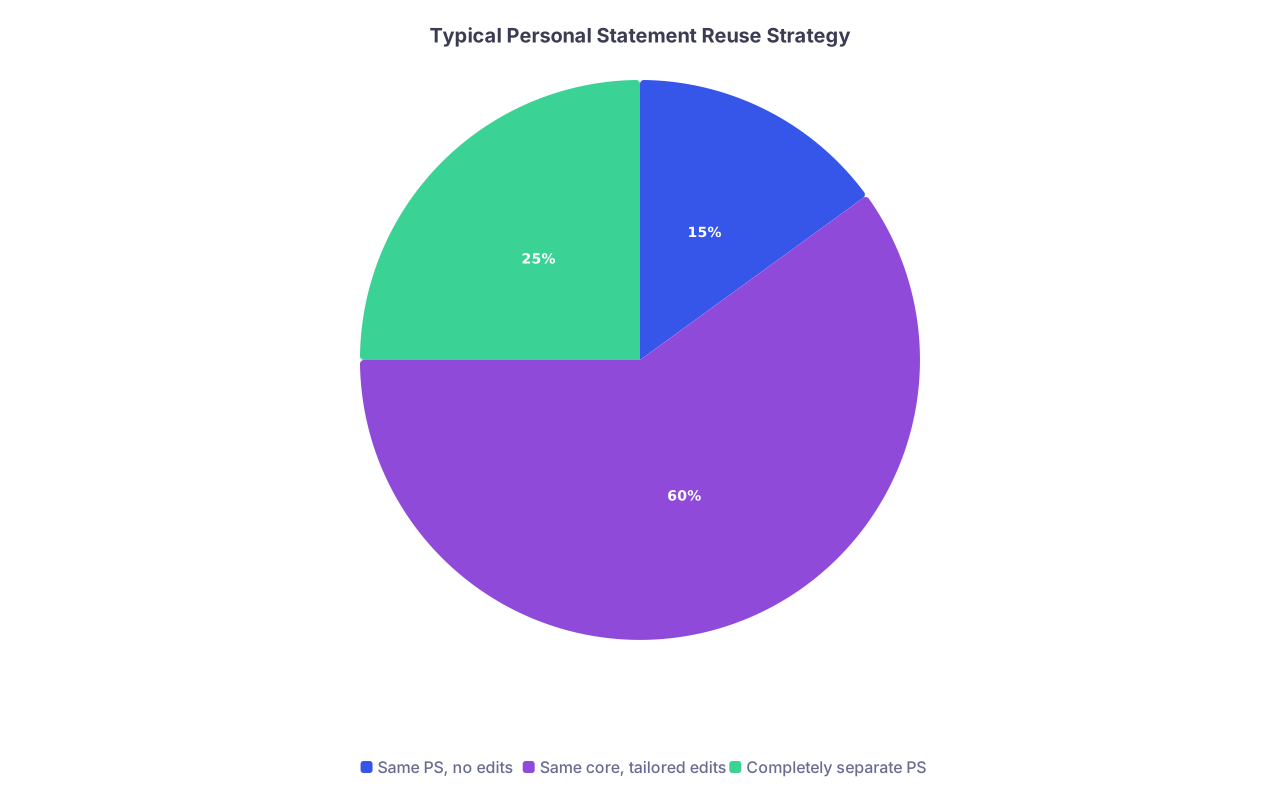
| Category | Value |
|---|---|
| Same PS, no edits | 15 |
| Same core, tailored edits | 60 |
| Completely separate PS | 25 |
If you’re applying to a lot of prelim programs:
- Use one general prelim IM statement for most medicine prelims.
- If there are 1–2 dream prelim programs (big academic, heavy ICU, etc.), you can customize a short paragraph for them specifically. Optional, but nice.
Transitional Year (TY) Programs: Slightly Different Beast
TY programs are often more outpatient-heavy and designed to be broad and flexible. They’re used a lot by:
- Radiology applicants
- Ophthalmology
- Radiation oncology
- Anesthesiology
TY PDs want to hear:
- You understand the value of broad exposure.
- You care about both inpatient and outpatient skills.
- You’re not just trying to slide through with the easiest 12 months possible.
Again, you can:
- Reuse your main essay’s intro and story.
- Add a paragraph about:
- Working in different settings.
- Enjoying continuity of care.
- Wanting diverse rotations to round out your training.
Same core, clearly retargeted. That theme keeps coming back because it’s the right approach.
Red Flags in Using the Same Personal Statement
If any of these apply, you should not use the same exact personal statement:
- Your statement repeatedly references very specific specialty-name stuff:
- “As a future dermatologist, I look forward to procedural clinics…”
going to a medicine prelim program.
- “As a future dermatologist, I look forward to procedural clinics…”
- You named a specific program or type of program (e.g., “I am drawn to small community internal medicine programs with longitudinal clinic continuity”) and now you’re sending that to a giant tertiary surgical prelim.
- Your whole essay is built around outpatient continuity, and you’re sending it to a surgery prelim where you’ll live in the OR and ICU.
- You wrote one generic, vague essay with no real specialty content at all, thinking you could “use it for everything.” That’s usually a weak essay for both sides.
If you see yourself in those, fix it. You don’t necessarily need to start from zero, but you do need revisions.
Concrete Example of a Good Reuse Strategy
Let’s say you’re applying:
- Advanced Neurology
- Prelim Internal Medicine (various)
For neurology:
- You write about a stroke rotation, fascination with neuro exam, long-term follow-up in clinic, maybe some research. Great.
For prelim IM:
- Same opening story (patient with stroke).
- When you describe the case, you add a line:
“While my long-term goal is to practice neurology, I saw firsthand how critical strong internal medicine training was in stabilizing and managing this patient’s comorbidities and acute medical needs.” - One paragraph explicitly about:
- Wanting robust inpatient experience.
- Managing heart failure, infections, electrolyte abnormalities.
- Learning to handle cross-cover calls and codes.
- Conclusion:
- “A rigorous preliminary year in internal medicine will give me the clinical foundation I need to be an effective neurology resident and a more complete physician for my patients.”
Same core. Different emphasis. This is how you reuse correctly.

| Step | Description |
|---|---|
| Step 1 | Need PS for both categorical and prelim? |
| Step 2 | Reuse core PS |
| Step 3 | Remove categorical-only language |
| Step 4 | Add 1-2 lines about prelim year role |
| Step 5 | Create prelim-focused version |
| Step 6 | Keep core story and values |
| Step 7 | Add paragraph on skills from prelim year |
| Step 8 | Explicitly state respect for prelim role |
| Step 9 | Same or different fields? |
FAQ: Personal Statements for Preliminary vs Categorical (7 Questions)
Can I upload one personal statement in ERAS and use it for all programs, prelim and categorical?
You can, but you shouldn’t. Technically ERAS allows it, but program directors will see right through a generic, one-size-fits-all essay. At minimum, you should create a main specialty statement and a slightly modified prelim/TY statement that acknowledges the role of that year in your training.If my prelim and categorical are both internal medicine, do I really need two versions?
You can often get away with one IM-focused statement for both, but it’s safer to have a prelim-specific version where you remove explicit “categorical” language and add a line or two about wanting a strong foundation for your future career (hospitalist, fellowship, whatever). This takes 10–15 minutes and prevents weird mismatches.Will a prelim program reject me if I mention my ultimate specialty in the personal statement?
No. They expect it. It’s normal to say, “I plan to pursue neurology/anesthesiology/radiology,” etc. What they don’t like is a statement that only talks about your advanced specialty and never acknowledges what you’ll actually be doing during the prelim year.Is it bad if my prelim personal statement is shorter than my main one?
Not at all. A clear, focused 600–700 word prelim statement is perfectly fine. They’re not grading you on word count. They want to see that you understand the training, will show up, work hard, learn, and not be a problem.Can I just change the specialty name in my main personal statement and use that for prelims?
If you literally only swap “neurology” for “internal medicine” and leave a neurology-focused narrative, it reads as fake. Changing the name isn’t enough. You need at least one solid paragraph that speaks directly to what you’ll be doing in that prelim year and why that matters.Do community prelim programs care as much about the personal statement as academic ones?
Generally, no. They lean much more on Step scores, MSPE, and letters. But a blatantly misdirected or disrespectful statement can still hurt you. Think of the personal statement as a chance not to screw it up, rather than a chance to win the entire game at a prelim spot.What’s the biggest mistake people make with prelim personal statements?
Two things: sending a specialty-specific essay that ignores the prelim field entirely, and writing something so generic it could be for any specialty at all. Both signal low effort. The fix is simple: keep your real story, then clearly articulate why that prelim year’s training (IM, surgery, or TY) is a critical foundation for the kind of doctor you want to become.
Key points to walk away with:
- You can reuse the core of your personal statement, but you must retarget it for prelim vs categorical programs.
- Prelim PDs don’t need a love story; they need evidence you understand and respect the year you’re signing up for.
- A 30-minute, thoughtful edit now is better than a year in a program that thinks you never cared in the first place.