
It’s August. You’re between clinic and night float, half-watching the EMR load, and your personal statement draft is open in another window. Paragraph three is about your mom’s cancer, your younger sibling with disabilities, or the grandparents you helped raise. You’re trying to explain the gap year. Or why you didn’t do three away rotations. Or why your Step 2 score dropped.
And every sentence reads like: “I’m sorry, I know this is a red flag, but please still consider me.”
You can feel it. The apologetic tone, the “despite these challenges,” the “unfortunately, I had to…” It sounds defensive. Small. Like you’re asking for permission to have a life.
Here’s what you actually need: a way to write about real family obligations and caregiving so you come across as grounded, capable, and still competitive — not as someone begging for forgiveness.
Let me walk you through exactly how to do that.
Step 1: Decide Why You’re Mentioning Caregiving At All
You don’t write about family obligations just because they were emotionally meaningful. This is not your therapy note. Programs are busy and pragmatic. They read personal statements looking for:
- Does this person understand the specialty?
- Will they be reliable and trainable?
- Is there evidence of resilience and maturity?
- Any huge unexplained gaps or risk flags?
So you mention caregiving when it does at least one of these jobs:
Explains something on your application:
- A USMLE dip or fail
- Fewer research experiences
- A leave of absence or extended graduation
- Staying local instead of doing aways
- A lower-than-expected clinical load or late exam timing
Demonstrates concrete professional qualities:
- Reliability under pressure
- Time management with real stakes
- Communication across generations / cultures
- Emotional steadiness in high-stress situations
Directly shaped your specialty choice:
- Neuro because you watched your father’s stroke rehab
- FM because you were the point person at every PCP visit
- Heme/Onc because you lived in infusion centers for months
If you can’t clearly answer: “What job is this story doing in my application?” — don’t put it in. Or keep it to a line.
The worst version is “I had hardships, please feel bad and go easy on me.” That reads needy. And residency directors don’t want needy — they want durable.
Step 2: Shift Your Mindset: From Apology To Evidence
The apologetic tone usually comes from your own internal script:
- “If I were stronger, I would’ve done all this and scored higher.”
- “Other people did more research; my caregiving isn’t ‘real’ enough.”
- “They’ll think I’m an excuse-maker.”
If you write from that mindset, lines like these show up:
- “Unfortunately, I had no choice but to…”
- “Despite these obligations, I still managed to…”
- “I know this is not an excuse for my score, but…”
Anything that sounds like you’re bracing for judgment usually backfires.
You’re not asking for pity. You’re presenting evidence.
Reframe it like this:
- You had X hours per week of non-negotiable caregiving.
- Within that, you still achieved A, B, and C.
- That’s not a deficiency; that’s performance under constraint.
This is the mindset: “Here’s what was on my plate, and here’s what I still produced. This is what I’m like when life is hard. You can rely on that.”
When you get that straight in your head, your language tightens up. You stop building disclaimers. You start stating facts.
Step 3: Use Clear, Neutral Language About Family — No Drama, No Overshare
Program directors don’t need your whole family tree. Or your sibling’s full psych history. Or every argument about discharge planning.
They need just enough to understand scale and stakes.
Aim for 2–4 clean sentences:
- Who: “my mother,” “my younger brother,” “my grandfather”
- What: “advanced heart failure,” “metastatic breast cancer,” “autism and epilepsy”
- Your role: “I was the primary overnight caregiver and medical decision-maker.”
- Time frame: “for 18 months of my third and fourth years”
Notice what’s missing: no long tragic monologues, no graphic descriptions, no sentimental adjectives.
Example of what not to write:
My mother tragically developed aggressive stage IV cancer when I was just starting my clinical rotations, and I was devastated, constantly overwhelmed, and often had to miss clinics to be at her bedside.
Now fix it:
During my third year, my mother was treated for metastatic breast cancer. I became her primary support person, coordinating appointments, managing medications, and serving as the main contact with her oncology team.
Same facts. Less drama. More agency.
You’re aiming for a “this is what I did” tone, not “this is what happened to me.”
Step 4: Connect Caregiving to Specific Skills — Not Vague “Resilience”
Everyone claims resilience. It’s the “hardworking” of personal statements: overused and meaningless.
Your caregiving story becomes powerful when you pull out specific, residency-relevant skills or changes in your behavior.
Things that actually matter in residency:
- Prioritization under time pressure
- Boundaries when caring for others
- Communicating bad news or complex plans
- Coordinating multiple moving parts (home, hospital, specialists)
- Recognizing burnout and seeking help before you implode
So show those.
Weak version:
Caring for my father taught me resilience and empathy.
Stronger version:
Managing my father’s heart failure regimen forced me to build systems: weekly pill boxes, shared calendars for appointments, and a running list of questions for his cardiology visits. Those same habits — anticipating problems, organizing information, and keeping stakeholders aligned — now shape how I preround and present on busy inpatient days.
See the difference? One sounds like a Hallmark card. The other sounds like someone I’d want on my service.
Another one, for boundaries:
I also learned to recognize when my coping strategies were failing. Halfway through his chemotherapy, I met with student health to restructure my schedule and started a standing appointment with a therapist. That experience made me much quicker, as a sub-intern, to reach out to my senior when I felt my emotional bandwidth thinning, rather than silently pushing past safe limits.
Now you’re showing judgment, not martyrdom.
Step 5: Address the “Red Flag” Directly, Briefly, and Then Move On
If your caregiving clearly affected a visible metric — Step scores, grades, LOA — you do have to name that. But not wallow in it.
One tight paragraph is enough.
Structure it like this:
- Fact: name the metric and what happened.
- Context: very briefly, what was going on.
- Action: what you did to stabilize/improve.
- Result: evidence that you bounced back.
Example:
During the period leading up to Step 2, my grandfather’s health declined rapidly, and I assumed more hands-on caregiving, including overnight shifts at home. My score of 230 does not reflect my typical performance. After his transition to hospice, I restructured my study schedule, sought academic support, and subsequently honored my medicine and surgery clerkships, which I believe more accurately represent my current clinical abilities.
Notice what’s missing:
- “I know this looks bad” — gone.
- “I’m not making excuses” — also gone.
- Apologies — nowhere.
You don’t need to call it an “excuse” or “not an excuse.” You’re presenting a pattern with context and follow-through.
Then you stop. Do not bring it up again. Let the rest of the statement show who you are going forward.
Step 6: Avoid These Phrases That Scream “Apologetic”
You want to strip out language that sounds like you’re asking for permission to exist.
Watch for:
- “Unfortunately, I had to…”
- “I regret that I could not…”
- “I know other applicants may have more…”
- “Despite my family obligations…”
- “Even though this took time away from…”
- “I hope this will not be held against me…”
Replace with:
- “During this time, I…”
- “In addition to full-time coursework, I…”
- “This experience meant that I…”
- “Within these constraints, I was able to…”
Example cleanup:
Apologetic:
Unfortunately, caring for my mother meant I couldn’t participate in more research or volunteering, but I still tried my best to stay involved when I could.
Confident:
During the two years I was my mother’s primary caregiver, I focused my limited extra time on one sustained commitment in our student-run free clinic, where I eventually helped create a simple care-coordination tool now used at intake.
Reads very different.
Step 7: Show You Can Handle Residency-Level Responsibility
Program directors ask themselves one boring, ruthless question: “If I hand this person a pager, will things get done without drama?”
Your caregiving story can help answer “yes” if you write it correctly.
Aim to show:
- You don’t crumble when family needs collide with work.
- You plan instead of constantly crisis-managing.
- You know your limits and how to ask for help early.
- You’ve already had long stretches of “no one else is coming” responsibility.
Example paragraph that does this well:
For nearly a year, I was the only family member in town to assist my brother, who has autism and epilepsy. That meant arranging transportation to day programs before pre-rounds, fielding calls from his support staff between patients, and taking him to the ED after breakthrough seizures. I learned to set clear backup plans with my co-students and attendings in advance, communicate early when something at home might affect my availability, and then be fully present at work once I committed to being there. That practice of transparent planning has carried into my sub-internship, where I proactively discuss coverage and limitations with my team rather than hoping conflicts do not arise.
This tells a PD: this person has already lived on “two fronts” and learned to handle it like a grown adult, not a perpetual victim of circumstance.
Step 8: Sample Structures You Can Steal
Here are a few scaffolds you can adapt. Don’t copy them verbatim — programs read hundreds of these — but use the shape.
Structure A: Short Explanation, Focus on Specialty
Good if caregiving mainly explains a small gap or timing issue.
- Brief specialty origin or patient story.
- One paragraph on caregiving context and its main lesson.
- Two to three paragraphs on your clinical experiences, interests, and future goals in that specialty.
Caregiving paragraph example:
During my third year, my grandmother’s dementia progressed from mild forgetfulness to significant functional decline. I took on the role of coordinating her care, from neurology visits to home health services. Balancing her needs with my rotations forced me to become more deliberate in how I managed time and emotional energy, skills I now rely on in busy inpatient settings.
Then move on. Don’t mention it again.
Structure B: Integrated, If Caregiving Is Central To Your Path
Good if caregiving heavily influenced specialty choice and large chunks of your time.
- Open with a concrete scene from your caregiving life that connects to the specialty (e.g., late-night COPD exacerbation, wrestling with home insulin titrations).
- Connect that scene to how you see patients in the specialty.
- One paragraph on the practical impact (scheduling, exams) and your academic rebound.
- Rest of the statement: your experiences, strengths, and goals in that field.
Opening example:
At 2 a.m., my mother’s shortness of breath worsened just as I finished pre-reading for my internal medicine shelf. Sitting on the floor by her bed, listening for wheezes and counting her respiratory rate while deciding whether to call EMS, I realized how different medicine feels when you are the one responsible. That night, and many like it, reframed internal medicine for me — not as abstract problem-solving, but as the quiet work of keeping people safe in the spaces between clinic visits.
Then you pivot into, “That perspective followed me onto the wards…” and talk about your clinical work.
Step 9: Keep Your Caregiving in the Right Proportion
One of the easiest ways to sound apologetic is to let caregiving swallow half your statement.
General rule of thumb:
- If it’s explaining one metric or a small gap: 10–15% of the statement.
- If it’s central to your story and shaped your specialty: 25–35%, not more.
Programs still need:
- Why this specialty?
- What have you actually done in it?
- How do you work on teams?
- What are your interests going forward?
If they finish reading and mainly remember your mother’s illness and not your actual medical work, you aimed at the wrong thing.
Use caregiving as context and seasoning, not the entire meal.
Step 10: Quick Tone Check Before You Submit
When you think you’re done, do this:
- Print the statement or change the font — anything to make it look unfamiliar.
- With a pen, circle:
- Every “unfortunately,” “even though,” “despite,” “but” after talking about family.
- Every sentence that starts with “I know…” or “I hope…”
- Rewrite those sentences to be:
- Factual
- Concrete
- Or just cut them
Then read it again asking yourself:
- Do I sound like someone explaining their reality?
- Or someone pleading for a second chance?
If it’s the second, your language is still apologizing instead of asserting.
Quick Comparison: Apologetic vs. Confident Caregiving Paragraphs
| Version | Key Traits | Example Length |
|---|---|---|
| Apologetic | Excuse-focused, defensive, lots of qualifiers | 4–6 sentences |
| Neutral | Factual, contextual, minimal emotion | 3–4 sentences |
| Confident | Skill-focused, forward-looking, shows growth | 4–5 sentences |
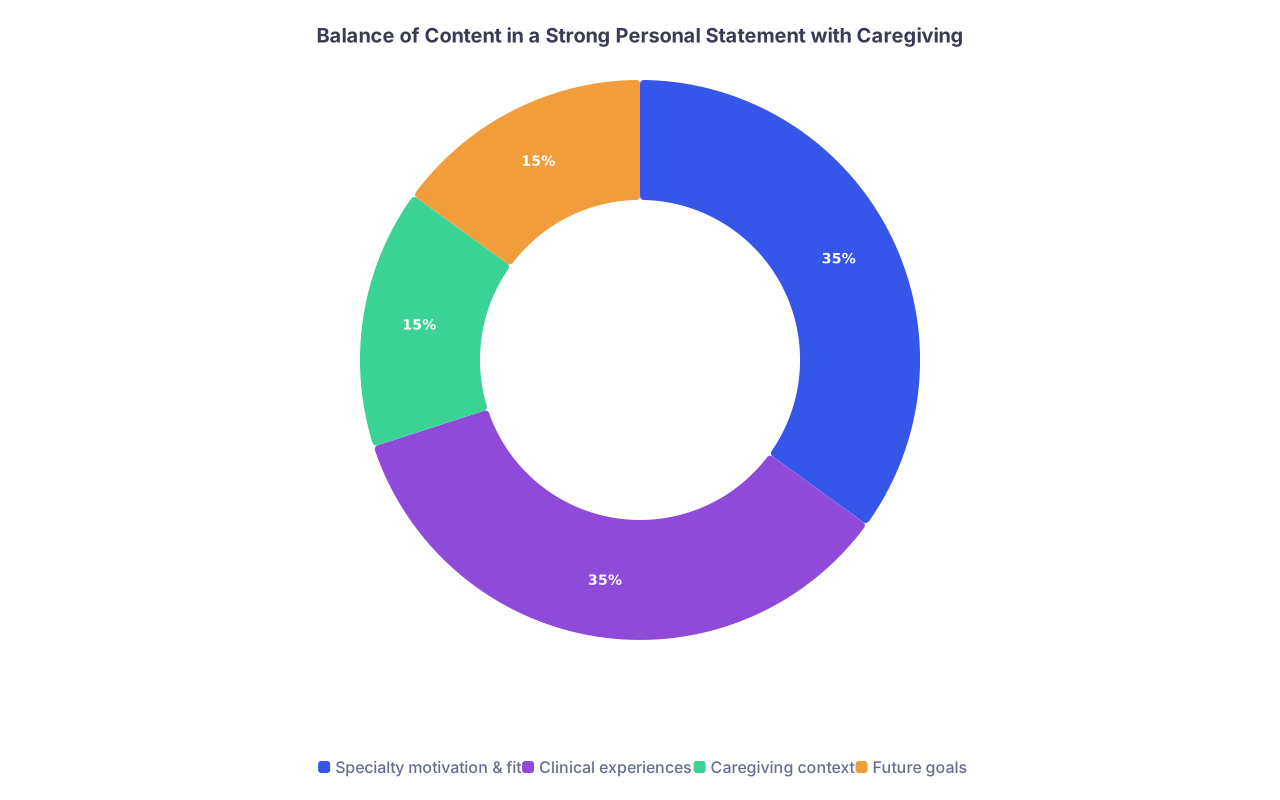
| Category | Value |
|---|---|
| Specialty motivation & fit | 35 |
| Clinical experiences | 35 |
| Caregiving context | 15 |
| Future goals | 15 |

| Step | Description |
|---|---|
| Step 1 | Caregiving Experience |
| Step 2 | Explain briefly in 1 paragraph |
| Step 3 | Integrate as part of motivation |
| Step 4 | Consider leaving it out or 1 line only |
| Step 5 | Did it affect your record? |
| Step 6 | Did it shape specialty choice or core skills? |


FAQs
1. Should I mention caregiving if it didn’t hurt my grades or scores?
Yes, if it clearly shaped who you are as a physician or why you chose your specialty. No, if it’s just there to show you had a hard life. Programs are not grading you on suffering. If including it helps them understand your motivation, priorities, or strengths in a way that connects to the specialty, use it. If it’s just “also, I did this,” cut it or reduce to one line in your activities.
2. Where’s the best place to address caregiving — personal statement or ERAS experiences section?
If it mainly explains a discrete issue (gap year, LOA, exam timing), you can often handle it in the Additional Information or experiences section and keep the personal statement focused on your specialty and clinical identity. If it really shaped your view of medicine or the specialty, put the meaning and key story in the personal statement, and then reference the concrete logistics (hours/week, tasks) in an experience entry. Don’t fully duplicate the same narrative in both.
3. How honest should I be about how hard it was mentally?
Honest, but not unfiltered. You can say you were overwhelmed, stretched, or emotionally exhausted. You can mention using counseling, support groups, or schedule adjustments. That actually reassures programs that you recognize stress and respond to it appropriately. What you avoid is suggesting you were non-functional for long stretches, chronically unreliable, or still in active crisis. Frame it as “I struggled, I adapted, and here’s what I learned that I now apply in clinical work.”
4. What if my caregiving is still ongoing? Will programs be scared I’ll be distracted?
Some will worry, yes. So you address that head-on with facts, not reassurances. Briefly explain your current situation and, crucially, how it’s now structured: who else is involved, what backup you have, how often you actually need to intervene. Show that you’ve thought practically about balancing residency demands with family responsibilities. One sentence like, “My mother is now stable with a home-health aide and local family support, and I do not anticipate my caregiving role affecting my reliability as a resident,” does far more than three sentences of “I promise it won’t interfere.”
Key takeaways:
- Use caregiving to explain, not to apologize — present facts, not pleas.
- Tie the experience to specific, residency-relevant skills and behaviors.
- Keep it proportionate: one tight paragraph if it’s context, a bit more if it shaped your path, and then move on to who you are as a physician now.