
The first three sentences of your personal statement will decide whether the rest of your story gets read or skimmed. Most applicants waste them. You cannot afford to.
Let me be blunt: residency faculty are reading your personal statement on low sleep, in between notes, with a pager going off. They scan the first few lines. If those lines feel generic, confusing, or melodramatic, they mentally file you as “average” and move on to your CV. If your opening is sharp and controlled, they actually lean in.
We are going to dissect those first three sentences like a biopsy. Structure, function, failure modes, and how to fix them.
Why The First 3 Sentences Matter More Than You Think
Program directors are not reading your statement like a novel. They are triaging.
Most of them read personal statements in one of three settings:
- On a second monitor while they flip through ERAS.
- On an iPad during a flight or conference.
- Printed, late at night, with a pen and zero patience.
Here is the quiet truth I have heard from multiple PDs and faculty reviewers: they often decide their “impression” of a candidate in the first 15–20 seconds of reading. That is your opening paragraph. Maybe 3–4 sentences. After that, they are just collecting evidence to confirm or slightly adjust their first impression.
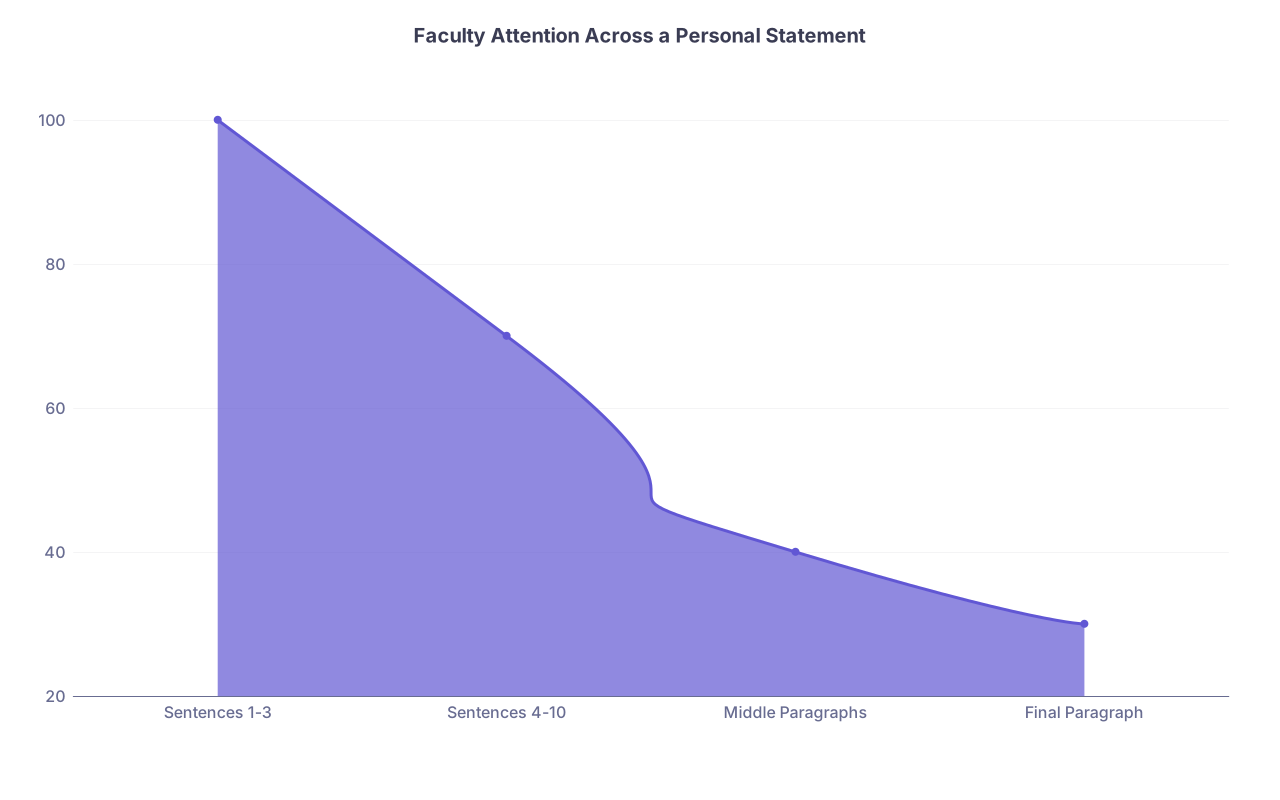
| Category | Value |
|---|---|
| Sentences 1-3 | 100 |
| Sentences 4-10 | 70 |
| Middle Paragraphs | 40 |
| Final Paragraph | 30 |
Those first 3 sentences must:
- Signal that you can write clearly and professionally.
- Establish that you have a real, specific voice (not AI, not template, not copied).
- Give some indication of what kind of physician you are becoming.
If your opening does not do this, it is not “fine.” It is actively hurting you because it wastes the moment when attention is highest.
The 5 Commonly Disastrous Opening Types
Let me walk through the most common openings I see. If you recognize yourself in one of these, good. Now you know what to fix.

1. The Grand Life Philosophy
“Medicine is both an art and a science.”
“Since the dawn of time, humans have sought to heal each other.”
“From a young age, I knew I wanted to help people.”
These sentences could belong to anyone. Any specialty. Any year.
Problem: You are burning your highest-value real estate on content that says nothing about you. You sound like a premed generic essay factory. Faculty will skim.
Better rule: Do not start with a statement that would fit on a motivational poster.
2. The Overcooked Trauma Scene
“The blood pooled on the floor as the trauma team rushed in.”
“The piercing screams of the toddler echoed in the resuscitation room.”
I know where this comes from. You think you need something dramatic. You remember some personal statement “hook” advice from undergrad. You think you are supposed to write like a TV pilot.
Two problems:
- You are not a screenplay writer. You are an applicant talking to other doctors.
- Leading with a patient’s suffering as your “hook” often comes off as exploitative or immature.
Important nuance: Patient stories are absolutely fair game. But opening like Grey’s Anatomy Season 1 makes you look like a tourist in the hospital, not a colleague who understands gravity and confidentiality.
3. The CV Rehash
“I completed my undergraduate training at X where I majored in Y. I then attended Z School of Medicine, where I pursued research in A.”
This is already in ERAS. They know. You are wasting the only part of the statement where narrative matters most.
Your opening should not read like the first paragraph of your MSPE.
4. The Vague Identity Statement
“I have always been a hardworking and compassionate individual.”
“I have a strong commitment to excellence and lifelong learning.”
These adjectives are cheap. Nobody writes, “I am lazy and indifferent.” If the only thing your opening does is assert your virtues, you sound insecure and unconvincing.
Better: show traits through a specific context or decision, then let the reader infer.
5. The Timeline Dump
“I was born in X, moved to Y at age 7, and first became interested in medicine when…”
You are not writing a memoir. The committee does not need your geographical history in sentence 1.
Use the opening to set up the version of yourself that is applying to this specialty now, not the kindergarten version.
What A High-Impact Hook Actually Does
Strong openings in residency personal statements are not magic. They usually share three features:
- Specificity – Something concrete: a setting, decision, pattern, or tension unique to you.
- Control – Clear, uncluttered sentences that do not try to do too many things at once.
- Trajectory – They point forward to the rest of the statement, not sideways into a random anecdote.
Think of your first 3 sentences as:
- Sentence 1: Anchor – plant the reader in a specific, controlled idea or moment.
- Sentence 2: Context – clarify what that idea/moment reveals about you or your path.
- Sentence 3: Direction – signal where this statement is going (specialty, theme, or question).
You are not writing clickbait. You are setting up a professional narrative.
Four Reliable Opening Frameworks (With Specialty-Specific Examples)
You do not need to be a literary genius. You need a structure that keeps you from wandering into the usual clichés. Let me walk you through four frameworks I see consistently working for residency applicants across specialties.
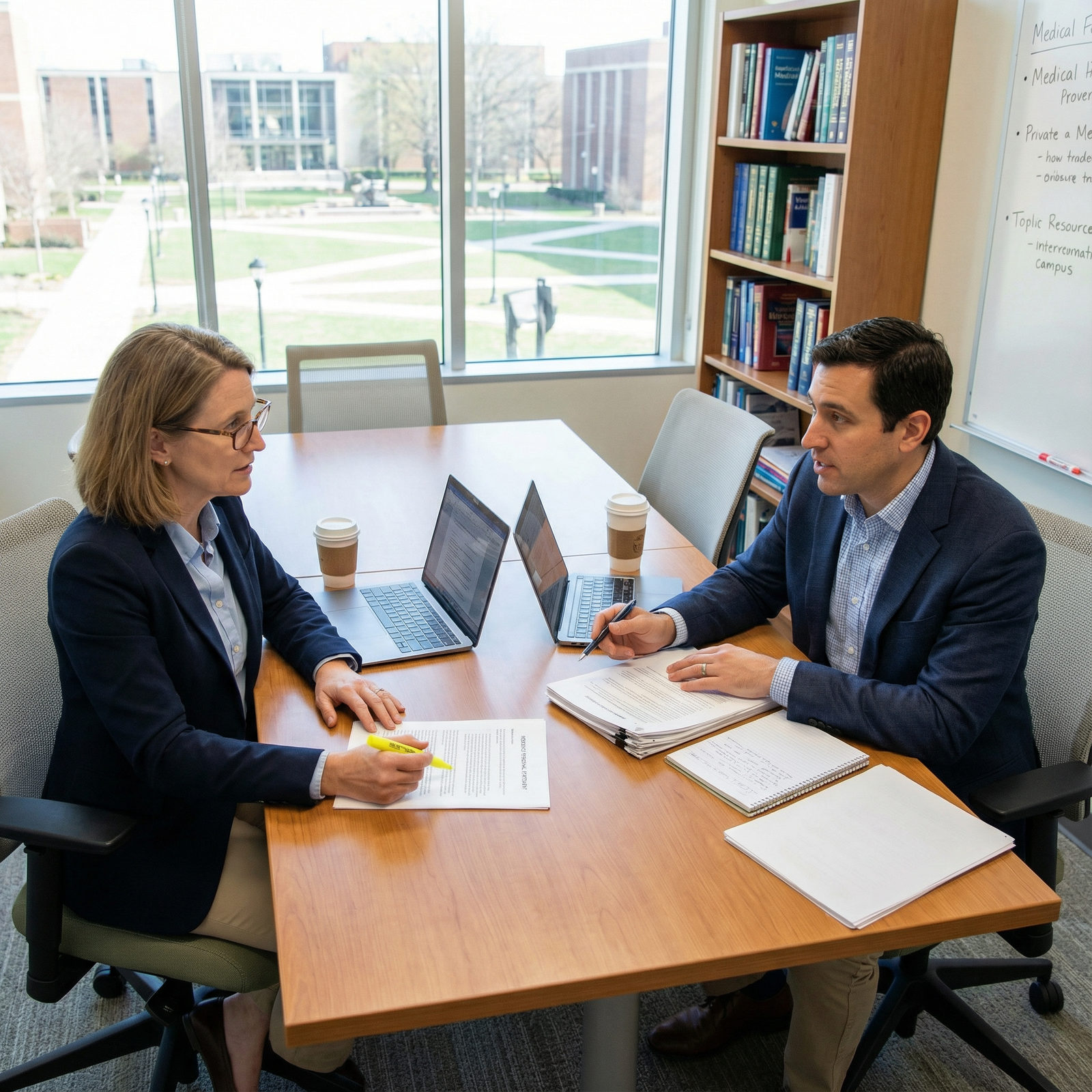
Framework 1: The Pattern You Noticed
Use this when your interest in the specialty grew from repeated experiences, not a single moment.
Structure:
- S1: Name a pattern in your clinical life that connects directly to the specialty.
- S2: Add a specific detail or example of that pattern.
- S3: Link it explicitly to your developing identity or motivation.
Example – Internal Medicine:
“The patients who stayed after rounds to ask ‘one more question’ always found their way to me. Whether it was a new diagnosis of heart failure or yet another admission for uncontrolled diabetes, I kept gravitating toward the long conversations about tradeoffs, goals, and fears. Over time, I realized that these complex, longitudinal relationships were where I felt most like the kind of physician I wanted to become—an internist.”
Why this works:
- Instant signal: this person is wired for longitudinal, complex care.
- Specific (long conversations, heart failure, diabetes) without melodrama.
- Sentence 3 points clearly to internal medicine and to a core theme: relationships over time.
Example – Psychiatry:
“On most rotations, I ended up being the one sitting at the bedside of the patient everyone else called ‘difficult.’ The more I listened, the less ‘difficult’ they seemed and the more the chart note of ‘non-compliant’ felt lazy. Those repeated encounters pulled me steadily toward psychiatry, where a patient’s story is not decoration but the central diagnostic tool.”
You see the pattern: repeated behavior → realization → specialty.
Framework 2: The Tension You Lived
Use this when your story involves a conflict: between two interests, two specialties, or your background and medicine.
Structure:
- S1: State the tension directly, without drama.
- S2: Ground it in a concrete situation or choice.
- S3: Hint at how this tension pushed you toward your specialty.
Example – Surgery vs Medicine tension:
“For much of third year, I felt split between the satisfaction of solving diagnostic puzzles and the urgency of fixing a problem with my hands. I loved morning medicine rounds, but I found myself replaying the brief moments in the OR long after I left the hospital. That persistent pull toward decisive, procedural care eventually made general surgery feel less like a risk and more like an honest admission of where I belong.”
No theatrics. Just a cognitive-emotional conflict stated plainly, then resolved toward a direction.
Example – Background tension (FM):
“I grew up in a town where most people met a doctor only when they were already very sick. During medical school, I kept noticing how often our plans ignored the realities of transportation, childcare, or health literacy that had shaped my own family’s choices. That tension between what we prescribed and what patients could realistically do is what led me to family medicine, where whole-person care and context are not peripheral—they are the work.”
Tension openings work very well for primary care, psychiatry, and any specialty where systems, identity, and context matter.
Framework 3: The Moment That Changed Your Understanding (Not Your Life)
Note the distinction: not “this moment changed my life and made me want to do medicine.” That story is usually premed-level. By the time you apply for residency, the “moment” should refine or clarify how you want to practice, not whether you want to be a doctor.
Structure:
- S1: Anchor in a specific clinical moment.
- S2: Show your internal cognitive shift, not just external drama.
- S3: Connect that shift to what you now seek in a specialty.
Example – Emergency Medicine:
“At 3 a.m., I watched my senior calmly manage a crashing GI bleed while simultaneously updating the family and coordinating with the ICU. I had expected emergency medicine to be mostly adrenaline and procedures; instead, I was struck by how much of that night was about triage, communication, and clear thinking under pressure. That shift in my understanding—from chaos to controlled systems thinking—is what drew me to emergency medicine.”
Notice: no graphic blood details, no “the smell of…”, no exploitation. The focus is on how your perception evolved.
Example – Anesthesiology:
“Before my anesthesia rotation, I thought of the OR as the surgeon’s domain. During one complex case, I watched my attending anticipate hemodynamic changes, adjust ventilator settings, and quietly guide the team through an unexpected complication. That was the first time I understood anesthesia as the art of managing physiology minute by minute, and I recognized a style of medicine that fit how I think—precise, vigilant, and quietly decisive.”
Again, the scene exists only to frame your shift in understanding.
Framework 4: The Through-Line From Your Past To This Specialty
Use this if you have a strong pre-medical or pre-clinical identity (engineering, teaching, global health, athletics) that genuinely continues in your specialty choice. Do not force this if the link is weak.
Structure:
- S1: Name the through-line (a recurring mode of thinking or doing).
- S2: Give a brief, concrete example from before or early in medical school.
- S3: Show how this same trait or interest finds its home in the specialty.
Example – Radiology, with an engineering background:
“I have always been drawn to hidden structures—whether that was debugging code as an undergraduate computer science major or mapping out circuitry by hand. During my radiology elective, that same satisfaction returned as I learned to trace subtle patterns on CT and MRI that explained a patient’s story. Radiology feels like a natural extension of how my mind works: solving complex problems by seeing what is underneath the surface.”
Example – Pediatrics, with a teaching background:
“For five years before medical school, I taught middle school science and spent my days translating complex ideas into language twelve-year-olds could actually use. On my pediatrics rotation, I recognized that same challenge in every family meeting and medication explanation. The continuity between teaching and pediatrics—meeting children and families exactly where they are—made the specialty feel less like a new identity and more like the right continuation of the old one.”
The key word there is continuity. You are not dumping your CV. You are showing a coherent line.
Breaking Down the Mechanics: Sentence-by-Sentence Control
Now let us strip this down surgically. You will write 3 sentences. Each has a job.
Sentence 1: The Anchor
This sentence answers: “Where are we starting, and what is the lens?”
It must be:
- Specific enough to be yours.
- Controlled enough to sound like a resident physician, not an undergrad essayist.
- Oriented toward your current professional self, not childhood.
Weak:
“Ever since I was a child, I have been fascinated by the human body.”
Better:
“I am most engaged as a clinician when I am trying to make sense of a complex, undifferentiated problem at 2 a.m. on call.”
Or:
“On nearly every rotation, I found myself seeking out the patients whose stories seemed hardest to fit into neat diagnostic boxes.”
You feel the difference. Anchored, adult, clinically oriented.
Sentence 2: The Clarifier
This should answer: “What does that say about who you are or how you work?”
It often:
- Adds one concrete detail.
- Names an internal process (thinking, noticing, questioning).
- Begins to imply a trait without bragging.
Example pair (IM):
S1: “On nearly every rotation, I found myself seeking out the patients whose stories seemed hardest to fit into neat diagnostic boxes.”
S2: “I liked hearing how their symptoms changed over months, what treatments they had already tried, and how their illnesses disrupted their daily routines.”
Now the reader knows: this person is drawn to complexity and longitudinal stories.
Sentence 3: The Direction Setter
This last sentence of the trio should hint clearly where this is going:
- Name the specialty, or
- Name the core value that aligns with the specialty, or
- Pose the central question that the rest of the essay will answer.
Weak:
“These experiences have shaped me into who I am today.”
Better:
“These conversations are what drew me toward internal medicine, where uncertainty is expected and understanding a patient’s life is essential to effective care.”
or
“They crystallized what I value most in psychiatry: taking time to understand how a patient’s history and environment shape their current illness.”
After sentence 3, the reader should not be wondering, “So what?” They should know the general direction: specialty + theme.
Specialty-Specific Hook Angles That Actually Work
Let me give you some starting angles per specialty. Not lines to copy. Angles.
| Specialty | Reliable Hook Angle |
|---|---|
| Internal Medicine | Complexity, longitudinal relationships |
| General Surgery | Decisive action, anatomy, procedural focus |
| Pediatrics | Communication with children/families, advocacy |
| Psychiatry | Stories, meaning, “difficult” patients |
| Family Medicine | Context, community, continuity |
| EM | Systems, triage, controlled chaos |
| Anesthesiology | Physiology, vigilance, teamwork in OR |
| Radiology | Pattern recognition, hidden structures |
Do not say, “I love anatomy, therefore surgery.” That is naive. Instead:
- Surgery: decisive moments, responsibility, long pre-op planning manifesting in a single critical period.
- EM: you think in algorithms under pressure, you enjoy rapid rapport with strangers, you are comfortable handing patients off rather than following them for years.
- FM: you keep noticing the gap between ideal care plans and real life, and you like closing that gap.
You are not trying to cram every trait into the opening. Pick one strong through-line to open with.
Common Hook Myths You Can Ignore
There is a lot of bad folklore around “hooks.” Let me clean up a few.
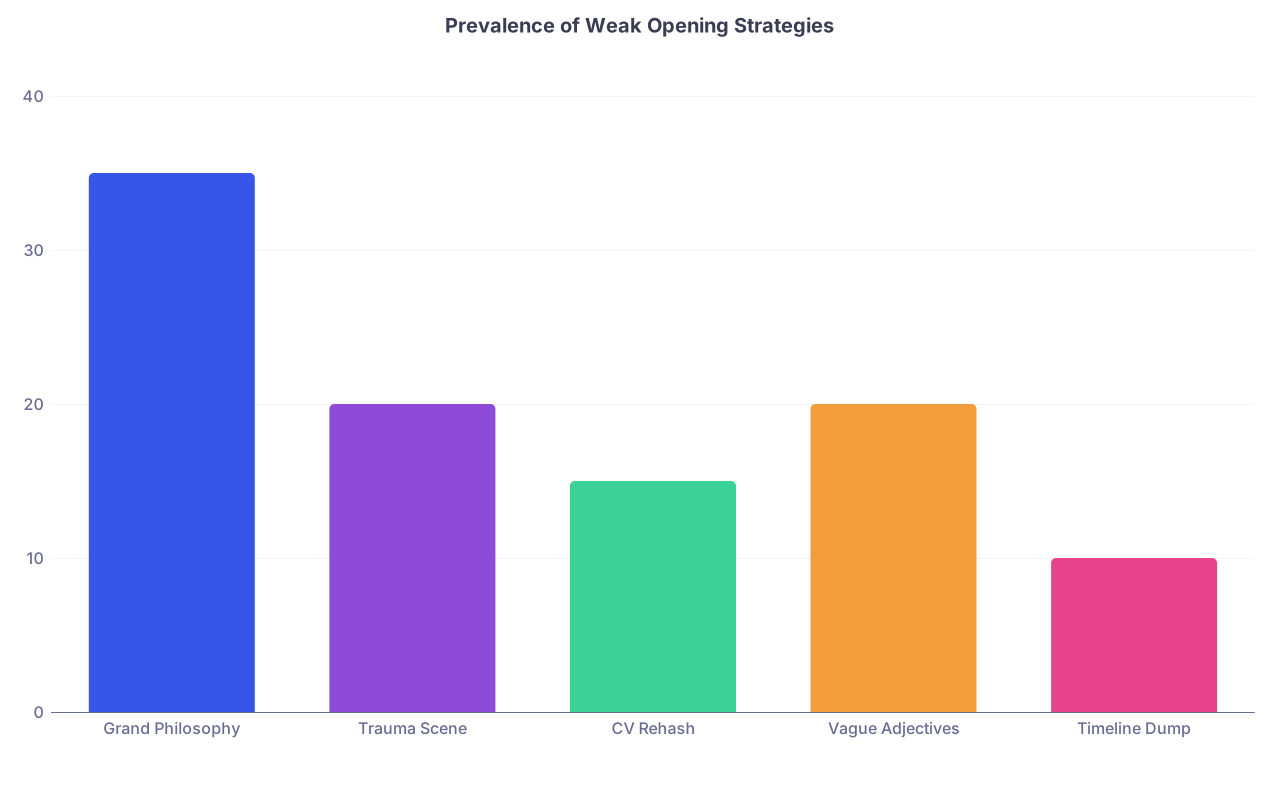
| Category | Value |
|---|---|
| Grand Philosophy | 35 |
| Trauma Scene | 20 |
| CV Rehash | 15 |
| Vague Adjectives | 20 |
| Timeline Dump | 10 |
Myth 1: You need a dramatic patient story to stand out
No. You need clarity and authenticity.
The 3.a.m. code, the dying child, the “patient who changed my life”—these are so overused that they now make you blend in. Unless the story is structurally central to your career trajectory (e.g., you are a cancer survivor applying in heme/onc), do not hinge your entire opening on high drama.
Myth 2: Hooks must be “creative” or “unique”
You are not being hired as a novelist. You are being evaluated as a future colleague. A clean, precise, straightforward opening that shows adult thinking is far more impressive than a forced metaphor about “journeys” and “paths.”
Creativity shows up in the way you observe and connect ideas, not in flowery language.
Myth 3: You must start with a quote
Absolutely not. Quoting Osler, Hippocrates, or your grandmother is one of the fastest ways to sound unoriginal. Use your limited space to say something only you can say, not something anyone can Google.
A Practical 30-Minute Exercise To Fix Your First 3 Sentences
Let us be concrete. Here is a process I have used with residents that actually works.

| Step | Description |
|---|---|
| Step 1 | Draft 10 First Sentences |
| Step 2 | Select 3 Strongest |
| Step 3 | Expand Each Into 3-Sentence Hooks |
| Step 4 | Get Outside Reader Reaction |
| Step 5 | Choose 1 Hook |
| Step 6 | Revise for Clarity and Tone |
Spend 10 minutes writing only first sentences.
No pressure, no editing. Aim for 8–10 different options using the frameworks above. For example:- “I am most at ease as a clinician when I am sitting at the edge of a hospital bed, trying to untangle a long and messy story.”
- “I tend to remember the patients whose psychiatric diagnoses do not explain everything in the chart.”
Circle the 2–3 that feel most honest and most directly related to your specialty.
Not the most “impressive.” The most accurate.For each of those, add sentence 2 and 3 following the Anchor–Clarifier–Direction pattern.
You now have 2–3 different 3-sentence hooks.Give just those 3-sentence openings to a trusted reader (resident, attending, or mentor).
Ask them one question: “Which one makes you most interested in reading the rest?” Do not debate. Take the answer.Pick one and clean up the language.
Remove clichés. Cut any unnecessary adjectives. Replace abstract words with concrete ones where possible.
You are done with the hardest part of the statement. Now the body just has to align with the opening you have already chosen.
A Few Before-and-After Examples
Let me show you how small changes in the first 3 sentences completely change the impression.
Example 1 – Psychiatry
Weak version:
“Psychiatry is a field that has always interested me. I have a passion for understanding people and helping them through their struggles. I believe that my empathy and dedication make me well suited for this specialty.”
Stripped of specifics. Reads like a template someone sent to all their friends.
Stronger version:
“Throughout medical school, I kept gravitating toward patients whose behavior others described as ‘difficult.’ I found myself wondering what had happened to them long before they arrived on our service and how their stories explained the inconsistencies in the chart. That curiosity about the layers beneath a diagnosis is what ultimately drew me to psychiatry.”
Same person. Totally different perceived maturity and fit.
Example 2 – Emergency Medicine
Weak version:
“The emergency department is a fast-paced and exciting environment that has shown me the importance of teamwork and quick thinking. From traumas to cardiac arrests, I have seen how emergency medicine can save lives. I am excited to pursue a career in this dynamic field.”
This could be copied from a brochure.
Stronger version:
“On my first ED shift, I was surprised by how much time my senior spent deciding what not to do. Watching her constantly reprioritize which labs, imaging, and consults were actually necessary shifted my view of emergency medicine from pure adrenaline to disciplined triage. I am drawn to a specialty where clear thinking under pressure and efficient decision making are the core skills.”
Notice again: not dramatic, just thoughtful.
Tone, Risk, And Where To Draw The Line
You are applying to be a physician in training, not auditioning for TEDx. Some applicants overcorrect and try so hard to “stand out” that they end up sounding flippant or inappropriate.
Quick rules for the opening:
- Do not use humor that punches down (patients, colleagues) or could be misread in text.
- Do not swear. Ever.
- Do not overshare personal mental health or trauma details in sentence 1–3 unless they are central to your career path and handled with clinical-level restraint.
- Do not negging-talk your prior specialties (“I hated surgery because…”) to prop up your choice.
Professional voice does not mean robotic. It means measured. You can say, “I felt frustrated when…” or “I was unsettled by…” That is human. You just avoid melodramatic extremes.
Bringing It All Together
By now, you should see the pattern:
- Weak openings are vague, dramatic in the wrong way, or generic enough to belong to thousands of applicants.
- Strong openings are specific, controlled, and clearly pointed at your chosen specialty and identity as a clinician.
One last visual to keep in your head:
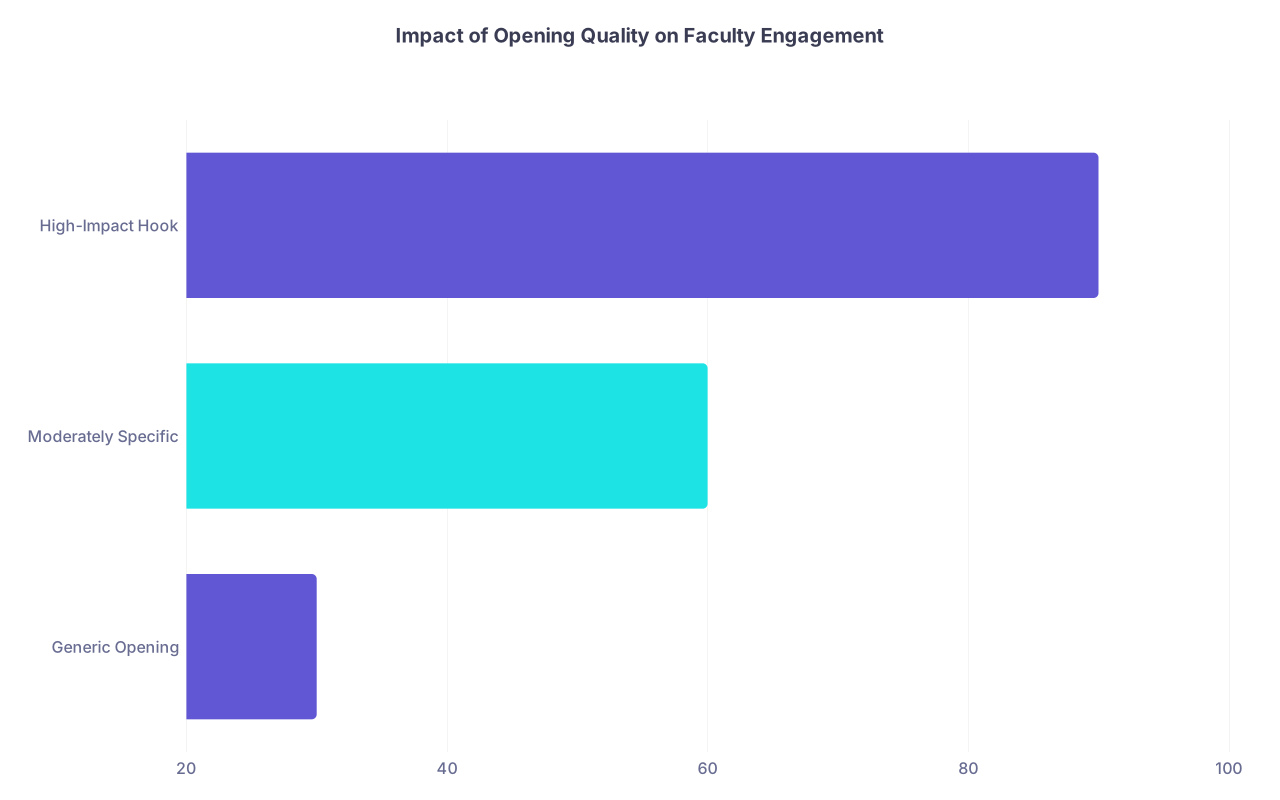
| Category | Value |
|---|---|
| Generic Opening | 30 |
| Moderately Specific | 60 |
| High-Impact Hook | 90 |
You do not need the perfect hook. You need an opening that gets you into the “high-impact” range where faculty actually read your second and third paragraphs with interest instead of obligation.
If you invest serious time anywhere in your personal statement, it should be here, in these first 3 sentences. Write them. Rewrite them. Test them on people who will be honest with you. The rest of the essay will feel dramatically easier once the opening is solid, because you know exactly what story you are telling.
With a clear, high-impact hook, you have earned the reader’s attention. Next comes the harder part: building a middle and closing that prove you are the resident they want on their team. That is the next step in your application strategy—and a conversation for another day.