It is 11:37 p.m. Your ERAS application is basically done. Letters uploaded. Programs selected. Your personal statement has been “final” for three days—until you re-read it just now and realized something awful:
Nothing is technically wrong.
But the prose is flabby. Vague. Overwritten.
This is where most people hit “submit” and hope for the best.
You are not doing that. You are here, wondering what to do at the word and sentence level to make this thing actually sharp. Not “fine.” Not “good enough.” Tight.
Let me walk you through the micro-edit. This is the stage almost nobody teaches, and it is exactly where mediocre statements become strong ones without changing a single story or paragraph.
1. The Micro-Edit Mindset: What You Are Actually Doing
Macro-editing is structure: which stories, what order, what message.
Micro-editing is surgery:
One word. One clause. One verb at a time.
You are not rewriting your life. You are:
- Removing dead weight
- Swapping weak words for precise ones
- Fixing rhythm and emphasis
- Cutting anything that sounds like every other applicant
If macro-editing is your attending walking you through the whole case, micro-editing is you suturing skin so cleanly that no one sees the scar.
The good news: this is teachable and very repeatable.
The bad news: it requires ruthless attention to small things that your brain wants to skip.
You are going to slow down and look anyway.
2. Step Zero: Freeze the Structure Before You Cut
Before you start changing words, lock the structure. If you are still moving paragraphs around, do that first and stop reading this.
Once the narrative arc works (intro hook → 2–3 focused experiences → specialty fit → forward-looking close), then and only then:
- Save a duplicate:
PS_InternalMed_FINAL→PS_InternalMed_FINAL_MICRO - Commit: you will not add new stories, only refine language
Now your job is not “How do I say more?”
Your job is “How do I say the same thing with more precision and power?”
3. The Big Five Word-Level Problems (And How To Fix Them)
These are the five patterns that destroy clarity and make programs’ eyes glaze over.
3.1 Weak Verbs and Zombie Nouns
Classic offender: turning strong verbs into nouns plus weak verbs.
Example from an actual draft I saw:
“I was able to make a contribution to the improvement of patient education.”
Problems:
- “was able to” = filler
- “make a contribution to” = vague
- “improvement of” = noun-ified verb
- “patient education” = fine, but buried in fluff
Micro-edit:
“I improved patient education.”
Even better if you can be slightly more specific:
“I improved patient education by rewriting our discharge instructions in plain language.”
Rule: Prefer one precise verb over a scaffolding of helper verbs + nouns.
Common zombie noun patterns to hunt:
- “make a decision” → “decide”
- “provide care” → “treat,” “care for”
- “have an impact on” → “improve,” “change”
- “give support to” → “support,” “advocate for”
- “gain experience in” → “learn,” “practice,” “train in”
Do a search for these phrases. Replace them.
3.2 The “I Was Able To / I Had The Opportunity To” Problem
Screeners hate this construction. It is bloated and defensive. You sound like you are apologizing for existing.
Original:
“I had the opportunity to rotate in the MICU, where I was able to see critically ill patients.”
Micro-edit:
“On my MICU rotation, I treated critically ill patients.”
Tighter. More direct. More ownership.
Search for:
- “I was able to”
- “I had the opportunity to”
- “I got to”
- “I had the chance to”
Replace with:
- Simple past verb: “I led,” “I worked,” “I learned”
- Or restructure the sentence without centering yourself as a passive recipient of an “opportunity”
3.3 Adverb Creep (“Really,” “Very,” “Deeply,” “Truly”)
Overuse of intensifiers makes you sound like you are padding weak sentences.
“I was very excited to work with this patient and really wanted to help her.”
Micro-edit:
“I was eager to help this patient.”
“Excited,” “deeply honored,” “truly grateful,” “incredibly humbled”—once or twice, fine. Eight times in 650 words? No.
Go through and delete every “very,” “really,” and “extremely”. If the sentence still works, keep it. If it collapses, you needed a better verb or noun in the first place.
3.4 Vague Abstractions (Growth, Passion, Journey, Field)
Residency directors roll their eyes at this cluster: “passion,” “journey,” “calling,” “growth,” “skillset,” “the field,” “rewarding,” “challenging.”
They are not banned. But they are lazy if unsupported.
Vague:
“This experience was very rewarding and allowed me to grow both personally and professionally.”
That sentence means nothing. You could paste it into any applicant’s statement, any specialty.
Micro-edit tactic:
- Ask: How, specifically, did I grow? What changed in my behavior or thinking?
- Replace “rewarding” with a concrete outcome.
Revised:
“After repeatedly fumbling medication reconciliations, I started pre-rounding earlier and building my own checklist. By the end of the month, I was the intern the team relied on for accurate med lists.”
No “growth” or “rewarding.” But the growth is obvious.
3.5 Flabby Openings and Throat-Clearing
The first clause of too many sentences is pure filler.
- “I think that…”
- “I believe that…”
- “In my opinion…”
- “For me personally…”
- “In many ways…”
Example:
“I believe that internal medicine is a field that will allow me to combine my passion for physiology with my desire to form longitudinal patient relationships.”
Cut the throat. Say the thing.
“Internal medicine lets me combine physiology with longitudinal patient relationships.”
You gain confidence and brevity in one cut.
4. A Concrete Workflow: How To Run a Micro-Edit Pass
This is usually where people get lost. They know in theory they should tighten prose, but they just stare at the paragraphs.
Let’s make it mechanical.

| Step | Description |
|---|---|
| Step 1 | Lock structure |
| Step 2 | Print or open side-by-side |
| Step 3 | First pass: cuts |
| Step 4 | Second pass: verbs & nouns |
| Step 5 | Third pass: rhythm & emphasis |
| Step 6 | Final pass: specialty alignment |
4.1 First Pass: Pure Cutting
Your only question: “Can I remove this word / phrase / sentence without losing meaning?”
Targets:
- Doubling: “each and every,” “future career,” “end result”
- Redundant sentences that re-explain the same idea
- Repeated phrases: “I learned,” “I realized,” “this experience taught me” 5 times in a row
Tactics:
- Read paragraph out loud. When you get bored halfway through a sentence, it is too long.
- See if two adjacent sentences can be merged or one deleted entirely.
Example:
“This experience taught me the importance of communication. I realized that listening carefully to patients is essential in building trust.”
Micro-edit:
“This experience showed me that careful listening builds patient trust.”
One sentence. Cleaner.
4.2 Second Pass: Verbs and Nouns
Now you specifically hunt:
- “was,” “were,” “is,” “are” paired with noun phrases that could be verbs
- “did,” “made,” “had” where a sharper verb exists
Example:
“I was responsible for the management of patients admitted with DKA.”
Micro-edit:
“I managed patients admitted with DKA.”
Ask yourself sentence by sentence: can I sharpen the verb or noun without exaggerating responsibility? You still need to be honest about your role.
4.3 Third Pass: Rhythm and Emphasis
This is the part almost nobody does, and it is exactly where your writing starts to sound like a person instead of a committee.
You want a mix of:
- Short, decisive sentences for impact
- Longer, more complex sentences for nuance
Bad pattern: every sentence 25–30 words, similar structure: “I did X. I then did Y. This experience taught me Z.”
Fix:
- Use one short sentence to punctuate an important realization.
- Vary openings: not every sentence needs to start with “I.”
Original chunk:
“I presented the patient on rounds the next morning. I was nervous because it was my first time presenting on a complex patient with multiple comorbidities. I went through each part of the presentation carefully and received positive feedback from my attending.”
Micro-edit:
“The next morning, I presented her on rounds. It was my first complex patient with multiple comorbidities, and I was nervous. I walked the team systematically through her history, exam, and evolving labs. My attending’s feedback was simple: ‘You knew her better than anyone else on the team.’”
You get variation. You get a quote. You get emphasis.
If you want a quick rhythm check: read the paragraph out loud. Any sentence where you have to breathe twice means it is probably too long.
4.4 Fourth Pass: Specialty Alignment Language
Last micro-pass: check that your word choices actually sound like someone who knows what this specialty values.
You do not need heavy jargon. But you should not sound generic.
Some examples:
| Specialty | Vague Phrase | Tighter, Aligned Phrase |
|---|---|---|
| Internal Med | complex cases | diagnostic uncertainty, multimorbidity |
| EM | fast-paced environment | rapid triage, time-critical decisions |
| Surgery | hands-on work | operative decision-making, precision |
| Psych | mental health issues | mood disorders, psychosis, trauma |
| Peds | kids | children and their families, caregivers |
You are not showing off. You are showing you actually spent time in the specialty and speak in its terms.
5. Before-and-After Micro-Edits: Realistic Examples
Let us get very specific. I will walk you through typical internal medicine–style sentences that I see and how I would micro-edit them.
5.1 Example 1: Overwritten Motivation
Original:
“I have always had a passion for internal medicine because it is a field that allows for both complex diagnostic reasoning and the formation of meaningful long-term relationships with patients.”
Analysis:
- “have always had a passion” = cliché and probably untrue
- “is a field that allows for” = bloated structure
- “meaningful long-term relationships” = vague
Micro-edit:
“Internal medicine combines complex diagnostic reasoning with long-term relationships.”
If you want one level more personal:
“Internal medicine combines the diagnostic puzzles I enjoy with long-term relationships that keep me accountable to my patients over years, not days.”
5.2 Example 2: Experience + Lesson Blob
Original:
“During my third-year rotation on the general medicine ward, I had the opportunity to care for a patient with decompensated cirrhosis who taught me the importance of multidisciplinary collaboration and listening closely to patients’ goals of care.”
Problems:
- “During my third-year rotation on the general medicine ward” – long wind-up
- “had the opportunity to care for” – bloated
- “who taught me the importance of” – cliché construction
- Two lessons smashed into one clause
Micro-edit:
“On my third-year medicine rotation, I cared for a patient with decompensated cirrhosis. Managing his ascites, encephalopathy, and frequent admissions pushed me to coordinate closely with hepatology, social work, and palliative care. Only when I finally asked what he wanted from the time he had left did we stop cycling him through the ED and start honoring his goals.”
We turned one overstuffed sentence into three, cut dead phrases, and made the “lesson” visible rather than announced.
5.3 Example 3: Closing Paragraph Bloat
Original:
“In conclusion, my experiences throughout medical school have solidified my desire to pursue a residency in internal medicine, where I hope to continue growing as a clinician, educator, and advocate for my patients. I am excited for the opportunity to join a program that will challenge me clinically and academically and allow me to contribute to the field.”
Common problems:
- “In conclusion” – completely unnecessary in a 650-word statement
- “have solidified my desire to pursue” – 6 words to say “confirmed”
- “I hope to continue growing” – fluff
- “program that will challenge me clinically and academically” – everyone writes this
- “contribute to the field” – empty phrase
Micro-edit:
“My experiences have confirmed that I want to train in internal medicine. I am ready for a residency that will push me clinically and give me the tools to teach, question my own assumptions, and advocate for patients beyond the walls of the hospital.”
Shorter. Clearer. More specific about what “challenge” actually means.
6. Common Micro-Edit Targets: A Practical Checklist
If you like checklists, here is your pre-submission micro-edit list. Use it.
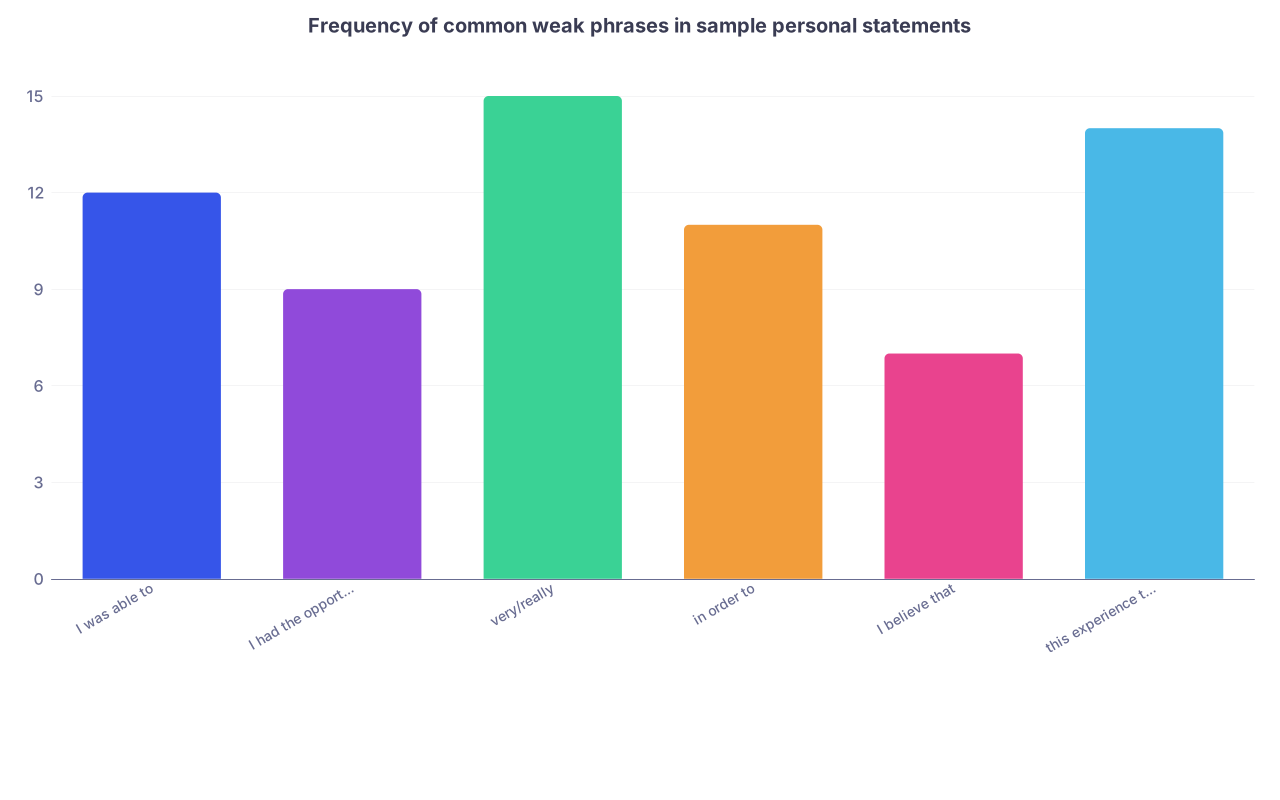
| Category | Value |
|---|---|
| I was able to | 12 |
| I had the opportunity to | 9 |
| very/really | 15 |
| in order to | 11 |
| I believe that | 7 |
| this experience taught me | 14 |
6.1 Search-And-Destroy Phrases
Use your word processor’s search function. Replace or delete.
Look for:
- “I was able to”
- “I had the opportunity to”
- “I got to”
- “I had the chance to”
- “very,” “really,” “extremely”
- “in order to” (almost always can be “to”)
- “I believe that,” “I think that”
- “for me personally”
- “this experience taught me”
- “I learned that”
- “it made me realize”
- “in many ways”
You do not need to remove every single one, but if you still have more than one or two of each after editing, you have not been strict enough.
6.2 Overused Content Words
Scan your paragraphs and see how many times you use:
- “passion”
- “journey”
- “rewarding”
- “challenging”
- “calling”
- “growth”
- “teamwork”
- “communication”
- “resilience”
- “empathy”
You can keep the concept, but try to express it with concrete behaviors rather than the label:
Instead of “This required resilience,” you can write,
“I rewrote my note three times based on my attending’s feedback and asked the senior for examples until my assessment was clear.”
6.3 Overuse of “I”
Yes, the statement is about you. No, every sentence does not need to start with “I.”
Original paragraph:
“I am interested in psychiatry because I have always enjoyed hearing patients’ stories. I realized this during my clinical rotation when I spent extra time talking with patients. I found that I was drawn to understanding the underlying factors that shaped their experiences. I want to use this perspective to help patients manage their mental health.”
Almost every sentence begins the same way, which flattens the voice.
Micro-edit:
“Psychiatry appeals to me because I enjoy hearing patients’ stories. On my psychiatry rotation, I often stayed after rounds to understand the social and developmental threads in their histories. I found myself asking not just what symptoms they had, but how those symptoms fit into the rest of their lives. I want to use that perspective to help patients manage their mental health over time.”
You still have “I,” but with variation in position and sentence structure, it stops sounding like a list.
7. Precision Without Arrogance: Tight Language That Still Sounds Like You
There is a real risk here: over-editing into robotic, sterile prose.
The goal is clean, precise, human. Not “Step 2 question stem.”
A few guardrails:
7.1 Keep One or Two Quirks
If you have a sentence that sounds exactly like you speak—and it is clear and not cliché—keep it.
Example:
“I still remember the exact look my senior resident gave me when I suggested that we call the patient’s daughter before discharging him: half surprised, half relieved.”
That is voice. Keep that.
7.2 Avoid Unnecessary Jargon
Yes, some specialty language is good. But first-pass readers often are coordinators or faculty from other fields.
Bad:
“I am particularly drawn to the management of septic shock with early goal-directed therapy and nuanced vasopressor titration.”
Better in a personal statement:
“I am drawn to caring for critically ill patients, where small changes in management—fluids, vasopressors, careful reassessment—can mean the difference between intubation and walking out of the ICU.”
Shows understanding without trying to prove you memorized the Surviving Sepsis guidelines.
7.3 Read It Out Loud To Someone Who Has No Idea What “Micro-Edit” Means
If they say, “It sounds like you,” and a resident or faculty member says, “It is clean and not bloated,” you hit the balance.
If they say, “This sounds like ChatGPT,” you over-edited or over-genericized. Go back and re-insert one or two concrete details, small moments, or specific quotes that only you would write.
8. A Quick Before/After: Full Paragraph Transformation
Let me show you what a full micro-edit pass can do to one paragraph.
Original:
“During my third-year surgery rotation, I had the opportunity to work with a patient who had been diagnosed with colon cancer. This was a very challenging experience for me because it was the first time I had followed a patient from pre-operative counseling through post-operative care, and it taught me the importance of empathy and clear communication during difficult moments. I realized that being able to support patients through these transitions is one of the most rewarding aspects of medicine.”
After a disciplined micro-edit:
“On my third-year surgery rotation, I followed a patient with newly diagnosed colon cancer from pre-op counseling through recovery. Sitting with him and his wife the night before surgery, I stumbled through explanations until my attending stepped in and showed me how to be honest without being blunt. The next morning, when I updated them after the case, I understood how much calm, specific language matters in the middle of fear. Supporting patients through those transitions is still one of the parts of medicine I value most.”
Same story. Same function.
Less abstraction, less padding, more concrete language and rhythm.
9. When To Stop Editing
You can absolutely micro-edit this to death.
Here is the rule of thumb I use when I review statements:
- If edits are still cutting 1–3 words at a time and consistently tightening → keep going.
- When edits start swapping one equally good synonym for another purely on “vibe” → stop.
- If clarity starts decreasing or the voice starts sounding less like an actual human → roll back to the previous version.
A good endpoint check:
- No sentence is confusing on first read.
- No sentence feels obviously too long when read out loud.
- You can point to at least 2–3 places where concrete wording would not be true for every other applicant.
- You are not embarrassed by any cliché phrases you know everyone else will also use.
At that point, close the document. Send it. Go do literally anything else.
You have done the work that 80–90% of applicants skip.
FAQ (Exactly 6)
1. How long should I spend on micro-editing my personal statement?
For a typical 650–750 word residency personal statement, two focused micro-edit sessions of 45–60 minutes each are usually enough. If you are still making major cuts after the second session, your macro-structure may still be off. Do not drag this out for weeks. Past a certain point, the return on investment drops sharply.
2. Is it okay to use tools like Grammarly or other grammar checkers?
As a first pass for catching obvious grammar slips or missing commas, fine. But those tools are terrible at nuance and voice in this context. They tend to recommend longer, more pompous phrases and passive constructions. Use them to spot typos, not to rewrite your sentences. If the suggestion makes your sentence longer or fuzzier, reject it.
3. How do I avoid making my statement sound generic after tightening the language?
Keep the specifics. Micro-editing should remove fluff, not detail. If you cut story-specific details (like the kind of patient, the actual conflict, your specific mistake or growth), you drift toward generic. Whenever you remove an abstract phrase like “growth” or “rewarding,” try to replace it with a concrete behavior or moment from your own experience.
4. Can I use contractions in a residency personal statement?
Yes, within reason. A few well-placed contractions (“I’m,” “don’t,” “can’t”) help your writing sound like a real person and not a policy document. If every sentence is packed with contractions and slang, you look casual. If there are none, you can sound stiff. A middle path is best: use them where they make the sentence flow naturally.
5. How do I get feedback on word-level edits without ending up with five conflicting versions?
First, finish your own micro-edit pass. Then pick one or two people whose writing judgment you trust: ideally a resident and maybe a faculty member or advisor. Explicitly ask for “clarity and concision” feedback, not story-level rewrites. If different reviewers disagree on phrasing and both options are fine, choose the one that sounds more like you and move on. Do not committee-ize your voice.
6. Should I write different micro-edited versions for every program?
No. Your core personal statement should be stable. Program-specific customization belongs in supplemental questions or secondary essays, not in a completely different micro-edited statement for each place. What you should do is make sure your main statement’s language clearly aligns with your chosen specialty and is tight enough that you are not embarrassed to have it represent you everywhere. Then leave it alone.
You are at the point now where small changes matter more than big ones. The stories you chose are the bones. The micro-edit is the fascia and the suturing—what people actually see when they skim.
Once you have tightened this statement, you are ready for the next stage: translating those same clear, precise stories and word choices into how you speak on interview day. But that is its own skill set, and its own long night at the desk.