Most residency personal statements ruin good advocacy and leadership stories by turning them into brag sheets.
Let me walk you through how to avoid that—specifically, concretely, and in a way that actually impresses program directors instead of making them roll their eyes.
You are not being penalized for doing impressive things. You are penalized for talking about them badly. There is a difference.
The Core Problem: Advocacy ≠ “Hero Narrative”
Residents reading applications (and yes, many residents screen your file before the PD ever sees it) are hypersensitive to one thing: the “I single-handedly saved the system” tone.
The pattern is disturbingly consistent:
- “I noticed a problem…”
- “No one else was doing anything…”
- “So I took the initiative…”
- “This experience taught me the importance of leadership…”
On paper it sounds fine. In reality, it reads like: I am the main character. Everyone else is scenery.
The issue is not that you led a clinic, started a curriculum, or lobbied for policy change. The issue is how you frame:
- Whose problem was this?
- Who benefited?
- How many people were involved?
- What changed—not for your ego, but for actual humans?
If your advocacy and leadership stories center more on your virtue than your impact, you sound self-congratulatory. And programs are tired of that.
So we fix it at the level of structure and language.
Step 1: Diagnose When You Sound Self-Congratulatory
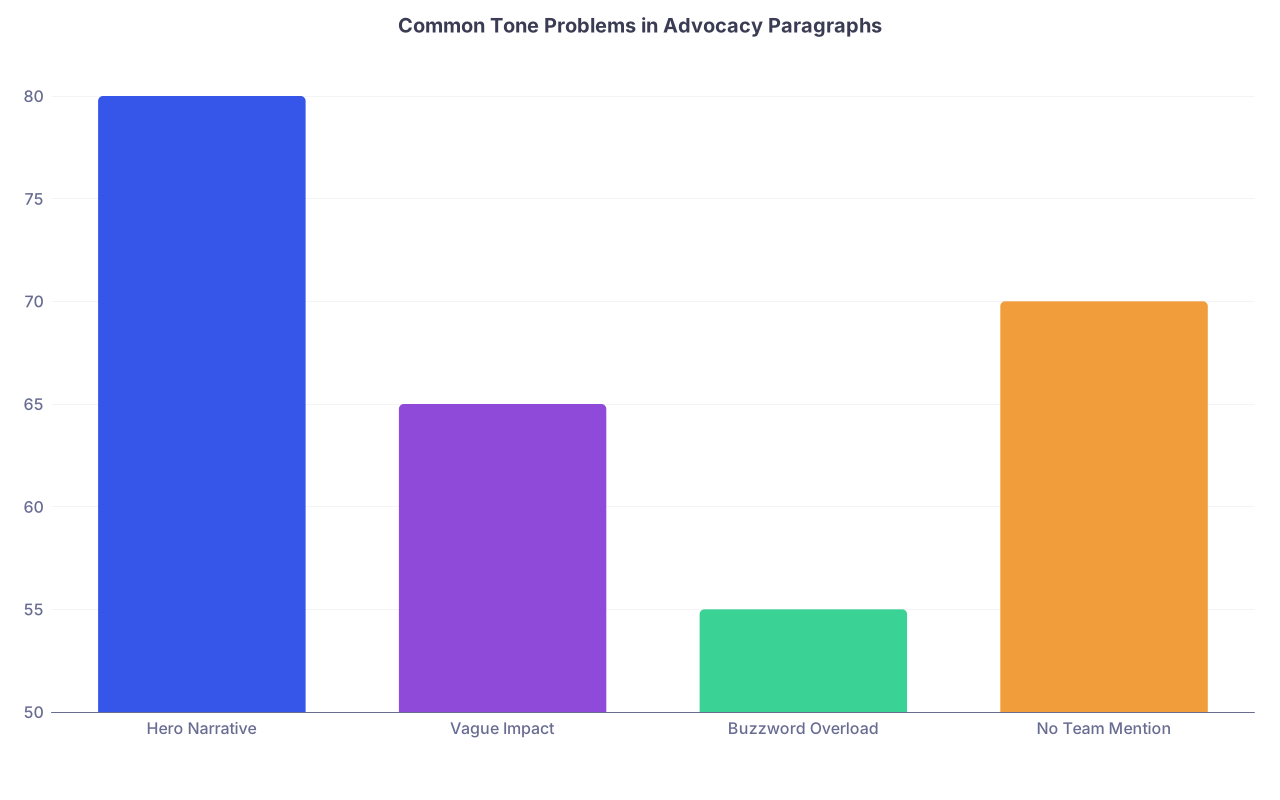
| Category | Value |
|---|---|
| Hero Narrative | 80 |
| Vague Impact | 65 |
| Buzzword Overload | 55 |
| No Team Mention | 70 |
Look at your draft and be ruthless. If you see these patterns, you are in trouble.
1. You are always the subject of the sentence
“I led… I organized… I implemented… I designed… I created…”
Grammatically fine. Tonally obnoxious when every line starts with “I” plus a strong verb. Real leadership writing gets comfortable with:
- Passive structures used sparingly, when the process matters more than the hero
- Sentences where the subject is the team, the patients, the outcome, or the system
Compare:
- Self-congratulatory: “I designed and implemented a new intake workflow that reduced waiting times.”
- Stronger: “Waiting times dropped from three hours to ninety minutes after the team adopted a new intake workflow we piloted in our student-run clinic.”
You are still in the story. But you are not the only person in the room.
2. Your “impact” is vague and emotional
Watch for phrases like:
- “This experience changed my life.”
- “I realized the importance of advocacy.”
- “It showed me the power of leadership.”
Those lines are content-free. They do not distinguish you from the 2,000 other applicants who used the same sentence.
Replace them with:
- Concrete numbers (patients reached, policies changed, attendance improved)
- Behavior changes (what you started doing differently after the experience)
- System changes (what is different now at that clinic/program/organization)
3. You “discover” problems patients already knew about
Programs are allergic to the “I, a medical student, suddenly realized poverty exists” narrative. If your advocacy story sounds like you just discovered structural racism during third-year, it can come off as naive at best, self-centered at worst.
You avoid this by:
- Centering patient/community voices, not just your epiphany
- Acknowledging that you learned from people already doing the work
- Showing continuity—how you moved from awareness to action to sustained involvement
4. Your leadership = holding a title
This one is common. You write:
“As president of the Internal Medicine Interest Group, I…”
Then spend 3 sentences describing things any president would do minimally to not be removed from the position: organizing talks, sending emails, scheduling events.
Titles are cheap. Initiative is not. Program directors know this.
Talk less about titles and more about:
- What changed under your leadership
- What problem you actually solved
- What you did that was optional, not required
Step 2: Center the Work, Not Your Virtue
Good advocacy and leadership writing obeys one principle: the work comes first, your role comes second.
You are not writing a movie pitch where you are the protagonist. You are documenting:
- A setting (clinic, community, hospital committee, policy setting)
- A problem (access, inequity, workflow, education gap)
- An intervention (what was tried, built, changed)
- An outcome (what happened, even if imperfect)
- Your reflection (what you learned, how it shaped your approach as a future resident)
Put those in that order. Your ego automatically gets dialed down.
Example: Bad vs Better vs Strong
Let me get very specific.
Version 1 – Self-congratulatory
As leader of the student-run free clinic, I dramatically improved our care delivery. I noticed that many patients were experiencing long wait times, so I took the initiative to completely revamp our triage system. I created new roles, trained our team, and as a result, patient satisfaction soared. This experience taught me the importance of leadership and confirmed my passion for advocating for underserved patients.
Problems:
- “Dramatically,” “completely,” “soared” – all unsubstantiated.
- Everything is “I”. The rest of the team is invisible.
- Reflection is generic and self-focused.
Version 2 – Better, still a bit generic
At our student-run free clinic, patients routinely waited over three hours for a ten-minute visit. As part of the leadership team, I proposed a structured triage system that matched students’ experience levels with patient complexity. Over several weeks, I worked with our volunteers and faculty advisor to pilot the new workflow. Average waiting time decreased to ninety minutes, and volunteers reported feeling more confident in their roles. The process showed me that meaningful advocacy often starts with small, unglamorous changes in how care is delivered.
Better:
- Begins with patient experience, not “I”.
- Uses numbers.
- Acknowledges team and advisor.
- Reflection is more specific.
Version 3 – Strong, residency-ready
Our student-run free clinic served patients who had already waited months for an appointment, only to spend another three hours in the waiting room. Watching a patient with uncontrolled diabetes leave before being seen because she had to get back to her job pushed our leadership team to rethink how we used each volunteer’s time. I mapped out our existing workflow and realized that every patient was being “seen” three times before reaching the attending. Working with two classmates and our faculty advisor, we consolidated the initial steps into a single, focused intake led by more senior students. Over the next six weeks, median waiting time dropped to ninety minutes. More importantly, no-show rates at follow-up visits decreased, and patients started telling us they could now come without risking their jobs.
That experience changed how I think about advocacy. It is not always a new program or a public campaign. Sometimes it is the quiet, iterative work of redesigning a process so patients do not have to choose between health and employment. As a resident, I want to be the person in the team who keeps asking, “Whose time are we valuing with this system?”
Notice what this does:
- Patients’ problem leads. Not your glory.
- Your role is clear but not performative.
- Outcomes are patient-centered.
- Reflection ties to future behavior, not abstract “passion.”
That is the template you want.
Step 3: Swap Ego Language for Impact Language
You do not fix tone by simply deleting “I.” You fix it by swapping self-focused language for impact-focused language.
Here is a translation grid you can actually use while editing.
| Self-Focused Phrase | Impact-Focused Alternative |
|---|---|
| I am proud to say | Since then, the clinic/program/initiative has |
| I was honored to | I was asked to |
| I single-handedly | Working with X / In a small team of Y |
| I transformed | Wait times/rates/policies changed by… |
| This showed my commitment to | This led to sustained changes in… |
| I realized the importance of | I began doing X differently, which resulted in… |
| My leadership resulted in | The team’s work resulted in |
You are still central. You are just not performing virtue. You are describing work.
Step 4: Write About Advocacy Without Romanticizing Yourself
The phrase “advocacy” has been abused. It appears everywhere: “advocating for my patients,” “advocating for my peers,” “advocating for change.” Most of it is hand-waving.
Your job is to show advocacy as a series of concrete actions, not an identity you claim.
Build your advocacy story with four anchors
When you write an advocacy paragraph for your personal statement, make yourself answer these, on paper:
- Problem – What specific barrier or harm were people experiencing?
- Stakeholders – Who was already affected / involved before you showed up?
- Action – What exactly did you do? Meetings, emails, data, drafts, presentations, follow-up.
- Result / Ongoing work – What is different now, even if partially?
Now look at a common weak advocacy paragraph and how you would fix it.
Weak version
My passion for advocacy led me to work on improving language access at our hospital. Many of our patients struggled to understand their care. I advocated for more interpreter services by speaking with administrators and highlighting the issue. Now I understand the importance of system-level change and hope to continue advocating for my patients as a resident.
Check it against the four anchors:
- Problem: vague (“struggled to understand their care”)
- Stakeholders: none named
- Action: “spoke with administrators” – that is it?
- Result: none
Rewritten version
During my third-year rotation on general medicine, I repeatedly watched Spanish-speaking patients wait hours for an interpreter or try to piece together discharge instructions through a bilingual family member. One woman with heart failure nodded politely during teaching, then whispered to her daughter in Spanish, “I still do not know which pills are morning and which are night.”
I started tracking how often our team used the formal interpreter line and how long patients waited. Over two weeks, half of our Spanish-speaking patients were discharged without a documented interpreter encounter. I brought that data, and two anonymized patient stories, to our unit’s nursing huddle and then to our clerkship director. Together with a bilingual charge nurse, I helped create a simple checklist embedded into our discharge note template: “mode of communication” became a required field, with interpreter ID if used.
Three months later, audit data from the same unit showed interpreter use documented for 82% of Spanish-speaking patients being discharged. It is a small step, and far from solving language inequity, but it taught me what advocacy actually feels like: slow, uncomfortable, and grounded in other people’s stories, not my own.
Now you actually sound like someone who understands advocacy instead of someone who used the word a lot.
Step 5: Writing About Leadership Without Inflating Yourself
Leadership is another landmine. Many applicants think leadership = position. Residency programs know leadership = how you behave when things are ambiguous, messy, or failing.
So when you choose leadership stories, prioritize:
- High-stakes situations (patient care, safety, significant projects)
- Moments of conflict or pushback
- Situations where you changed course based on feedback
- Times you made others’ work easier, not just your own more visible
The “three beats” of a good leadership story
In personal statements, a tight leadership anecdote has three beats:
- Tension – something was not working, or people were hesitant, or you were out of your depth.
- Action – what you actually did: conversations, planning, delegation, listening, decision-making.
- Growth – what changed in your understanding of leading peers / teams.
Quick example:
As a senior student on our surgery clerkship, I was asked to coordinate a skills session for incoming third-years. My initial instinct was to design the session myself and assign roles to the other students. Instead, during our first planning meeting, it became obvious that my classmates had very different ideas about what would have helped them early on—and some were hesitant to speak up. I paused the agenda and asked each person to write down one thing they wished they had learned before starting on the wards.
The list was humbling. My original plan focused on knot-tying and suturing speed. Their priorities were how to page consults, what to do when they felt unsafe in the OR, and how to respond when they saw a colleague being belittled. We reshaped the session around those themes, with brief skill stations woven in. Attendance doubled compared to prior years, and written feedback highlighted the discussion on psychological safety as the most valuable component.
That experience made me rethink leadership as less about having a vision and more about creating a structure where others can safely express what they need.
No heroic language. No “I transformed the culture.” Just real, specific, peer-level leadership. That is what residency looks like daily.
Step 6: Integrating These Stories Into Your Actual Personal Statement
You have, at most, 750–900 words. You cannot write a full grant proposal in there. So placement and proportion matter.
Where advocacy/leadership fits in a residency personal statement
A typical, functional structure:
- Brief opening that anchors your interest in the specialty with a concrete moment or theme.
- 1–2 paragraphs on clinical experiences that shaped how you approach patients / teams.
- 1 paragraph on advocacy/leadership/research that shows you do more than show up.
- Short forward-looking close: the kind of resident/physician you are becoming and what you seek in training.
Your advocacy and leadership pieces usually live in section 3. Sometimes also bleed into 2. They should not hijack the entire statement.
If half your essay is about a health policy internship and you are applying to Internal Medicine, the reader starts to wonder if you actually like patient care.
Two rules:
- Anchor every advocacy/leadership story back to patient care or team function. If the reader cannot see how it will change how you write orders at 2 a.m., it is filler.
- Limit yourself to 1–2 substantial examples. Depth beats a laundry list.
Step 7: Simple Line-Edit Tricks To Tone Down Self-Congratulation
You have your stories. Now you polish.
Run these quick checks:
Count the “I”s.
If you have five sentences in a row starting with “I,” break them. Swap in:- “Our team…”
- “The clinic…”
- “This experience shifted…”
- “Patients began…”
Strip out empty intensifiers.
Delete or replace:- “incredibly,” “extremely,” “deeply,” “immensely,” “truly”
- “very meaningful,” “truly impactful,” “life-changing” Replace with a specific example or metric instead.
Check for Oscar speech language.
“I was honored,” “I was humbled,” “I was privileged.”
You can be those things in real life. On the page, they often read as performative. Keep them rare and only when what follows is concrete.Replace “this taught me the importance of X” with what you actually do now.
Compare:- Weak: “This taught me the importance of clear communication.”
- Strong: “Since then, I start each patient encounter by asking them to tell me in their own words what they understood from the prior visit.”
One sounds like a lesson. The other sounds like a habit. Programs want habits.
Step 8: How Program Directors Actually Read This Stuff
Let me be blunt: most PDs and APDs are speed-reading your statement. Residents screening for them read even faster. They are scanning for:
- Red flags (grandiosity, lack of insight, weird ideology, evidence you hate teamwork)
- Coherence (does your story match your experiences, your letters, and your specialty choice?)
- Signal that you will function in a team, care about patients, and not implode under pressure
Your advocacy/leadership paragraphs are not there to prove you are special. They are there to answer one pragmatic question:
“What happens when this applicant sees a problem on my ward?”
Do you complain? Do you moralize? Or do you quietly start collecting data, talking to nurses, looking for small experiments, and looping in appropriate leadership? The way you phrase your stories shows that.
So frame your examples like someone they would actually want on their quality improvement committee at 7:00 a.m., not like someone auditioning for a TED talk.

| Step | Description |
|---|---|
| Step 1 | Start: Choose Experience |
| Step 2 | Define concrete problem |
| Step 3 | Identify patients & stakeholders |
| Step 4 | Describe specific actions you took |
| Step 5 | State measurable or observable results |
| Step 6 | Reflect: how it shaped your approach as a future resident |
FAQ: Advocacy and Leadership in Residency Personal Statements
1. Do I have to write about advocacy or leadership at all?
No. You are not required to. A tightly focused, clinically oriented personal statement with excellent letters can match just fine. But if advocacy and leadership are genuine strengths and occupy real space on your CV, ignoring them is a waste. The key is to pick one or two high-yield examples, go specific, and keep the tone grounded.
2. How do I avoid repeating what is already in my ERAS experiences section?
You do not repeat; you zoom in. ERAS entries are for breadth and bullet points. The personal statement is for depth and narrative. If “Co-director, student-run free clinic” is on ERAS, your statement should not list duties. It should pick one concrete challenge from that role, walk through what happened, and show how it changed your approach to patient care or systems work.
3. Can I write about pre-med or early college advocacy work?
Only if it is:
a) directly connected to what you continued in medical school, and
b) still relevant to how you practice or think now.
A one-off college event from six years ago, never revisited, looks stale. A longitudinal thread—for example, immigration rights work in college that evolved into legal-medical partnership projects in med school—can be powerful if you show continuity and growth.
4. What if my leadership role failed or had limited impact? Will that hurt me?
Failure, written well, often reads better than success written as self-praise. If you tried to start a curriculum and it fizzled, but you can clearly articulate why, what you misjudged, and what you would do differently, that shows maturity. The non-negotiable: do not blame everyone else. Own your part, show what you learned, and connect it to how you will handle similar situations as a resident.
5. How many advocacy/leadership stories is too many for one statement?
For a standard 1-page residency personal statement: one substantial anecdote plus at most one shorter supporting example is usually enough. More than that, and you crowd out the rest of who you are—your clinical growth, your interest in the specialty, how you handle uncertainty. Remember: you are applying to be a resident, not a full-time advocate. Show that your advocacy and leadership strengthen your clinical persona, not replace it.
Key points, distilled:
- Center patients, teams, and outcomes before you center yourself; describe work, not virtue.
- Use concrete problems, actions, and results; ban vague “this taught me the importance of” sentences.
- Limit yourself to a few specific, well-told advocacy/leadership stories that clearly connect to how you will function as a resident.