
Using Failure Narratives Effectively: A Detailed Personal Statement Framework
It is 11:47 p.m. You have your ERAS personal statement open for the fifteenth time this week. The cursor is blinking in the middle of a paragraph about “facing challenges” and “growing as a physician,” and you hate all of it. You are staring at the big question everyone dances around:
Do you talk about that failure?
The Step 1 fail.
The remediation.
The code you froze in.
The rotation where the attending basically told you, “You are not ready.”
You have been warned: “Don’t raise red flags.” But your file already has red flags. Or at least bright orange ones. So now the real question is not whether you failed. It is whether you know how to write about it like an adult and a future colleague instead of a med student still in damage-control mode.
Let me break this down very specifically.
This is a guide on how to use failure narratives strategically and effectively in a residency personal statement. Not the high school “I learned so much from losing the big game” nonsense. An actual framework for:
- When to use a failure story vs when to leave it alone
- How to structure the narrative so it helps you instead of burying you
- The exact language patterns that program directors read as maturity vs excuses
- How to align your failure story with the overall “why this specialty, why you now” arc
If you write this well, you can take something that scares you and turn it into the clearest evidence that you are coachable, self-aware, and safe to train.
1. When You Should (and Should Not) Use a Failure Narrative
Not every stumble deserves a starring role. Some failures belong in the PS; some belong in the ERAS “Adversity” box; some belong nowhere.
The honest starting point: what are you trying to fix?
Ask yourself bluntly:
If a program director pulled up my ERAS, what uncomfortable question would they have after 10 seconds?
Typical problem areas:
- USMLE/COMLEX fail or major score drop
- Course/rotation remediation or failure
- Leave of absence (LOA), extended curriculum
- Major professionalism concern that is likely in your MSPE
- GPA collapse early in med school with later recovery
If there is no visible problem in your record, do not build your whole PS around a dramatic failure. You are manufacturing risk. You may still use a “small miss” story to show growth (e.g., a tough feedback moment, a clinical error that did not harm a patient), but that is different from explaining a documented red flag.
Rule of thumb: visibility and severity
Use this simple triage:
| Situation | PS Failure Narrative? |
|---|---|
| Documented exam fail | Usually yes |
| Rotation remediation | Usually yes |
| LOA for academic reasons | Yes, somewhere (PS or ERAS explanation) |
| Mild shelf score dip | No |
| One harsh eval with no formal action | Maybe, as a growth anecdote |
If it is in your MSPE, transcripts, or score report and demands an explanation, you either:
- Address it clearly in the personal statement, or
- Address it in a dedicated “Additional Info / Adversity” area and keep the PS more forward-facing.
What you must avoid is the “mystery red flag”: silence where an explanation should be. PDs assume the worst version.
Here is my general position:
High-stakes, high-visibility failure (Step fail, rotation fail, LOA):
Usually worth a carefully structured failure narrative in the PS, especially if your whole candidacy is about “growth over time.”Moderate issues (multiple marginal evals, slow start in clerkships, modest score gap):
Often better in a short, focused paragraph rather than building the entire essay around the failure.Minor stumbles (one tough case, small conflict, generic “I used to overwork myself”):
Use these as seasoning, not the main dish.
2. The Core Framework: The 5-Part Failure Narrative
You need structure. The worst failure paragraphs ramble emotionally and never show a clear arc. The best ones are deceptively simple.
- Context – What was at stake, succinctly
- The Failure – Concrete what actually went wrong (not just vague “I struggled”)
- Ownership – Your role, stated directly, no hedging
- Repair and Process – The specific actions and feedback loops that changed your behavior
- Result and Relevance – Measurable outcomes + how this shapes the resident you will be
Let me show you the difference between weak and strong at each step.
1. Context: anchor the reader, do not over-dramatize
Bad:
“Throughout my life, I have faced many challenges, but none as daunting as the USMLE….”
Too melodramatic. PDs roll their eyes.
Better:
“During my second year, I failed Step 1 on my first attempt.”
One sentence. Clear. No buildup.
For a clinical failure:
“On my first month of internal medicine, I received a final evaluation that described my performance as below expectations.”
You are grounding the reader: where, when, what domain (exam vs clinical vs professionalism).
2. The Failure: specific, not theatrical
Do not hide behind passive vagueness.
Bad:
“The outcome was not what I had hoped, and I realized I needed to change my approach.”
Outcome of what? How bad? What actually happened?
Better:
“I scored below the passing threshold, which delayed my third-year clerkships.”
Or:
“My attending documented concerns about my organization, prioritization, and follow-through on tasks.”
You are not journaling. You are giving a PD the information they would want in a 2-minute hallway conversation about a resident applicant.
3. Ownership: the line most applicants dodge
Here is where people usually self-destruct. They either:
- Blame the test, the school, the rotation, “unsupportive environment.”
- Or overconfess in a way that sounds like they are still fragile.
You need a clean, honest statement of your role.
Examples:
“I underestimated the breadth of Step 1 content and relied too heavily on passive review instead of active question-based learning.”
“Clinically, I struggled to anticipate next steps and often waited to be told what to do rather than developing my own plans.”
“I avoided seeking feedback early in the rotation because I was afraid of criticism, which meant I had little time to change course.”
This is where PDs decide if you are coachable. They do not need you to be perfect. They need you to be trainable and honest about your deficits.
4. Repair and Process: this is the part most people underdevelop
You cannot just say, “I worked harder.” That tells me nothing.
You must show:
- A diagnosis of what went wrong
- A structured response that involved others (mentors, faculty, resources)
- A sustained process, not a one-week cram
For exams:
“I met with our learning specialist and mapped out a four-month study plan built entirely around question blocks and spaced repetition. I increased from 20 to 60 timed questions daily, reviewed every incorrect answer in detail, and used weekly assessments with a faculty mentor to track my progress and adjust my strategy.”
For clinical performance:
“I asked my attending for specific, written goals for the second half of the rotation and started each day pre-charting on my patients. I carried a pocket list of tasks, checked in with my senior before and after rounds, and presented my own assessment and plan before asking for guidance. I also sought mid-rotation feedback with concrete examples of what had improved and what still needed work.”
For professionalism / behavior:
“After a lapse in punctuality led to a formal warning, I met with the clerkship director and created a daily schedule that built in transportation buffers and checkpoint alarms. I shared this plan with my team and asked them to hold me accountable, then maintained perfect on-time attendance for the rest of the year.”
Notice the pattern: specific actions, external feedback, trackable structure.
5. Result and Relevance: numbers + identity
Results can be:
- Scores (improvement or pass)
- Subsequent clinical evaluations
- Leadership roles or trusted responsibilities
- Clear patterns (“no further professionalism concerns in 18 months”)
Examples:
“On my second attempt, I passed Step 1 with a 23-point improvement, allowing me to begin clerkships on schedule.”
“On my next two internal medicine rotations, my evaluations consistently described my organization and reliability as ‘above expectations,’ and I was asked to serve as a near-peer tutor for incoming third-year students.”
Then tie it to your identity as a future resident:
“This experience changed the way I approach my weaknesses. I ask for feedback early, build specific plans, and assume that skills are trainable if I am willing to do unglamorous, repetitive work. That mindset will guide how I grow as an intern in [Specialty].”
That last sentence is what makes the failure narrative relevant instead of self-indulgent.
3. Where to Place the Failure Narrative Inside the Personal Statement
Placement matters. A lot. The same story can land very differently depending on where you put it.
Think of your personal statement as having four functional zones:
- Opening hook / core identity
- Motivation for the specialty
- Evidence you will be a good resident (clinical, academic, interpersonal)
- Closing projection (the colleague you will become)
You have three realistic options.
Option A: Failure as early pivot (useful when the failure is defining)
Structure:
- Short, clean opening that sets the scene around the failure
- Use the failure story as the pivot to how you rebuilt yourself
- Transition into motivation for the specialty shaped by that growth
Example skeleton:
- First 2–3 sentences: “I failed Step 1…”
- Next ~2 paragraphs: the 5-part framework (context → result)
- Then: “As I began clerkships, the disciplined, feedback-driven approach I had built carried into the wards, especially on internal medicine…”
- Then your usual specialty motivation + strengths
This works when:
- The failure is major and already dominates your file
- The best thing about you is the trajectory after the failure
Option B: Failure in the middle (most common and usually safest)
Structure:
- Open with something positive: why this specialty, a patient interaction, or your core “angle”
- Build credibility: clinical experiences, attributes that fit the field
- Then insert a focused failure section as a “counterpoint” that shows self-awareness and resilience
- Return to forward-looking narrative: what kind of resident you will be
Why this works: you show PDs that you are more than your failure, but you do not duck it.
Option C: Very brief failure mention near the end (for smaller or already-explained issues)
This is useful when:
- You already wrote a detailed explanation in an ERAS “Additional Info” box
- The issue is modest (e.g., one failed shelf, a rough first clerkship)
- You want to acknowledge the pattern but not give it center stage
You might use 3–5 sentences, max:
“My first clerkship evaluation in surgery reflects difficulty with efficiency and prioritization. I recognized that my tendency to over-document and double-check every detail slowed me down. With guidance from my residents, I learned to focus my notes and identify the two or three key actions each patient needed that day. Subsequent evaluations in medicine and emergency medicine describe a significant improvement in this area, and I continue to work on balancing thoroughness with urgency.”
Short, clear, and then you move on.
4. What Program Directors Actually Read for in a Failure Narrative
Let me be very direct here. PDs are not reading your failure story thinking, “Poor you.” They are asking:
- Does this person see reality clearly?
- Will this person repeat the same mistake when the stakes are higher?
- Is this someone I want on call at 3 a.m. who can take feedback without melting down or picking a fight?
There are patterns that trigger “nope” instinctively.
Red-flag patterns to avoid
-
- “The exam did not fairly represent my knowledge…”
- “Due to a lack of support from the administration…”
- “My attending had unrealistic expectations…”
Do other factors matter sometimes? Of course. But the PS is not your litigation brief. Brief mention of context is acceptable. Centering blame there is not.
Vague self-improvement clichés
- “This taught me to work harder.”
- “I became more resilient.”
- “I learned better time management.”
Without how and proof, these are just filler. PDs skim right past them.
Emotional overflow without structure
- Pages of “I was devastated,” “I felt like a failure,” “I cried every day.”
- No clear transition into what you did with those feelings.
You are allowed to be human. But the emphasis must shift to action and insight.
Minimizing the seriousness
- “It was just one test.” (It was Step 1.)
- “Grades are not everything.” (True, but they are something.)
- “Failing the OSCE was a blessing in disguise.” (No, it wasn’t. It was a problem you had to address.)
You can show the positive outcomes without pretending the event itself was good.
Positive signals PDs actually like
- Specificity – signals honesty and real work, not spin
- Mentorship and feedback use – shows you function in a team hierarchy
- Evidence of sustained change – not a one-off “I passed the retake,” but “my behavior, not just the metric, changed”
- Alignment with specialty culture – e.g., an EM applicant showing decisive behavior under supervision; an IM applicant showing systematic, detail-oriented improvement
5. Tailoring Failure Narratives by Specialty Culture
This is where everyone oversimplifies. “Surgery likes toughness, peds likes empathy.” That is shallow. But every specialty does have cultural lenses.
You want your failure story to reinforce that you fit their way of working.
Internal Medicine / IM-leaning subspecialties
IM wants analysts and steady, longitudinal workers.
Emphasize:
- Building a system for improvement (study plans, workflows, task lists)
- Learning to synthesize complex information instead of memorizing
- Demonstrating reliability over time: “no missed handoffs,” “consistent follow-through”
Example line:
“Remediating my medicine clerkship forced me to create a structured system for tracking tasks and anticipatory guidance; that framework now shapes how I manage complex patient lists and transitions of care.”
Surgery
Surgery cares a lot about:
- Work ethic and resilience
- Situational awareness and team hierarchy
- Owning mistakes without crumbling
In a surgical failure narrative, focus on:
- Respecting the chain of command and learning from seniors
- Physical and mental stamina improvements (with specifics, not bravado)
- Concrete changes in your OR or floor behavior
Example:
“After my attending documented that I appeared disengaged in the OR, I realized that standing quietly and waiting to be instructed was being interpreted as lack of interest. I started reading about cases the night before, asking the chief beforehand what steps I could perform, and verbalizing my understanding of the anatomy and next steps during closure. My subsequent evaluations consistently describe me as engaged and prepared in the OR.”
Pediatrics / Family Medicine
These fields pay closer attention to:
- Communication, humility, and rapport
- Owning behavior that affects team dynamics or patient trust
- Growth in emotional intelligence, not just scores
In a peds/FM failure story, highlight:
- How you improved your communication style with staff, patients, and families
- How you became more open to help and more collaborative
- How the failure made you safer and more trustworthy with vulnerable populations
Emergency Medicine
EM reads for:
- Response to acute pressure
- Ability to triage and prioritize tasks
- Comfort with feedback from multiple directions at once
If your failure is clinical, emphasize:
- Learning to act with incomplete information
- Building mental models for prioritization
- Seeking mid-shift feedback and adjusting in real time
6. Putting It All Together: Example Frameworks
Let me sketch two high-yield structures you can adapt.
Example A: Step Failure as Central Narrative (Medicine Applicant)
Paragraph sequence:
- Opening: One or two sentences about the Step failure, plainly stated.
- Context + Failure: Brief description of when, what the impact was (delayed clerkships, shaken confidence).
- Ownership: Clear sentence about your misjudgment in preparation style.
- Repair: Specific study changes, mentors, timelines, question volume.
- Result: Improved score / pass, but emphasize changed process more than number.
- Transition to Clinical: How this new discipline showed up in IM clerkship—checking primary sources, careful reasoning, seeking early feedback.
- Motivation for IM: Cases and patterns where you discovered you liked complex problem-solving and longitudinal care.
- Evidence of Fit: Evaluations, roles, maybe a continuity clinic or research project showing consistency.
- Closing: Tie back to the failure as the turning point that made you a more deliberate, self-correcting learner—exactly what you will bring to residency.
Example B: Rotation Remediation as Mid-Essay Counterpoint (Surgery Applicant)
Paragraph sequence:
- Opening: A short, specific moment in the OR when you felt integrated and effective.
- Motivation for Surgery: What attracts you—procedural focus, immediate feedback, team structure.
- Strengths: Early examples where attendings praised your preparation, manual skills, or endurance.
- Failure Introduced: “This was not always the case. On my first surgical rotation, I received a below-expectations evaluation…”
- Context + Ownership: Detail concerns (initiative, presence in the OR, or communication) and own your part.
- Repair: Steps: reading, asking chiefs for expectations, mid-rotation feedback, changing OR behavior.
- Result: Subsequent rotations with strong evaluations, specific comment quotes (paraphrased).
- Closing: The version of you they are getting now: disciplined, coachable, invested in the OR and the team.
Notice: in both examples, the failure is part of your trajectory, not your entire personality.
7. Language Moves That Make Your Failure Narrative Stronger
Here are some precise phrasing patterns that work.
Use concrete verbs, not mush
Weak:
- “I realized…”
- “I felt…”
- “I began to understand…”
Stronger when paired with action:
- “I scheduled weekly meetings with…”
- “I rewrote my study plan to…”
- “I started presenting my own plan before asking for feedback.”
- “I tracked every task in a written list and checked it with my senior before sign-out.”
Use concise, neutral emotion language
You do not need to perform your anguish.
Simple is better:
- “I was disappointed and embarrassed.”
- “I was worried I had confirmed my worst fears about myself.”
- “I was afraid I was letting my team down.”
One or two lines, then pivot to action.
Echo specialty language without overdoing it
If you are applying to IM, words like “systematic,” “synthesis,” “follow-up,” “continuity” naturally fit. In surgery, “preparation,” “situational awareness,” “team,” “reliability.” Do not jam them in mechanically. But if your failure narrative naturally intersects with these, use the vocabulary.
8. Common Failure Narrative Misfires (And How to Fix Them)
Let me call out a few things I see all the time.
Misfire 1: The “Trauma Dump” Masquerading as Growth
You spend 70% of the essay describing how awful everything felt, then 3 lines about “and I grew.”
Fix:
Cut most of the emotional description. Keep one or two sentences. Replace with detailed process, behaviors, and results.
Misfire 2: The “Magically Fixed” Turnaround
“I failed the exam. I decided to try harder. On my second attempt, I passed, and I have never struggled again.”
PDs do not believe in magic.
Fix:
Describe how you studied or worked differently, how you measured progress, what external accountability you had, and how those changes show up now.
Misfire 3: Hiding the Ball
Your MSPE clearly states you remediated a rotation. Your personal statement vaguely alludes to “facing academic challenges” but never says what actually happened.
Fix:
Name the failure clearly in one sentence. Then follow the 5-part framework. Vague equals suspicious.
9. A Quick Process for Drafting Your Own Failure Narrative
Practical approach for the next 48 hours:
- Free-write the raw story in 15–20 minutes. No filtering. Just what happened, what you felt, what you did after. This is not the draft anyone will see.
- Underline sentences that answer these questions:
- What exactly failed?
- How was it visible (score, eval, LOA)?
- What was your contribution to that outcome?
- What concrete actions did you take afterward?
- What changed in your behavior, not just in your metrics?
- Build a paragraph sequence:
- 1–2 sentences context + failure
- 1–2 sentences ownership
- 4–6 sentences process and repair
- 2–3 sentences results, including at least one concrete data point
- 1–2 sentences on how this shapes your approach as a future resident
- Then check it against three filters:
- If a PD read only this section, would they know what happened and what changed?
- Is there any sentence that sounds like blame-shifting?
- Can I cut any emotional adjectives without losing meaning?
Once that section is solid, you can decide whether it belongs early, middle, or late in your overall statement.
10. Briefly: How Failure Narratives Fit with the Rest of the Application
One last point. The personal statement does not exist in isolation. PDs are mapping your failure story against your data.
Use failure narrative when it connects to:
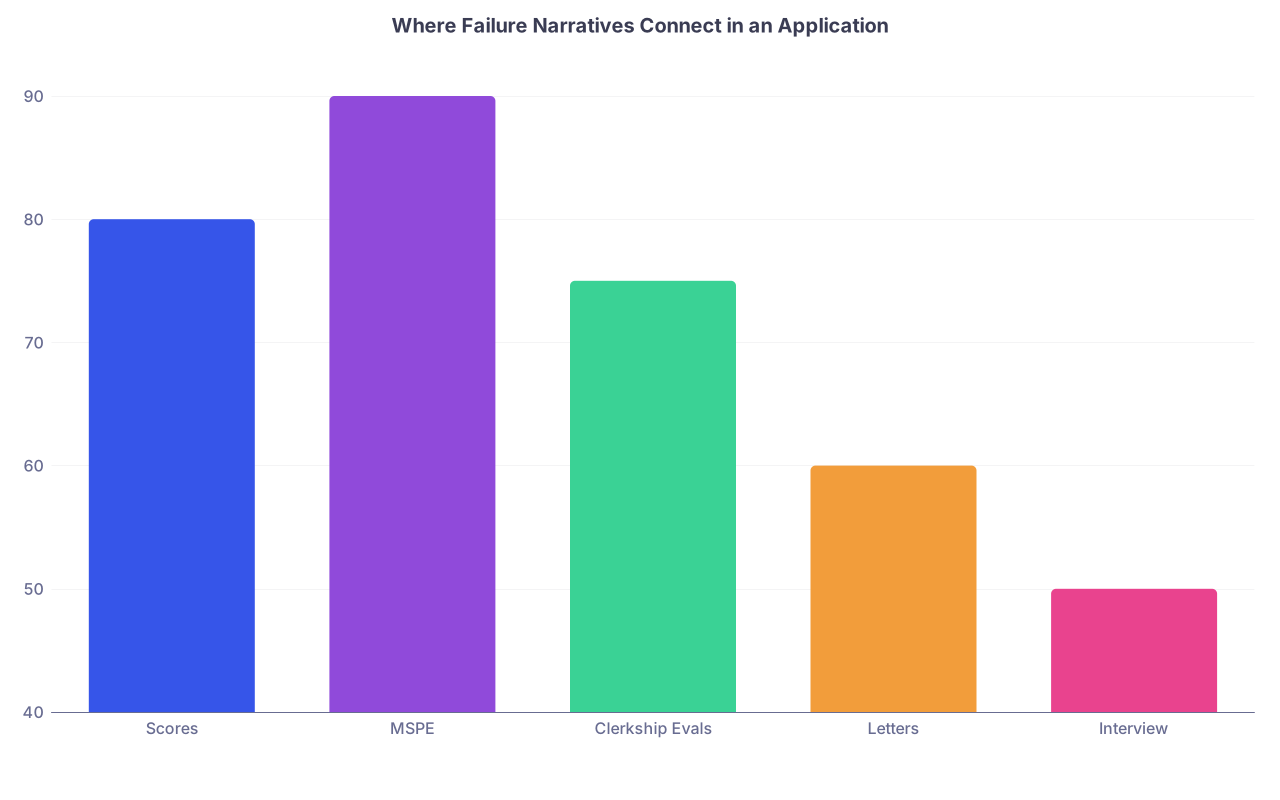
| Category | Value |
|---|---|
| Scores | 80 |
| MSPE | 90 |
| Clerkship Evals | 75 |
| Letters | 60 |
| Interview | 50 |
Interpretation: failure narratives mainly interact with obvious metrics (scores, MSPE, clerkship evals), and then indirectly influence how letters and interviews are interpreted.
So:
- Make sure your letters (if possible) come from post‑failure supervisors who can validate your growth.
- Be prepared to verbalize a concise version of this same narrative on interview day. The worst mismatch is a polished written story and a messy, defensive verbal one.
- If you have multiple issues (e.g., Step failure plus LOA), do not write a catalog of misery. Pick the most central event and show how the same growth arc helped you handle everything else.

| Step | Description |
|---|---|
| Step 1 | Open with identity or moment |
| Step 2 | Motivation for specialty |
| Step 3 | Strengths & fit evidence |
| Step 4 | Focused failure narrative |
| Step 5 | Demonstrated growth & results |
| Step 6 | Forward-looking conclusion as future resident |




Key Takeaways
- Use failure narratives strategically: only when they clarify a visible issue or showcase genuine, documented growth.
- Follow a 5-part structure—context, failure, ownership, repair, result—to keep the story grounded in action, not drama.
- Align your narrative with your specialty’s culture and your overall application so programs see not just that you failed, but that you learned how to become the kind of resident they can rely on.