
You are staring at a half-finished personal statement. There is a 9‑month gap in your training and a failed Step 1 score sitting in your ERAS transcript like a hazard light. You know programs will see it. You also know that pretending it never happened is the fastest route to the reject pile.
This is where most applicants freeze.
Let me break this down specifically: you need clean, controlled paragraphs that (1) acknowledge the issue, (2) own it without self-destruction, and (3) pivot to evidence of improvement. Not hand‑waving. Not trauma dumping. Not defensive monologues.
We are going to build those paragraphs.
Core Principles Before You Touch a Template
Before you copy a single sentence, you need to understand the rules of engagement for writing about gaps and setbacks.
1. Programs care about three things
They are not trying to psychoanalyze you. They are screening for risk. Every gap/setback paragraph has to reassure programs about:
- Reliability – Will you show up, complete residency, and not vanish mid‑PGY2?
- Trajectory – Are you trending up or down?
- Insight – Do you learn from failure, or blame everything on “circumstances”?
If your paragraph does not address those three, it is just noise.
2. Common applicant mistakes (that will sink you)
I see the same errors every cycle:
- Over‑explaining: 300 words on family drama before you even mention the Step failure.
- Under‑explaining: “I had personal issues” and nothing else. Vague = red flag.
- Excuse‑making: “The test was unfair,” “The school did not prepare us,” “USMLE changed the exam.” Programs hate this.
- Emotional overshare: Paragraph reads like a therapy note, not a professional statement.
- Misplaced location: Spending half the personal statement on your gap instead of focusing on why you’re a strong candidate.
Templates help you avoid this, but only if you follow the structure and keep your impulse to over‑justify in check.
3. Where to address the gap or setback
Strategy, not panic.
- Major academic issues (failed Step, repeated year, probation):
Usually deserve a clear, short paragraph in the personal statement, and one line in the ERAS “Education Interrupted” or “Additional Information” section. - Short clinical gaps (3–6 months):
Often better to address briefly in the personal statement OR in the “Experiences” descriptions if they’re tied to that period. - Long non‑clinical gaps (1+ year) for illness, family, visa:
Usually need 2–3 sentences in the personal statement and, if offered, program‑specific text boxes or supplemental questions.
You do not need three different essays explaining the same gap. One controlled explanation is enough.
Template Basics: Structure of a Gap/Setback Paragraph
Here is the skeleton almost every effective paragraph will follow:
- Context – One sentence. What happened, in neutral language.
- Accountability + Brief cause – One to two sentences. Why it happened, with you owning your part.
- Concrete response – Two to three sentences. What you did about it.
- Evidence of improvement – One to two sentences. Objective outcomes and what changed.
- Forward‑looking tie‑in – One sentence. How this affects you as a resident.
That is it. Most of these are 5–8 sentences total.
Think: short, factual, slightly under‑emotional. Do not try to win the tragedy Olympics.
Templates for Specific Situations
I will give you templates, then a “filled‑in” example for each. Adjust length and specificity to your situation.
1. USMLE/COMLEX Failure or Low Score
This one scares people the most. Programs see failed Steps as a risk for board passage. Your job is to show that the risk has already been addressed.
Template: Step/COMLEX Failure
“During my preparation for [Exam name] in [month/year], I did not perform at the level expected and [did not pass / received a lower score than anticipated]. This resulted from [brief, honest factor: inefficient study strategy / underestimating question practice / balancing exam prep with a demanding clinical schedule], for which I take full responsibility. After this outcome, I [specific actions: sought faculty guidance, created a structured study schedule, shifted to question‑based learning, completed X NBME practice exams]. I ultimately [passed / improved my score to ___ on (retake date)], reflecting a much stronger grasp of the material and a more disciplined approach. This experience forced me to examine my habits, accept feedback directly, and build a repeatable system for mastering high‑stakes material that I now apply to my clinical work.”
Example: Step 1 Fail → Pass
“During my initial attempt at Step 1 in June 2021, I did not pass. My study plan relied heavily on passive reading and limited question practice while I was still balancing a research commitment, and I underestimated how much this would affect my performance. After receiving my score, I met with our academic support office, overhauled my study schedule, and shifted to a question‑driven approach using UWorld and NBME self‑assessments, logging over 3,000 practice questions. On my second attempt in October 2021, I passed Step 1, and subsequently scored 244 on Step 2 CK. That process required uncomfortable honesty about my weaknesses and taught me to build structured, data‑driven study plans—an approach I now apply to staying current with the literature and preparing for patient care.”
Template: Low but Passing Score
“I recognize that my score on [Exam name] (___) is below the typical range for applicants in [specialty]. At the time, I [brief description: spread myself too thin between research, clinical responsibilities, or personal obligations] and did not study as effectively as I could have. In response, I [specific action: adjusted my schedule, worked with mentors, adopted a more disciplined question‑based strategy], which led to [improved performance: stronger clerkship grades, a [higher] score of ___ on [Step 2/COMLEX Level 2], or specific clinical evaluations]. This upward trend more accurately reflects my current level of knowledge and the deliberate approach I now bring to exam preparation and clinical work.”
2. Leave of Absence (Medical, Personal, Family, Mental Health)
You do not need to give your entire diagnosis or family tree. Programs want: what, why in broad strokes, what you did, and evidence that the issue is now stable and unlikely to recur in residency.
Template: Medical / Mental Health Leave of Absence
“In [month/year], I took a [duration] leave of absence from medical school due to [brief, high‑level description: a health condition that required focused treatment / a mental health concern that I needed to address]. Stepping away from training was a difficult decision, but it allowed me to [receive appropriate treatment / engage in therapy / develop sustainable coping strategies]. During this time, I [if applicable: maintained involvement in low‑intensity academic or volunteer work, once appropriate], and I returned to full‑time coursework in [month/year] without further interruption. Since then, I have [completed all remaining clinical rotations on schedule, maintained strong evaluations, had no additional leaves], and I continue to use the support systems and habits that helped me return to training. This experience has given me a deeper understanding of vulnerability, the importance of early help‑seeking, and the resilience required for residency.”
Example: Mental Health LOA
“In January 2021, I took a six‑month leave of absence from medical school to address a significant depressive episode. I had been pushing through symptoms for several months, and they began to affect my concentration and reliability. With the support of my dean and physician, I stepped away to engage in intensive treatment and therapy and to learn healthier ways to manage stress. I returned to full‑time clinical rotations in July 2021 and have since completed my remaining clerkships and sub‑internships without interruption, receiving strong evaluations for professionalism and teamwork. This period forced me to confront my own limits, seek help early, and develop concrete strategies for maintaining my mental health—skills I will carry into residency.”
Template: Family‑Related Leave / Caregiving
“In [month/year], I requested a [duration] leave of absence to [care for a seriously ill family member / manage an acute family crisis]. At that time, I was the only available person who could provide consistent support, and balancing those responsibilities with full‑time training was not sustainable. During the leave, I focused on stabilizing the situation and establishing long‑term support for my family so that I could return to medicine fully present. I resumed my [pre‑clinical / clinical] work in [month/year] and have progressed without interruption since then. This experience deepened my empathy for caregivers, sharpened my ability to prioritize under stress, and clarified my commitment to completing residency without further leaves.”
3. Year Repeated, Remediation, or Academic Probation
This is where accountability really matters. No hedging, no blaming. You show that the “old version” of you is not the one they are hiring.
Template: Repeated Year / Academic Probation
“During my [year: M1/M2/clinical year] in [academic year], I struggled academically and was placed on [probation / required to repeat the year] after [failing multiple courses / not meeting the minimum passing standard]. At that time, I [brief explanation: underestimated the volume of material, relied on ineffective study habits, hesitated to ask for help], and my performance reflected those choices. In response, I worked closely with [academic support / faculty advisors], adopted a more structured and active approach to learning, and repeated the year. Since then, I have [successfully passed all subsequent courses on first attempt, achieved higher scores, received strong clinical evaluations], demonstrating that I learned from this setback and can perform consistently at the level expected for residency. This experience increased my humility, willingness to seek feedback early, and confidence in my ability to recover from difficulty.”
Example: Clerkship Remediation
“During my initial Internal Medicine clerkship, I received a marginal pass and was required to complete a remediation rotation. My time management on a busy inpatient service was poor, and I struggled to prioritize tasks and communicate my limits to the team. After this feedback, I met with my clerkship director, observed high‑performing residents, and developed a daily structure for organizing patient care tasks and communicating expectations. On my remediation month, I received strong evaluations and ultimately honored two subsequent clerkships, including my Medicine sub‑internship. That early difficulty forced me to confront my weaknesses in organization and communication, and the strategies I developed then are now a core part of how I function on the wards.”
4. Non‑Traditional Path and Long Non‑Clinical Gaps
Maybe you worked as an engineer for 5 years, then applied. Or you took two years after graduation doing something that is not obviously clinical. If it is visible on your timeline, you need to make it make sense.
Template: Pre‑Med/Pre‑Residency Career Gap
“Between [graduation date] and [start of medical school / start of clinical rotations], I worked as a [role] at [organization] for [duration]. This period was not a detour from medicine, but a step that shaped how I now approach patient care. In that role, I [specific responsibilities], which taught me [transferable skills: systems thinking, project management, communication across disciplines, leadership]. As I progressed, I realized that I wanted to apply these skills more directly to individual patients, which led me to pursue medicine. The discipline and perspective I gained during those years have made me a more mature trainee and will continue to inform my approach as a resident.”
Template: Post‑Graduation Gap Before Residency
“After graduating from [medical school] in [month/year], I spent [duration] [explanation: engaged in full‑time research, working in another field, managing visa/immigration issues, addressing a family or personal matter]. During this time, I [specific activities: conducted research resulting in X abstracts/papers, worked clinically under supervision in X setting, completed additional coursework, supported my family while maintaining involvement in volunteering]. I remained connected to medicine by [details: clinical observerships, conferences, CME, teaching], and I am now fully prepared to transition back into full‑time clinical training. This period reinforced my commitment to [specialty] and gave me additional skills in [research, systems thinking, cultural competence] that I will bring to residency.”
5. Disciplinary Actions, Professionalism Concerns
These are the hardest, and you absolutely need to be direct. Programs care far more about your current trajectory and insight than about one past incident, if you handle it correctly.
Template: Professionalism / Conduct Issue
“In [month/year], I was cited for a professionalism concern related to [brief, factual description: a lapse in punctuality, incomplete documentation, an inappropriate comment]. The incident was formally reviewed, and I was [consequence: given a written warning, required to complete a professionalism course, placed on temporary probation]. I accept full responsibility for my behavior. In response, I [specific corrective actions: met regularly with my advisor, created concrete systems to ensure punctuality/compliance, sought feedback from supervising physicians]. Since then, I have [had no further professionalism concerns, received positive comments in my evaluations about reliability and communication], which I view as evidence that I internalized the feedback. The experience was uncomfortable but necessary, and it heightened my awareness of the professional standards expected of a resident.”
Where To Put These Paragraphs in the Personal Statement
You do not lead with your damage. You place these strategically.
The usual pattern that works:
- Opening: Why this specialty / formative story.
- Middle: Clinical experiences, skills, what you bring to a program.
- Gap/setback paragraph: One contained section, typically 2/3 of the way through.
- Closing: Your current goals, what you seek in a program, forward‑looking.
The red flag paragraph is not the “point” of your personal statement. It is a controlled disclosure inside a story that is otherwise about competence and fit.
If you had multiple setbacks, group them if possible:
“During my second year, I struggled with [X and Y], which led to [repeat/probation]. In response, I did A, B, C. Since then, I have…”
Do not scatter them in three different parts of the essay.
When to Use ERAS Text Boxes vs Personal Statement
Some years, ERAS or individual specialties add prompts like “Describe any interruptions in your education” or give a specific area to explain leaves.
General rule:
- If there is a dedicated “Education Interrupted / Leave of Absence” field:
Put the stripped‑down, factual version there. Use the personal statement for a slightly more narrative but still brief version, only if the issue is major (failed board, repeated year). - If the issue is minor or already fully explained in the supplemental:
You can skip mentioning it in the personal statement and trust that programs will read the explanation where it lives.
Think of hierarchy:
| Scenario | Best Primary Location |
|---|---|
| Single brief LOA (3–6 months) | ERAS "Education Interrupted" |
| Step failure with later high Step 2 | Personal statement paragraph |
| Repeated year / probation | Both (ERAS + PS) |
| Long pre‑med career gap | Personal statement only |
| Minor professionalism warning, resolved | ERAS / dean’s letter mostly |
Do not write three different versions of the same story. Consistency beats volume.
How Much Detail Is Enough?
Rule of thumb: if the thing could materially affect your ability to complete residency, give a little more detail and stronger reassurance. If it is mainly about optics, keep it tight.
Examples:
- “Major depressive episode, now in sustained remission on treatment for 2 years, no further interruption” – fine.
- “Every specific symptom, every medication trial, family history, and long commentary on stigma” – too much.
- “Family emergency” – too vague.
- “A sudden critical illness in a first‑degree relative for whom I was the primary caregiver” – enough.
You are not writing an HPI. You are demonstrating judgment.
Visual: How Much of the Essay Should Be About Setbacks?
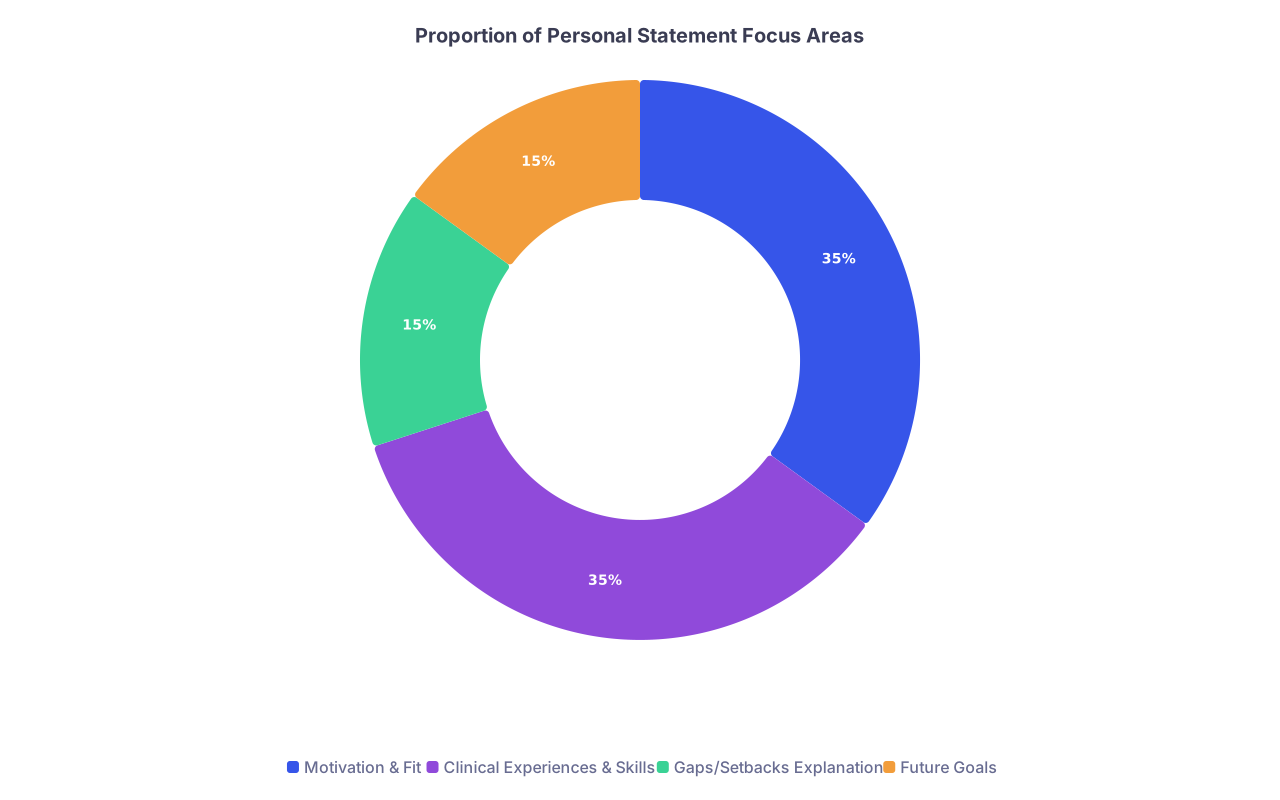
| Category | Value |
|---|---|
| Motivation & Fit | 35 |
| Clinical Experiences & Skills | 35 |
| Gaps/Setbacks Explanation | 15 |
| Future Goals | 15 |
If more than ~15–20% of your essay is about your problems, you are overdoing it.
Adapting Templates Without Sounding Robotic
You do not want your paragraph to read like everyone else’s “I learned resilience” boilerplate. A few ways to make it authentically yours:
- Swap generic “resilience” language for specific behaviors:
“I built a daily schedule, asked for feedback weekly, and adjusted based on objective scores.” - Use concrete outcomes:
“Honored 3 of my last 4 clerkships,” “Scored 250 on Step 2,” “No further concerns documented in my evaluations.” - Reflect briefly but specifically:
“This forced me to admit I needed help sooner,” not “I grew a lot.”
But do not get cute with metaphors or jokes here. This is the one part of the PS that should be nearly clinical in tone.
Putting It All Together: Example Integrated Paragraph
Let me show you what this looks like embedded.
Suppose you are applying to Internal Medicine with a Step 1 fail and a mental health LOA.
Your integrated paragraph might look like:
“During my second year, I faced two significant challenges in my training. I initially failed Step 1 after relying on passive review and trying to balance exam preparation with ongoing research, which I later realized was not sustainable. Shortly afterward, I took a six‑month leave of absence to address a depressive episode that had been affecting my concentration and reliability. I worked closely with our academic support office and my physician, engaged in structured treatment, and rebuilt my study approach around active, question‑based learning. I returned to full‑time coursework in July 2021, passed Step 1 on my second attempt, and subsequently scored 246 on Step 2 while completing my clinical rotations without interruption. These experiences were humbling, but they forced me to confront my limitations, seek help early, and build disciplined systems to manage both my mental health and my academic responsibilities—habits that I now carry into my work on the wards.”
Contained. Specific. Forward‑looking.

| Step | Description |
|---|---|
| Step 1 | Identify Issue |
| Step 2 | Skip in PS |
| Step 3 | Brief mention or ERAS box only |
| Step 4 | Use Structured Paragraph Template |
| Step 5 | Place in PS Mid/Late |
| Step 6 | Visible on Transcript/Timeline? |
| Step 7 | Serious: Fail/LOA/Probation? |
FAQ (Exactly 6 Questions)
1. Should I mention a Step 1 failure if I already have a strong Step 2 score?
Yes. Programs will see the failure anyway. A short, controlled paragraph that links the failure to concrete changes and a strong Step 2 score reframes it as a resolved issue, not an unexplained red flag. Ignoring it makes you look either unaware or evasive.
2. How specific do I need to be about mental health leaves?
High‑level is enough. Naming depression or anxiety is fine; you do not need to provide every detail of your treatment. What programs care about is: you recognized the problem, engaged in appropriate care, returned successfully, and have been stable since, with evidence in your coursework and clinical performance.
3. I had a 4‑month gap for board studying only. Do I need to explain it?
Probably not in the personal statement, unless it coincided with a failure or major score drop. A simple line in ERAS or in your CV timeline (“Dedicated board preparation period”) is usually enough. If asked in interviews, have a concise verbal explanation ready.
4. What if my school already addressed my issue in the MSPE (dean’s letter)?
You can keep your explanation shorter. The MSPE often provides the institutional perspective. Your job in the personal statement is to add your own accountability and describe how you changed afterward. A paragraph that complements, not contradicts, the MSPE is ideal.
5. Can I skip discussing a professionalism warning if it was minor and years ago?
If it is documented in your MSPE or appears formally on your record, you should address it very briefly, either in ERAS text boxes or in one short paragraph in the PS if it was significant. If it was resolved informally and is not recorded anywhere, you do not need to resurrect it in your application.
6. How do I avoid sounding like I am using trauma to “sell” myself?
Keep your tone factual, avoid dramatic language, and stay focused on actions and outcomes rather than on eliciting sympathy. One contained paragraph, clear ownership, concrete changes, and then move on. The goal is not to gain points for suffering; it is to show that you handled difficulty in a way that makes you a safer bet as a resident.
Key points to keep in your head while you write:
- One clean, structured paragraph per major issue beats scattered apologies.
- Own the problem briefly, spend more time on what you did and how you improved.
- Your personal statement is still about your fit for the specialty; the gap/setback is a controlled subplot, not the main story.