
The way most applicants write about “vulnerability” in residency personal statements is a liability, not a strength.
You are not writing therapy notes. You are not auditioning for a tragedy contest. You are building trust with a selection committee that has to decide: “Can I put this person in front of patients at 3 a.m. and not worry?”
Let me walk through how to show vulnerability without looking unstable, unprofessional, or exhausting to read.
The Core Problem: Committees Want Humans, Not Projects
Program directors are bored to death of two extremes:
The invincible robot:
“I have always wanted to be a surgeon since age 5… I love hard work… I am passionate about teamwork and lifelong learning.” Zero struggle. Zero real person.The emotional overshare:
Multi-paragraph accounts of depression, family trauma, burnout, relationship breakdowns, and graphic patient stories—written like a confessional blog post.
Both get you filtered out mentally, even if not on paper.
The real target is narrower and much smarter:
Show that you have:
- Been through real difficulty
- Reflected on it like an adult
- Changed your behavior or thinking
- Emerged more reliable, not more fragile
That is the balance: vulnerability in service of credibility.
What “Vulnerability” Actually Means in This Context
People throw around “be vulnerable” without defining it. Let’s be specific.
Professional vulnerability in a residency personal statement is:
- Admitting imperfection or struggle
- Taking ownership, not blaming
- Demonstrating insight and concrete growth
- Connecting the story directly to how you will function as a resident
It is not:
- Dumping your unprocessed emotions
- Listing traumas as if the pain itself is a qualification
- Justifying every red flag with “I had a lot going on”
Think of it like this: your vulnerability should make a program director think, “This person knows themselves. They have range. They are coachable and resilient,” not “This feels like a risk.”
The Hidden Audience: How PDs Actually Read These
Program directors, APDs, chiefs—they are skimming your statement after:
- Reading 40 others that day
- Doing a full clinical day
- Looking at thousands of ERAS applications
They are searching for 3 questions:
- Does this person understand what this specialty is really like?
- Do they show judgment, maturity, and self-awareness?
- Do they seem like someone I can trust on call, with nurses, with patients?
Vulnerability only helps if it answers those questions better.
Otherwise, it is noise. Or worse: a red flag.
The Most Common Vulnerability Mistakes (And Why They Hurt You)
Let me be blunt about the patterns that get applicants quietly downgraded.
1. Writing an Illness Memoir
Example patterns I see all the time:
- “My depression began in my second year of medical school…”
- “Growing up, my family faced food insecurity, immigration challenges, and domestic violence…”
- “I had a panic attack during an exam that led to multiple failures…”
None of those are automatically disqualifying. The way they are written often is.
Why it backfires:
- The emotional tone is raw, not processed.
- The narrative centers your suffering, not your functioning.
- There is little or no shift to “Here is how I am now stable and reliable in high-stress environments.”
If you write about your own mental health, you must do it like someone presenting a post-op patient: objective, oriented, focused on course and outcome.
2. Using Trauma as a Personality Substitute
Some statements read like: “I deserve this spot because my life has been hard.”
No. You may deserve empathy; you do not automatically deserve a residency spot.
Selection committees are looking for:
- Competence
- Growth
- Specific skills and attitudes
- Evidence of performance under pressure
Trauma is background. Growth is the point.
3. Oversharing About Family Dysfunction
“I was the child of an alcoholic,” “My parents’ divorce ruined my adolescence,” “My sibling’s addiction shaped my childhood.”
These realities shape a lot of physicians. But if the description is:
- Graphic
- Angry
- Unresolved
…you look like someone whose personal life might repeatedly spill into residency.
You can reference these things, but you keep it controlled, briefly framed, and clearly integrated into who you are now.
4. Justifying Every Red Flag with a Story
Failed Step 1? Leave of absence? Clerkship failure?
You get one real explanation space before it starts looking defensive.
If your statement becomes a catalogue of explanations, the subtext is: “I am a chronic exception.”
Programs do not want chronic exceptions. They want residents who mostly just show up and do the work.
A Clear Framework: How to Use Vulnerability Safely
Here is the structure I recommend when you want to include a challenging experience.
Think in four moves:
- Context (Brief)
- Reaction (Brief but honest)
- Processing (Concrete insight)
- Outcome (Behavioral change and current functioning)
Let me make that less abstract.
1. Context: One or Two Sentences, Not a Chapter
Wrong:
During my second year, my grandmother’s illness, my parents’ divorce, and my own anxiety symptoms converged in a perfect storm that left me unable to attend classes, complete coursework, and maintain focus…
Better:
During second year, I struggled with significant family and personal stressors that affected my academic performance.
You do not need to fully relive it for them to understand it mattered.
2. Reaction: Human, But Contained
You are allowed to say you were overwhelmed, scared, uncertain. You just do not camp there.
Acceptable:
I felt embarrassed and frustrated when I failed that rotation. I had rarely struggled academically before.
Dangerous:
I felt like my world collapsed. I could not get out of bed. I questioned whether I belonged in medicine at all for months.
You do not need to demonstrate the deepest possible suffering. You need to demonstrate reality and then move.
3. Processing: This Is Where Maturity Shows
This is the step most applicants skip or do badly. They jump from “it was hard” to “but I overcame,” with no cognitive work in between.
You want sentences that sound like:
- “I realized that my usual strategy of outworking problems was not enough; I needed to ask for help early.”
- “I recognized how much I tied my identity to performance alone.”
- “I learned to name burnout before it became a crisis.”
This is where you show insight. Without blaming, without self-pity.
4. Outcome: Evidence You Are Different Now
General “I became stronger” lines are useless. Show functioning.
Strong examples:
- A failed Step followed by clear improvement on CK and strong clinical comments.
- A leave of absence followed by uninterrupted rotations and strong letters.
- Burnout addressed with new habits, reflection, boundaries, and then no further academic issues.
You want the reader to unconsciously think: “That is already resolved. I am not inheriting this problem.”
What Belongs in the Personal Statement vs Supplemental Areas
ERAS and many programs give you multiple spaces:
- Personal statement
- “Additional Information” / “Education interruption” boxes
- Sometimes program-specific questions
You must decide where each vulnerable element lives.
General rule:
- Personal statement: Carefully selected, integrated vulnerability that explains your motivation, perspective, or approach to patient care or the specialty.
- Explanation boxes: Direct explanations of discrete problems (LOAs, failures, score anomalies).
Do not convert your personal statement into a dumping ground for academic problems. One targeted mention is fine if it connects to your growth as a clinician, but if it reads like a defense brief, you lost them.
Specific Content Types: Green, Yellow, and Red Zones
Let me categorize the most common “vulnerable” topics.
| Zone | Topic Type |
|---|---|
| Green | Reasonable struggle with a rotation |
| Green | Early self-doubt about specialty choice |
| Green | Non-graphic patient loss with reflection |
| Yellow | Personal illness with clear resolution |
| Yellow | Treated mental health condition |
| Yellow | Family hardship shaping values |
| Red | Ongoing severe mental health instability |
| Red | Graphic trauma descriptions |
| Red | Unresolved contempt toward others |
Green Zone: Almost Always Safe If Written Well
Examples:
- The first time you got harsh feedback on rounds and how you adjusted.
- A patient death that made you rethink how you handle uncertainty.
- Switching from one specialty interest to another after realizing what fits you.
These show humility and growth. They are almost always welcome when concise and tied to your current strengths.
Yellow Zone: Handle Carefully and Clinically
Topics like:
- Personal depression/anxiety now treated and stable
- Your own illness or hospitalization
- Caring for a very ill family member
- Financial hardship
Rules here:
- Avoid graphic detail.
- Emphasize stability and current functioning.
- Explicitly connect to empathy, boundaries, or resilience in your clinical work.
- Keep it proportionate: it should not dominate the statement.
Red Zone: Very High Risk
- Describing current major mental health instability
- Admitting ongoing inability to cope under stress without clear treatment/stability
- Writing with unresolved rage toward prior institutions, faculty, or family
- Graphic trauma descriptions that can feel voyeuristic or unsettling
These are not “you can never mention this,” but 9 times out of 10, including them in depth in a residency personal statement harms you more than it helps.
If you are in this territory, you need direct, individualized advice from a trusted faculty mentor, not a generic template.
Concrete Examples: Weak vs Strong Vulnerability
Let me show you how this plays on the page.
Example 1: Mental Health
Weak:
During my third year, I developed severe depression that made it difficult to attend rotations consistently. I often cried after work and felt completely inadequate as a student. My grades suffered, and I felt like a failure. This was an incredibly dark time in my life, but I pushed through and eventually came out stronger.
Problems:
- Dramatic language with no structure.
- “Pushed through” is vague and concerning.
- No explicit mention of treatment, support, or stability.
- No tie to current functioning as a resident.
Stronger:
During third year, I experienced significant depressive symptoms that affected my performance and led me to take a brief leave of absence. With the support of my PCP and a therapist, I began treatment and learned to recognize and address early signs of burnout.
Since returning, I have completed all remaining clerkships without interruption, consistently strong clinical evaluations, and a more sustainable approach to work. That experience has made me more attuned to the emotional load of our profession and more proactive in checking in on both my patients and teammates.
Notice:
- Clear description without dramatization.
- Treatment and support are named.
- Stability is demonstrated with concrete facts.
- Takeaway is relevant to residency.
Example 2: Family Hardship
Weak:
Growing up in an unstable household, I never knew when the next explosive argument would happen. My father’s rage and my mother’s absence left deep scars. I often stayed up late listening for footsteps, terrified of what might happen next. These childhood traumas still haunt me, but they also fuel my desire to help others.
Problems:
- Reads like a trauma memoir.
- Emotional tone is raw, not integrated.
- Ending with “still haunt me” is not reassuring.
Stronger:
I grew up in a home where conflict and instability were common. It forced me to mature quickly and to become the calm, steady presence for younger siblings. Those early experiences gave me a bias toward de-escalation and listening before reacting.
On busy inpatient services now, I find myself naturally drawn to the distressed family member in the hallway or the frustrated nurse at the desk. I understand what it feels like when the room is tense, and I work deliberately to bring the temperature down.
Here, the past is a source of skill, not an emotional vortex.
Professionalism: Guardrails You Should Not Cross
There are some lines that, when crossed, almost always damage your application.
1. Attacking Individuals or Institutions
Never write:
- “My attending was unfair and targeted me.”
- “My school did not support me.”
- “The system was stacked against me.”
You can describe lack of support or misalignment, but you keep blame out of it. Committees are allergic to victim narratives in residency applications.
2. Graphic Clinical Content
Do not include vivid descriptions of:
- Blood, injury, procedures
- Graphic patient deaths
- Abuse details
You are not writing creative nonfiction. You are applying for a job.
3. Romanticizing Suffering
“I am drawn to oncology because I have always been comfortable with suffering.”
No. You must respect it, not fetishize it.
Instead:
“I am not afraid of sitting with patients and families in painful moments, and I have learned how to be present without needing to immediately fix what cannot be fixed.”
Structuring the Personal Statement Around Balanced Humanity
Let me give you a simple macro-structure that naturally balances vulnerability and professionalism.
Suggested Outline
Opening paragraph
A specific clinical moment or realization that illustrates why you are drawn to this specialty. Human, but grounded.Middle part A: Your path into the specialty
How your experiences, skills, and interests lined up with this field. This is where a short, controlled vulnerable moment can live if it shaped your perspective.Middle part B: Evidence of readiness
Concrete experiences in the specialty (rotations, sub-I, research, QI, teaching) that show you know what the work entails and that you fit.Short vulnerability-driven growth paragraph (if needed)
A targeted, brief account of a hardship that:
– Is framed with context → insight → outcome
– Directly connects to how you will be as a residentClosing
Forward-looking statement: what kind of resident you aim to be; what you hope to contribute to the program and the field.
A Quick Visual: Where to Place the Emotional Weight
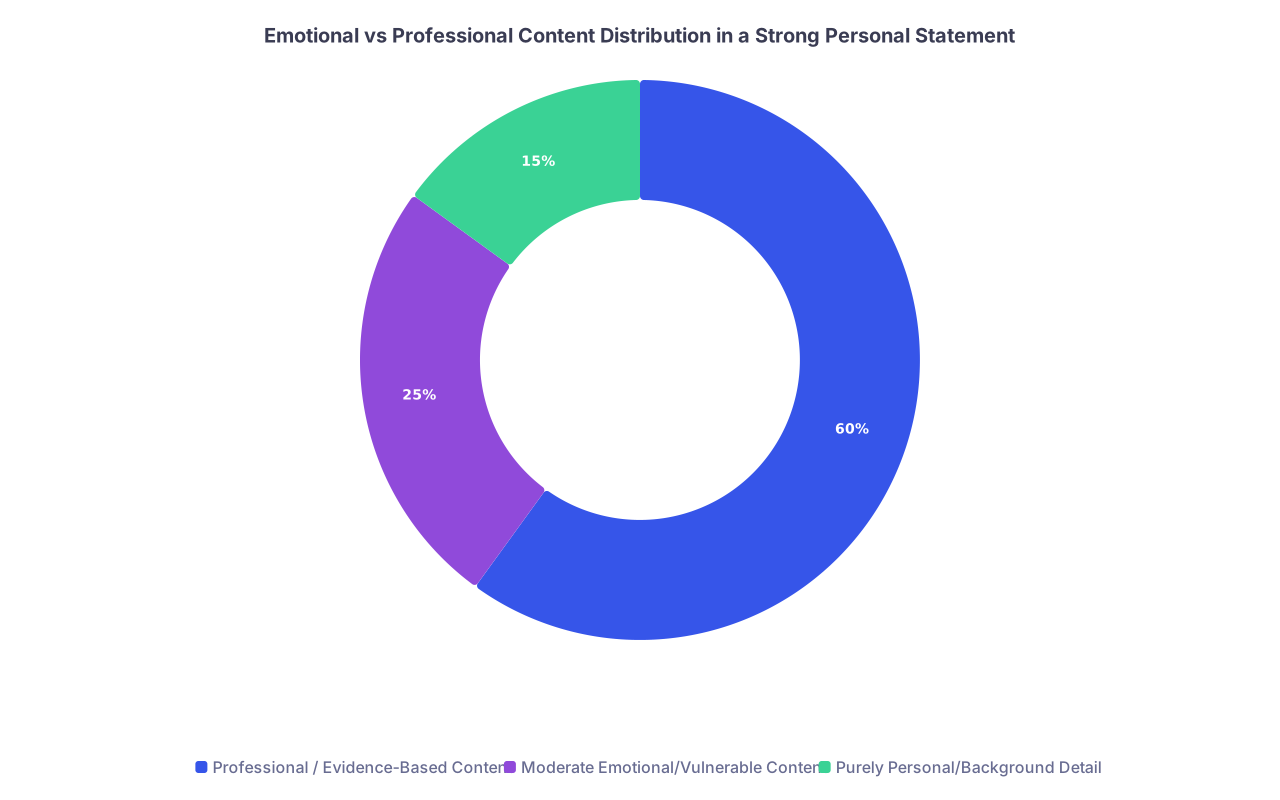
| Category | Value |
|---|---|
| Professional / Evidence-Based Content | 60 |
| Moderate Emotional/Vulnerable Content | 25 |
| Purely Personal/Background Detail | 15 |
If more than about a quarter of your statement is emotional processing and personal backstory, you are drifting off-center.
Specialty Nuances: How Much Vulnerability Is Normal?
Different fields tolerate (and even expect) slightly different flavors.
Psychiatry:
Very common to mention personal/family exposure to mental illness, but you still must project stability and professional distance. Over-identification is a real concern.Pediatrics / Family Medicine:
Family stories, community hardship, and personal background are common. But again, you cannot sound like your own boundaries are nonexistent.Surgery / EM / Anesthesiology:
Statements tend to be more pragmatic. Vulnerability is often framed around humility, learning from mistakes, and handling pressure.Internal Medicine:
Plenty of room for introspection, but the bar for coherence and intellectual maturity is higher. Vague “I like complex patients” plus a sad story does not cut it.
The principle is the same across the board: vulnerability should reinforce your fit for the culture of the specialty, not fight it.
Quick Self-Check: Is This Vulnerability Helping or Hurting?
Before you lock anything in, run this litmus test on any vulnerable paragraph:
- Could this paragraph be misread as: “I am unstable,” “I blame others,” or “I am not over this yet”?
- Does it clearly show a change in behavior, mindset, or performance?
- If a PD read only this paragraph, would they want to know more about me—or quietly move on?
If you hesitate on any of those, you revise or cut.
Process Flow: How to Draft This Without Self-Sabotage
Here is a simple workflow I have used with residents and MS4s.

| Step | Description |
|---|---|
| Step 1 | Brainstorm stories |
| Step 2 | Mark potential vulnerable content |
| Step 3 | Ask: Does this explain motivation, growth, or reliability? |
| Step 4 | Cut or move to explanation box |
| Step 5 | Apply context-reaction-processing-outcome structure |
| Step 6 | Check tone: stable, reflective, concise |
| Step 7 | Get feedback from trusted faculty/mentor |
| Step 8 | Revise for balance of personal vs professional |
Do the raw writing in a separate doc. Then be ruthless about what makes it into the final cut.
FAQ (Exactly 5 Questions)
1. Can I mention my own mental health diagnosis in a residency personal statement?
Yes, but only if it is clearly treated, stable, and you can describe it in a measured, clinical way. You must show that:
- There has been no ongoing impairment in recent years, and
- The experience changed how you approach patients, colleagues, or yourself in a constructive way.
If you cannot confidently do that, shift details to the “additional information” section or omit them.
2. Should I explain my Step failure or leave of absence in the personal statement?
Briefly, if and only if:
- You can connect it to a broader theme of growth and changed behavior, and
- You do not turn the entire statement into a justification.
Often, the cleaner approach is: detailed explanation in the designated ERAS field, plus at most one or two sentences in the personal statement that frame the experience as something you learned from and have already moved past.
3. How emotional is “too emotional” for a residency statement?
If a paragraph feels like something you would say in a therapy session or a late-night call to a close friend, it is probably too emotional. The tone should feel like a reflective conversation with a respected faculty mentor: honest, but composed. If you are describing tears, panic, or “the darkest time of my life,” you are likely overshooting.
4. Is it a mistake to avoid vulnerability altogether and keep it strictly professional?
You can match just fine with a largely professional, concrete statement. But a touch of humanity helps you stand out. One or two carefully chosen moments of struggle, uncertainty, or growth usually make you more memorable—as long as they are tightly controlled and clearly tied to your current strengths.
5. Who should review my vulnerable content before I submit?
At minimum: one faculty member who writes letters regularly and understands selection committees, and one person who knows you well enough to flag if you are underselling or oversharing. Avoid using only peers; they tend to either over-reassure you or over-dramatize the impact of your story. You want someone who can say, “This line makes me worry about you,” or “This doesn’t sound resolved enough—cut it.”
Key points, so you do not miss them:
- Vulnerability in a residency statement is only valuable when it increases trust in your judgment and reliability.
- Use a structured approach—context → reaction → processing → outcome—to keep emotional content professional and contained.
- If a vulnerable paragraph does not clearly show growth and current stability, it belongs out of the personal statement or out of the application entirely.