
Most residency personal statements don’t fail because the applicant is weak. They fail because the applicant sounds entitled.
Not underqualified. Not unmotivated. Entitled.
I’ve watched strong applicants with 250+ Step scores, honors in everything, and glowing letters get quietly de-prioritized because their personal statement made faculty roll their eyes. And the worst part? The applicant usually has no idea what they did wrong.
You’re not competing only on scores anymore. You’re competing on judgment. Your personal statement is one of the few places programs see your judgment in your own unedited voice. If that voice screams “I think I’m special and I deserve this,” you’ve just handed them a reason to move on to the next file.
Let’s walk through the phrases and tones that make you sound entitled—sometimes in very subtle ways—and how to fix them before they quietly tank your application.
The Subtle Language of “I Deserve This”
The fastest way to sound entitled is to slide from qualified into deserving. That shift often happens in very gentle, seemingly harmless phrases.
Here’s what I mean.
Phrases that scream “I deserve a spot” (even if you didn’t mean it)
Watch out for these:
- “I have worked too hard not to become a [specialty] physician.”
- “I deserve the opportunity to train at your program.”
- “My dedication guarantees I will succeed in residency.”
- “I know I will be an excellent [specialty] physician.”
- “Given my qualifications, I am confident I will excel in any program.”
Faculty eyes glaze over right around “deserve,” “guarantees,” and “any program.”
They’re reading this with 40 open applications in the same specialty. Everyone worked hard. Everyone sacrificed vacations, birthdays, relationships. Saying you’ve worked “too hard not to” become something implies the universe owes you a return on investment.
It doesn’t. And program directors definitely don’t.
Try this instead:
- “I have invested deeply in developing the skills and habits needed to be a reliable, teachable resident.”
- “My experiences have prepared me to contribute meaningfully as an intern while continuing to grow.”
- “I am committed to doing the unglamorous, daily work required to become a competent [specialty] physician.”
Notice the difference? You move from entitlement (outcome-focused, “I deserve”) to responsibility (process-focused, “I will show up and do the work”).
The “Main Character” Trap: You’re Not the Hero of the Hospital
One of the most common tone-deaf moves is writing your personal statement like a movie script where you’re the protagonist and everyone else is background.
I’ve seen so many variations of this:
“As I walked into the trauma bay, I knew this was where I belonged. The team looked to me as I quickly identified the problem, ordered the right tests, and reassured the family.”
You’re a medical student. The trauma team is not looking to you. They’re barely letting you touch the ultrasound probe.
Phrases that push you into “main character” syndrome
- “The team relied on me to…”
- “I quickly recognized that the attending’s plan was missing…”
- “I took charge of the situation and led the team…”
- “Everyone looked to me for answers…”
Do you hear it? You’ve just bumped yourself into resident/attending territory. That’s not confidence. That’s delusion. And it absolutely reads as entitlement.
What faculty actually respect:
- Accurate humility
- Situational awareness
- Respect for hierarchy and team roles
Try this:
- “I watched the senior resident lead the trauma activation with calm efficiency. My role was small—documenting, placing an IV—but I saw how every member of the team contributed.”
- “I suggested an alternative diagnosis to the resident, who walked me through why it was less likely and helped me refine my thinking.”
You want to sound like a thoughtful learner, not a misplaced superhero.
Name-Dropping, Prestige Chasing, and “Top Program” Syndrome
This one gets people in trouble all the time: chasing prestige so hard that your statement basically says, “I only want shiny things.”
Program directors are hypersensitive to this. They’ve been burned by residents who match, realize it’s not “fancy” enough, and mentally check out.
Tone-deaf prestige phrases
- “I’m looking for a top-tier program with a national reputation.”
- “I hope to train at a prestigious academic center like yours.”
- “Your program’s reputation as one of the best in the country attracted me.”
- “I want the most competitive training to match my ambitions.”
You think you’re flattering them. They hear: “If you’re not fancy enough, I’m out.”
Also, half the programs reading this do not see themselves as “top-tier,” even if you do. Or they’re in a smaller city. Or they’re community-based. You’ve just implied they’re your backup.
A better angle:
- Name specific strengths instead of vague prestige:
- “strong clinical volume in [X]”
- “early operative exposure”
- “underserved populations”
- “resident autonomy”
- Focus on fit and learning environment, not status.
Example fixes:
Instead of: “I want to train at a top-tier urban academic center.”
Try: “I’m seeking a program with a high-volume, diverse patient population, where residents are trusted early with responsibility and supported with close teaching.”
Instead of: “Your prestigious program is ideal for me.”
Try: “I’m drawn to your program’s emphasis on resident independence in the ICU and your commitment to caring for underinsured communities.”
Respectable, grounded, and not licking boots.
Overclaiming Empathy and Altruism (Without Proof)
Another entitlement trap: announcing what an empathetic, compassionate, selfless human you are—without any real evidence—and acting like that virtue alone earns you a spot.
I’ve seen lines like:
- “I am uniquely compassionate.”
- “My empathy sets me apart from other applicants.”
- “I’ve always been the person others turn to in times of need.”
- “I care more about my patients than anything else.”
Do you? More than your family? Your health? Your own safety? That kind of absolutist language doesn’t make you look noble. It makes you look immature and out of touch with real-life tradeoffs.
You know what reads entitled here? Assuming your self-described “good heart” entitles you to a residency position.
Program directors want to see:
- You handle hard situations without moral grandstanding.
- You’ve shown up for patients consistently, not just in one dramatic story.
- You understand boundaries, not just martyrdom.
So shift from claim to evidence.
Instead of: “I am deeply compassionate and always put my patients first.”
Try:
- “On my medicine rotation, I learned that genuine compassion often looks routine: sitting down when I was tired, re-explaining a plan for the third time, or calling a family member who couldn’t be at the bedside.”
- “My pre-clinical volunteer work in the free clinic taught me how often ‘caring’ is documentation done correctly, refills sent on time, and follow-ups not forgotten.”
Grounded. Real. No halos.
Arrogant Comparisons: Throwing Others Under the Bus
If you want to torpedo your application in one sentence, compare yourself favorably to “other students,” “other applicants,” or, worse, residents.
Yes, I’ve actually read lines like:
- “Unlike many of my peers, I prioritized learning over grades.”
- “Where other students were content to do the minimum, I always went above and beyond.”
- “I quickly realized I was performing at the level of an intern.”
- “Residents often told me I was better prepared than most medical students.”
Even if that last one is true, quoting it is a bad look. It’s the verbal equivalent of posting your own compliment as an Instagram caption.
Here’s why it reads as entitled:
- You’re setting yourself up as the standard and everyone else as lesser.
- You’re using other people as props to elevate yourself.
- You’re telling faculty you’ve already decided you’re exceptional.
You can communicate strength without stepping on anyone.
Instead of: “Unlike many of my peers, I always sought out extra learning.”
Try:
- “I found myself staying late to follow up on interesting cases and watch additional procedures, which helped me see the continuity of care beyond my assigned patients.”
Instead of: “Residents said I was already performing like an intern.”
Try:
- “I tried to anticipate the team’s needs—following up on labs, prepping notes early, organizing my patient list—which gave me a glimpse of the responsibilities of an intern.”
Same work ethic, zero arrogance.
The “Tragic Backstory = I’m Special” Problem
Personal adversity is real. Many of you have gone through brutal things: illness, family loss, immigration, poverty, discrimination.
The mistake isn’t sharing it. The mistake is using it as currency.
I’ve seen versions of this:
- “As someone who has overcome more than most people can imagine, I know I will be an exceptional resident.”
- “My hardships have made me more deserving of this opportunity.”
- “Given everything I have faced, I believe I’ve earned the chance to train in your program.”
Do not weaponize your trauma to imply hierarchy of deservingness.
Program directors care about adversity because:
- It shows resilience.
- It explains dips or gaps.
- It shapes your perspective on patients.
They do not use it as a point system to rank who has suffered the most.
Better framing:
- Connect your experiences to specific skills or perspectives.
- Avoid language of “deserving” or “earning” a spot.
- Emphasize growth, not moral superiority.
Instead of: “My challenges make me more deserving of this opportunity.”
Try:
- “Navigating [specific challenge] taught me how to function under chronic stress, ask for help when needed, and still show up for the people depending on me. These habits will be crucial in residency.”
- “Growing up [brief context] makes me particularly attuned to how social and financial barriers interfere with care, and it motivates me to advocate practically for my patients.”
You’re not more worthy. You’re differently prepared. That’s the line you want.
Hedging Into Entitlement: Fake Humility and Backdoor Bragging
Entitlement doesn’t always sound loud. Sometimes it’s dressed up as “I’m so humbled… by how great I am.”
You’ve seen this:
- “I was humbled to be recognized as the top student in my class.”
- “I was honored when faculty chose me for this highly selective role.”
- “I was surprised to receive the highest evaluation on the rotation.”
One of these is forgivable. Ten of them in a row? It’s bragging in a lab coat.
The red flag isn’t that you mention your achievements. You should. The problem is when you:
- Stack them as if listing awards in prose.
- Use “humble” and “honored” as a shield for flexing.
- Let accolades become the core of your personal statement instead of context.
Your personal statement is not your ERAS Awards section in paragraph form.
So:
- Mention one or two key achievements that connect to your story.
- Don’t artificially prefix every achievement with “humbled.”
- Let someone else brag in your letters; you focus on what you learned and how you work.
Instead of: “I was humbled to be recognized with multiple awards, including…”
Try:
- “Receiving the [specific award] for my work with [population] reinforced for me that sustained, unglamorous effort over years can quietly make a difference.”
Achievement included. Ego dialed down.
Buzzword Soup: “Leadership, Passion, Excellence” That Means Nothing
Another way to sound entitled is to hide behind vague, inflated buzzwords instead of concrete substance. Program directors have seen this word salad a thousand times:
- “I am passionate about leadership and excellence in patient care.”
- “I aspire to be a thought leader in the field.”
- “I’m committed to innovation and cutting-edge research.”
- “I value teamwork, communication, and multidisciplinary collaboration.”
None of this is inherently bad. But taken together, without specifics, it reads as a generic, self-important brochure. You’re saying, “I speak the language of ambition,” not, “I actually do work that matters.”
What entitlement sounds like here is: “Because I know the right big words, you should see my potential.”
Strip it down:
- Replace buzzwords with specific actions.
- Swap “passion” for examples of persistence when it was boring, tiring, or thankless.
- Describe what you actually did in teams, not that you “value teamwork.”
Instead of: “I am passionate about leadership in medicine.”
Try:
- “In our student-run clinic, I took over scheduling after weeks of missed appointments and confusion. It was unglamorous, repetitive work—but fixing that system meant fewer no-shows and better continuity of care.”
Now you’re not a “leader.” You’re a person who solved a real, annoying problem. That impresses faculty way more.
Entitled Endings: Demanding, Assuming, or Overpromising
The last paragraph is where many otherwise solid personal statements implode. People try to “end strong” and accidentally veer into melodrama or entitlement.
Watch for these endings:
- “I know I will be a future leader in [specialty].”
- “Given the chance, I will undoubtedly become an outstanding [specialty] physician.”
- “I am confident I will be an asset to any program.”
- “I eagerly look forward to joining your program.”
Specific issues here:
- You’re promising outcomes you can’t guarantee.
- You’re telling programs how they should feel about you (“I will be an asset”).
- You’re implying they’ve already picked you (“joining your program”).
Better options:
- Express clear interest without assuming acceptance.
- Reiterate how you approach work and learning, not how amazing your future self will be.
- Tie back to why the specialty fits your temperament and habits.
Try something like:
- “As I enter residency, I bring curiosity, stamina, and a willingness to do the work that isn’t glamorous but is essential. I look forward to growing into a dependable member of a [specialty] team.”
- “I’m excited for the steep learning curve of residency and the chance to contribute while continually being pushed to improve.”
Grounded. Respectful. No crystal ball predictions.
How Programs Actually Read Your Tone
Let me spell out what’s really happening on the other side of the screen.
A program director is reading your statement after skimming:
- Your Step scores
- Your grades / MSPE
- Your letters
- Your CV
They already know, roughly, whether you’re academically strong. Your personal statement isn’t there to prove you’re smart. It’s there to answer a different, brutal question:
“Will this person be a headache or a safe bet?”
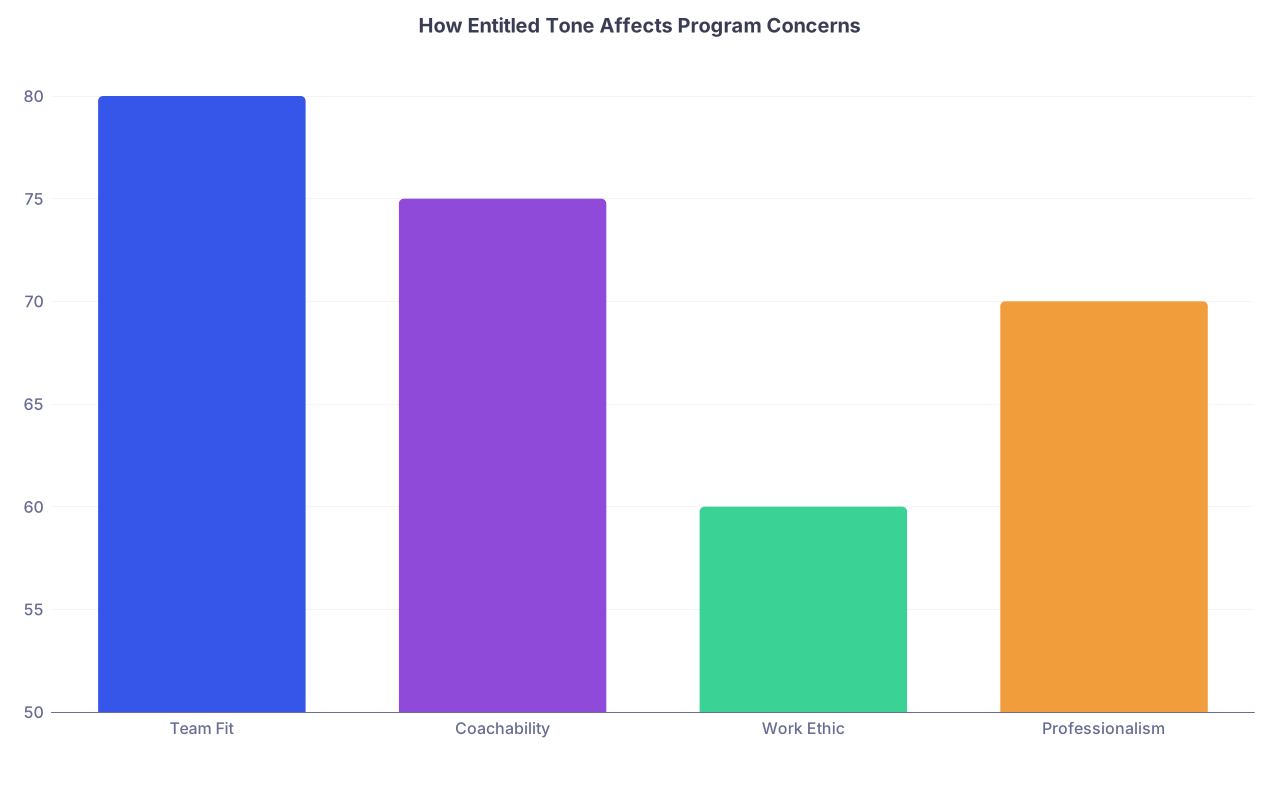
Tone-deaf, entitled language sets off alarms in a few ways:
| Category | Value |
|---|---|
| Team Fit | 80 |
| Coachability | 75 |
| Work Ethic | 60 |
| Professionalism | 70 |
Here’s what those concerns often look like in real comments I’ve heard in selection meetings:
- “Seems like they think they’re already a resident.”
- “I’m not sure they’ll take feedback well.”
- “This reads a little ‘I’m doing you a favor by being here.’”
- “Good applicant, but the statement rubbed me the wrong way.”
Nobody writes, “Rejected because entitled.” They just quietly rank you lower.
Your job is to remove every excuse they might invent to push you down the list.
A Quick Tone-Check Framework Before You Submit
Use this as a final pass on your draft. Read out loud and watch for red flags.

| Step | Description |
|---|---|
| Step 1 | Start Tone Check |
| Step 2 | Rewrite with responsibility focus |
| Step 3 | Remove or reframe without comparison |
| Step 4 | Replace with concrete fit reasons |
| Step 5 | Add specific behaviors or cut |
| Step 6 | Overpromising future greatness? |
| Step 7 | Ground ending in habits, not destiny |
| Step 8 | Tone likely safe |
| Step 9 | Any deserve or earned language? |
| Step 10 | Comparisons to peers or residents? |
| Step 11 | Prestige-only program motives? |
| Step 12 | Unproven claims of empathy/uniqueness? |
You’re hunting for:
- Any version of “deserve,” “earned,” or “too hard not to”
- Comparisons: “unlike my peers,” “better than,” “more than others”
- Prestige chasing: “top-tier,” “prestigious,” “best program”
- Overblown self-praise without proof: “uniquely compassionate,” “exceptional”
- Future guarantees: “will undoubtedly be…,” “know I will be a leader”
If you find them, you fix them. Now, before someone on the committee does it for you in their head.
One Concrete Step You Can Take Today
Open your personal statement right now and do this:
Highlight every sentence where you talk about yourself in positive terms—your qualities, strengths, or what you “will be.”
For each one, ask:
- Did I prove this with a concrete example, or did I just declare it?
- Could this sentence be read as “I’m special, therefore I deserve a spot”?
- Am I comparing myself to others, even subtly?
If the answer to any of those is yes, rewrite that sentence today so it shows effort, behavior, and growth—not entitlement.