
It’s 11:47 p.m. You’ve got your personal statement document open for the eleventh time. There are versions in your folder named “final,” “final2,” and “FINAL_real_this_time.” Every paragraph seems to start with “I am passionate about…” or “My passion for…” and somehow you’ve managed to be “passionate” about global health, teaching, research, underserved care, advocacy, critical care, and robotic surgery.
You read it back and think, “This sounds… impressive?”
It doesn’t.
To someone on the other side—PDs, faculty, tired chief residents reviewing apps between admissions—it sounds generic, over-sold, and frankly, unbelievable. That’s the mistake you’re about to make if you are not careful: turning your personal statement into a buzzword salad where you claim 9 passions and prove none of them.
Let me walk you through the traps here so you don’t burn a prime chance to stand out.
The Most Common Personal Statement Lie: “I Am Passionate About…”
Let me be blunt: if I print 50 personal statements from one specialty and lay them out on a table, I’ll see the word “passion” on almost every single one. Usually multiple times.
Here’s the problem: the more you say it, the less anyone believes it.
The red-flag pattern looks like this:
- “I am passionate about patient care.”
- “I am passionate about research.”
- “I am passionate about quality improvement.”
- “I am passionate about medical education.”
- “I am passionate about global health.”
By paragraph three, the reader stops believing you have a passion for anything. It sounds like you’re reciting a residency brochure.
Program directors are not counting how many passions you list. They’re asking themselves two simpler questions:
- What does this person actually care enough about that they’ve done something real with it?
- Does what they’re saying match what I see in the rest of the application?
If your statement screams “passion for research” but your ERAS has one poster from M1 on a project you barely remember, that doesn’t read as “driven.” It reads as “inflated.” That’s a trust problem, and trust problems kill applications.
The first mistake is thinking you need to tell them what you’re passionate about.
You don’t.
You need to show them what you care enough to actually do, consistently, when no one is forcing you.
Buzzword Overload: How It Shows Up (And Why It’s Dangerous)
Let’s be specific. These are classic buzzword clusters that show up in residency personal statements:
- Passion / passionate
- Lifelong learner
- Leadership
- Teamwork
- Compassion / empathy
- Holistic care
- Underserved / vulnerable populations
- Innovation / cutting-edge
- Evidence-based medicine
- Global health / advocacy / social justice
None of these words are inherently bad. The problem is when they appear in dense clusters with no proof, like this:
“I am a compassionate, empathetic, hardworking team player with a passion for lifelong learning, leadership, and evidence-based medicine. My experiences have fueled my commitment to underserved populations and global health, and I am excited to contribute to a program that values innovation and holistic care.”
On a website? Fine. On a brochure? Expected.
In your personal statement? Empty.
Why it’s dangerous:
- It makes you sound like everyone else. If your first paragraph could be copied into 50 other people’s statements unchanged, you have already lost ground.
- It signals insecurity. Overloading on big adjectives and “passions” sounds like someone trying to convince rather than simply describing who they are.
- It raises a consistency check. People read your statement and then flip to ERAS. If your “passions” don’t show up in your activities, letters, or CV, you just undermined your credibility.
Here’s how this plays out in a reviewer’s head:
“Passion for teaching? One tutoring entry, 2 hours/week for a semester. Passion for research? One abstract. Passion for global health? One 10-day trip between M1 and M2. Passion for QI? None listed. Okay, so they’re just writing every nice word they’ve heard.”
That’s not the conclusion you want.
Data Reality: Reviewers Do Not Have Time for Your Buzzwords
Let’s be real about the reading environment.
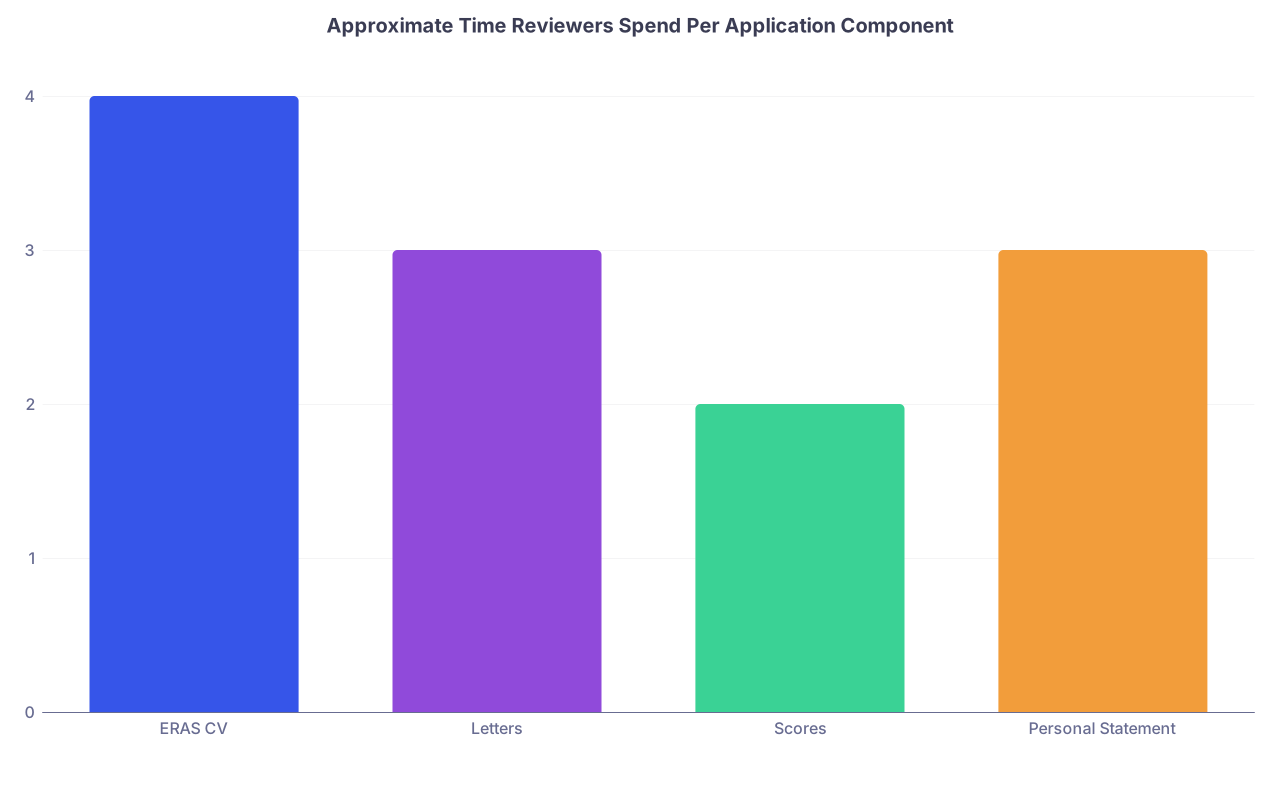
| Category | Value |
|---|---|
| ERAS CV | 4 |
| Letters | 3 |
| Scores | 2 |
| Personal Statement | 3 |
You might get 3 minutes for your personal statement on a good day. Often less.
Buzzwords slow the reader down without giving them actual information. That’s the opposite of what you want. You want:
- A clear sense of who you are
- One or two themes that actually stick
- A believable, specific reason you fit the specialty and type of program
If your first half-page is generic “passion” fluff, they might not even make it to the one honest story at the bottom you actually care about.
The “Too Many Passions” Problem: Why It Makes You Forgettable
The bigger structural mistake isn’t just the word “passion.” It’s trying to sell too many identities in one 1-page statement.
This is the pattern I see over and over:
Paragraph 1: “I discovered my passion for patient care when…”
Paragraph 2: “In addition, I have a strong passion for research…”
Paragraph 3: “I am equally passionate about global health and underserved medicine…”
Paragraph 4: “Teaching is another passion that has shaped me…”
Conclusion: “These experiences have fueled my passion for [specialty] and lifelong learning.”
By the end, what are you? A clinician-researcher-educator-global-health-advocate-QI-innovator who loves underserved care and cutting-edge technology. On paper, sure. In reality, you’ve crowded out any chance for the reader to remember even one thing about you.
The human brain does not remember lists of six equally weighted themes from one page of text. It remembers one or two strong, concrete impressions.
Trying to sound “well-rounded” by listing every conceivable “passion” is exactly how you end up sounding like an interchangeable template.
You should not aim to sound like you could match anywhere doing anything.
You should sound like a specific, real person who would be a great fit at certain kinds of places.
How Many “Passions” Is Too Many?
Here’s the part most people never get told: you do not need to show every dimension of yourself in the personal statement. It is not your autobiography.
For a residency personal statement, you usually need:
- One core driving interest/identity in the specialty
- Zero to one supporting interest that’s backed by your application
That’s it.
You can of course mention other aspects of yourself, but in terms of major themes you want the reader to walk away with: one main, one secondary. Not five equal pillars.
Examples:
Main: love for longitudinal patient relationships in IM
Secondary: mentoring and medical education (with real evidence)Main: addiction psychiatry and caring for marginalized populations
Secondary: quality improvement in inpatient psych (backed by a real project)Main: technical satisfaction and problem-solving in surgery
Secondary: research in outcomes or health services (with tangible work)
What you don’t do is claim equal, burning passion for:
- Cutting-edge robotic procedures
- Palliative care
- Rural underserved clinics
- Global surgical missions
- Basic science bench research
- Medical education and curriculum design
…in a 750-word statement. That’s not passion. That’s marketing.
Red Flags That Your Statement Is Buzzword-Heavy
Go through your current draft and check yourself. If you hit these, you’ve got a problem.
- You use the word “passion” more than twice.
- You have a paragraph that’s basically a list of “I value X, Y, and Z” with no specific story.
- You could change the specialty name and 80% of the statement would still work.
- You claim a strong interest in something that appears nowhere in your ERAS entries.
- You describe yourself with 4+ big abstract labels in one sentence (leader, advocate, lifelong learner, innovator, educator, etc.).
If you see this, the fix isn’t just changing words. You have to tighten your identity and choose what you’re actually going to stand on.
Show, Don’t Announce: Replacing “Passion” with Proof
The safest rule: Any time you want to write “I am passionate about X,” stop and force yourself to prove it instead.
Compare:
Buzzword version:
“I am passionate about caring for underserved populations.”
Evidence-based version:
“For the past three years, I’ve spent Wednesday nights at the student-run free clinic, where most of my patients are uninsured and speak limited English. Learning how to negotiate a treatment plan through an iPad interpreter, a crying toddler, and a 15-minute visit has shaped how I think about access and trust.”
One screams “admissions essay.”
The other sounds like an actual human being who has actually done something.
Another example:
Buzzword version:
“I am passionate about research and have presented my work at multiple conferences.”
Evidence-based version:
“During my third year, I joined a project examining readmission rates for heart failure patients. I spent months manually reviewing charts and building a dataset. It was monotonous at times, but when I presented our findings at the regional ACC conference and a cardiology fellow asked if they could adapt our checklist for their clinic, I saw how data can quietly change day-to-day practice.”
Same underlying content. Completely different level of credibility.
Your rule of thumb:
If a high school senior could write the same sentence about “passion” without sounding absurd, it’s probably too generic for a residency personal statement.
Alignment Check: Does Your Claimed Passion Match Your Track Record?
One of the most damaging mistakes is claiming a major “passion” that your application does not support. Reviewers absolutely notice.
Let’s map this out clearly.
| Claimed Passion | What Reviewers Look For |
|---|---|
| Research | Multiple projects, pubs, posters |
| Teaching / Med Ed | Long-term tutoring, TA, curriculum |
| Global Health | Sustained involvement, not 10 days |
| Underserved Care | Clinics, community projects, QI |
| Leadership | Officer roles with actual work |
If your “passion” column is huge and your evidence column is empty or thin, that gap is what makes committees raise an eyebrow.
This doesn’t mean you cannot mention genuine interests that are early-stage. But scale your language to the evidence.
Bad combo:
- One poster in M1
- No research since
- Statement: “Research is one of my greatest passions, and I hope to build a career as a physician-scientist.”
Better, grounded combo:
- One early poster, then nothing
- Statement: “My early exposure to research taught me how to ask structured questions and think critically about data. While I do not see myself in a primarily research-focused career, I want a program where I can stay engaged with clinical projects that improve care on the wards.”
Notice the difference? The second one respects reality. Reviewers respect that.
How to De-Buzzword Your Draft Step by Step
Here’s a practical process. Don’t overcomplicate it.

| Step | Description |
|---|---|
| Step 1 | Draft Complete |
| Step 2 | Highlight Buzzwords |
| Step 3 | Cut or Replace 50% |
| Step 4 | Pick 1-2 Core Themes |
| Step 5 | Add Specific Stories |
| Step 6 | Cross-check with ERAS |
| Step 7 | Read Aloud for Authenticity |
Highlight every buzzword phrase.
Passion, lifelong learner, leadership, teamwork, empathy, holistic, etc. Physically highlight them.Cut or replace at least half.
If you say “passion” four times, cut it to once or zero. Replace with concrete description of what you did, felt, or learned.Force yourself to choose 1–2 core themes.
Ask: “If they only remember two things about me from this page, what should they be?” Everything else is supporting detail.Add or extend one story instead of adding another passion.
Depth beats breadth. One rich example is more believable than five name-dropped interests.Cross-check against ERAS.
For every major theme in your statement, make sure there is related evidence in your activities or letters.Read it out loud.
If you feel like you’re giving a speech at a white-coat ceremony instead of talking like yourself, you’ve still got too many buzzwords.
Specialty-Specific Trap: Copy-Paste Passions
Every specialty has its cliché list of “acceptable passions” that applicants feel obligated to copy.
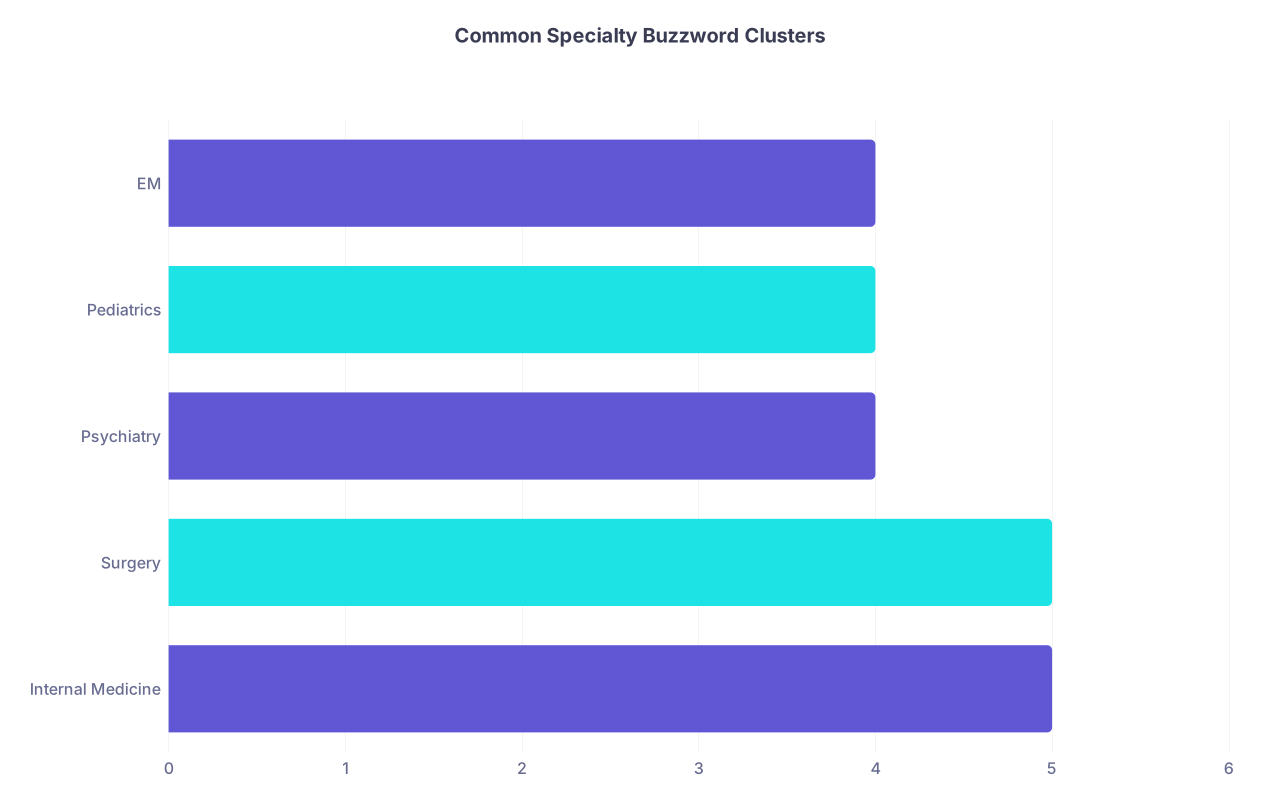
| Category | Value |
|---|---|
| Internal Medicine | 5 |
| Surgery | 5 |
| Psychiatry | 4 |
| Pediatrics | 4 |
| EM | 4 |
Rough translation (number = typical buzzwords per specialty people overuse):
- Internal Medicine: “lifelong learner,” “complex patients,” “holistic care,” “continuity,” “evidence-based”
- Surgery: “hands-on,” “immediate impact,” “technical skills,” “high-pressure,” “teamwork”
- Psychiatry: “stories,” “stigma,” “listening,” “mind-body”
- Pediatrics: “advocacy,” “families,” “growth and development,” “prevention”
- EM: “fast-paced,” “undifferentiated patients,” “team-based,” “resuscitation”
You should absolutely speak the language of your specialty. But if your statement reads like:
“I am drawn to emergency medicine because of its fast-paced environment, undifferentiated patients, team-based care, and opportunities for resuscitation…”
…you’ve just recited the first paragraph of half the EM program websites in the country.
The fix: keep one or two of those words if they’re truly you, but anchor them in your experience.
Instead of:
“I am passionate about the fast-paced, team-based environment of emergency medicine.”
Try:
“In our county ED, the hallway beds fill before noon. My favorite days are when the stroke pager, a septic shock admission, and a child with status asthmaticus arrive within an hour. Those shifts showed me that I think more clearly when I do not know what will come through the door next, and that I enjoy earning the trust of nurses, techs, and consultants in those moments.”
Same core idea. No buzzword fog.
The “Safe but Bland” Draft: Why Playing It Too Safe Is Its Own Mistake
A lot of people, once they hear “cut the buzzwords,” swing too far in the opposite direction. They strip out anything that sounds like a feeling and end up with a dry, purely chronological essay:
- I did this rotation
- Then I did this project
- Then I decided on this specialty
Technically fine. But forgettable. And still not honest.
The point is not to write like a robot. The point is to sound like yourself, just more edited and mature.
You can absolutely say you loved something. That you were angry, frustrated, or moved. You can absolutely show genuine excitement about a field.
The mistake is thinking you need inflated language and a dozen “passions” to justify being there. You don’t.
Your actual story is enough—if you stop burying it under generic fluff.
Quick Reality Checks Before You Hit Submit
Before you call the statement done, run these filters:
- If someone read only your first and last paragraphs, would they know why you chose this specialty and what makes you you—without relying on generic phrases?
- If an interviewer quoted a line back to you and asked, “So what did you actually do with this passion for X?” would you have a concrete story ready?
- If someone removed the specialty name and swapped in a different one, would the statement still “mostly work”? If yes, it’s too generic.
And one more harsh but useful question:
Would you hire you based on that statement? Not just “would you interview me,” but “would I want this person on my team at 2 a.m.?” If your answer is “Eh, maybe, they seem fine,” revise. “Fine” is not how you stand out in a stack of 1,000.
Bottom Line
Let’s keep this tight:
- Listing too many “passions” makes everything you claim less believable and more forgettable.
- Buzzwords don’t make you sound impressive; specific, aligned evidence does.
- One or two clear, well-supported themes beat a laundry list of vague identities every single time.
Trim the fluff. Pick what you actually care about. Prove it. Then stop talking.