
Your personal statement is not a confessional booth. Treat it like one and you’re practically begging for awkward interview questions you’re not ready to answer.
I’ve watched applicants tank otherwise promising interviews because of one or two reckless sentences in their personal statement. Not because the programs were harsh. Because the content invited uncomfortable, probing questions they couldn’t handle under pressure.
Let’s walk through what actually triggers those moments—and how to avoid handing programs ammunition against you.
The Core Problem: You Forget the Interviewer Has Your Essay in Front of Them
Programs do not read your personal statement as literature. They read it as a question bank for the interview.
Most interviewers—especially busy faculty—do not memorize your application. They skim your ERAS, and when it’s time to ask questions, they grab the easiest source: your personal statement. If something is vague, dramatic, or emotionally heavy, they latch onto it.
You need to assume three things:
- If you write it, they can ask about it.
- If it sounds dramatic, they will ask about it.
- If you’re not ready to be grilled on it in a small room with three people and no escape, it doesn’t belong there.
Let me show you the traps that show up every cycle.
Mistake #1: Trauma-Dumping Without Boundaries
This is the big one. Applicants write about heavy personal trauma—death of a parent, sexual assault, severe mental illness, abuse, serious medical conditions—and then freeze when someone says:
“So, can you tell me more about that?”
They weren’t prepared to talk about it out loud, to strangers, on a schedule.
Why this backfires
Interviewers aren’t trying to be cruel. But they’re evaluating:
- Emotional stability
- Professional boundaries
- How you’ll handle stress, grief, and crisis
If your personal statement reads like a therapy session, they’ll test your emotional processing of it. That’s when it turns awkward:
You: “My mother died of cancer during my second year and I lost all sense of purpose.”
Interviewer: “That sounds very difficult. Where are you now with that grief? How has it affected your clinical work?”
You: (tears, long pause, unable to continue)
I’ve seen this. More than once.
The problem wasn’t the grief. It was putting raw, unprocessed trauma in the essay without a clear arc or current stability.
Signs you’re trauma-dumping, not reflecting
- The story centers on pain, not on growth or insight
- You’re still visibly destabilized when you talk about it casually
- You’d dread someone saying, “Let’s go deeper into that”
- There’s no clear link to how it shaped you as a physician, beyond vague “it made me more empathetic” clichés
Safer way to handle sensitive content
You can reference hard things, but you need guardrails:
- Keep details minimal: no graphic descriptions, no long narratives of suffering
- Focus on what you did, not what happened to you
- End with where you are now—solid, functional, grounded
- Make sure you can discuss it calmly, without breaking down, three times in one day
If you’re not there yet, leave it out. Protect yourself. There are other ways to show resilience.
Mistake #2: Mental Health Disclosures That Invite Risk Questions
This is tricky. You’re told to “be authentic” and “break stigma,” so applicants sometimes disclose depression, anxiety, bipolar disorder, or prior suicidal ideation in a very open way.
In theory, destigmatizing.
In practice, it often triggers this kind of question:
“How do we know this won’t interfere with residency?”
“What happens when you’re on 28-hour call and your symptoms flare?”
“Have you required hospitalization? How recently?”
Do I love that these questions get asked? No. Do they get asked? Yes.
The reality programs are operating in
Residency is high stress. Programs are evaluating:
- Risk of leave of absence
- Reliability during night float and high-stress rotations
- Risk of breakdown under pressure
If you frame your mental health as unstable, crisis-prone, or barely managed, you make them nervous. Then the interview slides into an interrogation about your functioning.
How applicants accidentally trigger interrogation
- Describing yourself as “broken,” “shattered,” or “barely made it through”
- Talking about ongoing major impairment without clear treatment or stability
- Mentioning suicide attempts, recent hospitalizations, or self-harm without framing recovery and current support
- Centering the diagnosis instead of the growth
If you choose to disclose (and you do not have to), your story must emphasize:
- Consistent, ongoing treatment
- Stability over time
- Concrete strategies you use to function well
- No recent crises that suggest high risk during residency
And again: only include what you are fully prepared to discuss, with eye contact, without shutting down.
Mistake #3: Overconfession About Academic or Professional Problems
I’ve watched personal statements casually include:
- “I failed Step 1 the first time because I wasn’t really focused.”
- “I got called into professionalism remediation for being late a lot.”
- “I struggled with authority and clashed with an attending.”
Then in the interview:
“So tell me more about your professionalism concerns.”
“So why did you fail Step 1? Why should we believe it won’t happen again during in-service exams?”
“Do you think you have trouble with hierarchy? How would that work in our program?”
Now you’re trying to recover from a self-inflicted complication.
What you should never do
Never surprise a program in the personal statement with something worse than what’s already in your file.
If there’s a documented issue (LOA, remediation, exam failure), it belongs in the MSPE or a separate “red flag” explanation, not as an emotionally loaded centerpiece of your personal statement.
Your personal statement is not your “I must confess everything” document. It’s your “This is why I’ll be a strong resident in your specialty” document.
How to address red flags more intelligently
If you have to explain something:
- Be brief, factual, and non-dramatic
- Take responsibility, show specific changes you made, and show improved outcomes
- Do not turn it into a multi-paragraph emotional saga
You want the interviewer to say, “They owned it and moved on,” not, “Now I have to spend 10 minutes probing this mess.”
Mistake #4: Dramatic Life Stories With No Clear Relevance
You’re not writing a memoir. You’re trying to convince a program to trust you with their patients at 3 a.m.
Some of the worst awkward interview triggers come from overly cinematic personal stories:
- “I left everything behind in another country with no money and no English.”
- “I struggled with addiction for years and hit rock bottom on the bathroom floor.”
- “I was part of a religious community and escaped under threat.”
These can be profound parts of who you are. But on paper, if told in a dramatic way, they invite forensic questioning.
Interviewer brain:
“If this was intense enough to anchor their essay, I need to understand if there are ongoing risks, unresolved instability, or major baggage.”
Then they start asking:
- “What substances did you use? How long were you sober before med school?”
- “Is your family supportive now, or is there ongoing conflict?”
- “Were there legal issues involved?”
If the story isn’t directly clarifying why you’re a good resident candidate—not just why your life is interesting—think hard about shrinking or removing it.
Filter for relevance
Ask yourself about any big life story you’re tempted to include:
- Does this directly show qualities that matter in residency? (Reliability, teamwork, judgment, grit, maturity.)
- Can I summarize this in a few lines instead of three paragraphs?
- Am I okay being asked anything about this, including uncomfortable details?
If the answer to any of those is no, trim it down or cut it.
Mistake #5: Vague or Loaded Phrases That Demand Clarification
Some personal statements are mostly fine but have one sentence that sinks them.
Things like:
- “I went through a dark time during third year.”
- “I struggled with personal issues that affected my performance.”
- “I had to overcome significant health issues that almost derailed my education.”
- “I used to be very angry and cynical about medicine.”
Every one of those is a red flag phrase. Interviewers see it, underline it, and think: “What exactly happened?” Then you get:
“Can you tell me more about what you mean by a ‘dark time’?”
“What were those personal issues?”
“What kind of health problems? Are they resolved?”
If you’re going to allude to a challenge, you must either:
- Explain it clearly and briefly in the statement itself, or
- Delete the allusion entirely
Half-hiding problems is worse than either fully explaining or not mentioning them. You look evasive. And nothing makes an interview more awkward than an interviewer believing you’re hiding something.
Mistake #6: Overly Intense Self-Criticism or “I Used To Be Terrible” Narratives
There’s a trend of applicants writing the “I used to be a bad person/terrible student/arrogant jerk, then medicine transformed me” essay. They think it sounds mature and humble.
What programs hear is: “High risk history.”
Examples I’ve seen:
- “I used to party too much and blow off responsibilities until I realized—”
- “I was arrogant, dismissive, and thought patients were just diagnoses.”
- “I used to lie to get ahead, but now I value integrity.”
Interview follow-up: “Tell me more about that. How do we know that person won’t show up again at 2 a.m. on call?”
This is not the time to advertise your lowest version of yourself.
Yes, you can show growth. But not at the cost of making them doubt your baseline character.
A more controlled approach
Instead of “I was awful, now I’m redeemed”:
- Emphasize refinement, not total personality overhaul
- Describe specific skills you improved (time management, communication, asking for help)
- Avoid loaded moral language about your past self
Residency programs are trying to predict future behavior. Do not hand them evidence that your “previous setting” was chaos and unreliability.
Mistake #7: Polarizing Opinions and Hidden Landmines
Your personal statement is not Twitter. Bold, contrarian takes about healthcare, politics, ethics, or social issues invite questions that can go sideways fast.
Landmines I’ve seen in statements:
- Strong criticism of certain specialties (“Surgeons don’t care about the whole patient”)
- Absolutist takes on controversial topics (MAiD, abortion, gender-affirming care, end-of-life decisions)
- Loaded comments about “lazy residents,” “toxic attendings,” or “broken systems” without nuance
Interviewers then feel obligated to explore:
“Tell me more about why you think the system is broken.”
“How do you see your role in changing this?”
“What if your colleagues don’t agree with your views?”
Suddenly you’re in a political or ideological debate with your future PD. Dangerous.
Use restraint, not cowardice
You can show values—equity, compassion, advocacy—without planting ideological bombs:
- Describe what you did (volunteering, QI projects, advocacy work)
- Emphasize respect for diverse views
- Avoid demonizing other physicians, specialties, or institutions
If you’d be anxious having a recorded panel discussion on a topic with strangers, do not introduce that topic in your 1-page statement.
Mistake #8: Exaggerated or Inconsistent Stories That Invite Fact-Checking
Interviewers are very good at detecting embellishment. If your personal statement feels like a Netflix script, they will poke at it.
Red flags:
- “I single-handedly saved a crashing patient as a third-year student.”
- “I read 50+ journal articles a week to stay current.”
- “Every attending told me I was the best student they’d ever worked with.”
Then they ask:
“Tell me more about that code situation.”
“What journals do you follow?”
“Which attending said that? What specifically did they comment on?”
Under pressure, if your story was embellished, you stumble. The room gets quiet. Everyone feels the awkwardness.
Programs don’t have time for that. Integrity matters.
Quick self-check
Before including any anecdote:
- Can you describe the details comfortably if they push for specifics?
- Would your attending or resident from that rotation recognize the story?
- Does it sound like something a student/resident realistically does?
If not, tone it down. Better to under-sell than get caught stretching the truth.
Mistake #9: Overly Intimate Family or Relationship Details
You do not need to give a residency program a front-row seat to your family drama or romantic history.
Problem content I’ve seen:
- Long paragraphs about a romantic breakup that “shattered” you
- Detailed conflicts with parents about career choice, religion, or lifestyle
- Descriptions of caregiving that border on personal medical detail about a family member
- References to fertility struggles, pregnancy loss, or marital conflict
These often generate questions like:
“How is your relationship with your family now?”
“Is your partner supportive of your schedule?”
“Will your caregiving responsibilities continue during residency?”
You just pulled your personal life into the middle of a professional evaluation. And now you’re scrambling to sound composed and low-risk.
Keep the boundary. If a family story genuinely belongs there, make it:
- Brief
- Focused on your development, not their personal details
- Clearly not an ongoing crisis that will bleed into your training
What You Should Be Writing About Instead
Let me be clear: avoiding landmines doesn’t mean your statement has to be bland.
You just need to center things that:
- Show you understand the specialty’s reality
- Demonstrate dependability, teamwork, and teachability
- Reflect insight without oversharing or melodrama
- Are safe to talk about in any room, with any faculty member
Safer, strong anchors for your statement:
- A specific clinical moment that shifted your understanding of the specialty—but told with restraint
- Longitudinal work (clinic, research, QI, outreach) that shows commitment
- Real examples of being coached, improving, handling feedback
- Concrete experiences that show you understand hard parts of the field (workload, emotional weight, lifestyle challenges) and still want it
And for every single sentence, run this filter:
“If they look me in the eye and say, ‘Tell me more about that,’ can I answer clearly, calmly, and professionally?”
If the answer is no, that content has no business in your personal statement.
A Quick Comparison: Safe vs Problematic Content
| Goal | Safer Approach | Risky Approach |
|---|---|---|
| Show resilience | Briefly note a setback and specific recovery | Detailed trauma/mental health crisis story |
| Explain academic issue | Factual, concise explanation | Emotional, dramatic multi-paragraph confession |
| Show growth | Concrete skills improved over time | “I used to be a mess, now I’m fixed” narrative |
| Show passion for specialty | Specific cases/projects with reflection | Abstract declarations and grandiose language |
| Personal background | Focused on relevant context and growth | Detailed family drama or intense life upheaval |
Visualizing Where Applicants Go Wrong
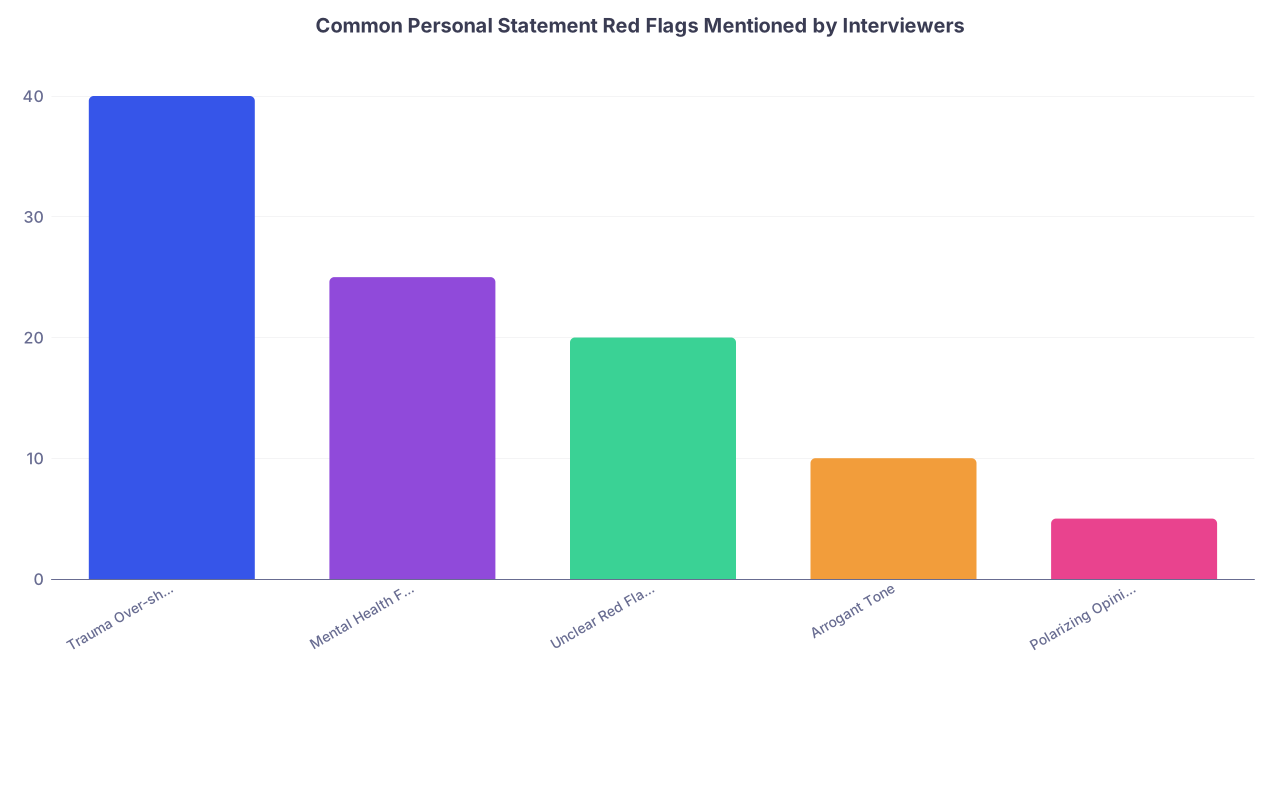
| Category | Value |
|---|---|
| Trauma Over-share | 40 |
| Mental Health Focus | 25 |
| Unclear Red Flag Allusions | 20 |
| Arrogant Tone | 10 |
| Polarizing Opinions | 5 |
How This Plays Out in a Real Interview Day

| Step | Description |
|---|---|
| Step 1 | Write risky sentence |
| Step 2 | Program screens application |
| Step 3 | Interviewer highlights sentence |
| Step 4 | Interview day |
| Step 5 | Interviewer asks probing question |
| Step 6 | Calm, concise answer |
| Step 7 | Awkward pause, emotional reaction |
| Step 8 | Negative evaluation |
| Step 9 | Prepared? |
Don’t Let “Vulnerability” Sink Your Application
You’ve probably been fed this line: “Be vulnerable. Be authentic.”
Fine. But you’re not writing for a support group. You’re writing for people deciding whether to trust you with sick patients, demanding schedules, and their program’s reputation.
Here’s what you need to remember:
- Vulnerability doesn’t mean telling your deepest wounds; it means being honest about who you are in a way that supports your case as a resident.
- Anything you put in that statement is fair game for detailed questioning—if you can’t discuss it comfortably, it doesn’t belong.
- Your job is not to be the most dramatic story. Your job is to be the clearest, safest, most compelling future colleague.
If you’re smart about what you leave out, you give the interview less room to wander into landmine territory—and more room to focus on the strengths that actually match you.