
The biggest mistake residency applicants make from July to September is freezing their personal statement in June and never touching it again.
At this stage, your personal statement should be alive. Reacting to interviews. Evolving with feedback. Sharpening as your story becomes clearer.
Here is how your refinement process should look, week by week and then interview by interview.
July: Lock a “Version 1.0” and Start Collecting Data
By July, you are submitting ERAS. At this point you should not be rewriting your personal statement from scratch. You should be refining and stress‑testing what you already have.
First half of July (July 1–15): Final polish before initial submissions
At this point you should:
Freeze a primary “Version 1.0” for upload
- Choose one core personal statement for your main specialty.
- If you are dual applying, you should have:
- 1 statement per specialty (e.g., IM, Neuro)
- A clear file naming system on your computer:
PS_IM_v1_2026-07-01PS_Neuro_v1_2026-07-01
- Your goal now is not perfection. Your goal is: “good enough to submit, still flexible enough to refine.”
Run a brutal last‑pass clarity check Read for:
- Thesis clarity in the first 2–3 lines:
- Why this specialty.
- Who you are as a future resident.
- Concrete evidence for your claims:
- “I care about teaching” → Do you have a single clear teaching example?
- “I thrive under pressure” → Do you show one specific pressure scenario?
- Redundancy:
- Remove repeated phrases: “I am passionate,” “I have always wanted…”
- Cut any sentence you could delete without losing meaning.
Quick checklist:
- First paragraph contains a clear “who I am” and “why this specialty”
- At least 2 concrete, specific clinical stories
- One future‑facing paragraph: what kind of resident you will be
- No vague “since childhood” clichés without proof
- 750–900 words max (for most programs, shorter and tighter beats longer)
- Thesis clarity in the first 2–3 lines:
Get one more targeted outside review Not a crowd of friends. Two people:
- One attending or senior resident in your specialty, asking:
- “Does this sound like someone you’d want on your team?”
- One non‑medical reader (friend / partner), asking:
- “Do you understand who I am and why I’m doing this in one read?”
You are not asking them to rewrite. You are mining for:
- Phrases that sound generic.
- Lines that are confusing.
- Any “I do not believe this” reaction.
- One attending or senior resident in your specialty, asking:
Second half of July (July 16–31): Submit and set up your refinement system
Once ERAS is submitted (or ready to submit) you should stop tinkering line‑by‑line for a few weeks and instead build your feedback loop for interview season.
At this point you should:
- Create a simple “Personal Statement Log”
Use a spreadsheet or note doc. You will use this the entire interview season.
| Column | Description |
|---|---|
| Date | When feedback or reaction occurred |
| Program | Program name |
| Event | Interview, email, mock interview |
| Feedback / Signal | Comments, reactions, questions |
| PS Line / Theme Related | Which part of your PS it connects to |
This log becomes your data. Not your feelings. Your data.
- Extract 3–5 “anchor themes” from your statement
Read your Version 1.0 and list its major themes. For example:
- Commitment to longitudinal patient relationships
- Interest in QI / systems improvement
- Passion for resident education and teaching
- Comfort with high‑acuity scenarios
- Long‑term goal: academic hospitalist / community rural practice / etc.
Write them in your log. These themes should show up:
- In your personal statement
- In your ERAS experiences
- In your interview answers
If they do not align, you will fix that in August and September.
- Draft 2–3 alternate intros
You do not need to use them yet. But you should be ready.
Common reality: halfway through interviews, people realize their “clever” opening story does not land. Or faculty keep asking about a different part of their application.
So:
- Keep your body paragraphs mostly stable.
- Write 2–3 alternate opening paragraphs focused on:
- A different clinical story
- A different angle on your motivation
- A clearer thesis
Label them:
Intro_A_trauma_caseIntro_B_longitudinal_clinicIntro_C_nontrad_career_change
You can plug these in later when you have evidence about what resonates.
August: Let Interview Feedback Reshape the Story
By August, early interview invitations start trickling in for many specialties. Even if your first in‑person (or virtual) interview is not until late August or September, you will start to see how programs talk to you.
This is where most applicants miss the opportunity. They stay loyal to Version 1.0, even when reality is telling them to move.
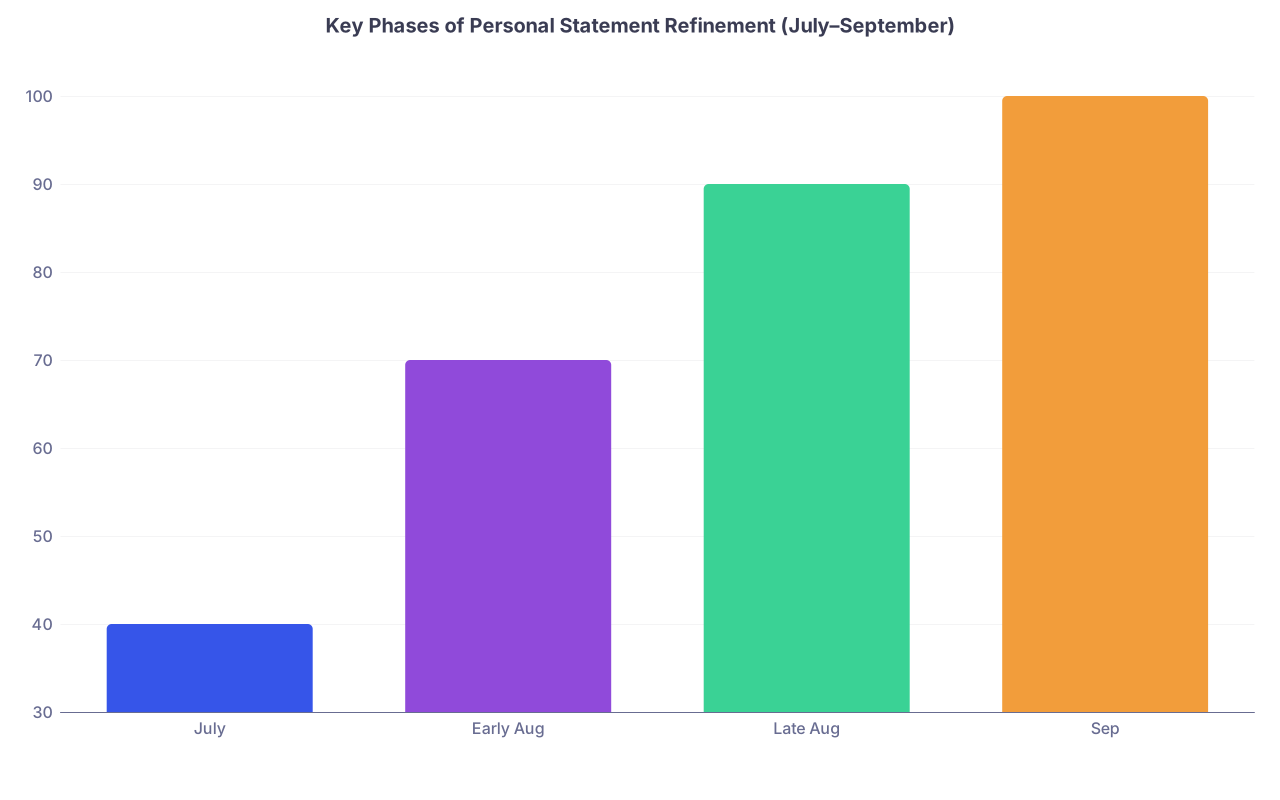
| Category | Value |
|---|---|
| July | 40 |
| Early Aug | 70 |
| Late Aug | 90 |
| Sep | 100 |
Early August (Aug 1–15): Start listening for patterns
At this point you should:
- Review your early interview invites and rejections
Look at:
- Which programs invite you early.
- Which remain silent or send early rejections.
You are not making wild conclusions from a handful of programs. You are scanning for alignment between:
- Your personal statement themes.
- The type of programs that seem interested.
Ask yourself:
- Do my themes scream “academic” while only community programs are inviting me?
- Does my PS emphasize research heavily when I actually applied to mostly clinical programs?
If the mismatch is obvious, flag it. You will address it with targeted tweaks, not a full rewrite.
- Run 2–3 serious mock interviews
One of the most efficient ways to stress‑test your personal statement is to listen to your own mouth when faculty ask:
“So tell me about yourself.”
“I read your personal statement. Can you expand on…”
During mock interviews, notice:
- Which parts of your PS are easy to talk about.
- Which stories feel forced or thin when you re‑tell them.
- Which experiences you keep mentioning that are not actually in your PS.
After each mock:
- Add entries to your Personal Statement Log:
- “Mock with Dr. Patel – she said the QI project sounded more unique than the clinic story.”
- “I naturally talked about being a first‑gen student; barely in PS now.”
Patterns will emerge.
- Do a “consistency audit” against your actual interviews
Use this simple check:
- Print your PS.
- Highlight:
- In yellow: things that interviewers asked about.
- In blue: things you wish they had asked about but never do.
- In red: things they never bring up and that you do not enjoy defending.
At this point you should decide:
- Anything yellow → probably keep and strengthen.
- Anything blue that matters deeply → consider surfacing more clearly.
- Anything red → consider trimming or reframing.
Late August (Aug 16–31): Prepare version updates and specialty‑specific tweaks
By late August, you are usually in one of three situations:
- A: You have a steady stream of interviews.
- B: You have a trickle and are worried.
- C: You have almost none yet (some specialties are later).
Regardless, this is your window to prepare refined versions before the heavy interview load hits.
At this point you should:
- Create a “Version 2.0” master statement (do not upload yet)
Using your logs and audits:
- Swap in one of your alternate intros if:
- Faculty keep asking about a different story than your current opener.
- Your intro feels disconnected from your strongest interview answers.
- Tighten any sections that feel over‑explained in live conversation.
- Emphasize the 2–3 themes that:
- Interviewers consistently react positively to.
- You genuinely enjoy talking about.
Version 2.0 should:
- Be more focused.
- Align better with what real people care about.
- Remove content you dread discussing.
- Build 1–2 “program‑type” variants
Do not go crazy customizing for every single hospital. That is how people burn out and make mistakes.
Instead, create variants by program type:
For example, in Internal Medicine:
- Academic‑leaning variant:
- Stronger emphasis on teaching, research, QI.
- More detail on scholarly output.
- Community‑focused variant:
- Stronger emphasis on continuity, underserved care, real‑world responsibilities.
- Less space on bench research, more on direct patient care and teamwork.
You might end up with:
PS_IM_academic_v2_2026-08-20PS_IM_community_v2_2026-08-20
Same core story, slightly different emphasis.
- Decide your upload strategy
ERAS lets you assign different personal statements to different programs. At this point, you should:
- Keep Version 1.0 assigned to programs that have already downloaded your file.
- Assign Version 2.0 or a program‑type variant to:
- Programs you add later.
- Programs that have not yet downloaded your PS (if you track this via ERAS status, when visible).
Do not panic‑swap statements blindly. Change only when the new version is meaningfully better and better aligned.
September: Real‑Time Refinement During Interview Season
By September, interview invites are actively rolling in for many fields. You are now testing your personal statement in real time with actual faculty and residents.
This month is about micro‑refinements and story coherence, not endless editing.
Week‑by‑week: How to use interviews to sharpen your PS
Let us break September into four practical blocks.

| Step | Description |
|---|---|
| Step 1 | Week 1: First Interviews |
| Step 2 | Week 2: Pattern Recognition |
| Step 3 | Week 3: Strategic Tweaks |
| Step 4 | Week 4: Final Stabilization |
Week 1 of September: First real interviews
At this point you should:
- Track every time your personal statement is mentioned
In your Personal Statement Log, after each interview, record:
- Did they explicitly say, “I enjoyed your personal statement”?
- Which line or story did they mention?
- What follow‑up question did they ask?
Typical comments I hear residents report:
- “Your story about the ICU night shift—tell me more about that.”
- “I liked your description of mentoring younger students.”
- “You mentioned wanting to be in an academic center. Why?”
Each of those comments is data:
- ICU story = anchor. Keep.
- Teaching = genuine interest. Maybe emphasize further in future variants.
- Academic vs community tension = ensure you are not saying “academic only” to community programs.
- Note any moments of internal cringe
Every time you think:
- “I hope they don’t ask about that line.”
- “I kind of exaggerated that project.”
- “That story sounds better on paper than it felt in real life.”
Write it down that same day. Those are candidates for removal or reframing if you create late‑season variants or need a version for SOAP.
Week 2 of September: Identify real patterns
After 3–5 interviews, patterns start to stabilize.
At this point you should:
- Re‑read your statement as if you were the PD
Imagine you are the program director who just spent 6 hours on Zoom interviews. Tired, scanning, looking for:
- Consistency.
- Red flags.
- Memorable hooks.
Ask:
- Does my statement lead naturally to the things I actually said in interviews?
- Are there any claims that feel off when I compare them to my real answers?
- Does the tone on the page match how I present myself live?
You want one coherent character:
- The written “you” and the interview “you” should match.
- Decide on one last structural change—if needed
This is the last point where I recommend real structural adjustments. Example changes:
- Replace your opening story with the one every interviewer keeps asking about.
- Shift a paragraph from “why this specialty” to “what I bring to a team” if that is what programs clearly care about.
- Clarify your career goals if you have shifted (e.g., realizing you actually want academic medicine after talking with several faculty).
Push this to a Version 2.1 or 2.2. After this, no more major reworks.
Week 3 of September: Tactical tweaks and alignment
Now you are in the rhythm of interviews. Your energy is limited. Editing should be surgical.
At this point you should:
- Refine for your best‑fit programs
Look at your interview list. Identify:
- 5–10 programs where you could genuinely see yourself thriving.
- Match your PS emphasis to the traits they explicitly value (from their website / conversations).
You might:
- Add one sentence about your interest in resident teaching for programs that stress education.
- Slightly expand the underserved care line for safety‑net hospitals.
Do not lie. Do not copy‑paste their mission statement into your PS. That is transparent and lazy. But you can tune which of your authentic priorities you foreground.
- Prepare for late‑cycle opportunities
Sometimes new programs pop up, or you decide late to apply to a few extra sites.
For these late programs:
- Use your most current, most aligned version (likely Version 2.1/2.2).
- Double‑check that any strong statements about “academic only” or “big city only” do not conflict with programs in smaller, community, or mixed settings—unless you actually mean it, in which case accept that it may limit you.
Week 4 of September: Stabilize and stop rewriting
By the final week of September, you should stop major edits. Endless tweaking at this point introduces mistakes and erodes authenticity.
At this point you should:
- Freeze your final interview‑season version
Choose:
- One primary PS per specialty for any additional programs.
- Keep a clear record:
- Which programs got which version.
- The major differences between versions (so you remember what they read when you interview in November or December).
- Align your interview answers with your final PS
Read your final statement and ask:
- Can I comfortably expand on every sentence if asked?
- Do I have at least one clear talking point ready for:
- My main clinical story.
- My most meaningful activity.
- My stated career goals.
You want to avoid:
- “I wrote that a long time ago, I don’t really remember.”
- “Oh, that part is not that important actually.” (Programs notice that disconnect.)
- Park a backup version for worst‑case scenarios (SOAP / late changes)
Life happens:
- You might need a slightly re‑angled PS if you end up in SOAP.
- You might switch focus slightly (e.g., from academic‑heavy to community‑focused).
Store:
- One generalist, low‑risk, honest version.
- Ready to deploy quickly if the match does not go as planned.
Day‑by‑Day Habits During Interviews
Across July–September, especially once interviews start, your personal statement refinement should fit into short, structured blocks. Not sprawling late‑night rewrites.
On any interview day, this is enough:
Morning (before interview)
- Skim the version of your PS that program received.
- Mentally rehearse:
- Your opening “tell me about yourself.”
- 2–3 PS‑related stories you expect to come up.
End of day (15–20 minutes)
- Immediately after the interview, log:
- Any PS lines or stories they explicitly referenced.
- Any new experiences or themes you found yourself emphasizing.
- Any tension or mismatch you noticed.
Once a week (not daily)
- Review the log.
- Decide if any pattern justifies a small PS tweak for new programs.
- If yes, do it in one focused sitting. Then stop.
Your next step is simple:
Open your current personal statement and create a one‑page Personal Statement Log for July–September. Write down your 3–5 anchor themes and set up columns for date, program, and feedback. That document will guide every intentional refinement you make from your next interview onward.