
The last week before ERAS submission is not for writing your personal statement. It’s for fixing what will quietly sink it.
You’re out of time for big reinventions. But you have plenty of time to ruin a decent essay with rushed edits, sloppy specialty versions, and last‑minute “advice” from five different people. I’ve watched strong applicants do exactly that—then wonder why interviews felt light for their numbers.
Let’s walk through how to use the final 7 days intentionally.
7 Days Before ERAS Submission: Lock the Foundation
At this point you should stop drafting from scratch.
You need a frozen baseline version of your personal statement for your primary specialty.
Day 7 – Morning: Choose Your True “Primary” Version
If you have 3–4 half-decent drafts floating around, pick one.
By noon today you should:
- Decide your primary specialty (the one getting most of your apps).
- Decide your primary statement for that specialty.
- Save it as something obvious:
PS_IM_Final_Base_SeptXX.docx.
Non-negotiable:
No major structural rewrites after today. You can cut, polish, clarify. You’re done “reimagining.”
Day 7 – Afternoon: Purpose + Spine Check
Now you make sure this statement actually has a backbone.
By end of Day 7, your statement should clearly answer:
Why this specialty?
Not “I like variety” or “I love procedures.” Those are filler. I mean:- What specific aspects of the work can you actually picture doing at 2 a.m.?
- Where did you see those things on rotations or sub‑Is?
Who are you as a resident?
Two to three traits that show up in your stories:- “Calm in chaos during cross-cover nights.”
- “Methodical and meticulous in pre-op prep.”
- “Persistent with difficult family dynamics.”
Where are you headed?
Not a paragraph-long fantasy fellowship plan. One or two lines:- “I hope to pursue fellowship in cardiology and work in an academic center.”
- “I’m drawn to community-based practice with a strong teaching role.”
Do a spine outline on scratch paper:
- Hook: ____________________
- Core story 1: ____________________
- Core story 2: ____________________
- Why this specialty: ____________________
- Future direction: ____________________
- Closing line: ____________________
If you can’t fill that out in under 5 minutes, your statement is wandering. Tighten today. Not later.
6 Days Before: Content Surgery, Not Cosmetic Edits
At this point you should fix substance before style.
Day 6 – Morning: Ruthless Cut Session (20–25% Shorter)
Your PS is probably too long and too vague. Most are.
Target length range: 650–800 words. Shorter and focused beats long and rambling.
By midday today:
- Print your statement.
- Take a pen. Cross out:
- Any sentence that could be copied into a PS for a different specialty.
- Any cliché you’ve seen before:
- “Ever since I was a child…”
- “Medicine is both an art and a science.”
- “I want to give back to the community.”
- Any description of the patient’s life story that doesn’t reveal you.
- Any paragraph that could stand alone as a personal essay, but doesn’t clearly tie to residency.
You’re not deleting permanently yet. Just slashing on paper. You’ll clean in Word later.
Rule of thumb:
If you’d be embarrassed to read a line out loud to a resident you respect, cut it.
Day 6 – Afternoon: Show, Then Tell
Now make sure your claims are backed by receipts.
Pick your 2–3 strongest moments and sharpen them. Example fix:
- Weak: “I learned the importance of communication on my OB rotation.”
- Better: “On OB, I was paged to speak with a patient who had refused induction twice. I sat at her bedside, listened as she described a previous traumatic birth, and realized the resident team hadn’t heard that story at all.”
Then, one explicit takeaway:
- “That conversation shifted how I approach patient ‘noncompliance’—as often a failure of listening, not of the patient.”
By end of Day 6:
- Every paragraph should either:
- Reveal character through a specific story, or
- Clearly explain your fit for the specialty.
- You should have removed at least 1 full paragraph of fluff.
5 Days Before: Specialty Alignment + Versions
At this point you should finalize which specialties get which statement.
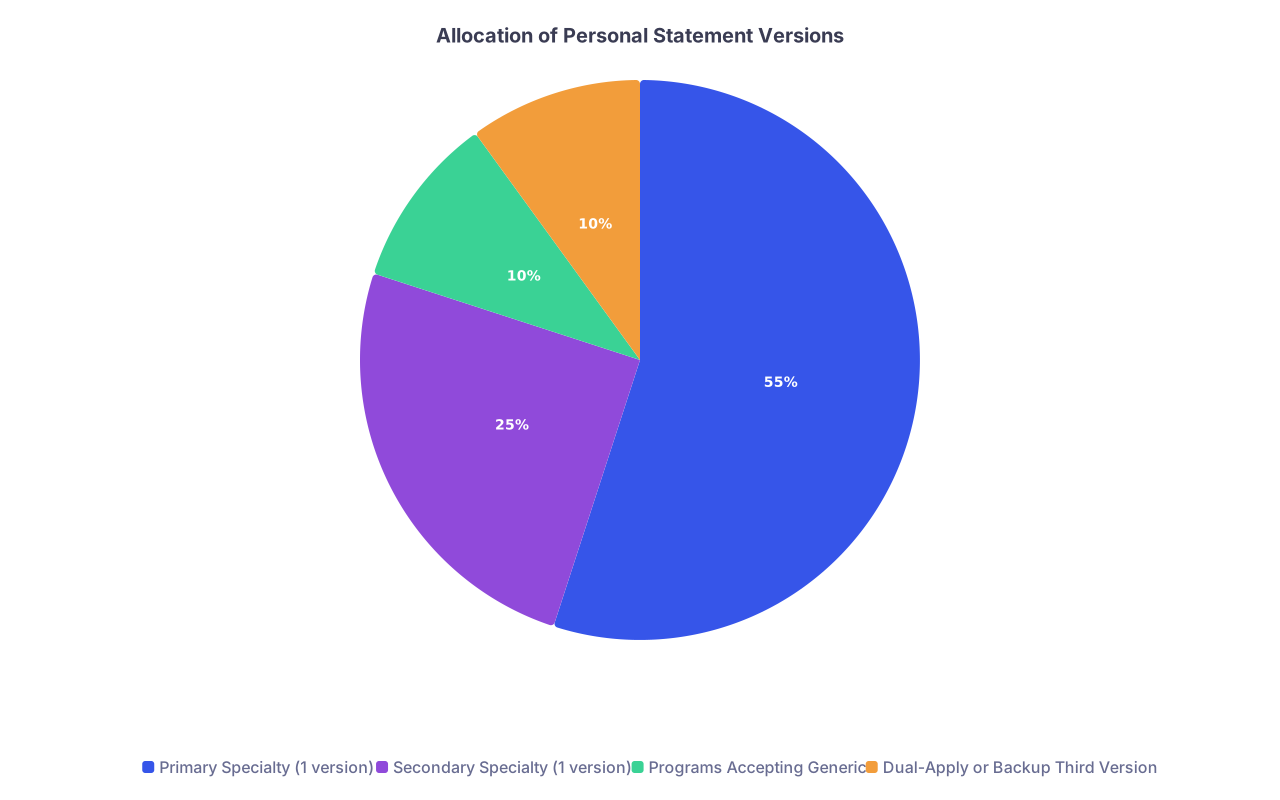
| Category | Value |
|---|---|
| Primary Specialty (1 version) | 55 |
| Secondary Specialty (1 version) | 25 |
| Programs Accepting Generic | 10 |
| Dual-Apply or Backup Third Version | 10 |
Day 5 – Morning: Decide Your Versions
By noon today, you should have:
- 1 main statement for your primary specialty.
- 1 alternate statement if you’re truly dual-applying (e.g., IM + Neurology, Gen Surg + Anesthesia).
- Optional: a generic but still honest version only if required by some prelim/transitional programs.
Do not:
- Use the exact same statement for IM and EM with just the word “internal” swapped for “emergency.” Program directors can smell that a mile away.
- Write 6 different statements you’ll never properly polish.
Day 5 – Afternoon: Align Content with Specialty
Now you check if your content belongs in that specialty.
Ask yourself for each version:
- Do at least 2 stories involve that specialty directly or a closely related environment?
- Does your reasoning for the specialty go beyond:
- “I like continuity of care”
- “I love procedures”
- “I enjoy working with my hands”?
You need specific links. Examples:
- For IM: managing diagnostic uncertainty, longitudinal follow-up, complex multi-morbidity.
- For EM: rapid triage, shifting gears, tolerating incomplete information.
- For Surgery: love of the OR environment and willingness for the lifestyle grind.
By end of Day 5:
- Each PS version should clearly scream its specialty by feel, even if you never name it in the first paragraph.
4 Days Before: Voice, Flow, and Red Flag Sweep
At this point you should clean tone and make sure you’re not accidentally sending up flares.
Day 4 – Morning: Read It Out Loud (Seriously)
Aloud. Full volume. No mumbling.
While reading, mark:
- Places you trip over phrasing.
- Overly long sentences (more than ~2 lines on screen).
- Any spot where you, as the reader, get bored.
Cut or split sentences. Example:
- Too long: “During my third-year internal medicine rotation at a community hospital, I learned the importance of a multidisciplinary approach as I cared for complex patients with multiple comorbidities, often requiring collaboration between cardiology, nephrology, and social work.”
- Cleaner: “On my third-year IM rotation at a community hospital, I learned what a real multidisciplinary team looks like. Our typical patient had three consultants and a social worker. The complexity wasn’t theoretical anymore.”
By midday, your statement should sound like how you’d talk to a PD in their office—professional, but human.
Day 4 – Afternoon: Red Flag Check
You’re looking for landmines. These are common:
Excuses that don’t land
- Long paragraphs about a bad Step score, leave of absence, or failure.
- Over-explaining personal hardship without clear growth.
- If it needs explanation, consider using the ERAS “Additional Information” section instead.
Bitterness
- Complaints about prior programs, attendings, systems.
- Phrases like “was not given the opportunity” or “unfairly evaluated.”
Savior complex
- “I realized I was the only one who cared.”
- “No one else was willing to sit with him except me.”
Oversharing
- Graphic descriptions of trauma, abuse, or death that feel exploitative.
- Details that would humiliate a patient if they read them.
By end of Day 4, your statement should:
- Take responsibility for your path.
- Avoid defensiveness.
- Show resilience without trauma-dumping.
3 Days Before: External Feedback (The Right Kind)
At this point you should stop self-editing and let a small, curated group read.
Day 3 – Morning: Select 2–3 Reviewers
You do not need ten reviewers.
Ideal mix:
- 1 resident or fellow in your chosen specialty (or very close).
- 1 attending or core faculty who has read many PSs.
- Optional: 1 non-medical but sharp reader for clarity and flow.
Avoid:
- The class GroupMe committee.
- That one super-anxious friend who wants to rewrite everyone’s narrative.
- Family members who insist you must “sound more impressive.”
Send them:
- The PS + word limit target.
- Your specialty.
- A short note: “Can you tell me 1) what you remember after reading, 2) anything confusing or cringey, and 3) any major red flags?”
Give them a 48-hour deadline. You don’t have time for slow edits now.
Day 3 – Afternoon: Walk Away
Seriously. Do not touch the document for a few hours.
Use the time to:
- Double-check ERAS PS assignments (which programs see which version).
- Review your experiences list language so it matches the tone and themes of your PS.
2 Days Before: Integrate Feedback Strategically
At this point you should make targeted changes, not let others rewrite you.
Day 2 – Morning: Sort Feedback into Three Buckets
Open a blank page and create:
Must-fix (clarity/accuracy/red flags)
- “This story is confusing.”
- “This line sounds arrogant/defensive.”
- “This paragraph contradicts your experiences section.”
Probably helpful (style/flow)
- Suggestion to tighten or shift paragraphs.
- Notes about repetition.
Ignore (preference only)
- “I’d start with a quote.”
- “You should sound more academic.”
- “Can you add more big vocabulary?”
You’re allowed to disagree. Your name is on this, not theirs.
Day 2 – Afternoon: Make One Clean Pass
Now do one integrated revision pass:
- Fix all must-fix items first.
- Choose only the best 2–3 style suggestions per reviewer.
- Ensure your voice is still yours. If it now sounds like a committee, you’ve gone too far.
Then:
- Run a spell check.
- Run a grammar check only as a tool, not a dictator. Ignore the suggestions that kill your voice.
By end of Day 2:
- Your content is final. No more new stories. No new paragraphs.
- Only micro-edits allowed from here on.
1 Day Before: Formatting, ERAS Upload, and Final Assignment
This is where people make dumb, preventable mistakes. You won’t.
Day 1 – Morning: Format for ERAS
Copy your final PS into a plain text editor (Notepad/TextEdit) to strip weird formatting. Then into ERAS.
Check:
- No strange symbols (curly quotes gone wrong, long dashes turned into boxes).
- Paragraph breaks are correct.
- No random double spaces or blank lines.
Now confirm word/character comfort:
- ERAS uses character count, but if you’re in that 650–800 word zone, you’re fine.
- You don’t need to max out the space. “Dense enough” is better than “wall of text.”

Day 1 – Afternoon: Assign to Programs Carefully
This part is tedious. Do not rush it.
Make a simple checklist:
- Primary specialty PS → all categorical programs in that specialty.
- Alternate specialty PS → all programs of that specialty.
- Generic/backup version → prelims/TYs that don’t specify otherwise.
Double-check:
- You haven’t accidentally assigned your EM PS to an IM program.
- Every program has some PS assigned—none left blank.
This is also when you:
- Save a PDF screenshot or printout of the ERAS PS screen (for your records).
- Save your final statement versions with clear names and date.
By end of Day 1, your PS should be fully uploaded and assigned. You’re not editing text in ERAS the morning of submission unless something is truly broken.
Submission Day: Micro-Check and Let It Go
You don’t rewrite on submission day. You verify and move on.
Submission Day – 30–45 Minutes Before You Hit Submit
Quick, structured check:
- Open ERAS → Personal Statement section.
- Click each final PS:
- Scan the first and last sentence.
- Confirm no obvious typos jumped in during copying.
- Confirm assignments one last time by scrolling the program list.
If you find:
- A minor style thing you now dislike? Leave it.
- A genuine typo or missing word? Fix it once, re-scan quickly, stop.
Do not:
- Add a new paragraph.
- Swap in a just-edited file.
- Change your whole opener at the last minute because a friend texted you “You should be more dramatic.”
After Submission: Stop Obsessing
You will notice imperfections after you submit. Everyone does.
Program directors aren’t hunting for flawless prose. They’re scanning for:
- Coherence: Can you think clearly?
- Professionalism: Do you seem grounded?
- Fit: Does your story match your specialty and your application?
If you followed this week’s timeline, you’ve handled those pillars.
Sample “Last Week” Micro-Timeline Overview
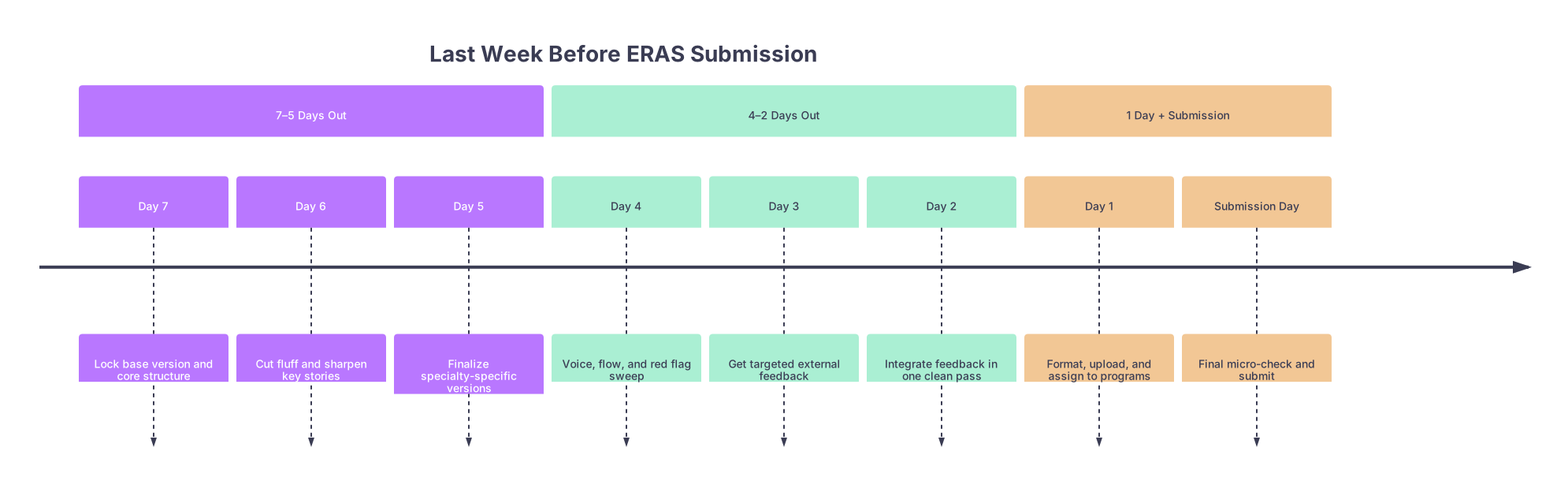
| Period | Event |
|---|---|
| 7–5 Days Out - Day 7 | Lock base version and core structure |
| 7–5 Days Out - Day 6 | Cut fluff and sharpen key stories |
| 7–5 Days Out - Day 5 | Finalize specialty-specific versions |
| 4–2 Days Out - Day 4 | Voice, flow, and red flag sweep |
| 4–2 Days Out - Day 3 | Get targeted external feedback |
| 4–2 Days Out - Day 2 | Integrate feedback in one clean pass |
| 1 Day + Submission - Day 1 | Format, upload, and assign to programs |
| 1 Day + Submission - Submission Day | Final micro-check and submit |
Quick Self-Check Table: Are You Actually Ready?
| Checkpoint | Status (Yes/No) |
|---|---|
| Single primary PS version locked | |
| Specialty-specific content present | |
| Length trimmed to ~650–800 words | |
| Red flags and bitterness removed | |
| 2–3 trusted reviewers gave feedback |
Last 24 Hours: Emotional Reality Check
You’re going to feel like:
- “My PS is boring.”
- “Everyone else’s is probably better.”
- “Should I add that one life story I cut?”
No. At this point you should trust the work you’ve already put in.
One solid, grounded, specialty-aligned personal statement beats the dramatic, last-minute Frankenstein essay every time. I’ve seen PDs skim statements in 45 seconds and say, “Clean. Knows what they want. No drama. Good.”
Aim for that reaction.
Today’s Concrete Action
Right now, open your current personal statement and circle the first and last paragraph. Ask yourself, bluntly:
- Does the first paragraph clearly belong to my chosen specialty?
- Does the last paragraph sound like the resident I actually plan to be next July?
If the answer to either is “not really,” fix just those two paragraphs today—then follow the rest of this week’s timeline without improvising.