
The worst personal statements are not underwritten. They’re over‑edited to death.
You’re not struggling with what to say as much as when to stop messing with it. And if you do not put hard dates on starting, stopping, and freezing edits, you will still be word‑smithing the night before you hit submit. That is how good content turns into bland mush.
Here’s the timeline I use with residents every year—month‑by‑month, then week‑by‑week, then day‑by‑day—so you know exactly when to start, when to pause, and when to force yourself to stop.
Big‑Picture Timeline: Start, Stop, Freeze
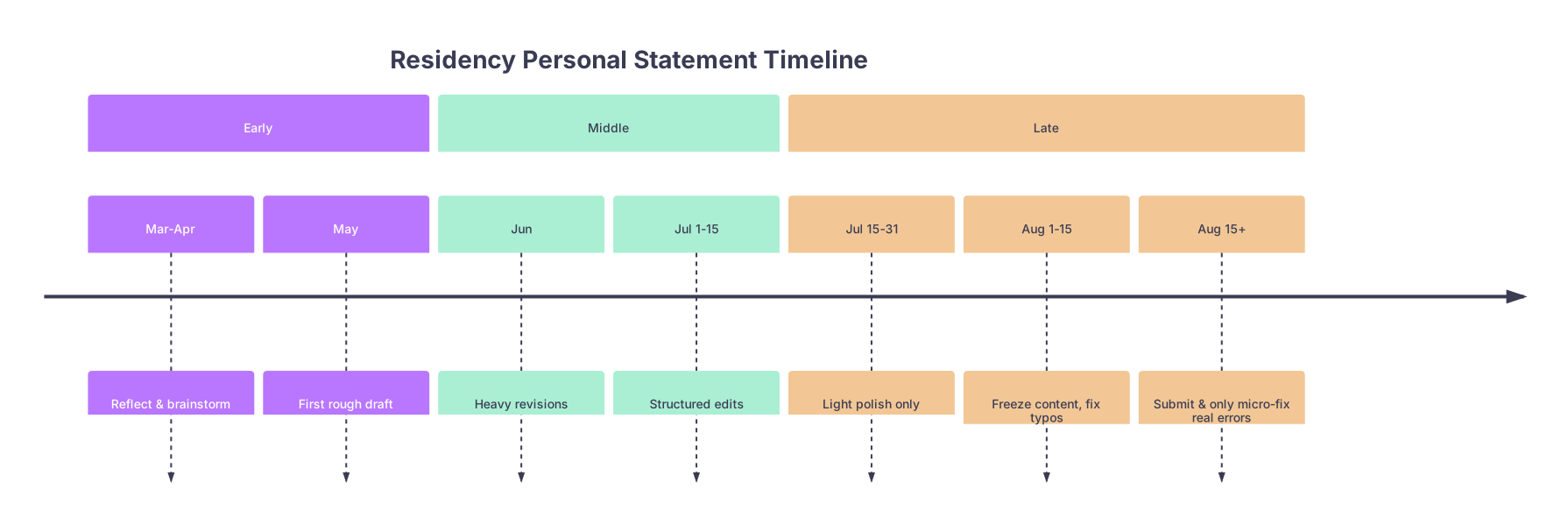
| Period | Event |
|---|---|
| Early - Mar-Apr | Reflect & brainstorm |
| Early - May | First rough draft |
| Middle - Jun | Heavy revisions |
| Middle - Jul 1-15 | Structured edits |
| Late - Jul 15-31 | Light polish only |
| Late - Aug 1-15 | Freeze content, fix typos |
| Late - Aug 15+ | Submit & only micro-fix real errors |
At this scale, your editing phases break down into three clear commands:
- START: When you go from vague ideas to actual words on a page
- STOP: When you stop making big changes to structure/content
- FREEZE: When you lock the story and only allow tiny surface edits
Let’s walk through the calendar the way you’ll actually live it.
Phase 1: The True Start — Reflection and Raw Drafting (March–May)
At this point you should not be “editing” anything. You should be generating material.
March–April: Reflection, Notes, Zero‑Pressure Writing
If you’re applying in the fall:
By March 15–31
- Block off 1–2 hours with no EMR, no pager, no group chats.
- Dump answers (bulleted, not pretty) to:
- Why this specialty?
- When did it actually click?
- Times you failed, got called out, or changed because of feedback.
- One patient story that still sits in your chest.
- This is not your statement. It’s the raw inventory.
April
- Once a week, 30–45 minutes:
- Expand one bullet into a messy paragraph.
- Voice memo yourself telling a story, then transcribe.
- Start a “line bank” of phrases that sound like you (not like UpToDate).
- Once a week, 30–45 minutes:
At this point you should not:
- Worry about word count.
- Ask attendings to “look at my statement.”
- Open “personal statement examples” for 2 hours and paralyze yourself.
You’re building clay. Editing comes later.
May: First Real Draft (Start Line: “I have a document called PersonalStatement_v1”)
By May 31, if you’re applying this cycle, you should have:
- A 650–900 word ugly first draft.
- A clear specialty focus. “Maybe IM or EM” is too vague; pick a direction for now.
- One anchor narrative (patient, rotation, event) instead of 6 scattered anecdotes.
How to write that first draft in 2 weeks:
Week 1 of May
- Day 1: Choose your opening story. Commit.
- Day 2–3: Write the story in full. No intro, no conclusion. Just what happened and what it meant.
- Day 4–5: Add:
- 1–2 paragraphs connecting that story to why the specialty fits you.
- 1 paragraph on what you’re like on a team / on call / under pressure.
- Day 6–7: Add a rough conclusion (“looking forward to” is fine for now; we’ll fix it later).
Week 2 of May
- Read the whole thing out loud once.
- Fix only what makes you cringe so hard you can’t keep reading.
- Save as PersonalStatement_v1 and stop.
You’ve officially started. Do not “polish” for the next person yet. They can’t fix a draft you’re still actively tearing apart.
Phase 2: Heavy Editing Window (June–Mid‑July)
This is where the real work happens. Structure, voice, and clarity. If you delay this, you end up making structural edits in September, which is how disasters happen.
June: Structural Revisions (Where you’re allowed to be ruthless)
By June 1–15, you should:
- Re‑read v1 after at least 7 days away.
- Answer (honestly):
- Is the first paragraph about a patient or about how you “always loved science”? If it’s the latter, rewrite.
- Can you summarize your main point in one sentence? If not, you do not have a clear arc.
- Would a stranger know your specialty by the end of paragraph 2?
Then:
- Create v2 with bold moves:
- Cut any paragraph that:
- Could appear in any applicant’s statement.
- Just lists achievements already on your ERAS.
- Move the best story to the top.
- Limit yourself to 1 primary narrative + 1–2 supporting moments.
- Cut any paragraph that:
At this point you should:
- Allow big rearrangements.
- Rewrite entire paragraphs.
- Change your opening and closing completely if they’re weak.
You should not:
- Obsess over synonyms.
- Wordsmith single sentences while the structure is still shaky.
Late June: Get Selective Feedback (Not a group edit circus)
By June 30, you should have v2 or v3 and:
- Sent it to 2–3 max people:
- One in your chosen specialty (resident or attending).
- One peer who knows you well.
- Optional: a career advisor / PD with a track record, not just a title.
Give them a clear, ruthless brief:
- “Don’t fix grammar yet. I want to know:
- Does this sound like me?
- Is anything confusing, cringe, or generic?
- After reading, what 3 words would you use to describe me as an applicant?”
Then schedule:
- 1–2 days for feedback to come back.
- 3–4 days to digest it before you touch the document.
At this point you should not:
- Let 7 different people line‑edit it into an attending‑voice robot essay.
- Try to please contradictory feedback from everyone. Pick 1–2 people you trust most and weight their input heavily.
Phase 3: The “Last Real Edits” Window (July 1–15)
This is where you stop making large changes. Yes, you could technically edit forever. No, you should not.
By July 1–7:
- Open PersonalStatement_v3 (or v4—fine).
- Make only these categories of edits:
- Clarity fixes
- Break up unwieldy sentences.
- Replace vague phrases (“I learned a lot”) with specifics (“I learned to call for help early when…).
- Redundancy cuts
- If you’ve said “I am a hard worker” more than zero times, delete the sentence and show it instead.
- Content alignment
- Make sure your examples match what you’re claiming.
- If you say you like “longitudinal care” in FM, you better have a continuity‑type story, not just ICU nights.
- Clarity fixes
By July 8–15, you should be on v4 or v5 and:
- Reading it out loud slowly.
- Fixing:
- Repeated words.
- Awkward phrasing.
- Section transitions that feel like a jump cut.
You should not at this point:
- Add new stories.
- Change your overall angle (“Actually, I want to make it about my research now.”)
Save that for a specialty‑specific research blurb in ERAS, not the PS.
This is your STOP line for big edits. Once mid‑July passes, anything more than a paragraph tweak is probably avoidance behavior disguised as “improvement.”
Phase 4: Locking the Story – The Freeze Period (July 15–August 15)
This is where most people mess up. They don’t freeze. They keep tinkering, lose their voice, and ship v19 that sounds like a committee wrote it.
You’re not one of those people.
July 15–31: Content Freeze, Surface Edits Allowed
At this point you should:
- Declare a content freeze:
- No new anecdotes.
- No restructuring sections.
- No changing your opening or closing paragraph themes.
What you are allowed to do (once or twice, not daily):
- Grammar and punctuation clean‑up.
- Tightening sentences:
- From: “I was able to learn how to communicate better with families.”
- To: “I learned how to communicate with families in crisis.”
- Cutting for length if you’re >850–900 words.
Make one dedicated polish pass:
- Day 1–2
- Grammar check with a tool if you want, but don’t obey every suggestion blindly.
- Make edits directly; save as PersonalStatement_FinalDraft.
- Day 3–4
- Print it or export to PDF.
- Read with a pen and mark only:
- Typos
- Truly clunky sentences
- Day 5
- Enter those corrections.
- Then stop.
By July 31, the Word/Google Doc version should be frozen. No more content adjustments.
Phase 5: ERAS Upload and Final Micro‑Edits (August 1–ERAS Submission)
ERAS opens. Everyone panics. This is where people blow through their own freeze because “I just thought of a better line.”
Resist that.
August 1–10: Transfer, Verify, Micro‑Fix Only
At this point you should:
- Copy/paste your FinalDraft into ERAS.
- Check for:
- Paragraph breaks preserved.
- No weird characters from formatting.
- Proper name spelling (hospitals, mentors, institutions).
- Read it in ERAS, not in your Word document.
You’re allowed to fix:
- Obvious typos you somehow missed.
- Spacing or line break issues.
- One or two micro‑phrasing tweaks only if they clearly improve clarity.
You are not allowed to:
- Swap stories.
- Rewrite whole paragraphs at midnight.
- Butcher the piece based on one friend saying, “You should start with a quote.”
August 10–Submission: Hard Freeze
By one week before your planned ERAS submit date (for most, that means around Aug 20, but adjust to your actual cycle year), you should institute a hard freeze:
- No further changes unless:
- You spot a factual error (wrong program name, incorrect date, etc.).
- You find a truly egregious typo (“pubic health” instead of “public health” level).
This is where your file naming matters. Use something like:
| Stage | File Name Example |
|---|---|
| First draft | PersonalStatement_v1_2026-05-10 |
| Structural edit | PersonalStatement_v3_2026-06-25 |
| Content freeze | PersonalStatement_FinalDraft.docx |
| ERAS pasted text | PS_ERAS_Confirmed_2026-08-05.txt |
The “Confirmed” file should match what’s in ERAS exactly. No secret edits that exist only in someone’s email attachment.
Specialty‑Switch & Late‑Decider Adjustments
Some of you will pivot specialties late. Or add a second specialty. That changes the start date for specialty‑specific tailoring, but not the logic of start/stop/freeze.
If You Decide Your Specialty in June
You’re behind on clarity, but not doomed.
At this point you should:
- Keep your core personal story the same.
- Rewrite:
- The “why this specialty” paragraphs.
- The conclusion to match the new field.
- Compress your heavy edit window into June–early July:
- 1 week: Rough new draft for the chosen field.
- 1 week: Structural edits + targeted feedback.
- 1 week: Polish and freeze.
Your hard stop for content changes is still mid‑July if you’re submitting in September. Don’t push structural changes into August.
If You’re Applying to Two Specialties
Then you essentially own one shared spine and two different overlays.
At this point you should:
- Lock a core version by late June that:
- Focuses on who you are.
- Uses a patient story that plausibly fits both specialties (e.g., IM + Neuro; FM + Peds).
- Build two specialty‑specific versions by early July:
- Different middle paragraphs.
- Different closing paragraph tailored to the field.
Then:
- Freeze both versions’ content by July 15–20.
- Allow only:
- Field‑specific terminology clean‑up.
- Program‑name checks before submission.
Do not keep rewriting the “IM version” the night before you submit while the “Neurology version” sits untouched and obviously weaker.
Week‑by‑Week Snapshot (For the “just tell me what to do when” crowd)
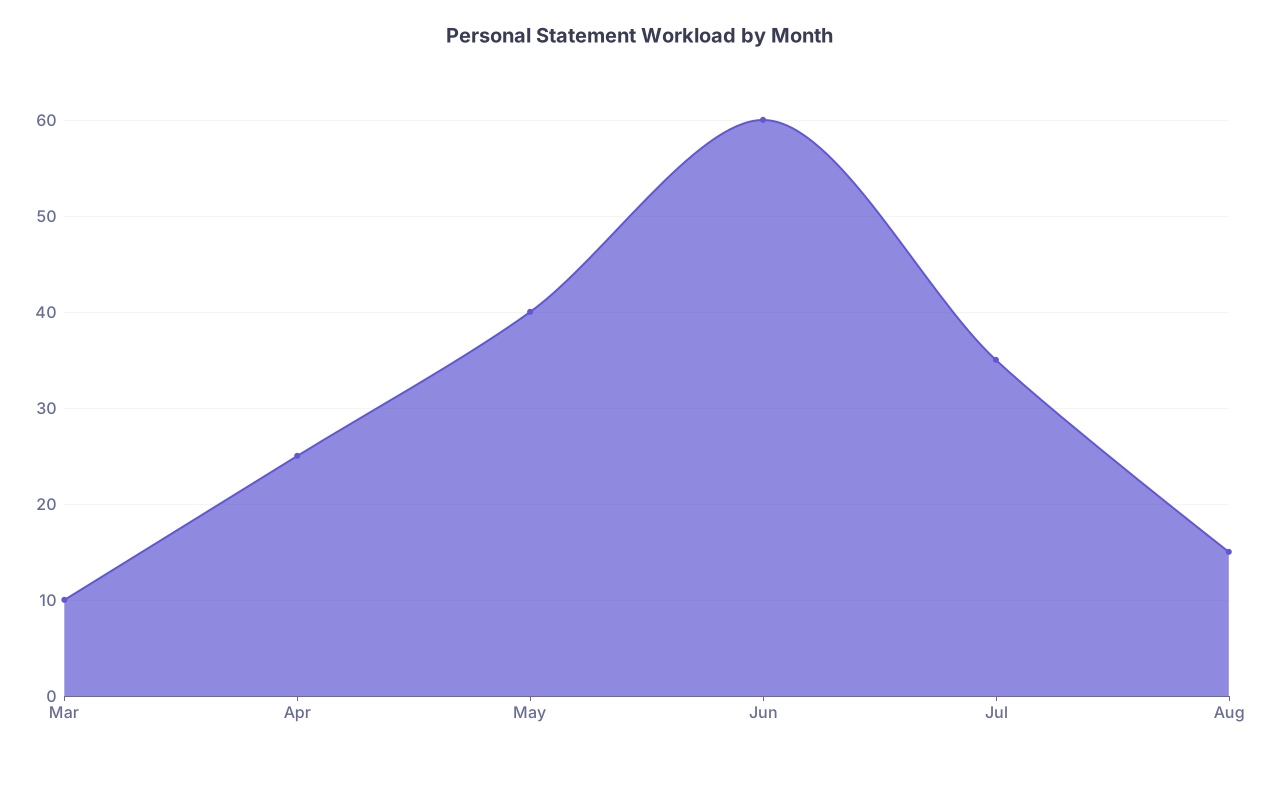
| Category | Value |
|---|---|
| Mar | 10 |
| Apr | 25 |
| May | 40 |
| Jun | 60 |
| Jul | 35 |
| Aug | 15 |
Here’s how it looks if you’re aiming to submit ERAS right when it opens:
- March
- 1–2 reflection sessions.
- Start your raw material document.
- April (weeks 1–4)
- Weekly 30–45 min story expansion.
- May (weeks 1–2)
- Draft v1 over ~5–7 days.
- May (weeks 3–4)
- Light self‑edit, arrive at v2.
- June (weeks 1–2)
- Structural edits → v3.
- June (weeks 3–4)
- Send for feedback, revise → v4.
- July 1–15
- “Last real edits” window. Land on v5 (or whatever number) as your true content version.
- July 15–31
- Content freeze. Only grammar/style tightening.
- August 1–10
- Transfer to ERAS, micro‑fixes.
- August 10–Submission
- Hard freeze. Stop touching it.
Red‑Flag Behaviors by Phase (And What To Do Instead)
I’ve watched the same patterns derail applicants every year. If you see yourself here, adjust early.
Early Phase (March–May) Red Flags
“I’m waiting until I know my Step 2 score to start.”
Translation: avoidance.
Fix: Start with stories, not scores. Your PS doesn’t care about your exact number.“I’ll just use my med school personal statement and tweak it.”
Bad move. They can tell.
Mid Phase (June–Mid‑July) Red Flags
“Can you take a quick look?” sent to 10 people.
You’ll get 10 incompatible versions back.Attending feedback that turns your voice into theirs:
- If you read it and can’t hear yourself speaking those words, walk it back.
Late Phase (Mid‑July–Submission) Red Flags
“I think I just had a better idea; what if I start with this other patient…” on August 18.
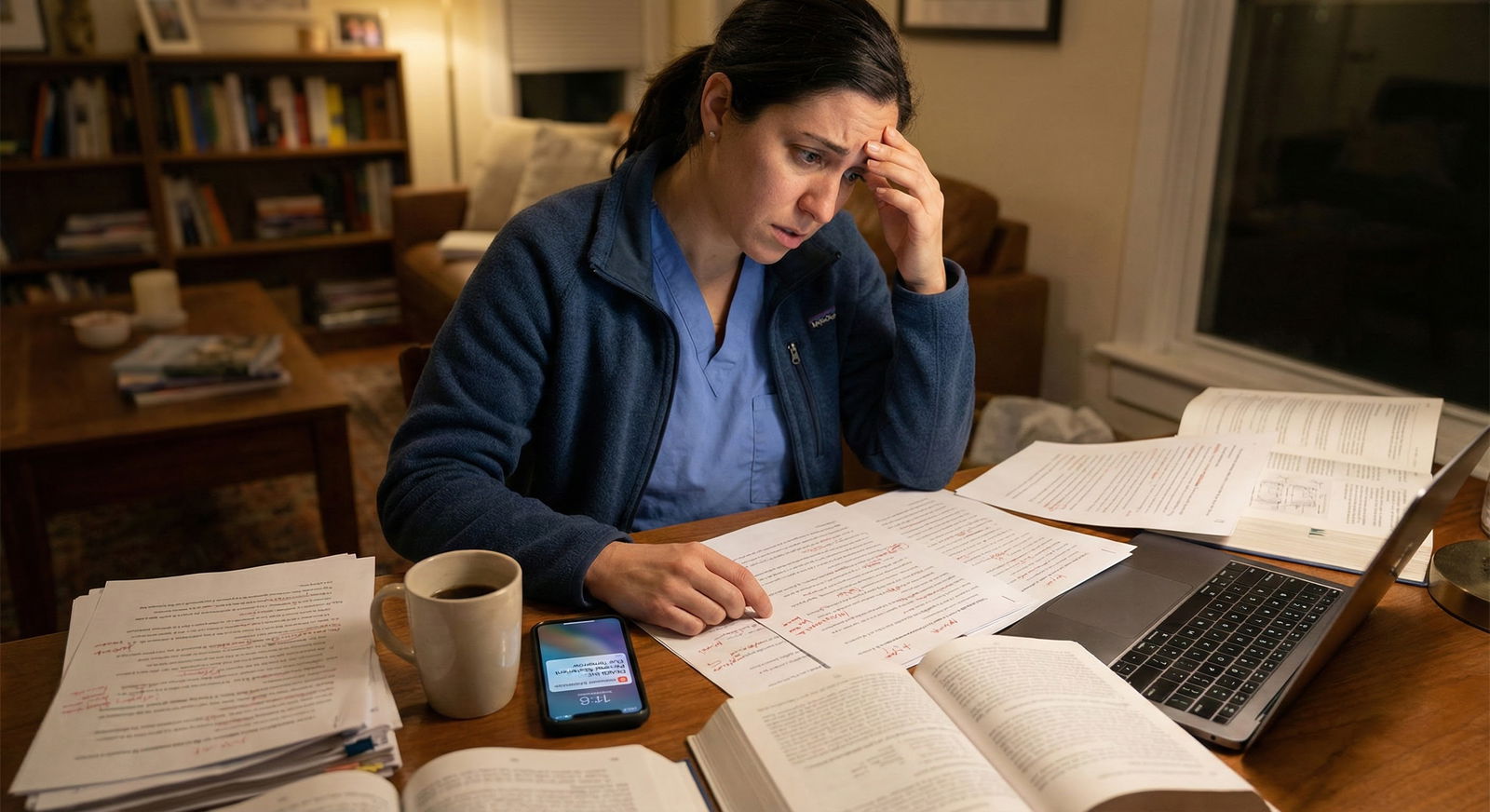
No. That’s panic, not insight.Editing because you’re anxious, not because you found a real flaw:
- Before changing anything, write down: “What specific problem am I solving?”
If you can’t answer, leave it.
- Before changing anything, write down: “What specific problem am I solving?”
Visual Flow: Decision Making Near the Deadline

| Step | Description |
|---|---|
| Step 1 | Want to change PS in Aug |
| Step 2 | Fix it |
| Step 3 | Do not change |
| Step 4 | One-time micro edit, then refreeze |
| Step 5 | Is it a typo or factual error? |
| Step 6 | Does it improve clarity significantly? |
| Step 7 | Does it change story structure or content? |
Put bluntly: in August, if it’s not a true error or a major clarity boost that does not alter your story structure, keep your hands off it.
Quick Reality Check on Length, Style, and Obsession
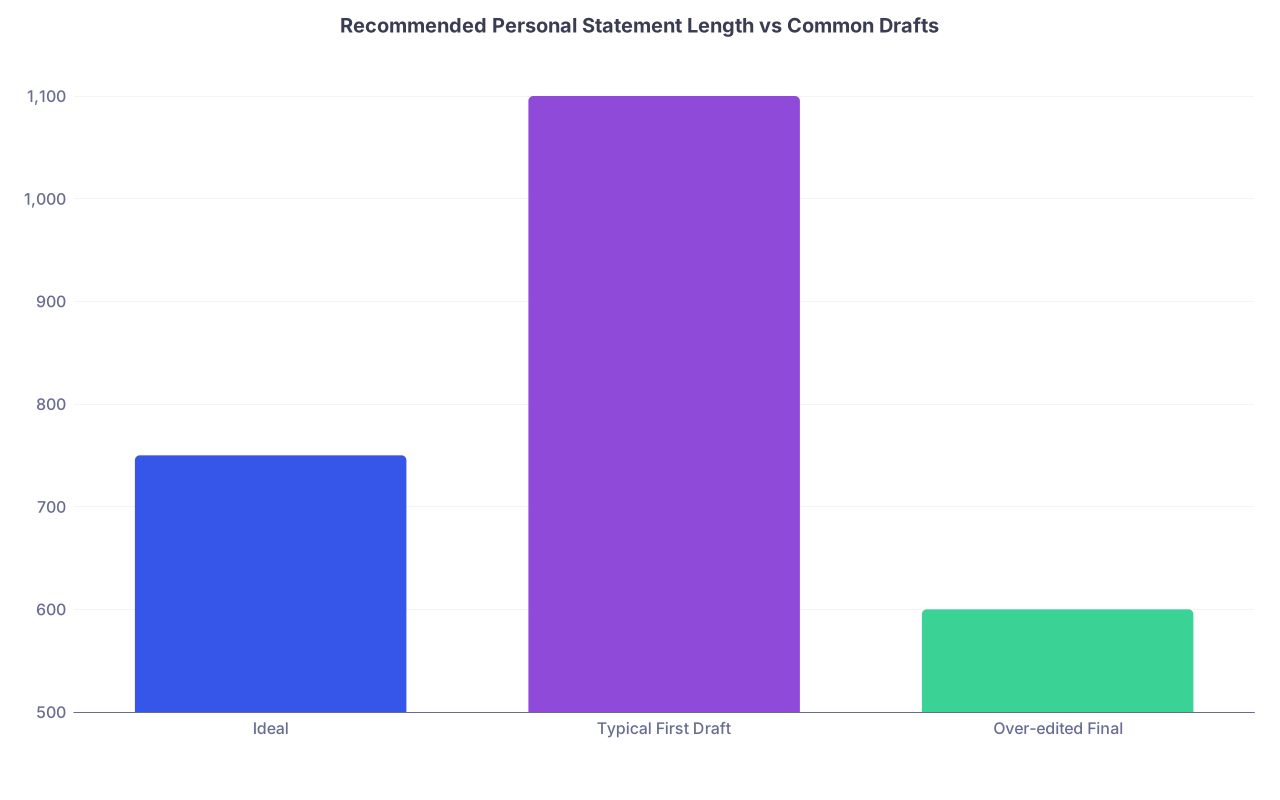
| Category | Value |
|---|---|
| Ideal | 750 |
| Typical First Draft | 1100 |
| Over-edited Final | 600 |
- Ideal final length: 650–800 words.
- If your first draft is 1100–1300 words, that’s normal. You’ll cut.
- If your “final” falls under 600 because you cut everything interesting, you over‑edited. Roll back to an earlier version and salvage your personality.
And style? At every phase ask:
- Could this sentence appear in 100 other people’s statements?
If yes, change it or kill it.
Two Sample Scheduling Patterns (Realistic Rotations Included)

| Stage | Hours/Week | Focus |
|---|---|---|
| March–April | 1–2 | Reflection & notes |
| May | 2–3 | Drafting v1–v2 |
| June | 2–4 | Structural edits & feedback |
| July 1–15 | 1–2 | Final content edits |
| July 15–Aug 10 | 1 | Polish & ERAS transfer |
You don’t need a sabbatical. You need focused, bounded time and a hard stop date.
If you’re on a brutal ICU month in June, front‑load May and early July for heavy edits. The principle stays: don’t push structural work into August.
Final Snapshot: When to Start, When to Stop, When to Freeze
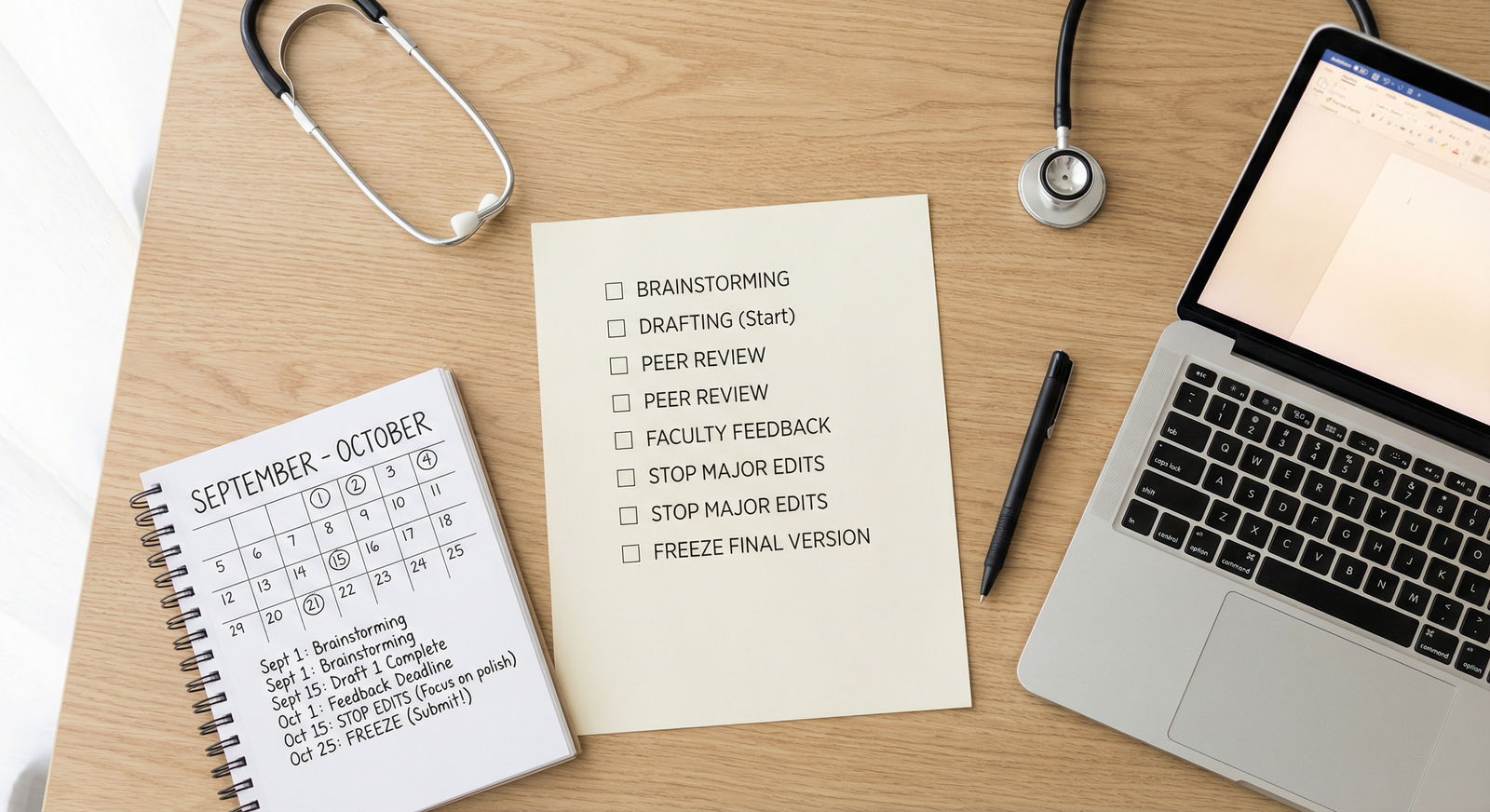
Here’s what I want you to walk away with:
- Start early with raw material (March–May) and a real draft by end of May. No one writes a strong statement in “a long weekend” without prior thinking.
- Stop major structural and content edits by mid‑July. Past that point, big changes usually make things worse, not better.
- Freeze the story by late July, then again fully once it’s in ERAS. August is for typos and formatting, not reinventing your narrative.
Follow those boundaries, and your personal statement will sound like a thoughtful future resident—not a terrified applicant still rearranging sentences at 2 a.m. the night before submission.