
The belief that your Step 2 CK score matters more than your personal statement is half right—and dangerously incomplete.
Programs absolutely screen with scores. But humans rank you. At specific times of the year, pouring another 20 hours into CK is smart. At other times, doing that instead of fixing a mediocre personal statement is just self-sabotage.
I’m going to walk you month-by-month through the application year and tell you, bluntly: “This month, CK rules.” Or, “This month, personal statement or you’re cooked.”
Big-Picture Timeline: CK vs Personal Statement
First, you need the aerial view. Then we’ll zoom into each month with specific to‑dos.
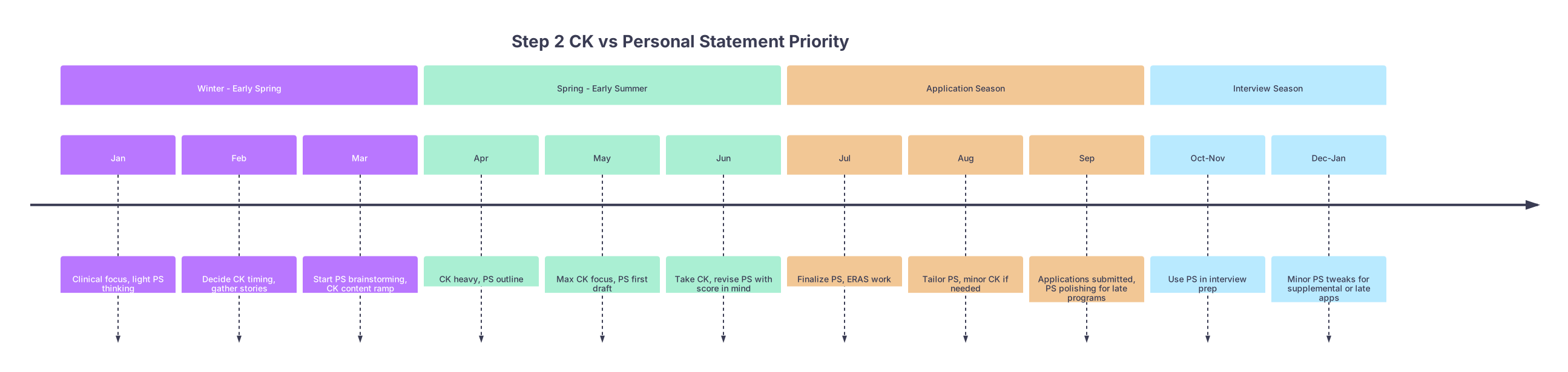
| Period | Event |
|---|---|
| Winter - Early Spring - Jan | Clinical focus, light PS thinking |
| Winter - Early Spring - Feb | Decide CK timing, gather stories |
| Winter - Early Spring - Mar | Start PS brainstorming, CK content ramp |
| Spring - Early Summer - Apr | CK heavy, PS outline |
| Spring - Early Summer - May | Max CK focus, PS first draft |
| Spring - Early Summer - Jun | Take CK, revise PS with score in mind |
| Application Season - Jul | Finalize PS, ERAS work |
| Application Season - Aug | Tailor PS, minor CK if needed |
| Application Season - Sep | Applications submitted, PS polishing for late programs |
| Interview Season - Oct-Nov | Use PS in interview prep |
| Interview Season - Dec-Jan | Minor PS tweaks for supplemental or late apps |
To make this practical, I’m assuming:
- You’re applying in the upcoming ERAS cycle.
- You haven’t taken Step 2 CK yet OR you took it recently and are waiting on scores.
- You’re somewhere between January and September of your application year.
If your dates are off by a month or two, shift the timeline, but keep the priority order.
January–February: Set the Foundation (Score Reality + Story Inventory)
At this point you should stop pretending you can “just do it all” at once. You cannot push a huge CK score jump and produce a thoughtful personal statement in the same compressed 3‑week window. You need sequencing.
January: Reality Check & Direction
Primary focus: Clinicals and deciding your Step 2 CK window.
Secondary: Very light personal statement prep.
This month, your main job is directional:
Confirm your CK target and test window
- If Step 1 was pass/fail only, Step 2 CK becomes your numerical flag.
- Competitive fields (derm, ortho, plastics, ENT, ophtho, rad onc): you cannot treat CK casually.
- Less competitive or backup specialty: you still cannot bomb it, but the pressure’s different.
Do a quick “story inventory”
- On your phone, open a note called “PS Stories.”
- Jot 5–10 very short bullets:
- Patients that stuck with you
- Times you were proud of yourself
- Times you screwed up and learned
- Feedback attendings gave you
- No full writing yet. Just capture raw material before you forget it.
At this point you should:
- Book a CK date range in your head (May–June for most).
- Have a note with at least 5 story seeds.
February: Commit to Timing, Start Collecting Content
Primary focus: Step 2 CK study ramp-up planning.
Secondary: Structured thinking for the personal statement.
Lock your CK date or 2–3 week window
- Look at your rotation schedule:
- Busy inpatient months? Do NOT slap CK in the middle.
- Lighter outpatient/electives? That’s your window.
- Aim for CK score release before programs start really filtering applications (August/early September).
- Look at your rotation schedule:
Deepen your story inventory
- Once a week, set a 20-minute timer.
- For each story seed, answer:
- What actually happened?
- What did I do?
- What changed because of me?
- What did I learn that changed how I practice?
No polished writing. Just messy paragraphs so you’re not starting from an empty page later.
At this point you should:
- Have a firm CK plan and rough study schedule.
- Have 3–5 half-page story chunks saved.
March–April: CK Takes the Wheel, PS Moves from “Idea” to “Skeleton”
From here, you’re balancing. But not equally. CK should still dominate your bandwidth.
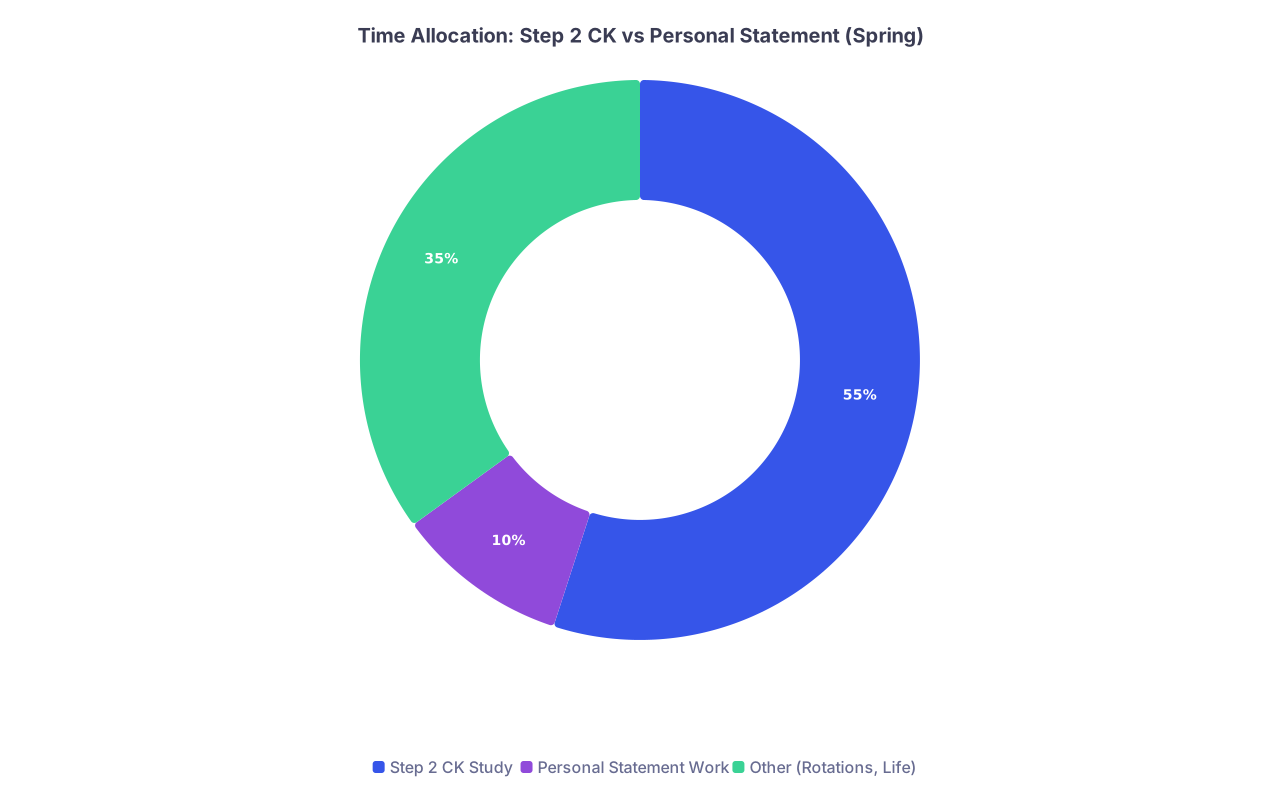
| Category | Value |
|---|---|
| Step 2 CK Study | 55 |
| Personal Statement Work | 10 |
| Other (Rotations, Life) | 35 |
March: Structured CK Prep, PS Outline
Primary focus: Build CK content foundation.
Secondary: Create a personal statement outline, not full prose.
Your weeks should look something like:
- Weekdays: Rotations + 2–3 hrs CK per day.
- 1 weekend day: 4–6 hrs CK.
- 1–2 hours per week: personal statement outline work.
Personal Statement work this month:
- Decide your core message in one sentence:
- “I’m an X who thrives in Y and wants Z.”
- Example: “I’m an internal medicine applicant who loves complex inpatient puzzles and wants a career in academic hospital medicine.”
- Pick 2–3 anchor stories from your inventory.
- Rough outline:
- Hook: 1 story/moment
- Middle: 2–3 paragraphs that connect your experiences to the specialty
- Ending: Future direction + what you bring to residency
Do not spend 10 hours trying to perfect your first sentence. That’s procrastination wearing a literary costume.
At this point you should:
- Have a CK resource plan (UWorld, AMBOSS, NBME schedule).
- Have a one-page PS outline with story bullets under each section.
April: CK Heavy, First PS Draft
Primary focus: Step 2 CK practice questions + first NBMEs.
Secondary: Write your first full draft of the personal statement.
CK:
- You’re now in serious QBank mode.
- First NBME or self-assessment by late April to see where you are.
- Tighten weak content areas.
Personal Statement:
- One goal this month: produce an ugly but complete draft.
- 650–850 words, depending on specialty norms.
- Do not worry about length on Draft 1; cut later.
Weekly PS plan:
- Week 1: Write the intro + first body paragraph.
- Week 2: Finish body.
- Week 3: Write conclusion.
- Week 4: Quick revise for clarity (not wordsmithing).
At this point you should:
- Have done at least one CK self-assessment.
- Have a complete personal statement draft that someone could read, even if you’re not ready to show them yet.
May–June: CK Domination, PS Strategic Refinement
This is where most people screw up. They either:
- Obsess over the personal statement at the exact wrong time and underperform on CK, or
- Ignore the personal statement completely, then panic in July.
You’re going to do neither.
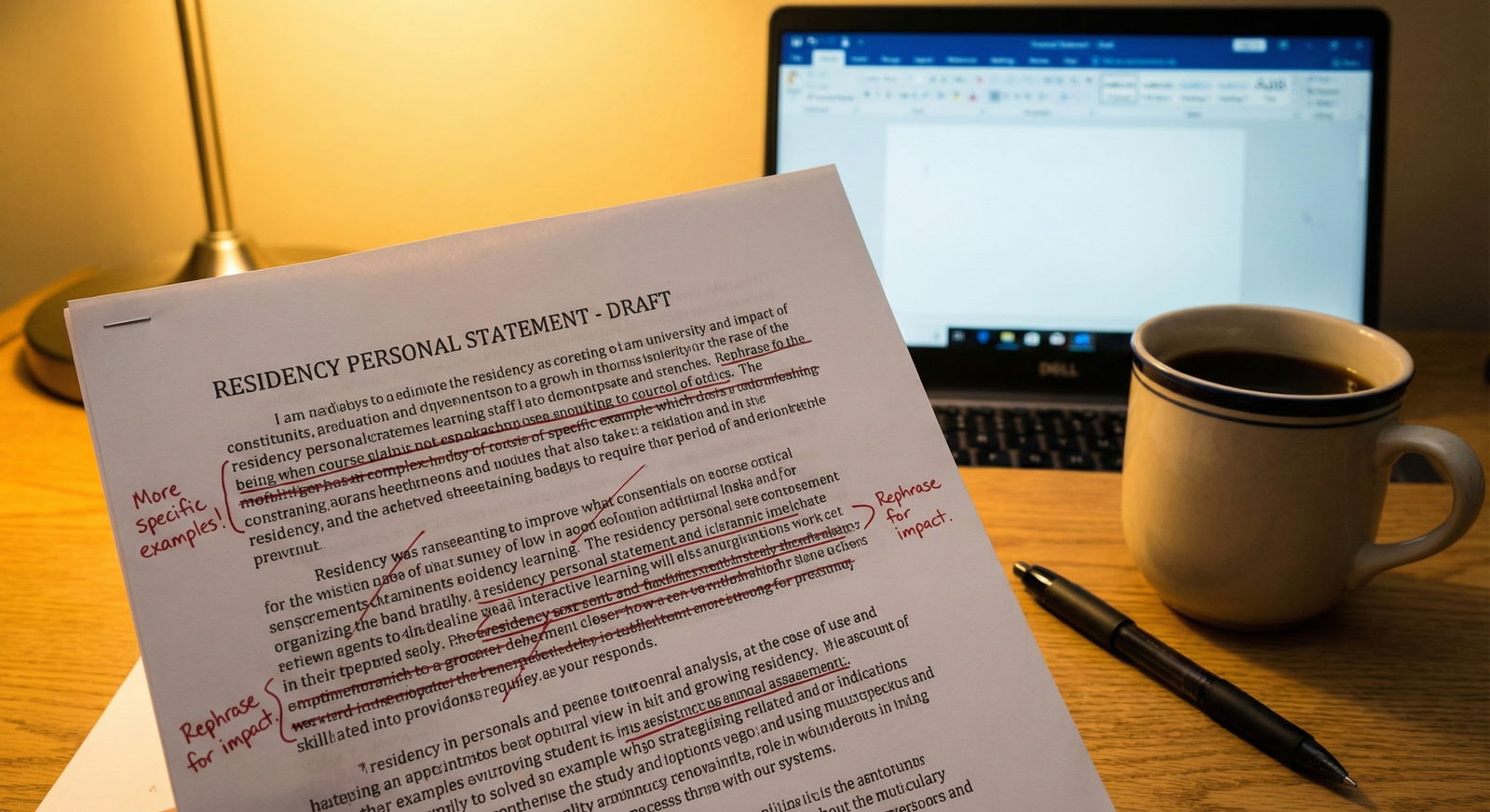
May: Max CK Focus, Thoughtful PS Revision
Primary focus: Maximize CK score trajectory.
Secondary: Tighten PS content once or twice this month.
CK:
- Full-length practice exams every 1–2 weeks.
- Daily question blocks, aggressive review.
- Adjust weak spots based on performance (e.g., renal, heme/onc, biostats).
Personal Statement:
- One focused 60–90 minute session every 1–2 weeks:
- Cut fluff. Every sentence should either reveal character, show insight, or connect to your specialty.
- Kill generic lines:
- “I have always wanted to be a doctor…” → gone.
- “Medicine is both an art and a science…” → gone.
- Check that your stories actually show the traits you claim: teamwork, resilience, curiosity.
At this point you should:
- Feel CK dominating your mental energy—and that’s correct.
- Have a PS that’s gone from raw to “workable and honest,” even if not polished.
June: Take CK, Then Use Your Score to Shape Your Narrative
Assuming you scheduled CK late May or June, this is crunch time.
First half of June (pre‑exam):
- CK is 90–95% of your academic brain.
- Personal statement: ignore it the last 7–10 days before CK. You need focus.
Step 2 CK exam week:
- Day before: no personal statement.
- Test day: survive.
- Day after: take a genuine break.
Second half of June (post‑exam, pre‑score or waiting):
- Step back into your personal statement with fresh eyes.
- Ask:
- Does this statement match the version of me who just sat for CK?
- Am I accidentally underselling my strengths?
If your CK went poorly (or you feel it did), don’t rewrite your PS into a defensive apology. You might address context later in your ERAS experiences or in a separate note, but the PS is about who you are as a physician, not a Step damage-control memo.
At this point you should:
- Have CK done or scheduled within 2 weeks.
- Have a PS that you’re ready to send to a trusted reader or mentor.
July: ERAS Season Starts – Personal Statement Takes Center Stage
CK is (ideally) behind you or waiting on score release. Now the personal statement moves from background process to primary project.
| Month | CK Priority (1-5) | PS Priority (1-5) |
|---|---|---|
| March | 5 | 2 |
| April | 5 | 3 |
| May | 5 | 2 |
| June | 5→0 (post-exam) | 3 |
| July | 2 | 5 |
| August | 2 | 4 |
Early July: Polishing and Specialty Alignment
Primary focus: Make your personal statement program-ready.
Secondary: Monitor CK score release and update strategy.
Concrete steps this month:
Get real feedback
- Send your draft to:
- One resident or attending in your specialty.
- One person who knows you well personally.
- Tell them: “Be blunt. Tell me where you stopped caring.”
- Send your draft to:
Fix the usual problems
- Too many patient stories, no “you” → cut down to 1–2 key stories.
- Laundry list of achievements (already in ERAS) → focus on reflection, not repetition.
- Vague specialty interest → show why this field, not just “I like helping people.”
Check consistency with your ERAS activities
- If you say you love research and there’s none in ERAS → that’s a mismatch.
- If your statement leans heavy on teaching, your experiences should show it.
At this point you should:
- Have a near-final PS that actually sounds like you, not like ChatGPT’s cousin or a brochure.
- Be ready to do minor style edits, not full rewrites.
Late July: Multiple Versions (If Needed)
If you’re dual applying or stratifying (e.g., academic IM vs community IM), this is where you create variants, not rewrites.
Reasonable versions:
- Core specialty (e.g., Internal Medicine).
- Backup specialty (e.g., Family Medicine).
- Medicine vs Preliminary year (short, focused version).
Do not write 7 different statements for 7 niche interests. Programs do not care that finely, and you will burn time you don’t have.
At this point you should:
- Have 1–3 targeted PS versions saved, correctly labeled:
PS_IM_FINAL_2026.docxPS_FM_BACKUP_FINAL_2026.docx
August: Tailoring and CK Score Integration
By August, your application skeleton is up: ERAS entries, LoRs in process, CK score ideally back.
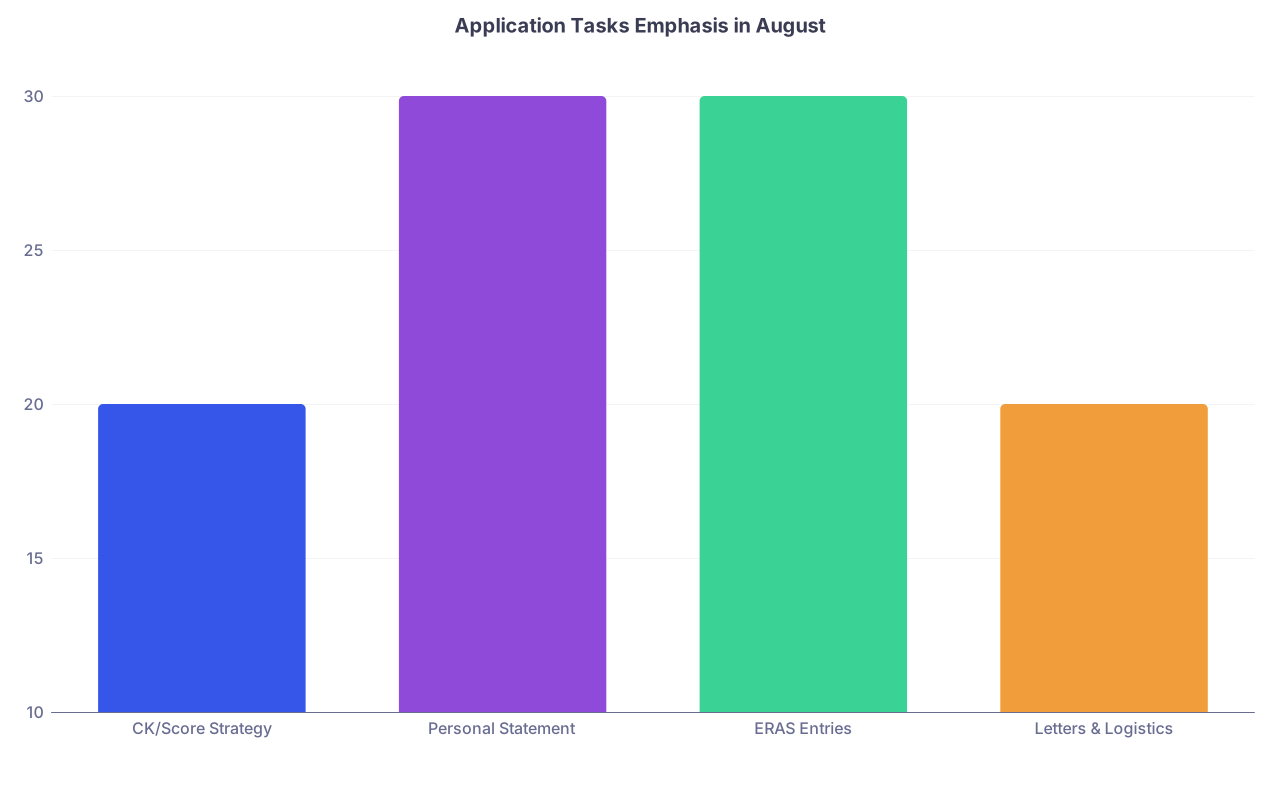
| Category | Value |
|---|---|
| CK/Score Strategy | 20 |
| Personal Statement | 30 |
| ERAS Entries | 30 |
| Letters & Logistics | 20 |
Early August: Interpret CK and Adjust Narrative (Quietly)
Primary focus: Integrate your CK reality into your overall application strategy.
Secondary: Light-touch PS refinement.
If CK is strong:
- You don’t need to mention it in the PS. Your score speaks.
- Let the PS lean into fit, personality, and future goals.
If CK is average or slightly below target:
- Don’t turn your PS into an apology tour.
- Instead, use it to:
- Highlight growth on rotations.
- Show maturity, reliability, and the kind of resident you’ll be at 2 a.m. on call.
If CK is significantly weaker than your field usually wants:
- Strategy talk with an advisor, not a PS rewrite:
- Adjust program list breadth.
- Consider dual application.
- Maybe a short explanation in another part of ERAS or an advisor letter, if there’s a clear reason (illness, family crisis).
At this point you should:
- Have a clear sense of how your CK score positions you.
- Have a PS that doesn’t contradict your numbers but doesn’t obsess over them either.
Late August: Final Language and Error Pass
This is boring work. Do it anyway.
- Read the PS out loud. Fix clunky sentences you trip over.
- Kill clichés:
- “Lifelong dream.”
- “A privilege to care for patients.”
- “I knew in that moment that I was meant for X.”
- Check:
- Name spelling.
- No program names (unless you really know what you’re doing).
- Proper grammar and punctuation—clean, not overly ornate.
At this point you should:
- Be ready to attach the correct PS version to each program.
- Not be making any substantive content changes.
September and Beyond: Applications Sent, PS as Interview Tool
By September, your priority shifts again.
September: Submit, Then Reframe Your PS as Interview Prep
Primary focus: Submitting ERAS and prepping for interviews.
Secondary: Micro‑tweaks for any very late applications.
Your personal statement’s job now:
- It becomes your interview script seed.
- Anything in it is fair game for questions like:
- “Tell me more about that patient you mentioned.”
- “You mentioned loving X—what does that look like day-to-day?”
Use your PS to:
- Build 3–4 talking points you’re comfortable expanding on.
- Practice 1–2 minute stories that align with what you wrote.
At this point you should:
- Not be rewriting the PS. That ship has sailed.
- Be using it as a guide to present a consistent, coherent narrative in interviews.
October–January: Small, Targeted Uses
During interview season:
- Rarely, a program may ask for a supplemental statement.
- You can pull from your core PS but:
- Tighten.
- Focus on what you bring to their specific environment (rural, academic, safety-net, etc.).
CK during this time?
- Maybe you’re studying for Step 3, but Step 2 CK is now just a line on your application. Obsessing about “what if I had scored 10 points higher?” is wasted mental energy.
Month-by-Month Checklist Summary
Here’s the stripped-down, no-nonsense version.
January
- Decide rough CK timing.
- Start “PS Stories” note with 5+ bullets.
February
- Lock CK test window based on rotations.
- Expand 3–5 stories into short paragraphs.
March
- Start serious CK content review + questions.
- Write one-sentence PS core message.
- Build PS outline (hook, 2–3 body paras, conclusion).
April
- Continue CK QBank + first NBME.
- Draft full PS (ugly but complete).
May
- Ramp CK practice tests and targeted review.
- Do 1–2 PS revision sessions (clarity, cut clichés).
June
- Take CK.
- After exam, revise PS with fresh eyes.
- Send PS to 1 advisor + 1 personal contact for feedback.
July
- Implement feedback and polish language.
- Align PS with ERAS experiences.
- Create specialty-specific versions if needed.
August
- Interpret CK score and adjust application list.
- Final proofread PS (read aloud).
- Attach correct version to each program.
September
- Submit ERAS.
- Use PS to script 3–4 core interview stories.
October–January
- Reuse/adapt PS content for any supplemental statements.
- Keep narrative consistent with what you already wrote.
Open your calendar app right now and block 60 minutes in the next 7 days labeled “PERSONAL STATEMENT – DRAFT 1 START.” Then block another 3–4 two‑hour slots across the next month labeled “CK – FULL FOCUS.” You do not need more motivation; you need those time boxes on your calendar before the year steamrolls you.