
The worst personal statements for dual applicants sound like they were written by a committee trying not to offend anyone. You cannot afford that.
If you are planning a dual-application strategy—say IM + Neuro, EM + IM, Psych + FM—you need a year-long plan for your personal statements, not a last-minute rewrite at 1 a.m. in September. At each point in the year, you should be doing something specific to protect your options and your sanity.
I will walk you month-by-month, then tighten to week-by-week and day-by-day once you hit the critical window.
12–10 Months Before Applications: Clarify Strategy, Not Sentences
Timeframe: September–November (MS3 for most, or PGY if switching)
At this point you should not be writing. You should be deciding.
Step 1: Define the Dual-Application Rationale (September)
You start here, or everything later becomes a mess.
By the end of this month, you should have:
- A clear primary specialty target
- A realistic backup or parallel specialty (not fantasy; data-driven)
- A short, blunt explanation for why both make sense for you
If you cannot explain, in 2–3 sentences, why you are applying to both, you are not ready to write anything.
Typical (real) pairs I have seen:
- Internal Medicine (primary) + Neurology (parallel)
- Internal Medicine + Psychiatry (combined program interest vs separate)
- Pediatrics + Child Neurology
- Family Medicine + Psychiatry
- EM + IM (categorical + EM/IM combined)
- Categorical surgery + prelim surgery or prelim medicine
At this point you should:
- Pull data.
- Look at NRMP Charting Outcomes, specialty competitiveness, your Step scores, class rank, home program support.
- Classify your dual plan.
Use this simple table:
| Strategy Type | Example | PS Approach |
|---|---|---|
| Primary + Real Backup | IM + FM | 2 distinct statements |
| Closely Related Fields | IM + Neuro | 2 distinct, but shared themes |
| Combined vs Categorical | Med-Peds + IM | 2 distinct, coordinate themes |
| Categorical + Prelim | Surgery categorical + Prelim | 1 main + brief prelim version |
| Re-specializing | EM to Anesthesiology + IM | 2 very tailored, plus explicit explanation |
If you are “Primary + Backup,” you cannot use one generic statement and hope both sides like it. That is lazy and programs can smell it.
Step 2: Map Rotations to Evidence (October–November)
At this point you should be planning experiences that will feed your statements.
List what each specialty wants proof of.
Example:- IM: longitudinal thinking, complex patient management, teaching, curiosity
- Neuro: localization thinking, patience with difficult exams, interest in neuroanatomy
- EM: decisiveness, high-acuity comfort, teamwork, shift work
- Psych: listening, longitudinal alliance, comfort with ambiguity
Decide which rotations will give you stories.
- Schedule sub-Is / acting internships strategically
- Pick electives that clearly align with each specialty
- Protect at least one strong rotation in each field you might apply to
By the end of this phase, you should have:
- A concrete list of 3–5 rotations likely to give you “anchor stories” for each specialty
- A ballpark plan for when you will complete them (and thus when you can write about them)
Drop the fantasy that you will “remember everything later.” You will not.
9–7 Months Before Applications: Collect Raw Material, Not Polished Narratives
Timeframe: December–February
This is the note-taking and data-gathering phase.
Daily/Weekly Habits on Rotations
During each relevant rotation, at this point you should be:
- Keeping a running log (on your phone, private document, not in the chart) of:
- Patients who changed how you think
- Conflicts or hard days that shifted your priorities
- Specific procedures, codes, family meetings, consults
- Tagging each entry with a specialty label:
- “IM anchor story candidate”
- “Neuro case – good for localization theme”
- “Psych – longitudinal follow-up story”
Aim for 1–3 bullet entries per week. That is it. No essays.
Monthly Reflection Checkpoints
At the end of each month, you should:
Re-read your rotation notes.
Force yourself to answer, for each specialty:
- What kind of problems felt satisfying?
- What kind of days drained you?
- What language do attendings use that I naturally echo?
Start a “Why X” scratch file for each specialty. No structure yet, just:
- “I keep liking complex endocrine cases”
- “I actually enjoy long family meetings more than procedures”
- “The Neuro team’s morning rounds felt… right”
You are not drafting. You are collecting voice and content.
6–5 Months Before Applications: Commit to Dual Strategy and Storyline
Timeframe: March–April
At this point you should have enough experience to stop hedging.
Step 1: Lock Your Dual-Application Plan (March)
By late March, you should make explicit decisions:
- Am I truly applying to both specialties, or was one a phase?
- Do I have at least 1–2 strong letters in each specialty?
- Is there a coherent throughline between them (e.g., complex chronic care, neurocognitive interest, systems-level thinking)?
If you cannot answer “yes” to those, rethink dual-application before you sabotage both sides.
Step 2: Define Separate Core Themes (Late March–April)
For each specialty, at this point you should:
Write a one-sentence “thesis” for your statement. Examples:
- IM: “I am driven by managing complex chronic disease through meticulous longitudinal care and teaching.”
- Neuro: “I am drawn to unraveling neurologic puzzles and supporting patients through life-altering diagnoses.”
- EM: “I thrive in acute, team-based settings where rapid decisions change outcomes.”
- Psych: “I value deep therapeutic alliances and helping patients rebuild identity and function.”
Identify 2–3 anchor stories per specialty that fit that thesis
- If a story could belong to either specialty, decide which one it serves best and commit it there.
You are creating two separate skeletons, not trying to stretch one skeleton into two outfits.
4 Months Before Applications: Structural Outlines, Not Final Drafts
Timeframe: May (right before ERAS season heats up)
At this point you should start outlining in detail.
Week 1–2 of May: Build Templates for Each Specialty
For each specialty, outline something like:
Opening paragraph
- One anchor story or moment that shows you doing the thing this specialty values
- Avoid childhood fluff; start in clinical training if at all possible
Middle paragraphs
- 2–3 experiences that broaden the picture:
- Rotations
- Research (only if genuinely connected)
- Leadership / advocacy that fits the field’s identity
- 2–3 experiences that broaden the picture:
Closing paragraph
- Tie back to your thesis
- Briefly mention future goals (academic vs community, subspecialty interest if authentic)
Do this twice. Two separate documents. No copy-pasting whole paragraphs.
Week 3–4 of May: Reality Check With Mentors
At this point you should:
- Send each outline to a mentor in that specialty, separately.
- Ask them bluntly:
- “If you saw this structure for an applicant who was also applying to X, would you buy it?”
- “What is missing that everyone successful in your field usually has?”
If one specialty’s outline feels forced or flimsy, you fix that now, not in August.
3 Months Before Applications: Drafting Window Opens
Timeframe: June (ERAS season; primary applications typically open)
This is where things get real.
Week 1 of June: Rough Draft #1 for Primary Specialty
At this point you should:
- Block 2–3 uninterrupted writing sessions (60–90 minutes each)
- Push out a full ugly draft for your primary specialty first
Day-by-day for this first week:
- Day 1: Draft opening story + first middle paragraph
- Day 2: Draft remaining middle paragraphs
- Day 3: Draft conclusion, then read the whole thing once out loud
- Day 4: Light cleanup only: kill clichés, cut childhood origin stories
- Day 5–7: Let it sit. Do not endlessly tweak.
You are aiming for a clear, specific, honest story. Not perfection.
Week 2 of June: Draft #1 for Secondary Specialty
Similar structure:
- Day 1–3: Complete first full draft of the second specialty statement
- Day 4: Compare side by side with your primary statement:
- Is the voice obviously the same person? (Should be)
- Are the reasons and examples clearly different? (Must be)
- Day 5–7: Set this one aside as well
Avoid the cardinal sin: using 60–70% identical content. Programs read thousands; they remember.
Week 3–4 of June: First Feedback Round
At this point you should:
- Choose no more than 2–3 reviewers per statement:
- 1 attending or senior resident in the specialty
- 1 person who knows you well (could be from school leadership)
- Optional: 1 peer with strong writing skills
Stagger it:
- Week 3: Send primary specialty PS for feedback
- Week 4: Send secondary specialty PS
Give them a deadline: 5–7 days. If they do not respond, move on. Your calendar will not wait.
2 Months Before Applications: Refinement and Integration
Timeframe: July
By now you should have comments back. This is polish and strategic alignment time.
Week 1–2 of July: Second Drafts, Specialty by Specialty
For each statement:
List the feedback. Identify what you agree with.
Fix global issues first:
- Confusing timeline
- Too much research flexing for a clinical specialty
- Generic language (“I am passionate about helping people” = delete)
Then address specialty-specific tone:
- IM: more detail on thought process, complexity, continuity
- EM: pace, acuity, team dynamics, rapid decisions
- Psych: depth of listening, longitudinal relationships
- Neuro: cognitive challenge, diagnostic reasoning, tolerance for uncertainty
At this point you should also:
- Ensure zero internal contradictions:
- Do not tell Psych: “I want long-term continuity in one-on-one relationships” and then tell EM: “I prefer episodic care and rapid turnover”—unless you can actually justify your duality in real life. Programs will compare if they feel something is off.
Week 3 of July: Cross-Check With Program Lists
Here is where dual-application personal statement planning runs into logistics.
At this point you should:
Start building your program spreadsheet:
- Columns for program name, city, specialty, competitiveness, whether they have dual/combined tracks, etc.
Mark:
- Where you will send Primary PS A
- Where you will send Secondary PS B
- If there is any truly mixed case (e.g., Med-Peds vs IM; EM/IM vs IM or EM)
For borderline situations (Med-Peds + IM, or Child Neuro + Peds), you might need slightly customized variants, but do not create 10 versions. You will lose track.
1 Month Before Submission: Finalization and Logistics
Timeframe: August (or 4–5 weeks before you actually submit)
This is the systemization phase. Sloppy here = disaster later.
Week 1: Final Content Pass
At this point you should:
Read each statement out loud start to finish. Fix:
- Clunky sentences
- Overused words (“passion,” “always,” “fascinating”)
- Paragraphs that start the same way
Confirm:
- Each specialty has its own clear thesis and unique anchor stories
- No section reads like it was obviously copy-pasted between them
Week 2: Technical Checks and File Management
Create ERAS-ready versions:
Save with obvious naming in a dedicated folder:
PS_IM_FINAL_2026_08_12PS_PSYCH_FINAL_2026_08_12
Make a mapping document:
- List each program and which PS they get
- Note any special-track tweaks (e.g., EM/IM combined vs regular IM)
This sounds tedious. It prevents catastrophic mistakes like sending your Psych PS to Emergency Medicine.
Week 3–4: Align Letters and Statements
At this point you should:
- Check that your letters of recommendation support the same narrative:
- Your IM PS emphasizes teaching and complex medicine? Ensure at least one IM letter mentions your teaching or complex case management.
- Your Neuro PS talks about your interest in neuroimaging? Ideally have a Neuro letter that saw you on stroke or epilepsy service.
If you are forced to use mostly generic letters, that is fine. But your PS must then carry more of the specialty-specific weight.
Submission Month: Week-by-Week and Day-by-Day
Timeframe: September (or your actual ERAS submission month)
You are now in execution mode.
Week 1: Final Read With Fresh Eyes
At this point you should:
- Print each statement or convert to PDF
- Read line by line as if you were the PD:
- Would I believe this person if I knew they were dual-applying?
- Is there a clear, honest story here, or is it hedging?
If you cannot answer “yes” confidently for both, fix it now. Not after submission.
Week 2: ERAS Upload and Assignment
Over 2–3 focused days:
- Upload both personal statements into ERAS.
- Assign them to programs carefully:
- Double-check before finalizing
- Use your mapping spreadsheet as a checklist
Do a final visual check:
- Open a random program entry. Confirm the correct PS is attached.
- Spot check 3–5 programs per specialty.
Week 3–4: Interview Prep Alignment
Yes, this is still personal-statement-related.
At this point you should:
- For each specialty, extract:
- 3 key stories from your PS you are willing to discuss in detail
- 2–3 themes about “why this field” that you can say out loud, naturally
You must remember which story appears in which statement. Program directors will often open your PS on the screen while you speak.
Common Dual-Application Mistakes and When to Prevent Them
Here is how the timeline actually protects you:
| Mistake | When You Should Have Prevented It |
|---|---|
| Using 1 generic PS for 2 specialties | March–April (theme definition phase) |
| Pivoting to a second field but no stories | December–February (rotation log phase) |
| Conflicting narratives across PSs | July (cross-check and refinement) |
| Wrong PS sent to wrong program | August–September (mapping and upload checks) |
| Sounding apologetic for dual-applying | June–July (drafting and tone work) |
Visual Planning: Your Year at a Glance
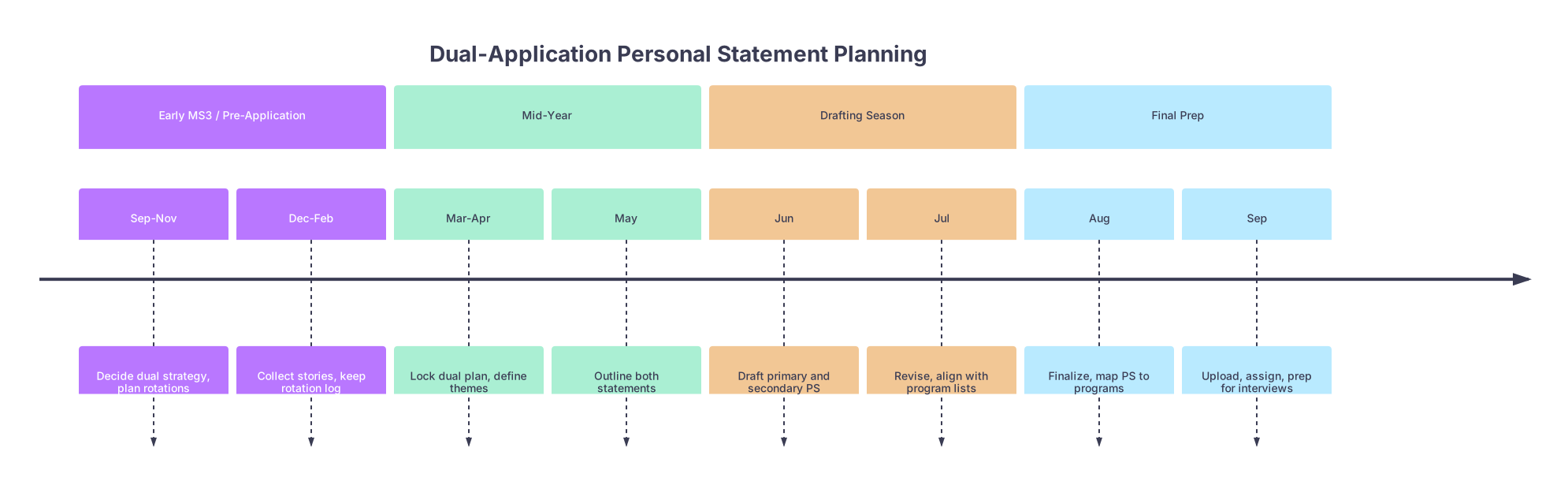
| Period | Event |
|---|---|
| Early MS3 / Pre-Application - Sep-Nov | Decide dual strategy, plan rotations |
| Early MS3 / Pre-Application - Dec-Feb | Collect stories, keep rotation log |
| Mid-Year - Mar-Apr | Lock dual plan, define themes |
| Mid-Year - May | Outline both statements |
| Drafting Season - Jun | Draft primary and secondary PS |
| Drafting Season - Jul | Revise, align with program lists |
| Final Prep - Aug | Finalize, map PS to programs |
| Final Prep - Sep | Upload, assign, prep for interviews |
Final 2 Weeks Before Submission: Micro-Level Checklist
Here is how I would tell you to use your last 10–14 days.
Day 1–2
- Re-read both statements
- Fix any last clarity issues
- Confirm word/character counts fit ERAS comfortably
Day 3–4
- Update mapping spreadsheet with any late program list changes
- Check for any programs where your strategy changed (e.g., removed one specialty)
Day 5–6
- Upload both PS versions to ERAS
- Assign PSs to a small test batch of programs (do not submit yet)
- Log out, log back in, confirm assignments are correct
Day 7–8
- Finish program-specific questions, CV, and experiences
- Keep personal statements untouched unless you notice a real error
Day 9–10
- Final cross-check:
- Mapping file vs ERAS assignments
- LOR distribution vs PS narratives
Submission Day
- Submit in the morning when servers are less overloaded
- Immediately after, export or screenshot your ERAS assignment pages so you have a record of which PS went where.
Two Things to Remember
- Dual-application personal statements succeed when they are distinct but coherent: same person, different emphases, no contradictions.
- The calendar is not optional. If you follow the timeline—strategy in the fall, stories in winter, themes in spring, drafts in early summer, refinement before submission—you will not be the person trying to “convert” one statement into another at midnight on September 14.