
The biggest lie you’ve been told about residency personal statements is that “nobody really reads them.” Attendings absolutely read them—and they judge you harder than you think.
Let me walk you through how they actually use your personal statement. Not the polished version from webinars. The real, petty, tired-at-11:47 PM-on-the-couch version.
This is the unwritten code they use when they open that PDF and decide, in under two minutes, who you are.
What Attendings Really Want From Your Personal Statement
Most attendings are not looking to be inspired. They’re looking to answer three questions:
- Will I hate working with this person at 3 a.m.?
- Is this applicant real or manufactured?
- Do they actually belong in this specialty—or are they hedging, lost, or desperate?
Nobody says it exactly like that in committee meetings. But I’ve sat in enough rank-list rooms to know: that’s the subtext.
The personal statement is not about your “journey.” It’s about risk management. Programs are betting 3–7 years of training, clinic reputation, patient safety, and their own sleep on you. When an attending reads your statement, they’re scanning for risk—emotional, professionalism, work ethic, and fit.
They already have your scores, MSPE, and letters. The PS is where they check if the story hangs together or falls apart.
How They Read It: The First 30 Seconds
Here’s how it actually goes down.
They open ERAS, click your file, and they see everything at once: scores, school, experiences, photo, personal statement. If you think they sit down with coffee and “settle in” to your essay, you’re living in a fantasy.
Many do this:
- Scroll to the top. Read the first 3–4 sentences.
- Glance at the end. Read the last paragraph.
- Rapid skim down the middle, eyes stopping at unusual words, subheadings (if you were bold enough to use them), or obviously emotional lines.
- Decide in under 90 seconds: solid / interesting / generic / red flag.
Then, if they’re on the fence, that’s when they might reread more carefully.
So your first paragraph and your last paragraph carry far more weight than the beautifully crafted story you buried in the middle. Attendings are triaging your essay the same way they triage consults: quick pattern recognition, then deeper dive only if something doesn’t fit.
The Unspoken Gut-Check Categories
Most attendings won’t articulate this openly, but when they read your statement, they’re mentally sorting you into rough buckets. I’ll put it in words they would never put in writing—but they absolutely say behind closed doors.
| Category | Attending Reaction |
|---|---|
| Safe & Boring | Rankable, nothing special |
| Genuine & Grounded | Strongly positive |
| Try-Hard / Overwritten | Eye-roll, mild distrust |
| Red Flag / Concerning | Avoid if possible |
| Specialty Tourist | Wrong fit, lower rank |
Let me unpack each—because the unwritten rules live in these categories.
1. “Safe & Boring” – The Default Pile
This is most of what they see.
You write about loving patient care. You mention teamwork. You toss in a family member’s illness. You say the specialty combines “intellectual rigor and procedural skills” or “continuity and acute care.” You end with some version of “I look forward to growing as a compassionate, skilled [specialty] physician.”
Attendings’ reaction? “Fine. Next.”
This doesn’t hurt you, but it doesn’t help you either. You won’t be discussed as “the one with the great statement.” You’ll just live or die on numbers, letters, and school reputation.
The unwritten rule here: bland is safe but forgettable. Programs will rank you if the rest of the app is solid, but your statement didn’t buy you any extra goodwill.
When is “safe & boring” perfectly acceptable?
– You have strong scores and solid letters in a non-ultra-competitive specialty
– You have some mild red flags and you mainly need not to make things worse
If that’s you, your goal is: no clichés that make them groan, no melodrama, no arrogance. Clean, coherent, adult.
2. “Genuine & Grounded” – The Quiet Winners
These are rare. And attendings perk up when they find one.
What makes a statement “genuine & grounded” to an attending?
Three things.
First, the voice sounds like a real human, not a committee. I’ve heard faculty say, verbatim: “I could hear this kid talking in pre-rounds from the first paragraph.” That’s a compliment.
Second, the details are small and specific, not grand and performative. Instead of “I learned the importance of empathy,” they remember that you sat with a confused post-op patient to re-explain what had already been said. Instead of “I’m passionate about teaching,” they see you running informal shelf review sessions and getting texts from classmates at midnight.
Third, you show some self-awareness. Real growth. A resident once got praised in our meeting because he wrote very plainly about initially resenting “scut” on surgery and then gradually realizing what actually mattered. No flowery language. Just honest, concrete, and tied clearly to why he now fits that culture.
The unwritten rule here: attendings trust people who sound like they know their own flaws and have already started to work on them. That reads as lower risk.
The Red Flags Attendings Will Never Admit in Public
Here’s where it gets spicy. There are patterns that faculty bring up again and again in closed-door meetings, but you’ll never see them on a program website.
I’ll lay out some of the common ones. If you see yourself in these, fix it now.
Red Flag #1: The Trauma Dump With No Processing
Yes, many people go into medicine because of personal or family illness, poverty, trauma, or tragedy. Attendings are not heartless. They’ve lived through plenty themselves.
The issue is not that you talk about trauma. It’s how.
What worries them:
- Graphic, emotionally heavy stories that dominate the entire essay.
- No clear pivot from “this happened to me” to “here’s how I function now.”
- Vague statements about “struggling with mental health” without any reassurance of stability or support.
You may think you’re being open and vulnerable. What they see is risk: Will this person crumble under ICU nights? Are we one bad month away from a leave of absence?
They’ll never put that in writing. But I’ve heard variations of this line more times than I can count: “This is heavy. I’m not sure I want to be responsible for them in this environment.”
If you must mention something serious, the unwritten rule is: spend 20% on what happened, 80% on how you processed it, got help, matured, and now function reliably. And if you cannot honestly say that yet—do not build the essay on that story.
Red Flag #2: Icarus Syndrome (Overconfidence, No Humility)
Attendings are allergic to swagger in a PGY-1.
Phrases that trigger that reaction:
- “I quickly became the leader of the team…”
- “I realized I was often the most knowledgeable person in the room…”
- “I know I will be an asset to any program because…” (followed by generic virtues)
I watched one program director read a statement that said, “I was essentially functioning at the level of an intern by the end of third year,” then quietly close their laptop and say, “Pass.” That was it.
The unwritten rule: they want confidence plus deference. You can say you took initiative, handled complex tasks, and earned trust—but you must also show that you knew when to ask for help and that you respected your residents and attendings.
If your statement reads more like a victory lap than a growth arc, you’re shooting yourself in the foot.
Red Flag #3: Specialty Tourism and Weak Commitment
This one matters more in competitive fields, but it exists everywhere.
If you write an IM personal statement that sounds like it could be swapped with FM, EM, or Peds just by changing 3–4 words, they notice. They may not call it out, but during ranking someone will say: “I don’t see a strong internal medicine identity here.”
Same in ortho, derm, ENT, ophtho, anesthesia, EM. When you say things like, “I considered many fields, but ultimately chose X because I enjoy procedures, continuity, and teamwork,” it signals nothing.
Then they start wondering: Are you dual applying and just did a find/replace? Is this a backup choice? If we rank you high, do we get burned when you match somewhere else?
Unwritten rule: They want to feel like you chose their world on purpose, not by elimination.
That does not mean you need to sound obsessed since age 6. But it does mean your examples, mentors, and reflections should clearly line up with the actual day-to-day of that specialty.
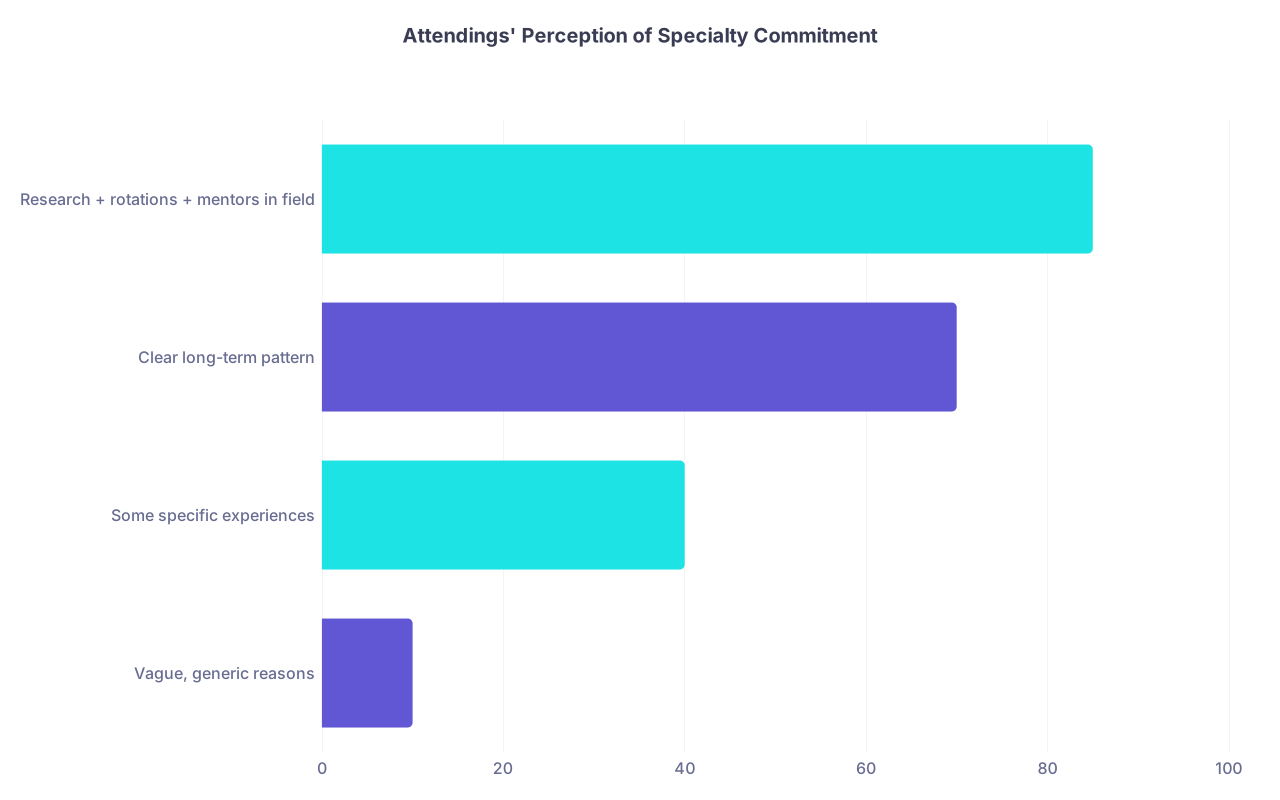
| Category | Value |
|---|---|
| Vague, generic reasons | 10 |
| Some specific experiences | 40 |
| Clear long-term pattern | 70 |
| Research + rotations + mentors in field | 85 |
Numbers here are conceptual, but the pattern is real: the more aligned your story, the safer you look.
Red Flag #4: Overproduced, Overedited, Obviously Coached
You think a perfectly polished, thesaurus-heavy essay impresses faculty. It doesn’t.
Many can smell when something’s been heavily ghostwritten by a consultant, parent, or committee. It has that uncanny quality: too smooth, no rough edges, no specific human quirks.
Phrases that set off alarms:
- “I have long been enamored with the intersection of…”
- “My odyssey through medical school has been transformative…”
- “I stand at the precipice of residency, eager to embark on this journey…”
When an attending reads that, they ask themselves two quiet questions:
- Is this who I’m actually going to meet on day one?
- If not, what else in this application is performative?
You’re better off at 90% polished but clearly yours than 100% polished and generically “perfect.”
What Attendings Are Positively Surprised By
It’s not all negative. There are unwritten positive rules too—things that make them halfway smile while scrolling.
1. Subtle Evidence You Understand the Real Job
Attendings are tired of reading about “saving lives” and “helping people” in the abstract. They perk up when you show you know what the actual work feels like.
Examples that land well:
- You write about repeatedly adjusting insulin and fluids at 3 a.m. for a brittle diabetic, and how the resident taught you to think systematically instead of panicking.
- You mention visiting a patient on your own time to clarify their discharge plan, after realizing how confusing it was for them.
- You describe how sitting in on a family meeting about goals of care gave you a different respect for how attendings navigate conflict and culture.
What they’re picking up is: you didn’t just tour the specialty, you lived inside it enough to see the grittier pieces—and you still want in.
2. Emotional Range—But Contained
Attendings actually like when you show that you care. They do. The myth that you must sound completely detached is nonsense.
The key is controlled vulnerability. You’re allowed to say a patient’s death shook you. You’re allowed to admit feeling overwhelmed on your first ICU call. The unwritten rule is that you then pivot to how you stabilized, who you learned from, and how you translated that into better functioning.
What they’re testing: Will this person bring humanity and reliability to my team? Or are they going to leak emotions all over the unit?
3. A Quiet, Specific Hook
The most memorable statements usually aren’t dramatic. They just have a clear, consistent hook that matches the rest of the application.
One applicant to IM I remember:
- Mentioned early in the statement how he loved “finding patterns in the chaos”—grew up doing New York Times crosswords with his grandmother.
- Wove that into how he enjoyed complex diagnostic puzzles on the wards.
- Did research in sepsis and worked on a QI project reducing diagnostic delays.
The PS wasn’t flashy. But when his name came up in the meeting, someone said, “Oh, the patterns guy. He’d be great on our ICU service.” That’s the effect you want.
The Unwritten Structural Rules
There are also craft rules attendings apply, usually unconsciously.
Length and Density
Most programs read dozens of statements a week in season. They do not want to fight through a wall of text.
Unwritten expectations:
- 1 page in ERAS, not 1.5.
- Shortish paragraphs, not 20-line bricks.
- Clean sentences. Minimal complex constructions.
If they have to reread a sentence twice to figure out what you meant, they assume you’ll write your notes the same way. That’s not a plus.
The Opening Line Trap
Everyone’s obsessed with “hooks.” Know what attendings hate? Forced hooks.
Fake-deep openers like:
- “The monitor alarms were screaming as I held Mrs. S’s hand…”
- “I never imagined that a single night in the ER would change the trajectory of my life…”
They’ve seen that exact movie a thousand times.
What actually works better is a clean, grounded opening that orients them quickly. Something like:
“I did not plan to become a psychiatrist. I just liked talking with patients more than writing orders, and one attending on my third-year rotation noticed before I did.”
Readable. Human. No cinematic drama. That buys you goodwill.
Endings That Don’t Make Them Roll Their Eyes
The ending is where many students fall apart. They panic and start stacking clichés.
If your last lines sound like:
“I look forward to continuing my journey as a compassionate, empathetic, and skilled physician, dedicated to lifelong learning and serving my community,”
you just threw away the goodwill you built.
A better ending is specific and modest. Something along the lines of:
“I’m looking for a residency that will push me, teach me to think more clearly when things are messy, and surround me with seniors I can model myself after. I’m ready to show up, do the work, and keep getting better.”
That sounds like someone an attending actually wants on their team.
How Personal Statements Quietly Shift Your Rank
Let me be blunt. The personal statement rarely takes a weak applicant and saves them. But it often takes a solid applicant and nudges them up or down.
Here’s what happens in the room.
You’re discussing a mid-tier candidate: decent scores, okay school, rotations fine, letters good but not glowing. Someone asks, “Any reason not to rank them?” And then:
- If the PS was genuine, thoughtful, and specialty-specific, someone says, “I liked their statement. They seem self-aware.” That usually shifts you slightly up.
- If the PS was arrogant, vague, or emotionally concerning, someone says, “Their statement worried me a bit.” Translation: shift you down, or onto the “rank only if we need to fill” tier.
On the other end, I have seen borderline candidates get moved into the “worth a shot” zone because a PD or key attending really connected with their personal statement. It didn’t erase everything else, but it tipped the scale when the room was otherwise neutral.
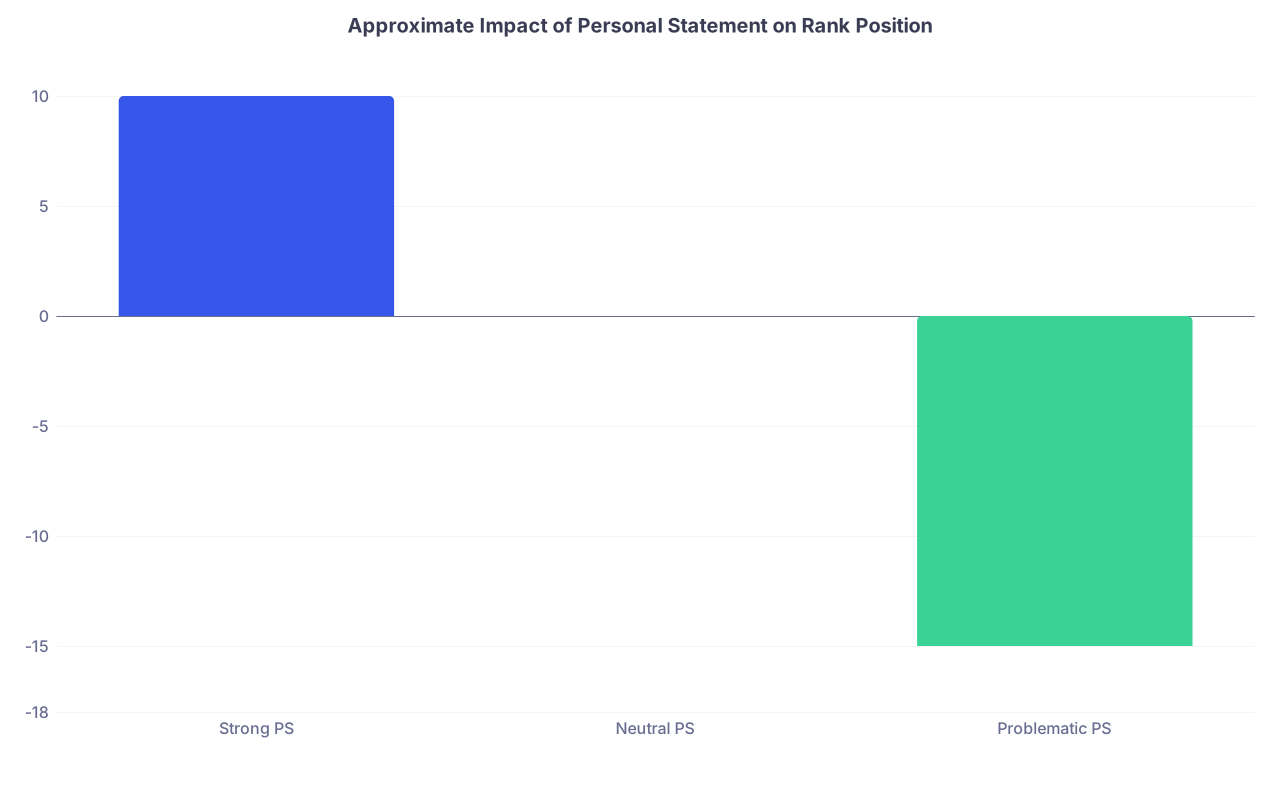
| Category | Value |
|---|---|
| Strong PS | 10 |
| Neutral PS | 0 |
| Problematic PS | -15 |
Again, these numbers are conceptual—but you get the idea. A strong statement might pull you modestly up. A bad one can drop you like a rock.
How to Write With These Unwritten Rules in Mind
Practical translation of all this:
Write like a future colleague, not a contestant auditioning for a role.
That means:
- Use normal, intelligent language. You’re allowed to sound like yourself.
- Choose 1–2 concrete stories that show how you behave on the wards—not just how you feel.
- Make it obvious you understand the actual day-to-day of the specialty you’re applying to.
- Admit small, human weaknesses and show how you’re working on them.
- Avoid both extremes: no trauma-for-drama, no superhero narrative.
And do yourself one more favor: have someone who’s not an English major read it. Have a resident or fellow in the specialty read it and ask them: “What’s the risk profile you get from this?” They may not phrase it that way, but they’ll tell you if you sound unstable, arrogant, bland, or like a real person.
Because here’s the quiet truth: attendings are not searching for the most inspiring story. They’re searching for people they’d trust with sick patients, vulnerable families, and tired teams. Your personal statement is their first uncensored look at your judgment, your self-awareness, and your fit.
Years from now, you won’t remember every sentence you wrote. But you will remember the kind of physician you were already becoming when you wrote it—because that, more than any poetic line, is what they are really reading between the lines.