
What if the thing you think makes your personal statement “stand out”… is exactly what gets you quietly filtered into the ‘no’ pile?
Let me be blunt: “Trying to be unique” ruins more otherwise strong residency personal statements than weak grades or mediocre Step scores ever will.
Not because uniqueness is bad. Because most applicants chase it in all the wrong ways.
I have watched applicants with stellar CVs, excellent letters, and great scores sabotage themselves with one poorly conceived, “creative,” or gimmicky statement. They were trying so hard to be memorable that they became untrustworthy, unclear, or just exhausting to read.
You are not competing in a talent show. You are trying to convince overworked program directors that:
- You understand the specialty.
- You are safe, reliable, and teachable.
- You will actually show up at 4:30 a.m. and not implode.
Let’s walk through the most common “I want to be unique” mistakes that wreck solid applications—and how to avoid every single one of them.
Mistake #1: Treating Your Statement Like a Creative Writing Contest
You know the type of opening:
“I first understood the fragility of the human condition as the rain fell sideways, the monitors screamed, and my soul cracked open like the ER doors…”
I have seen 40 versions of that sentence. Different weather. Same problem.
Programs are not looking for the next great novelist. They are screening for residents who can:
- Communicate clearly
- Think clinically
- Reflect like an adult, not perform like a poet
What goes wrong when you chase “creative”?
- You bury the point. The reader has to work to figure out your specialty interest, your path, your motivation. They will not. They do not have time.
- You sound immature. Overwritten metaphors and dramatic language make you sound like you are trying to impress, not communicate.
- You increase the risk of cringe. Over-share, melodrama, and performative vulnerability read as unstable, not “deep.”
The red flags I see all the time:
- Opening with a dream, hallucination, or “imagine this” scenario
- Two full paragraphs of scenery before we know your name, your specialty, or why you care
- Dialogue-heavy scenes (“‘Doctor, save her!’ the mother screamed…”)
- Extended metaphors carried through the whole essay (chess, running marathons, climbing mountains, orchestras, etc.)
What to do instead:
- Open clean. “During my third-year internal medicine rotation, I was assigned to care for…” Simple is not boring. It is readable.
- Use one brief, concrete clinical story. Show what you did, what you learned, and how it shaped your choice. Then move on.
- Write like a future colleague, not a contestant for a writing prize.
If your non-medical friends say, “This is beautiful,” but your chief resident says, “This is confusing,” trust the chief resident.
Mistake #2: Forcing an Overly “Unique” Origin Story
Another common disaster: the forced quirky hook.
You know the script:
- “I knew I wanted to be a surgeon when I dissected a frog in seventh grade.”
- “My passion for psychiatry began when I watched House.”
- “As a child taking apart remote controls, I was destined for radiology.”
These are not unique. They are clichés dressed up as uniqueness.
Worse versions I have seen:
- An applicant trying to link their love of cooking to pathology through a tortured analogy about “recipes” and “diagnoses.”
- Someone forcing their college soccer experience into every paragraph of a neurology statement.
- A statement where 70% of the content is about a pre-med mission trip and 30% about actual clinical experience in medical school.
The problem is not the stories themselves. It is over-weighting them and pretending they are profound predictors of specialty choice.
Program directors want to see:
- How you engaged with the specialty during medical school / rotations / sub-I’s
- How you think about patient care now, as an almost-resident
- Evidence that you actually know what you are signing up for
What they do not need:
- A destiny narrative that started when you were five
- An over-polished “aha moment” that sounds fake
- A childhood hardship stretched into a justification for everything
Ask yourself the ruthless question:
“Would this story still make sense if I swapped out the specialty name?”
If yes, it is not demonstrating fit. It is just decoration.
You can mention:
- Family experiences with illness
- Prior careers
- Cultural background
But make them 1–2 paragraphs max and directly tied to:
- How you relate to patients
- How you work with teams
- How you see your future in this specialty
Anything else is indulgence.
Mistake #3: Gimmicks That Backfire
This is where “I want to be unique” gets dangerous.
I have seen:
- Personal statements written as patient chart notes
- SOAP-note structured statements
- Letters to the specialty (“Dear Emergency Medicine…”)
- Screenplay format with “Scene 1, Scene 2”
- Acronyms using the specialty letters (e.g., P-E-D-S stands for…)
They are memorable, yes. But not in the way you want.
Remember who is reading:
- Program directors skimming hundreds of applications
- Faculty volunteering to read during lunch
- Residents scanning to see, “Is this someone I want to work nights with?”
They expect:
- Professional tone
- Conventional structure
- Evidence you respect norms
When you break form, you risk three interpretations:
- You do not understand professional boundaries.
- You are trying to compensate for weak content with style.
- You will be high-maintenance and attention-seeking as a resident.
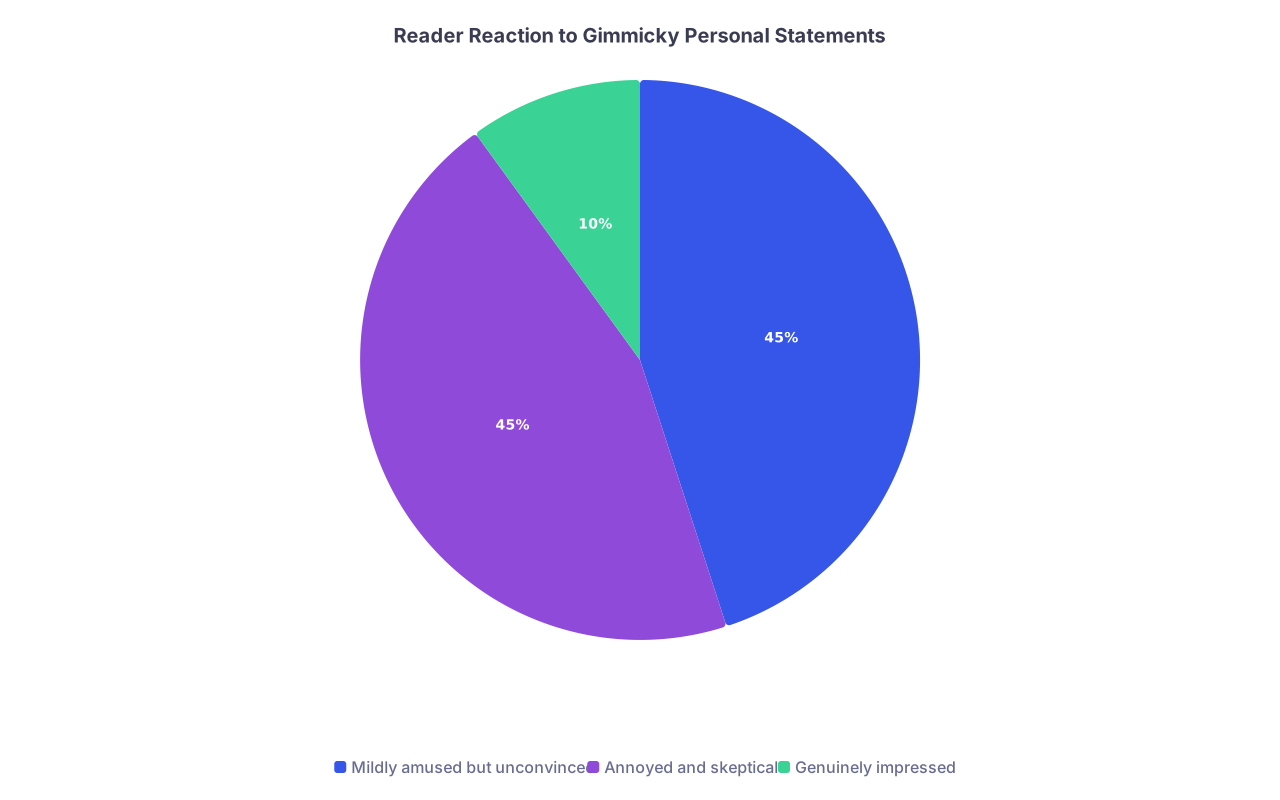
| Category | Value |
|---|---|
| Mildly amused but unconvinced | 45 |
| Annoyed and skeptical | 45 |
| Genuinely impressed | 10 |
That ~10% “genuinely impressed” is not worth the 90% risk.
You do not get bonus points for format innovation. You get points for:
- Clarity
- Maturity
- Alignment with the specialty
Save the gimmicks for social media, not ERAS.
Mistake #4: Confusing “Unique” With “Trauma Dump”
This one is sensitive, and it wrecks applications every year.
Applicants are told: “Tell your story.” “Be authentic.” “Show vulnerability.”
Some interpret that as: “Unload the most traumatic events of your life in graphic detail and hope it proves you are resilient.”
What goes wrong:
- You describe active, unprocessed trauma. The reader worries about your current stability.
- You present severe mental health struggles without showing ongoing care, insight, or boundaries.
- You force the reader into the role of therapist instead of colleague.
Program directors are not cold. Many are deeply sympathetic. But their primary obligation is to patient safety and team function. If your essay makes them wonder:
- “Is this applicant emotionally safe to have in the ICU at 3 a.m.?”
- “Will they decompensate under stress?”
You have lost.
You can reference hardship. Thoughtfully. Briefly. With control.
What is usually safe and effective:
- 1–2 sentences acknowledging a past event (loss, illness, migration, financial hardship).
- Focusing on what you learned and how it shapes your empathy and work ethic.
- Making it clearly about patient care and professional growth, not needing comfort.
What is risky:
- Detailed descriptions of abuse, self-harm, active substance use, or psychiatric hospitalization without clear recovery framework.
- Turning the statement into a therapeutic narrative rather than a professional one.
- Ending without showing support systems, coping skills, or reflection.
Ask yourself:
- “Am I sharing this to help them understand my professional story?”
- Or, “Am I sharing this because I feel I need them to know my pain?”
If it is the second, do not put it in your residency personal statement.
Mistake #5: Over-Curating a “Quirky” Personality
There is a whole subgenre of personal statements that read like dating profiles:
- “When I am not suturing, you can find me roasting my own coffee beans, training for triathlons, and learning my fourth language.”
- “I am the sort of person who brings a sourdough starter on away rotations.”
- “My friends know me as the guy who only writes with fountain pens.”
These details are not inherently bad. Occasionally, one well-placed personal detail can humanize you.
The problem is volume and purpose.
If 30–40% of your personal statement is about hobbies and quirks, the message becomes:
- “Pick me because I am interesting,” not “Pick me because I will be an excellent resident.”
You are not being hired as a personality ornament. You are being recruited to take care of sick people at ungodly hours.
Better approach:
- One short paragraph that grounds you as a human being outside medicine.
- Focus on traits that actually translate to residency: persistence, teamwork, long-term commitment, discipline.
- Avoid the curated “I am so unique and eclectic” catalog.
Here is a simple test:
Take your hobbies paragraph. Now ask:
- “Could 5 other applicants plausibly say this?”
If yes, fine. That is normal. You do not need exotic hobbies.
If no, ask:
- “Does this help them trust me more as a future resident?”
If still no, cut it.
Mistake #6: Hiding the Actual Substance Behind Style
Some applicants panic: “My scores are average. My research is okay. I need something to stand out.”
They respond by stuffing the personal statement with:
- Grand philosophical reflections about mortality
- Long paragraphs about “the meaning of being a physician”
- Abstract statements that could be pasted into anyone’s essay
It feels deep. It reads empty.
The quiet, devastating effect of this: you never actually say what you bring to this specialty.
You skip:
- Concrete examples of when you took responsibility beyond expectations
- Specific patient encounters that changed how you think
- Instances of feedback you received and how you integrated it
So the reader finishes and thinks: “Nice words. Who is this person as a worker?”
Programs are selecting people to:
- Pre-round on 16 patients
- Communicate with nurses, social workers, consultants
- Document, follow up, admit, discharge
They want evidence you can function on a team, tolerate hierarchy, and grow.
Overly “philosophical” or stylistic essays signal the opposite: someone who prefers ideas to work.
What you should do instead:
- Name one or two concrete situations where you acted like an intern already.
- Show how you handled uncertainty, conflict, or a mistake. Briefly. Maturely.
- Spend more words on what you did and learned than on abstract reflections about medicine.
You do not need to sound like a bioethics professor. You need to sound like a smart, grounded, coachable junior resident.
Mistake #7: Ignoring the Core Questions Every Program Director Is Asking
Trying to be “unique” usually means you are not answering the only questions that matter.
Every decent residency personal statement should answer, clearly:
- Why this specialty?
- Why you will do well in this specialty?
- What kind of colleague and trainee you will be?
- What you hope to develop or explore in residency (teaching, research, patient population, etc.)?
If your draft is full of clever lines but light on those four points, it fails.
Here is what a dangerously “unique” statement often looks like:
- 60% storytelling and style
- 20% personal hardship
- 15% hobbies and quirks
- 5% vague mention of the specialty
Here is what a strong, non-gimmicky statement tends to be:
| Section Focus | Strong Statement | Overly 'Unique' Statement |
|---|---|---|
| Specialty fit & motivation | 40–50% | 5–15% |
| Clinical examples | 25–35% | 10–20% |
| Professional growth & traits | 15–25% | 15–20% |
| Personal background/hobbies | 5–10% | 30–50% |
You do not need to be unforgettable. You need to be obviously safe, clearly appropriate for the specialty, and straightforward to train.
That alone will separate you from a painful chunk of the applicant pool.
A Simple Structure That Almost No One Regrets Using
You want to avoid mistakes. Good. Use a structure that reduces opportunities to screw up.
Here is a clean, boring, effective outline that works for almost every specialty:
Opening (1 short paragraph)
- One concrete patient or clinical moment that introduced or solidified your interest in the specialty.
- No extended scenery. No drama. Just: what happened, what you noticed, why it stuck.
Development of interest (1–2 paragraphs)
- How clerkship, sub-I, elective experiences deepened your interest.
- Specific aspects you enjoy: types of patients, procedures, pace, cognitive style.
- Show you understand the real day-to-day, not just the TV version.
Evidence you will be a strong resident (2–3 paragraphs)
- Examples of teamwork, ownership of tasks, reliability.
- Brief mention of research, teaching, leadership if they matter to that specialty.
- One short story where you handled challenge, feedback, or failure professionally.
Personal background / humanization (1 paragraph)
- A bit about who you are outside of medicine.
- Maybe a hobby or interest, but framed in what it shows about you (discipline, persistence, community).
Conclusion (1 paragraph)
- Reaffirm your commitment to the specialty.
- Name what you hope to contribute and what you are excited to develop.
- No grandiose “I will change medicine” claims. Simple, grounded, forward-looking.
Is this “unique”? Not at all. Which is precisely why it works.
Your uniqueness comes from:
- The specific patients you describe
- The tone of responsibility you convey
- The pattern of experiences you highlight
You do not need to force it. It is already there if you stop hiding it behind tricks.
How to Audit Your Draft for “Trying Too Hard to Be Unique”
Print your draft. Pen in hand. Be ruthless.
Highlight anything that feels like a gimmick.
- Weird formats, extended metaphors, dialogue, “Dear ____” intros.
- Ask: “Would I say this out loud, with a straight face, to a senior attending?” If not, fix it.
Circle every sentence that could appear in any applicant’s statement, for any specialty.
- “I am passionate about patient care and lifelong learning.”
- “Medicine combines science and humanism.”
Too many circles? You have fluff. Replace with specifics.
Mark every paragraph that talks about pre-med or high school.
- You get maybe 1 paragraph for old history, and only if it is truly relevant.
If you have more, compress ruthlessly.
- You get maybe 1 paragraph for old history, and only if it is truly relevant.
Underline the parts that actually show you functioning on a team or service.
- Those are usually your strongest sections. Expand them. They anchor you in reality.
Ask a resident or attending in that specialty one question:
- “Does this make you more or less confident that I will be solid at 3 a.m.?”
If they hesitate, listen to them. They know what that night feels like. You do not yet.
- “Does this make you more or less confident that I will be solid at 3 a.m.?”

| Step | Description |
|---|---|
| Step 1 | Draft Complete |
| Step 2 | Remove or rewrite plainly |
| Step 3 | Add concrete specialty reasons |
| Step 4 | Add clinical examples of ownership |
| Step 5 | Scale back, show stability |
| Step 6 | Resident/attending review |
| Step 7 | Final polish and submit |
| Step 8 | Any gimmicks? |
| Step 9 | Clear why this specialty? |
| Step 10 | Shows team function & responsibility? |
| Step 11 | Trauma or oversharing? |
If you do nothing else, walk your statement through that logic. It will save you from most avoidable disasters.
Two Non-Negotiables Most Applicants Ignore
Professionalism > originality.
Programs would rather rank a “boring but solid” applicant than a fascinating wildcard. Your statement should make them think: “I know what I am getting, and it looks good.”Clarity beats cleverness.
If a tired program director cannot tell, in 30–60 seconds of skimming, why you chose this specialty and what you bring to it, you have failed—no matter how “beautiful” the prose.
Key Takeaways
- Chasing uniqueness with gimmicks, trauma dumping, or over-stylized writing almost always hurts you more than it helps.
- You do not need to be unforgettable; you need to be obviously safe, prepared, and appropriate for the specialty.
- Use a clear, conventional structure, concrete clinical examples, and restrained personal details—and let your actual work, not your cleverness, carry the statement.