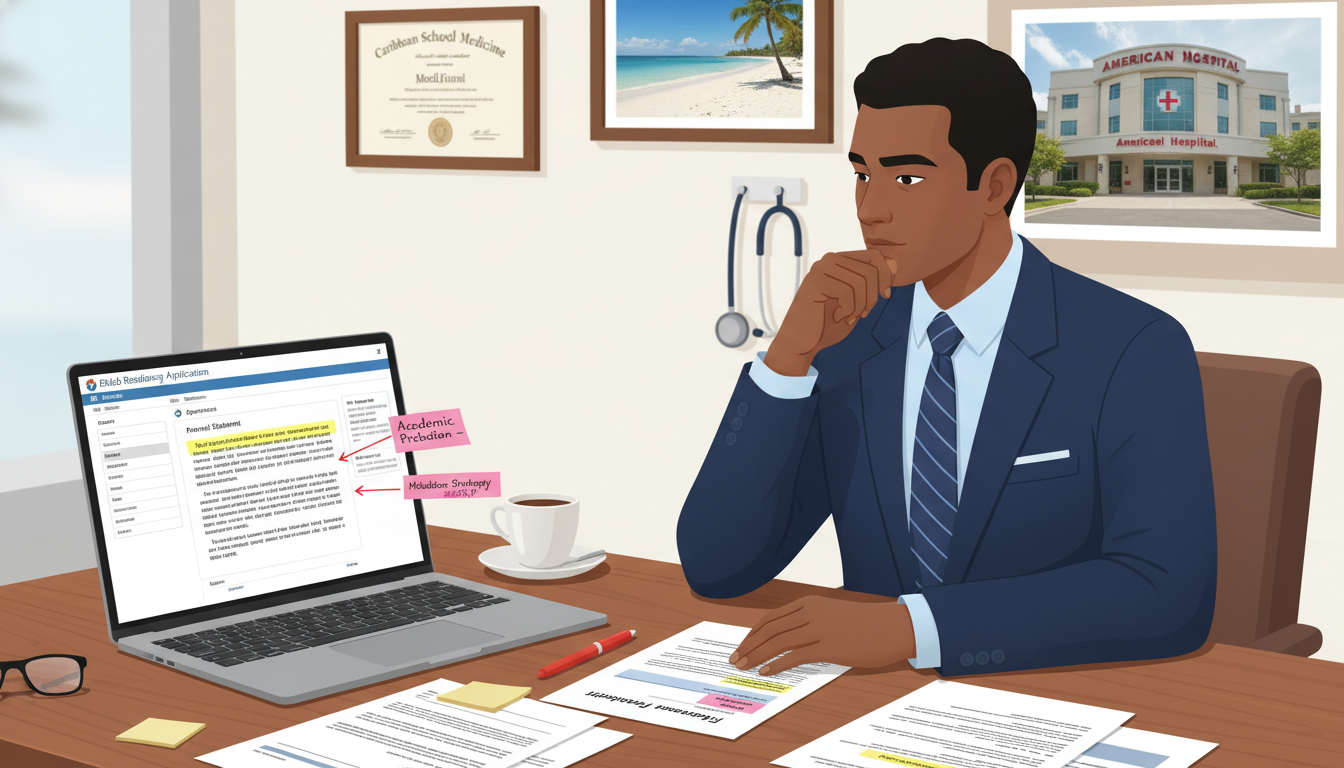
Academic probation can feel like a permanent stain on your record—especially as a Caribbean IMG trying to match into U.S. residency. Many applicants quietly wonder: “Will this ruin my chances?” “Do I really have to disclose it?” “If I do, what should I say?”
You’re not alone in this. A significant number of otherwise strong Caribbean medical students run into academic difficulty at some point—failed courses, USMLE delays, professionalism concerns, or personal crises that affect performance. Programs know this happens. What matters most is how you address it.
This article will walk you, step-by-step, through academic probation disclosure strategies specifically tailored for Caribbean IMGs, including those from schools like SGU, Ross, AUC, Saba, and others. We’ll cover both the practical “where/how to disclose” aspects and the deeper “how do I frame this so it doesn’t sink my application?” questions.
Understanding Academic Probation and Why It Matters
Before you can disclose probation confidently, you need a precise understanding of what it is, how schools document it, and how residency programs interpret it.
What is academic probation in medical school?
Academic probation is a formal status assigned by your medical school when you fall below certain academic or professionalism standards. Common triggers include:
- Failing or remediating one or more courses or clerkships
- Multiple marginal passes or low GPA across a term
- Failing or delaying a major exam (e.g., USMLE Step 1 readiness exam, NBME comp, school’s internal exams)
- Professionalism or conduct issues (attendance problems, unprofessional behavior, plagiarism, misconduct)
For Caribbean medical schools, policies are often clearly written in the student handbook. Probation might appear on:
- Your official transcript
- Your Medical Student Performance Evaluation (MSPE/Dean’s Letter)
- Internal records that may or may not be sent to programs
Residency programs care less about the label and more about:
- The reason (academic vs professionalism vs conduct)
- The pattern (one-time vs repeated, early vs late)
- The trajectory (decline vs steady improvement)
- Your insight (do you understand what happened?)
- Remediation and growth (what changed afterward?)
Caribbean IMGs and additional scrutiny
As a Caribbean IMG, your application is already reviewed carefully. Program directors often:
- Pay close attention to transcripts from Caribbean schools
- Look for any red flags: failed courses, remediation, academic probation medical school notations, or professionalism concerns
- Compare your application to large pools of other IMGs and U.S. grads
This means that a discipline record residency programs see—whether academic or professional—will get attention. That doesn’t mean automatic rejection, but it does mean you need a carefully planned strategy to address it head-on.
Is academic probation always a deal-breaker?
No. Many applicants with probation have successfully matched, including into solid community and even some university-affiliated programs. Success depends on:
- Strength of the rest of your application (USMLE scores, clinical evaluations, letters, research, personal statement)
- Severity and type of issue (e.g., one failed course vs repeated failures or serious professionalism violations)
- Your narrative: how you explain what happened and what you learned
The more competitive the specialty, the heavier the burden of proof on you. For Caribbean medical school residency goals, realistically, most probationed applicants will be strongest in:
- Internal Medicine
- Family Medicine
- Pediatrics
- Psychiatry
- Transitional Year / Preliminary programs
But success is still possible with a smart strategy tailored to your record.
Where and How Probation Appears in Your Application
To disclose effectively, you must know exactly where academic probation might show up to programs—and where you are required to mention it yourself.
1. Medical school transcript
Most Caribbean schools will note:
- Failed or repeated courses/clerkships
- Remediation status
- Academic probation designations where applicable
Programs review transcripts closely for Caribbean IMGs. Even if “probation” isn’t explicitly written, repeated failures or large gaps often signal academic issues.
Action step:
Before applying, request and review your official transcript. Look for:
- Any “P/F”, “R”, “Remediated”, “Repeat” or notation codes
- Any line explicitly stating “Academic Probation” or “On Probation”
You must understand what programs will see without your explanation.
2. MSPE (Dean’s letter)
The MSPE usually:
- Summarizes any academic difficulties
- Highlights professionalism concerns
- May state explicitly if you were placed on academic probation or if your progress was delayed
Some Caribbean schools are more transparent than others, but assume that any significant issue may be mentioned.
Action step:
Obtain your MSPE (or at least request to review it) as early as possible. If your school does not share drafts, ask specifically:
- “Will my academic probation be included, and how?”
- “How will my remediation/failure be described?”
Even if you cannot control the content, knowing what it says lets you align your own explanation with it.
3. ERAS application: the “red flags” questions
ERAS has direct questions that may relate to probation, discipline, or interruptions. Wording can vary slightly by year, but typically includes items such as:
- “Have you ever been placed on academic probation?”
- “Have you ever been the subject of disciplinary action or investigation?”
- “Have you ever had any interruption in your education or training?”
If you faced academic probation medical school status—or any formal disciplinary status—you must answer these honestly.
How to disclose probation in ERAS:
- Always answer truthfully. Dishonesty is a much more serious red flag than probation itself.
- If ‘Yes’ is required, there is usually a text box for explanation. This is your first chance to frame your narrative.
- Keep your explanation concise, factual, and growth-oriented (more on structure below).
4. Letters of recommendation (LORs)
Most letter writers won’t emphasize your academic difficulty, but they may:
- Mention improvement over time (“She failed early but is now among our strongest students.”)
- Reference overcoming challenges or personal hardship
If probation was tied to clinical performance or professionalism, those issues may either be addressed directly or indirectly.
Action step:
Choose letter writers who:
- Worked with you after your probation period
- Can credibly attest to your improvement and reliability
- Can speak to professional behavior and consistency
This is especially important if your probation had any professionalism component.

How to Frame Academic Probation: Core Disclosure Principles
You can’t change what happened, but you have complete control over how you present it. Strong disclosure follows a few key principles.
Principle 1: Absolute honesty
Residency programs are far more forgiving of academic missteps than of dishonesty. Attempting to hide:
- Academic probation
- Course/clerkship failures
- Discipline records
- Gaps or delays in training
puts you at risk of:
- Offer rescission if discovered later
- Contract termination
- Permanent damage to your professional reputation
If ERAS or programs ask about probation, discipline, or interruptions, answer accurately. If a school policy or the MSPE indicates probation, assume programs can see it and address it proactively.
Principle 2: Own responsibility without self-destruction
Programs look for insight and professional maturity. They want to see you:
- Take clear responsibility (“I struggled with time management and did not seek help early enough.”)
- Avoid blaming others (“The exam was unfair,” “My school is too harsh,” etc.)
- Also avoid extreme self-criticism (“I am a terrible student; I always fail.”)
Aim for balanced ownership:
“I underestimated the volume of material and did not adjust my study strategies early enough. I now recognize that I should have sought faculty guidance sooner.”
This shows accountability and growth potential.
Principle 3: Explain context, not excuses
Context helps programs understand your situation, but there is a subtle line between context and excuse.
Appropriate context examples:
- Serious family illness or death
- Personal medical or mental health issues (carefully and selectively disclosed)
- Visa problems, natural disasters, or major disruptions
- Transition challenges from another academic system
The goal is not to avoid responsibility, but to help programs see that your performance was affected by significant, understandable factors.
Example:
“During that term, a close family member became critically ill, and I attempted to balance full-time caregiving with my coursework. In hindsight, I should have taken a formal leave of absence. I have since learned to recognize when I need support and to use institutional resources appropriately.”
Principle 4: Emphasize remediation and concrete improvement
This is where you can shift your narrative from a pure red flag to a story of resilience and growth.
Be very specific:
- What exactly did you change?
- Study method (e.g., Anki, UWorld, spaced repetition)
- Time management tools (e.g., calendars, daily schedules)
- Seeking help (tutoring, faculty office hours, academic support services)
- Mental health support (therapy, counseling, medical care)
- What are the results of these changes?
- Subsequent course/clerkship grades
- USMLE Step 1/2 CK outcomes
- Stronger clinical evaluations or commendations
Programs want proof that:
- You have insight into the problem.
- You changed your behavior in actionable ways.
- Those changes produced measurable improvement.
Principle 5: Show a clear upward trajectory
For Caribbean medical school residency applications, an upward trend is powerful, especially after a rough start.
Try to demonstrate:
- Early difficulty → Later stability or excellence
- Pre-probation grades vs post-probation grades
- Step 1 vs Step 2 CK performance (Step 2 CK becomes especially important if Step 1 or earlier coursework was weak)
If you’re from a school known for large classes and high attrition, a strong improvement story reassures programs that you can handle residency workload.
Writing Your Probation Explanation: Concrete Templates and Examples
Here we’ll answer the critical question: how to disclose probation effectively in ERAS, your personal statement, and interviews.
A. ERAS academic probation explanation
ERAS gives you a limited space. Think: clear, factual, structured.
Suggested structure (3–5 sentences):
- Briefly state what happened (1 sentence)
- Provide concise context (1–2 sentences)
- Describe what you changed (1–2 sentences)
- Highlight your improved performance (1–2 sentences)
Example 1 – Academic performance issue:
“In my second year of medical school, I was placed on academic probation after failing the cardiovascular systems course. At the time, I was using passive study techniques and underestimated the volume and pace of the curriculum. In response, I met regularly with academic support services, adopted active learning methods, and implemented a structured weekly schedule. Since that time, I successfully passed all subsequent courses on the first attempt and performed significantly better on my clinical clerkships and USMLE Step 2 CK.”
Example 2 – Personal/medical context:
“During my third semester, I was placed on academic probation after failing two integrated system exams. This occurred while I was managing an untreated anxiety disorder that significantly affected my concentration and exam performance. I subsequently sought professional care, engaged in regular therapy, and developed healthier study and coping strategies. After returning to full-time coursework, I passed all remaining courses on the first attempt, completed my clinical rotations on schedule, and demonstrated consistent improvement in my evaluations and exam scores.”
Notice what these do:
- They admit the problem clearly.
- They provide limited but meaningful context.
- They show concrete actions and specific improvements.
B. Personal statement: When and how to address probation
You are not required to discuss academic probation in your personal statement. Whether you should depends on:
- How prominent it is in your record
- Whether the MSPE highlights it heavily
- Whether your ERAS explanation feels too short to fully convey your growth
For many Caribbean IMGs, it helps to address probation briefly in one focused paragraph, especially if:
- It was a turning point in your medical education
- It clearly shaped your work ethic, empathy, or clinical approach
- It led to major changes in your learning style that explain your later success
Where to place it:
Typically mid-statement, after introducing why you chose your specialty but before your final summary.
Example paragraph:
“Early in my basic sciences, I struggled to adapt to the intensity of the curriculum and failed a core systems course, resulting in academic probation. This experience was deeply humbling and forced me to reconsider how I approached learning and self-care. I began meeting regularly with faculty, used structured question banks and active recall strategies, and learned to set boundaries that protected my study time and mental health. The result was a sustained upward trend in my performance, culminating in strong clerkship evaluations and a Step 2 CK score that reflects my current abilities more accurately than my early transcript.”
Common mistake:
Spending half your personal statement defending your record. That shifts focus away from your strengths. Aim for one tight, honest, growth-focused paragraph unless your situation is unusually complex.
C. Interview responses: Talking about probation confidently
You should expect some programs to ask:
- “I see you were placed on academic probation. Can you tell me about that?”
- “What led to the academic difficulty you experienced?”
- “What did you learn from that experience?”
Strategy for answering:
Use a simple 3-part structure: What happened → What you changed → How you’re different now
Example answer:
“In my second year, I was placed on academic probation after failing a major systems exam. I had relied too heavily on passive study methods and didn’t seek help early enough when I started to fall behind. Once I was placed on probation, I met with academic advisors, switched to active question-based learning, and created a structured weekly study schedule that I’ve maintained since. Since then, I’ve passed all rotations on the first attempt, received strong clinical evaluations, and scored significantly higher on Step 2 CK. That experience taught me to be proactive, to use available resources, and to treat feedback as something to act on immediately.”
Key tips:
- Stay calm and matter-of-fact; don’t get defensive or overly emotional.
- Keep your answer to about 60–90 seconds.
- Avoid blaming your school, specific faculty, or “unfair” systems.
- End with how this experience actually makes you more prepared for residency (resilience, early help-seeking, mature coping strategies).

Special Considerations for Caribbean IMGs: Strategy and Mitigation
With academic probation on your record, you need a deliberate plan for your Caribbean medical school residency applications.
1. Strengthen everything else you can control
Your goal is to make programs say: “Yes, there’s a red flag—but the rest of the application is so solid that it’s worth interviewing this candidate.”
Focus on:
USMLE Step 2 CK:
- Prioritize a strong Step 2 CK score, especially now that Step 1 is pass/fail.
- A high Step 2 score can partly offset earlier academic concerns and show true clinical knowledge potential.
Clinical performance:
- Aim for strong evaluations, honors where feasible, and positive comments in core rotations related to your target specialty.
- Choose audition/sub-internship rotations carefully, particularly at IMG-friendly programs.
Letters of recommendation:
- At least one or two letters from U.S. clinicians in your chosen specialty.
- Ask specifically for letters that mention your reliability, work ethic, and improvement.
Professionalism:
- Be early, prepared, and respectful in every rotation and communication.
- Any additional professionalism concern on top of probation can be catastrophic.
2. Be realistic and strategic about specialty and program list
If you have academic probation on your record as a Caribbean IMG, aiming for very competitive specialties (Dermatology, Plastic Surgery, Neurosurgery, etc.) in the U.S. is usually unrealistic. Even moderately competitive specialties (Radiology, Anesthesiology, EM in some regions) become significantly harder.
More realistic and often successful targets include:
- Internal Medicine
- Family Medicine
- Pediatrics
- Psychiatry
- Transitional Year / Preliminary IM or Surgery (as part of a longer-term strategy)
When building your list:
- Prioritize IMG-friendly programs (look at their current residents’ backgrounds).
- Include a healthy mix of community hospitals and community–university affiliated programs.
- Be mindful of geographic regions that traditionally accept more IMGs (certain parts of the Midwest, South, and Northeast).
3. Handling discipline record residency concerns
If your record includes not only academic probation but also any discipline:
- Professionalism warnings
- Honor code violations
- Conduct issues
…you need even greater care in your narrative.
Key differences:
- Programs are generally more forgiving of purely academic problems than of professionalism or integrity issues.
- If your probation stemmed from professionalism, you must demonstrate substantial behavior change and credible third-party validation (LORs, evaluations).
In such cases:
- Have at least one letter from a supervisor who can attest to your professionalism after the incident.
- In your explanation, clearly articulate what behavior changed and how you ensure it will not recur.
Example:
“I was placed on probation following a professionalism concern related to repeated tardiness for didactic sessions. At that time, I had poor time management and did not fully grasp how my actions affected the team. I worked closely with faculty mentors, implemented strict scheduling routines, and have not had any further professionalism issues in clinical rotations. My supervisors now consistently comment on my reliability and punctuality, which I can support with strong recent evaluations.”
4. Consulting your dean’s office and advisors
Don’t navigate this alone. Before you submit your ERAS:
Meet with your dean’s office or academic affairs office. Ask:
- How is my probation documented?
- What will be included in my MSPE?
- Are there standard school statements you recommend for students in my situation?
If your school supports a strong Caribbean network (e.g., SGU residency match advising, alumni mentorship), seek advice from:
- Recent grads who matched with similar red flags
- Faculty familiar with U.S. match expectations
Use this input to refine your narrative and to set realistic expectations.
FAQs: Academic Probation Disclosure for Caribbean IMGs
1. Will academic probation ruin my chances of matching?
Not automatically. Academic probation is a red flag, but many Caribbean IMGs with probation do match—especially into IM, FM, Peds, and Psych—if they:
- Demonstrate a clear upward trend afterward
- Achieve strong Step 2 CK scores
- Secure excellent letters of recommendation
- Explain the situation honestly and thoughtfully
What hurts more than probation itself is a pattern of repeated failures, continued performance problems, or apparent dishonesty about what happened.
2. Do I have to disclose probation if it’s not written on my transcript?
If ERAS specifically asks whether you have been on academic probation or disciplined, you must answer truthfully based on your school status, not just what appears on your transcript. Even if your transcript is silent, your school or MSPE may still document the issue. Deliberate omission can lead to serious consequences later, including losing a residency spot.
3. How detailed should I be about personal or mental health issues related to probation?
Disclose only what is necessary to provide context and demonstrate your growth. You do not need to share your full medical or psychiatric history. A safe approach is:
- Acknowledge the challenge in general terms (“health issues,” “anxiety,” “family crisis”).
- Emphasize that you sought appropriate help and that the issue is now well-managed.
- Focus on how your performance has stabilized or improved since.
If you’re unsure about specifics, consider discussing wording with a trusted advisor, dean, or counselor.
4. I’m from a Caribbean school like SGU with a strong match history. Does that offset probation?
Attending a school with a robust SGU residency match record or similar Caribbean institution can help in terms of overall institutional reputation and alumni networks. However, probation will still be evaluated on its own merits. A strong school reputation does not erase a red flag, but if you combine:
- A reputable Caribbean school
- A compelling improvement story
- Strong exam scores and clinical performance
…you can still present as a credible, competitive candidate for many Caribbean medical school residency opportunities in the U.S.
Academic probation doesn’t define your entire career—unless you let it. As a Caribbean IMG, you already know what it means to take a nontraditional path and persist despite obstacles. If you approach your disclosure with honesty, maturity, and strategic framing, probation can become part of a powerful narrative of resilience rather than a permanent barrier to residency.