
Understanding Red Flags as a Caribbean IMG
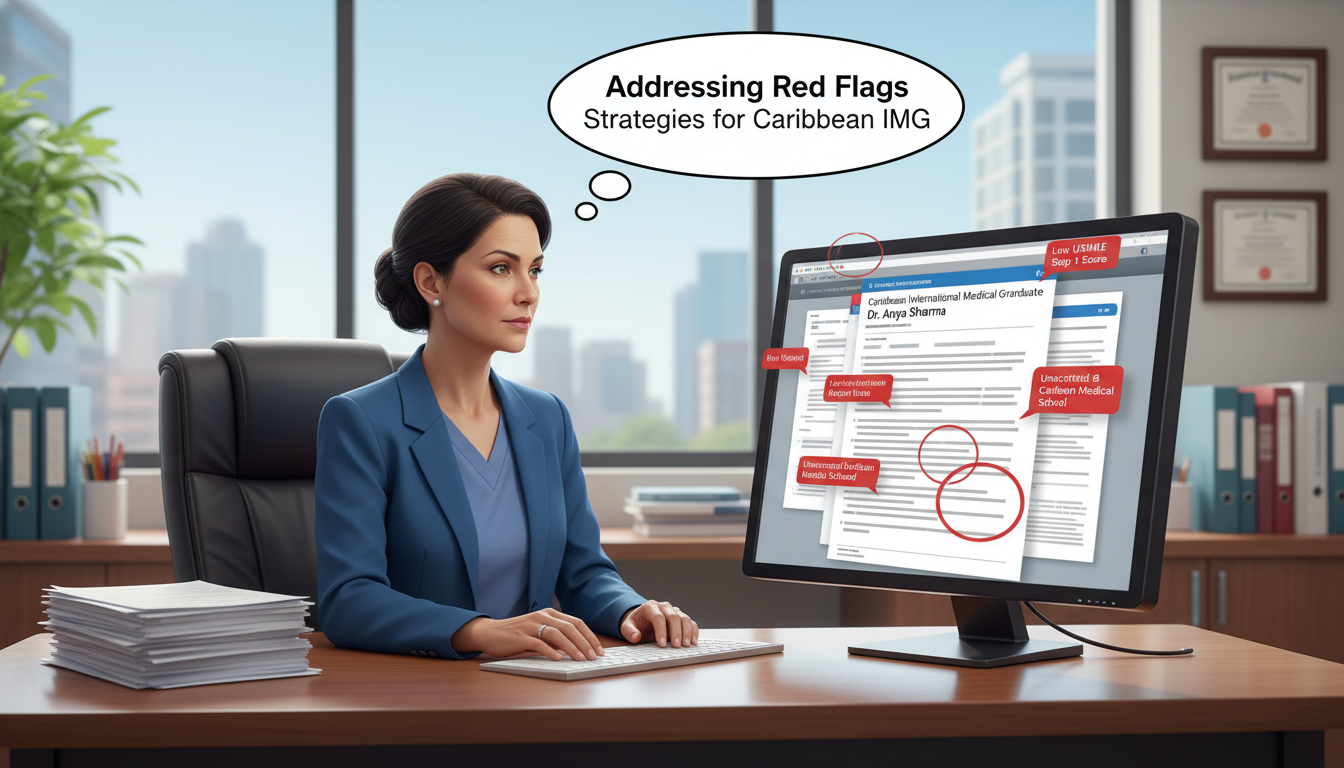
If you’re a Caribbean IMG applying to U.S. residency programs, you already know your application will be scrutinized closely. On top of that, any “red flags” can feel like a major threat to your chances. The reality is more nuanced: red flags don’t automatically disqualify you, but they do require strategic, honest, and thoughtful handling.
This guide focuses specifically on addressing red flags for Caribbean IMGs: what they are, how program directors interpret them, and how to respond in a way that preserves trust and highlights growth. Whether you’re applying from SGU, AUC, Ross, Saba, or another Caribbean medical school, these strategies apply to you.
We’ll cover:
- The most common red flags for Caribbean IMGs
- How to prioritize which red flags to address (and where)
- Frameworks for how to explain gaps, failures, and professionalism concerns
- Tailored advice for Caribbean medical school residency applicants (including SGU residency match–focused tips)
- Sample language and practical steps to strengthen your overall application
Throughout, remember the program director’s mindset:
“Can I trust this person to care for my patients, be reliable on call, work well with my team, and successfully complete residency?”
Your job is to acknowledge concerns, demonstrate insight and growth, and reassure them you’re a safe, reliable bet.
Common Red Flags for Caribbean IMGs and Why They Matter
Before you can address red flags, you need to understand how they’re perceived. For Caribbean IMGs, some issues are more heavily weighted because programs already see you as a higher-risk applicant compared with U.S. MD seniors.
1. Academic Performance Issues
Typical academic red flags include:
- Multiple course failures (especially in core subjects like physiology, pharmacology, pathology)
- Repeating semesters or repeating Step exams
- Low or failed USMLE scores
- Sudden or prolonged decline in grades or clinical evaluations
Why this matters to programs:
- Residency is academically demanding; they worry you may struggle to pass in-training exams, boards, or keep up with patient care.
- For Caribbean schools, where attrition can be higher, repeated failures may be seen as confirmation of risk.
However, academic setbacks are also some of the most “recoverable” red flags—if you show a clear upward trajectory and concrete changes in how you approach studying and clinical work.
2. USMLE Failures or Low Scores
USMLE performance is one of the most prominent Caribbean medical school residency filters. Common red flags:
- Failed Step 1 or Step 2 CK
- Multiple attempts to pass
- Very low passing scores (especially in competitive specialties)
This is where keyword concepts like addressing failures and red flags residency application are directly relevant. Programs interpret USMLE performance as a proxy for:
- Knowledge base
- Study habits and discipline
- Ability to pass future board exams
Programs are more likely to interview a Caribbean IMG who failed a Step once but then scored solidly on a retake than an applicant who barely passed both times with no upward trend.
3. Gaps in Medical Education or Career
Unexplained or poorly explained gaps are a major concern. Examples:
- Time off between basic sciences and clinicals
- Long delays between graduation and starting residency applications
- Multiple months without clinical activity
- Significant time between taking Step exams
Program directors immediately wonder:
“What happened? Were there personal, academic, or professionalism issues?”
Because Caribbean IMGs often face visa delays, financial difficulties, or family responsibilities, gaps are not unusual—but you must know how to explain gaps convincingly, with dates and clear rationale.
4. Professionalism or Conduct Issues
These are the most serious and hardest to overcome:
- Dismissal or suspension from medical school
- Formal professionalism sanctions
- Negative comments in MSPE/dean’s letter (e.g., unprofessional behavior, poor teamwork, dishonesty)
- Conflicts with preceptors, nurses, or team members documented in evaluations
Program directors view professionalism red flags as potential liability risks. They ask:
- Will this person respect patients and the team?
- Could this lead to conflict, complaints, or litigation?
While these are tough to mitigate, credible insight and concrete behavior change can still keep you in the game for some programs.
5. Multiple Transfers or Unorthodox Path
Caribbean IMGs may:
- Transfer between multiple schools
- Start in one country, finish in another
- Switch between different degree programs (e.g., pre-med to MD in different institutions)
Frequent moves can raise questions about commitment, stability, and adaptability. Alone, they may not be disqualifying, but combined with other red flags, they can appear concerning.
General Principles for Addressing Any Red Flag
Every red flag is different, but successful explanations share common features. Use these principles whether you’re explaining a Step failure, an academic dismissal, or a long gap.
1. Be Honest, But Strategic
Lack of honesty is a deal-breaker. Program directors are very experienced at spotting vague or evasive answers.
However, “honest” doesn’t mean oversharing every painful detail. Aim for:
- Factual accuracy
- Relevant details that explain the impact on your training
- Boundaries around sensitive personal information (mental health, family, finances) while still conveying the truth
Example (strong):
During my second year, my mother developed a serious medical condition, and I returned home for several months to help with her care. Balancing caregiving and coursework led to poor performance and a failed exam. I realized I could not meet both responsibilities fully and took a formal leave of absence. Once my family situation stabilized, I returned to school with a specific study plan and support from our academic office, and I have passed all subsequent courses and exams on the first attempt.
Versus (weak):
Some personal issues happened, and my school made me take time off.
The first version is honest, specific, and shows insight and growth. The second creates more questions than answers.
2. Take Ownership, Avoid Blame
Programs want mature residents who can own their mistakes.
Use language that:
- Accepts responsibility: “I underestimated…,” “I did not manage my time well,” “I failed to seek help early.”
- Minimizes blame: Avoid statements that focus solely on the school, exam writers, or “unfair” circumstances.
You can mention external factors (family illness, financial hardship, visa delays), but always pair them with your own actions and lessons learned.
3. Focus on Insight, Change, and Outcomes
A red flag becomes less threatening when you can show:
- What went wrong
- What you learned
- What you changed
- How your outcomes improved afterward
Programs look for evidence of growth, not just words. Emphasize:
- Later strong exam scores
- Positive clinical evaluations
- Consistent work or research productivity
- Strong Step 2 CK performance after a Step 1 issue
4. Be Consistent Across All Parts of Your Application
Your story should match:
- ERAS application entries
- MSPE / Dean’s letter
- Transcripts
- Letters of recommendation
- Personal statement
- Interview answers
Inconsistency is itself a red flag. Before submitting, review all documents to ensure your timelines and explanations align.
5. Practice Delivery for Interviews
Even a well-written explanation can fall flat if you sound defensive, overly emotional, or vague during interviews. Practice:
- A 60–90 second verbal explanation for each major red flag
- A calm, matter-of-fact tone
- Clear transitions from “what went wrong” to “what I changed” to “how I now function as a stronger candidate”
Practice with:
- A mentor or advisor
- A faculty member from your Caribbean medical school
- A friend role-playing as a skeptical program director
Addressing Specific Red Flags: Concrete Strategies and Sample Language
Now we’ll walk through how to tackle the most common red flags you may face as a Caribbean IMG, with practical, customizable templates.
1. USMLE Failures or Low Scores
USMLE concerns are especially critical for Caribbean medical school residency applicants, including those targeting an SGU residency match or similar pathways.
Strategy
- Explain the context (without making excuses).
- Identify your error(s): study method, timing, personal issues.
- Describe your remediation plan in detail.
- Show improved performance on retakes or later exams.
Sample Explanation (Personal Statement or Interview)
I failed Step 1 on my first attempt. At the time, I relied heavily on passive learning—reading and watching videos—without enough active practice and self-assessment. I also underestimated how much time I needed to consolidate my knowledge from the Caribbean basic sciences curriculum.
After receiving my score, I met with my school’s academic support office and redesigned my study approach. I created a structured schedule focused on question-based learning, frequent self-assessments, and dedicated time for weak areas such as biochemistry and immunology. I also formed a small study group with classmates who had strong test-taking strategies.
On my second attempt, I passed Step 1 with a significantly higher score. I applied the same disciplined and question-based approach to Step 2 CK, which I passed on my first attempt with a competitive result. This experience taught me to systematically analyze my weaknesses and adjust quickly—skills I now apply daily in clinical decision-making.
Key points:
- Honest about the failure
- Specific about what changed
- Shows upward trajectory
- Connects the experience to current strength as a learner
2. Course Failures or Repeated Semesters
Strategy
- Clarify how many courses/semesters were affected.
- Explain why this occurred (e.g., adjustment to new system, language, personal stress).
- Highlight your academic rebound with higher grades and solid clinical evaluations.
Sample Written Explanation (ERAS “Experience” or “Education” Section Comments)
During my first year in basic sciences, I failed two courses and repeated the semester. Transitioning from my home education system to the intensive pace of a Caribbean medical school, I initially relied on memorization rather than deeper conceptual understanding and time management.
In response, I met with faculty advisors, enrolled in our academic support program, and implemented a weekly study schedule with clear goals and frequent self-testing. When I repeated the semester, I passed all courses and subsequently completed the remainder of my curriculum without any further failures. My later performance in clinical clerkships and on Step 2 CK reflects the effectiveness of these changes.
3. Gaps in Training or Employment: How to Explain Gaps
Gaps are not inherently fatal, but unexplained gaps are. Programs want to know:
- What were you doing?
- Why were you not in school or clinicals?
- Did you regress clinically?
Strategy
- Specify the exact time frame (month/year to month/year).
- Clarify primary activities: caregiving, visa issues, financial work, health, research.
- If possible, show clinical relevance (e.g., observerships, research, self-study) during or after the gap.
Example: Family Caregiving Gap
From June 2021 to March 2022, I took a formal leave from medical school to return home and assist my family during my father’s critical illness. During this period, I was the primary coordinator for his medical care and also worked part-time to support our household. Although I was away from formal coursework, I maintained my clinical knowledge through board review resources and later completed a four-week observership in internal medicine upon returning. When I resumed my studies, I passed all subsequent rotations and Step 2 CK on the first attempt.
Example: Visa or Logistical Gap for Caribbean IMG
Following my graduation in December 2020, I experienced unexpected visa delays that postponed my ability to start U.S. clinical experiences. Between January and September 2021, I remained in my home country. During this period, I completed online CME courses in internal medicine, engaged in remote case-based discussions with a local internist, and volunteered at a community clinic in a non-physician role. Once I received my visa, I began in-person observerships in the U.S. and have since maintained continuous clinical involvement.
The emphasis is on:
- Clear timeline
- Legitimate reasons
- Some ongoing academic or clinical engagement

Handling Professionalism Concerns and Non-Academic Red Flags
Professionalism issues are among the toughest red flags, but not always impossible—especially if they are older, relatively minor, and clearly resolved.
1. Prior Dismissal or Suspension
If you were dismissed or suspended from a Caribbean medical school (or another institution), some programs may automatically screen you out, but others will consider you if your explanation is honest and shows sustained improvement.
Strategy
- State the event clearly (dismissal vs. suspension).
- Clarify the official reason (academic vs. professionalism).
- Describe the appeal or remediation process, if applicable.
- Emphasize sustained performance since the event.
Sample Interview Response
In my second year, I was placed on academic suspension after failing multiple courses. At that time, I was working extensive off-campus hours due to financial stress and did not seek help early when I began to fall behind. The school required that I step away for one term, work with academic counseling, and demonstrate readiness to return.
During the suspension, I focused on stabilizing my finances and meeting regularly with an academic advisor. I also audited several courses to rebuild my foundation. Since returning, I have passed all subsequent courses and clinical rotations without failures and passed both Step 1 and Step 2 CK on the first attempt. The experience taught me the importance of early help-seeking and realistic workload management—skills I now apply proactively.
2. Negative Comments in Evaluations or MSPE
If your MSPE or evaluations mention attitude issues, lateness, or conflict:
- Expect to be asked about it—especially if programs see you as otherwise strong.
- Have a concise, non-defensive explanation ready.
Strategy
- Acknowledge the feedback.
- Describe the circumstances without blaming others.
- Highlight concrete steps you took to improve (punctuality systems, communication training, feedback-seeking).
- Provide evidence of change (later positive evaluations, leadership roles).
Sample Interview Response
During my early clinical rotations, one evaluation noted concerns about my punctuality and communication with nursing staff. At the time, I was adjusting to a new hospital system and underestimated the impact that even small delays and miscommunications could have on the team.
I met with my clerkship director to review the feedback in detail, started arriving 20–30 minutes earlier for all shifts, and made a point of checking in regularly with the nursing staff at the beginning and end of each day. Subsequent evaluations have consistently commented on my reliability and teamwork, and I’ve since been selected as a team lead on two rotations. This experience made me much more intentional about communication and reliability in clinical settings.
Application-Wide Strategy: Where and How to Address Red Flags
You don’t need to (and shouldn’t) overexpose your red flags everywhere. Use a targeted approach to control the narrative.
1. Personal Statement
Use the personal statement to address:
- Major, defining red flags that shaped your professional development (e.g., a Step failure that transformed how you study; a family/health crisis that explains a gap).
- Choose only one primary red flag for the main narrative, unless others are minor and can be referenced briefly.
Tips:
- Don’t let the entire statement become an apology.
- Spend more time on who you are now and why you’re a strong fit for the specialty.
2. ERAS Application Fields
Use ERAS to:
- Clearly mark leaves of absence and gaps with brief, factual explanations.
- Ensure date ranges match transcripts and MSPE.
- Provide short clarifying comments where the system allows (e.g., “Leave of absence due to family illness; returned and completed curriculum without further interruptions”).
3. MSPE / Dean’s Letter
For Caribbean IMGs, sometimes the MSPE is less detailed than U.S. schools. Still:
- Know what’s in your MSPE before interviews.
- If there is a known negative comment, mirror the same language when addressing it verbally.
4. Letters of Recommendation
Strong letters can actively counterbalance red flags. For example:
- A supervising physician who notes your reliability and professionalism can offset past concerns about punctuality.
- A letter emphasizing your strong clinical reasoning can help mitigate earlier academic struggles.
When requesting letters:
- Choose faculty who have seen your recent performance post–red flag.
- Briefly (and professionally) share that you previously had “X” issue but have since improved; ask if they can comment on your current strengths.
5. Interviews
This is often the decisive moment in a red flags residency application. During interviews:
- Never sound surprised when asked about an obvious red flag.
- Answer directly, then smoothly pivot to what you’ve learned and how it’s made you better prepared.
- Avoid emotional oversharing; keep the tone professional and reflective, not confessional.
Example pivoting phrase:
“That experience was challenging, but it forced me to become more structured and self-aware as a learner. Since then, I’ve…”
Tailored Advice for Caribbean IMGs: Maximizing Your Chances Despite Red Flags
As a Caribbean IMG, you are already considered “non-traditional” by many programs. Navigating red flags from this position requires both damage control and strength maximization.
1. Lean on Your Strengths: Clinical Experience and Adaptability
Highlight:
- High-volume clinical exposure (especially in U.S. hospitals affiliated with your Caribbean school).
- Strong letters from U.S. attendings who know you well.
- Experience working in diverse, resource-limited, or multicultural settings.
These strengths can help convince program directors that, despite past red flags, you will function well in their clinical environment.
2. Choose Programs Strategically
Your odds are higher at programs that:
- Have a history of interviewing and matching Caribbean IMGs.
- Are community-based or university-affiliated community programs.
- Located in regions that traditionally welcome IMGs (e.g., certain parts of the Midwest, South, and Northeast).
If you’re from a school like SGU, look at SGU residency match lists to identify:
- Programs repeatedly taking SGU or other Caribbean graduates.
- Specialties where Caribbean IMGs frequently match (e.g., internal medicine, family medicine, pediatrics, psychiatry, some prelim positions).
Apply broadly and wisely, aligning your application to where your profile is realistic.
3. Build a Strong “Red Flag–Resistant” Profile
To offset red flags, reinforce as many positives as possible:
- Step 2 CK: Aim for a strong score. This is one of the most powerful signals that you’ve overcome previous academic issues.
- Research or scholarly activity: Even small projects or QI posters show initiative.
- Meaningful U.S. clinical experience: Observerships, externships, or research with clinical exposure.
- Volunteering and leadership: Demonstrate reliability, commitment, and professionalism in non-academic spheres.
Each strength makes programs more willing to look past concerns.
4. Consider a Transitional Step if Needed
If your red flags are significant and you don’t match after one cycle, consider:
- Additional U.S. clinical experience in your target specialty
- Research positions or fellowships in an academic center
- A structured plan to improve any lingering weaknesses (e.g., additional coursework, advanced degrees relevant to your specialty)
Use that time to actively address the root issues behind your red flags—not just add lines to your CV.
FAQs: Addressing Red Flags as a Caribbean IMG
1. Should I always bring up my red flags in my personal statement?
Not always. Consider:
- Yes, if the red flag is major (e.g., Step failure, dismissal, long gap) and directly shaped who you are as a physician.
- Maybe, if it will obviously raise questions and you want to control the narrative proactively.
- No, if the issue is minor, already clearly documented and explained elsewhere, and you want to keep your statement focused on your motivations and strengths.
When in doubt, discuss with an advisor familiar with Caribbean IMG applications.
2. How much personal detail should I share when explaining gaps or failures?
Share enough for the reader to understand:
- Why the event happened
- That it was legitimate and time-limited
- How you responded and grew
You don’t need to share highly sensitive details (e.g., specific psychiatric diagnoses, intimate family situations) unless you’re comfortable and it significantly clarifies the situation. Maintain professionalism and respect your own boundaries.
3. Is a failed Step exam an automatic rejection for Caribbean IMGs?
It’s not an automatic rejection, but it narrows the field:
- Some programs will filter out any failures.
- Many community and IMG-friendly programs will still consider you, especially if you show clear improvement on the retake and Step 2 CK.
- Your strategy must emphasize upward trends, structured remediation, and strong clinical performance.
4. Can strong letters of recommendation overcome serious red flags?
Strong letters can’t erase major issues, but they can soften their impact. A glowing letter that explicitly addresses your reliability, professionalism, and clinical ability reassures programs that:
- The problem was time-limited and not your current pattern.
- You are safe and effective in the clinical environment.
For serious red flags, you’ll need both: strong letters and a thoughtful, consistent explanation.
By understanding how program directors interpret red flags—and by preparing honest, growth-focused explanations—you can present yourself as a resilient, self-aware, and trustworthy candidate. As a Caribbean IMG, you may face extra scrutiny, but with clear strategies for addressing failures, explaining gaps, and demonstrating maturity, it is entirely possible to secure a strong Caribbean medical school residency position and move confidently toward your training in the U.S.