Understanding “Red Flags” in Internal Medicine Residency Applications
For a non-US citizen IMG (international medical graduate), the path to an internal medicine residency in the United States is demanding even under ideal circumstances. When your application includes “red flags,” that challenge becomes steeper—but not impossible.
Red flags do not automatically end your chances at an IM match. Program directors in internal medicine routinely work with candidates who struggled at some point in their journey. What matters most is how you understand those red flags, how you have grown from them, and how effectively you communicate that growth in your application and interviews.
This article will help you:
- Recognize the most common red flags in an internal medicine residency application
- Learn how program directors actually interpret each type of concern
- Build a strategy for how to explain gaps, failures, or other concerns in a credible and professional way
- Adapt this specifically to the context of a non-US citizen IMG or foreign national medical graduate
Common Red Flags for Non-US Citizen IMGs
Red flags fall into several broad categories. As a foreign national medical graduate, you may face more scrutiny in some areas (e.g., exam attempts, continuity of training) than a US graduate.
1. Academic Difficulties and Exam Failures
Common academic red flags:
- USMLE Step 1 or Step 2 CK failure (one or multiple attempts)
- Very low USMLE scores compared to program norms
- Failed medical school courses or rotations
- Repeated years, delayed graduation, or academic probation
How program directors view them (Internal Medicine–specific):
Internal medicine is cognitive and exam-focused. PDs look for evidence that you can handle complex reasoning, heavy reading, and board-style thinking. A single exam failure is often survivable; multiple failures or a pattern of low performance raise concerns about:
- Knowledge base and test-taking ability
- Work habits and consistency
- Potential future board exam performance (ABIM)
However, many IM programs have matched successful physicians who initially struggled academically—especially when there is a clear upward trend and convincing remediation.
2. Unexplained Gaps in Training or Employment
Gaps can be a major issue, especially for a non-US citizen IMG where continuity of training is scrutinized.
Typical gap scenarios:
- 6+ months after graduation with no clinical, academic, or professional activity
- Years between medical school graduation and application without clear explanation
- Periods without work due to visa issues, personal or family illness, or relocation
Why gaps worry program directors:
- Concern about “rustiness” in clinical reasoning and procedural skills
- Uncertainty about professionalism, motivation, or reliability
- Fear that the gap hides serious problems (disciplinary issues, legal problems)
Gaps are not always fatal, but they must be explained clearly, honestly, and with evidence that you have re-engaged clinically and academically before starting residency.
3. Professionalism Issues and Disciplinary Actions
Professionalism concerns are among the most serious red flags and can stop an application from being considered.
Examples:
- Formal professionalism remediation or probation in medical school
- Dismissal or suspension from a residency or internship
- Unprofessional behavior reported on MSPE/Dean’s letter
- Legal issues (fraud, criminal charges) related to clinical work
How they’re interpreted:
Internal medicine programs emphasize teamwork, ethics, communication, and reliability. A PD might accept weaker scores or a gap, but serious professionalism concerns can be disqualifying—unless there is a truly convincing record of insight, remediation, and consistently exemplary behavior afterward.
4. Multiple Attempts at USMLE or Other Exams
For a non-US citizen IMG applying to internal medicine, the number of USMLE attempts matters greatly.
Red-flag patterns:
- More than one failure on any USMLE Step
- Step 2 CK passed on 3rd attempt or more
- Major discrepancy between Step 1 and Step 2 CK (e.g., large drop in performance)
Why attempts matter:
- Programs worry about future ABIM board exam pass rates
- Visa-sponsoring programs (J-1 or H-1B) often create filters based on attempts
- Multiple failures can suggest learning or test-taking issues not yet fully addressed
That said, many candidates with one Step 1 or Step 2 CK failure successfully match into community internal medicine programs, particularly if they show clear improvement.
5. Extended Time Since Graduation (YOG Concerns)
For a foreign national medical graduate, “year of graduation” (YOG) is a silent filter at many IM programs.
Why older YOG is seen as a red flag:
- Worry that knowledge and clinical skills are outdated
- Fear that the candidate could struggle to adapt to US clinical systems
- Preference for fresh graduates who are more recently tested and supervised
However, if you are several years out of medical school and have been active in clinical practice, research, hospitalist work, or academic roles, you can offset this concern.
6. Limited or No US Clinical Experience (USCE)
While not always labeled a “red flag,” lack of USCE can be a major barrier for non-US citizen IMGs.
USCE concerns:
- PDs worry you have not practiced within US systems, EMR, or team-based care
- LORs from your home country may not sufficiently validate your readiness
- Some programs filter out applicants without US-based inpatient or outpatient internal medicine experience
If you also have other red flags (e.g., low scores, exam failures), strong USCE becomes even more critical to counteract them.

Strategy First: How to Think About Your Red Flags
Before writing personal statements or answering interview questions, you need a strategic mindset.
Step 1: Identify Your Red Flags Honestly
Make a list of all potential concerns:
- Exam history: failures, low scores, number of attempts
- Training timeline: graduation year, gaps, delays
- Professionalism or disciplinary events
- Visa status and its impact on your training path
- Lack of USCE, limited research, or weak letters
Ask trusted mentors, especially US-based faculty or program alumni, to review your CV and point out anything that might be perceived as a red flag.
Step 2: Separate What You Can and Cannot Change
Cannot change:
- Past failures, attempts, or low scores
- Year of graduation
- Completed disciplinary actions
Can change (or mitigate):
- Recency and quality of your clinical experience
- Strength of letters and networking
- Explanation and framing of your red flags
- Evidence of improvement (courses, research, QI projects, new scores)
Focusing on what you can change keeps you productive and helps you build a convincing narrative.
Step 3: Build a Coherent Narrative of Growth
Program directors do not expect perfection. They do expect:
- Insight: You understand what went wrong.
- Ownership: You take responsibility, not blame others.
- Action: You took concrete steps to improve.
- Outcome: Your later performance actually got better.
This four-part pattern—Insight, Ownership, Action, Outcome—should guide how you address any red flag in your personal statement, ERAS experiences, and interviews.
How to Explain Specific Red Flags in Your Application
This section walks through common scenarios and provides language frameworks you can adapt. Do not copy memorized lines; instead, make them authentic to your story.
1. Addressing Exam Failures or Low Scores
For many non-US citizen IMGs, exam issues are the most common concern.
In the personal statement
You do not need to mention a single low score, but you should address any failure or multiple attempts, especially if they stand out.
Framework:
- Brief context – What happened, in 1–2 sentences.
- Insight – What you learned about your preparation, habits, or circumstances.
- Action – Specific changes you made (study plan, resources, schedule, health).
- Outcome – Improved later performance or new achievements.
Example (adapted, not to be copied word-for-word):
During my initial attempt at Step 1, I underestimated the transition from subject-based studying to integrated, systems-based review. My preparation lacked structure and sufficient practice questions, and I did not reach the score I needed to pass.
This experience forced me to re-evaluate how I learn. I sought guidance from peers who had been successful, created a disciplined study schedule, and focused on high-yield question banks and timed practice exams. By the time I retook Step 1, I had transformed my approach, and I passed with a solid improvement in performance.
I applied this new structure to Step 2 CK as well, which I passed on my first attempt with a score that more accurately reflects my clinical knowledge and reasoning.
Emphasize the trajectory rather than the failure itself.
In interviews
Expect a direct question like:
“Can you tell me about your Step 1/Step 2 CK failure?”
Use the same IOAO structure:
- Insight: “I realized that…”
- Ownership: “I did not manage… I underestimated…”
- Action: “So I changed…”
- Outcome: “Since then, I have…”
Keep the answer 1–2 minutes, factual, and calm.
2. How to Explain Gaps in Training or Employment
Program directors notice gaps of more than 3–6 months. For a non-US citizen IMG, long periods of inactivity raise questions about visa, motivation, or clinical currency.
Types of gaps and how to frame them
Family or personal health reasons
- Acceptable if described briefly, with emphasis on your return to medicine.
- Avoid oversharing; maintain privacy and professionalism.
Visa or immigration delays
- Common for foreign national medical graduates.
- Explain how you used the time productively (online courses, research, observerships, language improvement).
Exam preparation leave
- Some PDs may worry you needed full-time study just to pass.
- Counterbalance with proof of strong subsequent performance or additional responsibilities.
Non-clinical work or unrelated jobs
- Show transferable skills (communication, organization), but also show how you stayed connected to medicine.
Practical example: Short paragraph for personal statement or ERAS
After graduating in 2019, I experienced a delay in securing a US visa, which resulted in a 10-month gap before I could begin formal US clinical experiences. During this period, I stayed engaged academically through online internal medicine CME courses, regular case discussions with mentors via videoconference, and dedicated preparation for Step 2 CK. Once my visa was approved, I immediately began observerships in internal medicine at [Hospital], where I could apply and reinforce this knowledge in a clinical setting.
Key elements:
- Brief, honest cause
- Evidence of ongoing engagement with medicine
- Clear transition back into active clinical work
In interviews
Avoid vague answers like: “I was dealing with some personal issues.”
Instead:
- Give a concise reason
- Emphasize how you maintained or rebuilt clinical readiness
- Transition to your strengths: “This period strengthened my commitment to internal medicine because…”
3. Explaining Professionalism or Disciplinary Concerns
This is delicate and must be handled with extreme honesty and maturity.
If you had a professionalism issue (e.g., tardiness, communication problems)
- Do not hide it if it is documented in your MSPE or dean’s letter.
- Use humble, non-defensive language.
- Focus heavily on remediation and consistent positive behavior since the incident.
Example structure:
In my third year, I received formal feedback for repeatedly arriving late to morning rounds. At the time, I misunderstood the importance of pre-round preparation and did not manage my commute well. My clerkship director placed me on a professionalism improvement plan.
This was a serious wake-up call. I adjusted my schedule, moved closer to the hospital, and began arriving at least 20–30 minutes early to review patient charts. Over the remainder of medical school and in my subsequent clinical roles, my evaluations consistently highlighted reliability and preparation as strengths. This experience permanently changed how I approach professional responsibilities.
You must show a clear before-and-after change.
If you were dismissed or withdrew from a residency
This is one of the most serious red flags. Matching again is possible but challenging. You will need:
- Letters from that institution where appropriate
- Evidence of remediation (additional training, counseling, performance reviews)
- Very strong, recent clinical evaluations in similar settings
Work closely with an advisor or attorney experienced in graduate medical education before applying again.
4. Addressing Older Year of Graduation (YOG) as an IMG
Many non-US citizen IMGs are 5–10+ years out of medical school. The key is continuous engagement in medicine.
How to frame an older YOG
- Emphasize ongoing clinical work, especially internal medicine or related fields (hospitalist, primary care, ICU).
- Highlight leadership roles, teaching, or quality improvement projects.
- Show how your maturity and experience are assets, not liabilities.
Example:
I graduated in 2014 and have spent the last eight years practicing internal medicine in a high-volume public hospital in [Country]. During this time, I managed complex inpatient cases, supervised junior doctors, and led several quality improvement initiatives to reduce hospital-acquired infections. These experiences have strengthened my clinical judgment, efficiency, and commitment to patient-centered care. To prepare for US training, I completed USMLE Steps 1 and 2 CK recently and have undertaken US observerships, which have helped me adapt my clinical approach to the US healthcare system.
Include recent US-based experiences and exam results to reassure PDs that you are current and adaptable.
5. Limited US Clinical Experience (USCE) and Weak Letters
For a non-US citizen IMG with red flags, strong USCE and robust letters can be the difference between being filtered out and being seriously considered.
Action steps:
- Prioritize inpatient internal medicine rotations in the US over purely observership-style experiences.
- Seek hands-on roles when possible (externships, research with patient contact, etc.).
- Target institutions where faculty are familiar with IM residency expectations.
- Ask for letters only when you have worked closely enough with the attending to demonstrate your reliability, clinical reasoning, and communication skills.
In your application:
- Describe USCE in detail: responsibilities, types of cases, structure of the rotation.
- Highlight feedback that counteracts your red flags (e.g., “strong fund of knowledge,” “excellent work ethic”).

Communicating About Red Flags in Personal Statements and Interviews
How you talk about your red flags often matters as much as the details themselves.
Principles for Writing About Red Flags
- Be concise: 1 short paragraph is usually enough for each major issue.
- Avoid excuses: External factors (illness, family responsibilities) can be mentioned, but always pair them with personal responsibility.
- Emphasize correction and growth: Show that you learned and changed behavior.
- Connect to internal medicine: Explain how the lessons you learned made you a better future internist.
Example: Integrating into an Internal Medicine–focused personal statement
Instead of placing your red flag at the beginning, structure your statement like this:
- Why internal medicine appeals to you
- Key clinical and academic experiences that shaped your interest
- Brief, targeted paragraph addressing your red flag(s)
- Recent achievements that show your readiness for residency
- Your goals within internal medicine (community practice, hospitalist, fellowship interests)
This ensures your application is not defined by your red flag; it is framed within a story of commitment and growth.
Answering Red Flag Questions in Interviews
Common questions for non-US citizen IMGs with red flags:
- “Tell me about the gap in your CV between 20XX and 20XX.”
- “Can you describe what you learned from your Step 1/Step 2 CK failure?”
- “You graduated several years ago. How have you kept your skills current?”
- “I see you changed direction in your career; what led to that decision?”
Tips:
- Practice your answers out loud; record yourself.
- Keep answers structured (Insight, Ownership, Action, Outcome).
- End on a positive note that connects to your readiness for internal medicine training.
Example outline:
“Yes, I did experience a gap between 2019 and 2020. The primary reason was [brief honest explanation]. During this period, I [demonstrated continued engagement with medicine]. This time also reinforced [personal insight, e.g., resilience, commitment to IM]. Since then, I have [recent activities that show readiness], and I feel well-prepared to contribute fully from day one of residency.”
Practical Steps to Strengthen an Application With Red Flags
To move from damage control to proactive improvement, focus on what you can build now.
1. Maximize Recent, Relevant Clinical Experience
- Secure USCE that is directly related to internal medicine inpatient or outpatient care.
- Pursue longer blocks (4–8 weeks at the same site) to build deeper relationships and stronger letters.
- If USCE is limited, engage in clinical work in your home country while you prepare to apply again.
2. Show Academic Recovery and Commitment
- Consider taking standardized assessments (e.g., additional board-style exams, if appropriate) or participating in recognized online coursework to demonstrate ongoing learning.
- Engage in research or quality improvement, especially in internal medicine topics.
- Present or publish if possible; even local presentations show scholarly activity.
3. Choose Programs Strategically
- Focus on community internal medicine programs, university-affiliated community programs, and IMG-friendly institutions.
- Check program websites and past match data for IMGs, exam attempt policies, and YOG cutoff.
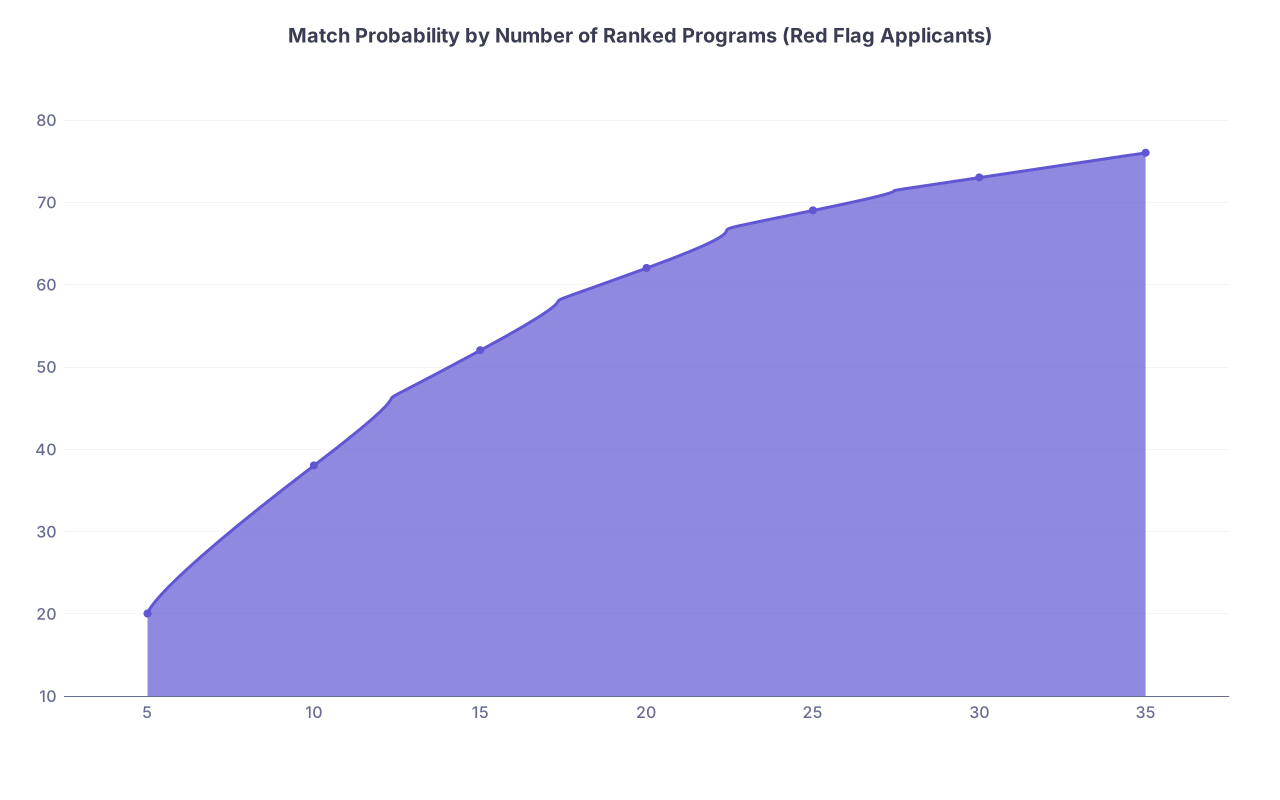
- Consider applying more broadly geographically and to a higher number of programs than an applicant without red flags.
4. Leverage Mentors and Networking
- Seek honest feedback from US-based faculty or IMGs who recently matched.
- Attend virtual open houses and meet-and-greets for internal medicine residencies.
- When appropriate, send a concise, professional email to program coordinators or faculty if you have a connection with the institution, highlighting your growth and current strengths.
5. Maintain Emotional Resilience
Facing red flags as a non-US citizen IMG can be emotionally draining. It is easy to internalize past failures as personal worth. Remind yourself:
- Many excellent internists had imperfect paths.
- Your job is not to erase your past but to demonstrate maturity, integrity, and readiness now.
- Seeking support—from peers, mentors, or counselors—is a sign of strength, not weakness.
FAQs: Red Flags for Non-US Citizen IMGs in Internal Medicine
1. I failed Step 1 once but passed Step 2 CK on the first attempt with a decent score. Can I still match in internal medicine?
Yes. A single failure is a red flag but not an automatic rejection, especially in community internal medicine programs that are IMG-friendly. Emphasize your improved performance on Step 2 CK, explain the Step 1 failure honestly, and demonstrate strong clinical evaluations and USCE. Your narrative should show that the failure was an early obstacle, not a recurring pattern.
2. How should I explain a 1–2 year gap after graduation in my application?
Be transparent and concise. Clearly state the main reason (family responsibilities, visa delays, exam preparation, health issues) and then focus on how you stayed engaged with medicine—through clinical work, CME, online courses, research, or case discussions. Program directors mainly want reassurance that you remained intellectually active and are now fully ready for residency.
3. As a foreign national medical graduate with an older year of graduation, what can I do to reduce its impact as a red flag?
You must prove recency and relevance:
- Show continuous or recent internal medicine practice in your home country.
- Obtain strong letters from recent supervisors.
- Complete USCE, ideally within 1–2 years of your application.
- Highlight leadership, teaching, and QI roles that demonstrate advanced maturity and responsibility.
When a PD sees that you are clinically current and highly engaged, your older YOG becomes less concerning.
4. Should I mention every red flag in my personal statement?
No. Focus on major issues that are likely to draw attention: exam failures, major gaps, and documented professionalism issues. Minor concerns (slightly lower scores, brief time off) do not require long explanations. When you do address a red flag, keep it brief, honest, and oriented toward growth and preparation for an internal medicine residency. Save additional details for interviews if asked.
Red flags do not define your entire candidacy. For a non-US citizen IMG, they demand that you be more strategic, more reflective, and more deliberate in how you present yourself. With a thoughtful explanation, strong recent performance, and clear evidence of growth, you can still build a compelling case for your future as an internal medicine resident in the United States.