
Understanding Red Flags in Pediatrics-Psychiatry Applications
For a non-US citizen IMG (international medical graduate), applying to Pediatrics-Psychiatry (often via peds psych residency tracks or Triple Board programs) is already highly competitive. When you add “red flags” to your profile—exam failures, gaps, visa issues, disciplinary actions—the process can feel overwhelming. Yet many foreign national medical graduates with less-than-perfect histories do match successfully.
This article focuses on how to identify, prepare for, and thoughtfully explain red flags in your application, with specific emphasis on peds psych residency and Triple Board programs, and additional considerations unique to non-US citizen IMGs.
We will cover:
- What program directors consider “red flags”
- How peds-psych and Triple Board PDs think about risk and fit
- Step-by-step strategies for how to explain gaps and other issues
- Addressing failures (exams, courses, attempts) in a constructive way
- Practical examples and wording you can adapt for your own application
- Special concerns for foreign national medical graduates (visas, clinical exposure, communication)
What Counts as a Red Flag in Pediatrics-Psychiatry?
Residency programs in combined pediatrics-psychiatry and Triple Board training invest 5+ years in each resident. Program directors are not only selecting for academic ability, but also for reliability, professionalism, emotional maturity, and resilience. Any data point that raises concern about these areas can become a “red flag.”
Common red flags in a peds psych residency application include:
1. Academic and Exam-Related Red Flags
- Multiple USMLE failures or multiple attempts (especially Step 1 or Step 2 CK)
- Long delay between graduation and exams
- Significant decline in performance (e.g., strong Step 1, poor Step 2 CK)
- Poor or failed psychiatry or pediatrics rotations
- Repeated course remediations in medical school
For a non-US citizen IMG, program directors may wonder:
- Can this applicant manage the intense cognitive load of a Triple Board curriculum?
- Will they pass USMLE Step 3 and board exams in pediatrics and psychiatry within training timelines?
2. Gaps in Training or Career
- More than 6–12 months between graduation and start of residency without clear activity
- Long time since graduation (e.g., >5–7 years) with limited recent clinical work
- Periods where you were not engaged in anything healthcare- or education-related
Red flag questions PDs often have:
- Was there a professionalism or performance issue behind the gap?
- Has the applicant’s clinical knowledge become outdated?
- Are there underlying mental health, family, or legal issues?
3. Professionalism and Conduct Concerns
- Disciplinary actions in medical school
- Negative comments on MSPE/Dean’s Letter or letters of recommendation
- Documented concerns about behavior, teamwork, reliability, or boundaries
In psychiatry-focused fields, professionalism and boundary issues are major red flags because of the vulnerable populations and long-term therapeutic relationships involved.
4. Communication and Language Concerns
For a foreign national medical graduate, spoken and written English are heavily scrutinized:
- Poorly written personal statement or error-filled ERAS entries
- Difficulty understanding or answering questions during interviews
- Negative comments from US clinical rotation evaluations about communication
Pediatric-psychiatry residents deal with children, parents, and multidisciplinary teams. PDs will worry about:
- Can this applicant communicate effectively and safely with families in crisis?
- Will they integrate smoothly with teams across pediatrics and psychiatry services?
5. Visa and Immigration-Related Red Flags
Unique to non-US citizen IMGs:
- Incomplete or inconsistent information about visa status
- Prior visa denials or violations
- Very late disclosure of needing visa sponsorship
- Applying mostly to programs that do not sponsor your visa type (J-1 vs H-1B)
These are not “moral” red flags, but they can signal logistical risk to programs: Will this resident be able to start and complete all 5 years on time?
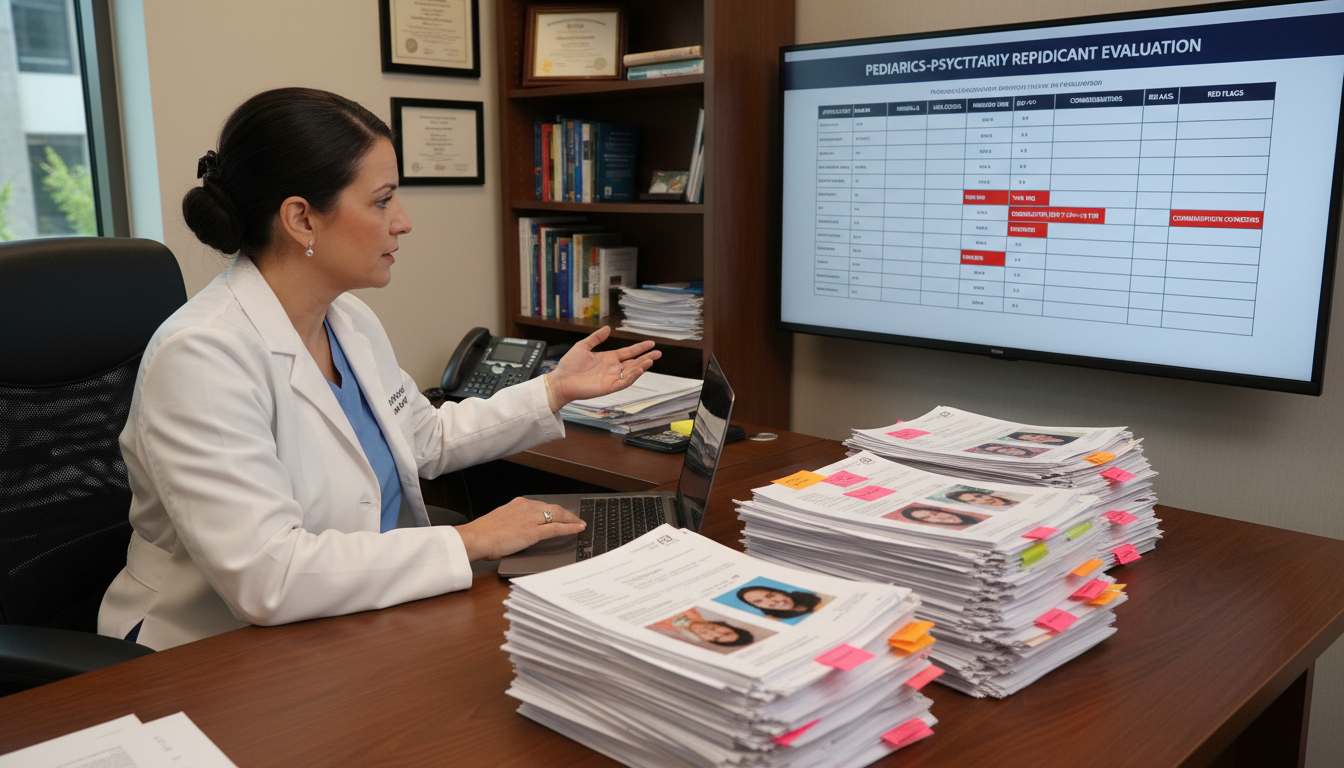
How Pediatrics-Psychiatry Programs View Red Flags
Combined pediatrics-psychiatry and Triple Board programs are small and close-knit. A single problematic resident can significantly affect the team, call schedules, and reputation with partner departments.
The Risk-Benefit Calculation
Program directors often ask themselves:
- Risk: Is there evidence this applicant might fail exams, struggle with workload, or behave unprofessionally?
- Cost: If problems arise, can our small program absorb the impact of a resident needing extended leave, remediation, or dismissal?
- Benefit: Does this applicant bring unique strengths—especially relevant to child and adolescent mental health—that justify taking a chance?
For a non-US citizen IMG, the benefit side can be strong:
- Experience with child and family mental health in underserved or culturally diverse settings
- Fluency in additional languages useful for patient care
- A genuine long-term commitment to careers serving children and families, including in low-resource settings
Your goal is to minimize perceived risk and highlight compelling benefits.
What Makes a Red Flag “Survivable”?
A red flag becomes more acceptable when:
It is clearly in the past
- No repeated patterns.
- Documented improvement since the event.
There is a credible explanation
- Specific, honest, and coherent narrative.
- Avoids blaming others; focuses on your growth.
You have evidence of change
- Recent strong clinical evaluations in pediatrics and psychiatry.
- Solid US letters commenting on reliability, communication, and professionalism.
- Improved exam performance, if applicable.
It fits a story of resilience
- The experience led to insight, maturity, and clearer career goals.
- You can describe what you changed in your methods, habits, or support systems.
Peds-psych and Triple Board PDs, as psychiatrists and pediatricians, often value self-reflection, emotional insight, and growth. A well-addressed red flag can actually demonstrate the personal qualities they want.
How to Explain Gaps, Failures, and Other Red Flags
The two most important skills in addressing red flags are:
- Clarity: Program directors should not be left guessing.
- Accountability: Take responsibility while showing growth.
Below are specific strategies for different types of red flags.
1. Addressing Failures and Multiple Exam Attempts
Exam failures are among the most common red flags for IMGs. For pediatrics-psychiatry, PDs are particularly concerned about cognitive load and time pressure.
Step-by-Step Approach
- State the fact clearly and briefly.
- Provide context without making excuses.
- Describe what you learned about your weaknesses.
- Explain concrete changes you made.
- Show evidence of improvement (scores, later performance, clinical feedback).
Example: USMLE Step Failure
You might address this in your personal statement or ERAS “Additional Information” section:
During my initial attempt at USMLE Step 1, I failed by a small margin. Looking back, I underestimated the adjustment required to change from my medical school’s memorization-focused exams to the USMLE’s application-based style. I was also working nearly full-time in a non-clinical role to support my family during that period, which impaired my focus.
This failure was a wake-up call. I changed my approach: I created a structured 6-month study schedule, joined a weekly peer study group, and used question banks extensively to practice clinical reasoning. I also reduced my work hours so I could treat exam preparation like a full-time responsibility.
On my second attempt, I passed comfortably. My later Step 2 CK score and strong clinical evaluations in pediatrics and psychiatry reflect the more disciplined strategies I now use for mastering complex material. This experience has made me more aware of my limits and better at asking for help early, a skill that I know will be essential in a demanding combined pediatrics-psychiatry program.
Key Principles
- Own the failure: Do not say only “circumstances” caused it; acknowledge your role.
- Show learning and adaptation: PDs want to see that you can course-correct.
- Connect to residency success: Explain how your new habits will help you pass boards and handle workload.
2. How to Explain Gaps in Training or Work
Gaps often worry programs even more than a single failure because they suggest the possibility of unresolved issues.
Common reasons for gaps include:
- Family illness or caregiving responsibilities
- Immigration or visa delays
- Personal or mental health issues
- Financial pressures requiring non-clinical work
- Research or exam preparation
Structuring Your Explanation
- Timeline: Clearly state when and how long the gap was.
- Reason: Brief but specific; avoid oversharing deeply personal details.
- Activities: Describe what you did to remain connected or eventually re-integrate into medicine.
- Current status: Emphasize stability and readiness for full-time training.
Example: Gap for Family Responsibilities
Between March 2020 and June 2021, I stepped away from full-time clinical work to care for an immediate family member who developed a serious medical condition. As the oldest child and the only physician in my family, I was responsible for coordinating care and providing daily support.
During this period, I remained engaged with the field by completing online CME courses in child psychiatry and developmental pediatrics, participating in regular virtual case discussions with colleagues from my home institution, and preparing for USMLE Step 2 CK. When my family member’s condition stabilized, I returned to structured clinical work in pediatrics and child mental health settings.
This time reinforced my commitment to caring for children and families during crises, deepened my empathy for caregivers, and clarified my goal of training in a combined pediatrics-psychiatry pathway. My family member is now medically stable, and I have the full logistical and emotional capacity to commit to the demands of residency.
Example: Gap for Exam Preparation (Non-US Citizen IMG)
After graduating in 2018, I spent approximately 14 months primarily focused on preparing for the USMLE exams and arranging the finances and logistics required as a non-US citizen IMG. I understand that such a gap can raise concerns about continuity, so I remained connected to clinical medicine by working part-time in a pediatric clinic in my home country, initially as an unpaid observer and later in a supervised clinical assistant role.
I used this time to strengthen my foundation in pediatric and psychiatric conditions and to adapt to evidence-based, guideline-driven practice. By the time I completed Step 2 CK, I was more confident in my clinical reasoning and better prepared for US practice. Since then, I have maintained continuous clinical engagement, including recent US clinical experience in pediatrics and child psychiatry to ensure my knowledge is current and aligned with US standards.
3. Addressing Professionalism or Conduct Issues
These are sensitive but must be approached directly, especially in a field that centers on ethics and boundaries.
Approach
- Do not hide documented issues; PDs will see them.
- Show insight into why the incident concerned others.
- Emphasize what you changed in your behavior or decision-making.
Example: Minor Professionalism Concern
Early in medical school, I received formal feedback regarding unprofessional lateness to a pediatrics rotation. At that time, I was commuting long distances and misjudged the time required to arrive before morning rounds. My clerkship director was clear that this was not acceptable.
I took this seriously and made immediate changes: I moved closer to the hospital, started arriving 30–45 minutes before rounds, and used calendar reminders and checklists to organize my responsibilities. I have not had any further professionalism concerns. In fact, my later evaluations in both pediatrics and psychiatry specifically mention reliability and punctuality as strengths.
This experience taught me that good intentions are not enough in medicine; the impact on team functioning and patient care matters most. I now prioritize being early and fully prepared, especially when caring for children and families who rely on team coordination.

Tailoring Your Strategy as a Non-US Citizen IMG in Peds-Psych and Triple Board
For a foreign national medical graduate targeting combined pediatrics-psychiatry or Triple Board training, your strategy for addressing red flags must also address international-specific barriers.
1. Strengthen Your Clinical Credibility
Non-US citizen IMGs are often evaluated with skepticism about “transferability” of skills. To counter this:
- Obtain recent US clinical experience (USCE) in:
- General pediatrics (inpatient or outpatient)
- Child and adolescent psychiatry, behavioral pediatrics, or developmental clinics
- Aim for strong letters that comment specifically on:
- Your clinical reasoning
- Professionalism and reliability
- Communication with children and parents
- Adaptability in a new system
If you have red flags like exam failures or gaps, these letters should also, if appropriate, reflect your current stability and improvement.
2. Communicate Clearly and Professionally
To reduce concerns about communication:
- Ask a fluent mentor to heavily edit your personal statement and ERAS entries.
- Practice mock interviews focused on:
- Discussing red flags concisely and confidently
- Explaining complex cases with children and families clearly
- Responding to questions about cultural and system differences
In peds psych and Triple Board, expect interview questions like:
- “Tell me about a time you made a mistake and what you learned.”
- “How do you handle stressful situations involving children and families?”
- “How has your background as a non-US citizen IMG shaped your interest in pediatrics-psychiatry?”
Have concise, honest answers ready that demonstrate insight and growth.
3. Be Transparent and Organized About Visa Status
To avoid visa-related red flags:
- Research each program’s visa sponsorship policies (J-1 vs H-1B) before applying.
- State your visa needs clearly and accurately in ERAS.
- If you’ve had prior visa issues, discuss them privately if asked, but be ready with documentation and a reassuring narrative of resolution and compliance.
- Emphasize long-term plans that align with the training length:
- For Triple Board (5 years), show that you understand and accept the commitment.
Programs value foreign national medical graduates who show they understand US systems and have thought realistically about immigration timelines.
4. Align Your Story with Pediatrics-Psychiatry Values
Red flags are more forgiven when your positive attributes strongly match the specialty. For peds psych residency or Triple Board:
- Highlight experiences managing:
- Child and adolescent mental health in primary care settings
- Developmental disorders, autism, ADHD, behavioral issues
- Complex family systems, trauma, or child protection concerns
- Connect your personal story:
- Growing up in a region with limited child mental health resources
- Witnessing stigma around child psychiatry and wanting to change that
- Working with refugee or migrant children and families
If you can show that your journey—including its difficulties—clearly led you to this specific training pathway, your red flags become part of a larger narrative of purpose and resilience.
Practical Tips for Presenting Your Application
1. Use the ERAS “Additional Information” Section Wisely
This area is ideal for brief, focused explanations of red flags. Principles:
- 3–6 sentences per topic
- Focus on fact → context → change → current status
- Avoid emotional detail that doesn’t help PDs assess your readiness
2. Calibrate How Much to Say in the Personal Statement
- Use the personal statement to integrate your challenges into your story, not to catalog problems.
- Mention major red flags once, in a paragraph that emphasizes growth and relevance to your current goals.
- Do not turn the statement into a confession; maintain a forward-looking tone.
3. Prepare for Interview Discussion
Most PDs will ask directly about noticeable red flags. When answering:
- Be succinct: 1–2 minutes maximum.
- Avoid defensiveness or blame.
- End with a confident statement about your current stability and readiness.
For example:
Yes, I did have a gap of about one year after graduation due to family responsibilities and exam preparation. At that time, I underestimated how difficult it would be to manage both. I learned that I need clear structures and support systems in place when facing major challenges. Since then, I have maintained continuous clinical involvement, completed my USMLE exams, and received strong evaluations in pediatrics and psychiatry. I now have a stable family situation and a realistic understanding of the demands of a combined pediatrics-psychiatry program, and I am fully ready to commit myself to residency.
4. Seek Targeted Letters that Address Concerns
If possible, ask a trusted attending who knows your background to directly address past concerns in a positive way, for example:
- Commenting that you are now reliable, punctual, and professional.
- Stating that your clinical reasoning and exam preparation are solid and improving.
- Noting your ability to manage stress and seek help appropriately.
Letters like this can reassure PDs that your past red flags are no longer active issues.
FAQs: Addressing Red Flags for Non-US Citizen IMGs in Pediatrics-Psychiatry
1. As a non-US citizen IMG with a USMLE failure, can I realistically match into peds psych or Triple Board?
Yes, it is possible but more challenging. You will need:
- A clear, honest explanation and evidence of improved performance.
- Strong US clinical experience and letters in pediatrics and psychiatry.
- A very targeted application strategy to programs that are IMG- and visa-friendly.
Your red flag will likely limit the number of interviews, so the quality of your explanations and letters is critical.
2. Should I mention every red flag in my personal statement, or only the biggest one?
Focus on major red flags that will definitely appear in your application (e.g., exam failures, large gaps, documented professionalism issues). Minor issues (short gaps, isolated low grades) often do not need detailed discussion unless they form a pattern. Use the personal statement and/or ERAS “Additional Information” to address only what helps PDs understand your journey and growth.
3. How can I show that an older graduation date is not a problem?
For older graduates, programs worry about outdated knowledge. To counter this:
- Show recent, continuous clinical work, ideally with children and mental health.
- Obtain current USCE and strong letters noting that your skills are up to date.
- Highlight recent CME, courses, or certifications in pediatrics and psychiatry.
- In your narrative, explain how your additional years have given you maturity, perspective, and commitment, not stagnation.
4. If I had personal mental health challenges during training, should I disclose this as the cause of my gap or failure?
You are not required to disclose specific diagnoses. You can frame it more generally, for example:
- “I experienced a significant personal health challenge that required treatment and adjustment of my responsibilities.”
- Emphasize that the issue is treated, stable, and well-managed, and focus on what you learned about self-care and seeking help.
Because you are applying in a psychiatry-related field, program directors will appreciate honesty and insight, but be careful to share only what is necessary to demonstrate stability and readiness.
By approaching red flags with honesty, structure, and self-reflection—and by aligning your story with the mission of pediatrics-psychiatry and Triple Board programs—you can transform potential weaknesses into evidence of resilience and suitability. As a non-US citizen IMG and foreign national medical graduate, your unique journey can be a strength, provided you clearly show how you have learned, grown, and prepared for the demands of caring for children and families across both body and mind.