
Understanding Red Flags in Neurology Residency Applications as a Non‑US Citizen IMG
For a non‑US citizen IMG or foreign national medical graduate targeting neurology, “red flags” can feel like doors slamming shut before you even apply. But most neurology program directors are not looking for perfection; they are looking for patterns, honesty, insight, and growth. Many applicants with obstacles such as attempts, gaps, leaves of absence, or lower scores still secure a neuro match when they understand how to explain gaps and strategically address weaknesses.
This article focuses on how to recognize, manage, and frame red flags in a neurology residency application — specifically for non‑US citizen IMGs. You’ll learn what program directors worry about, how to present your story, and what concrete steps you can take now to turn liability into evidence of resilience and maturity.
What Counts as a Red Flag in a Neurology Residency Application?
Before you can address red flags, you need to identify them clearly. For a non‑US citizen IMG applying to neurology, common red flags include:
1. Academic Performance Issues
- USMLE/COMLEX failures or multiple attempts
- Step 1 or Step 2 CK failures
- Low scores relative to program norms
- Large score drop between Step 1 and Step 2
- Failed medical school courses or repeated years
- Remediation or professionalism notes in your Dean’s letter/MSPE
Why PDs worry: Neurology residency is cognitively demanding. Programs fear that repeated failures suggest difficulty with complex neuroanatomy, neurophysiology, or managing a steep learning curve.
2. Gaps or Irregular Timeline
- Long gap after graduation (e.g., >2–3 years without clinical activity)
- Unexplained break in medical education
- Interrupted training (withdrew or dismissed from another residency)
Why PDs worry: Gaps raise concerns about clinical de-skilling, loss of knowledge, visa issues, burnout, or underlying personal/professional problems.
3. Professionalism or Behavioral Concerns
- Formal professionalism citations in medical school
- Disciplinary actions (plagiarism, unprofessional conduct, boundary violations)
- Terminated or non-renewed contract in a prior training program
Why PDs worry: Neurology deals with vulnerable patients: stroke, dementia, epilepsy, neuromuscular disease. Professionalism, reliability, and communication are critical.
4. Weak or Inconsistent Commitment to Neurology
- Limited or no neurology rotations (especially recent clinical experience)
- Lack of neurology-related letters of recommendation (LoRs)
- A CV dominated by another specialty (e.g., mostly internal medicine or surgery) without a clear narrative transition to neurology.
Why PDs worry: They question whether you truly want neurology or might be using it as a “backup.” They also wonder if you understand what neurology practice actually involves.
5. Visa and Sponsorship Challenges
Strictly speaking, visa status is not a red flag in the same way as failures, but for a non‑US citizen IMG or foreign national medical graduate, certain patterns can raise concerns:
- Prior visa denials or complicated immigration history
- Inability to articulate a realistic plan for visa type (J‑1 vs H‑1B)
- Very late ECFMG certification creating processing pressures
Why PDs worry: Programs must be sure they can onboard you on time and maintain compliance.

How Neurology Programs Interpret Red Flags in IMGs
Understanding how neurology program directors think about red flags helps you craft better explanations.
1. Context Matters More Than the Event Itself
A single failure, a gap, or a low score is rarely an automatic rejection. PDs ask:
- Did this occur early, with clear improvement later?
- Was there a serious life event (illness, caregiving, war, financial hardship)?
- What has the applicant done since then?
For example:
- Scenario A: Step 1 failure, then Step 2 CK high score (e.g., 250+) with strong neurology letters and research.
- Scenario B: Step 1 failure, Step 2 CK barely passing, no US clinical experience, and no explanation.
Scenario A can still be competitive in neurology, especially at mid-tier or community/university-affiliated programs. Scenario B triggers more concern because of the pattern: poor performance, no improvement, and no reflection.
2. Program-Specific Tolerance
Different neurology programs have different thresholds:
- Highly competitive academic centers often have strict filters (no failures, cutoffs for scores, recent graduation).
- Mid-tier university programs may accept some red flags if compensated by research, strong US letters, or clear neurology commitment.
- Community-based programs may be more flexible about certain academic red flags but still demand professionalism and reliability.
As a non‑US citizen IMG, you must target programs realistically based on your overall profile, not just wishful thinking.
3. Consistency and Trajectory
PDs look for a trajectory of growth:
- Improvement in exam performance over time
- Gradually more responsibility and leadership
- Increasing involvement in neurology-related activities
They are more forgiving when they see: “I struggled, I understood why, I changed my approach, and I improved.”
4. Honesty and Insight vs. Excuses
When addressing failures or explaining gaps, the tone matters:
- Accept responsibility where appropriate.
- Avoid blame-heavy narratives (e.g., “the exam was unfair,” “the school targeted me,” “the system is biased”) unless there is very clear, objective evidence.
- Highlight what you learned and what you did differently.
What PDs want to see is emotional maturity and self-awareness. Many will give credit for resilience if your story is coherent and supported by actions.
Specific Red Flags and How to Address Them Effectively
This section moves from theory to practical strategies: how to explain gaps, failures, and other issues in a neurology residency application as a non‑US citizen IMG.
1. USMLE Step Failures or Multiple Attempts
Core principle: Turn a failure into a demonstration of growth, not an ongoing pattern.
A. Strategy
Be transparent but concise.
- Do not hide the failure; PDs see your official transcript.
- Address it once in the application (personal statement or ERAS “Additional Information” section) to give context.
Show objective improvement.
- If possible, take Step 2 CK after significant preparation and earn a score that shows mastery.
- If scores are not stellar, emphasize:
- Progression (e.g., failed once, then passed comfortably)
- Solid neurology shelf/subject exam performance (if documented)
- Strong clinical evaluations in neurology electives
Explain “why” in a non-defensive way.
Common explanations:- Underestimated the exam, ineffective resources
- Language adjustment period
- Major concurrent life stressor (illness, family crisis)
Outline what changed.
Very important for addressing failures:- New study system (e.g., question banks, NBME practice exams, time management)
- Group study vs. solo, improved note-taking
- Mentoring or coaching from senior residents or faculty
B. Sample Wording (Adaptable Template)
“I did not pass Step 1 on my first attempt. At that time, I underestimated the breadth of the exam and relied on passive reading rather than active practice questions. After this setback, I reassessed my approach, sought guidance from mentors, and adopted a structured study schedule with regular self-assessment exams. This change in strategy not only allowed me to pass Step 1 on my second attempt but also prepared me to perform more confidently on Step 2 CK. This experience taught me how to identify weaknesses early, ask for help, and adapt quickly — skills that I bring to neurology training.”
This template conveys ownership, insight, and change — exactly what PDs want when addressing failures.
2. Gaps in Training or Long Time Since Graduation
For a non‑US citizen IMG, gaps often result from licensing, visa, financial, or family challenges. Unexplained gaps are much more harmful than explained ones.
A. Identify What You Did During the Gap
List any of the following (as long as it’s truthful):
- Clinical work in home country
- Observerships or externships (especially neurology or internal medicine)
- Research (neurology or related fields)
- Teaching (medical students, nursing students, test prep)
- Additional degrees (MPH, MSc, PhD)
- Caregiving responsibilities (elderly, children, ill family member)
- Military service or national service
- Language or test preparation courses
B. How to Explain Gaps Clearly
- State the reason early and plainly.
- Show continuous development, even if non-clinical.
- Emphasize how you maintained clinical knowledge, especially in neurology.
Example (1–2 year clinical gap):
“From 2021 to 2023, I returned to my home country to address family responsibilities when my father became seriously ill. During this time, I worked part-time as a general practitioner and volunteered in a stroke rehabilitation clinic, where I followed patients with post-stroke aphasia and hemiparesis. This exposure deepened my interest in neurology and motivated me to pursue targeted observerships in US neurology departments once I was able to return. Although this period delayed my application timeline, it strengthened my commitment to neurology and refined my ability to communicate with patients and families coping with chronic neurological disability.”
Key elements:
- Specifies timeframe
- Gives a legitimate primary reason
- Shows continued clinical involvement
- Reinforces neurology interest
C. When Your Gap is Non-Clinical (e.g., Immigration, Exam Prep Only)
You can still frame it positively:
“After graduating in 2019, I devoted significant time to preparing for USMLE exams and managing the logistics of immigration and ECFMG certification. During this period, I supplemented my preparation with online neurology CME courses, case-based learning, and regular review of neurology journals. While I was not in full-time clinical practice, I used this time purposefully to strengthen my medical knowledge base and prepare for neurology training in the US system.”
Always include what you did to stay connected to medicine and neurology.
3. Professionalism Concerns or Disciplinary History
These are more serious red flags. Yet they can sometimes be mitigated if:
- The incident was isolated and early
- There is clear evidence of subsequent excellent professionalism
- You can show insight, remorse, and concrete behavior change
A. Principles for Addressing Professionalism Issues
- Never minimize or dismiss the seriousness.
- Do not blame others as the main explanation, even if other factors were present.
- Focus on:
- What you learned about yourself
- Systems you put in place to prevent recurrence
- Strong subsequent evaluations without issues
B. Example (Minor Non-Recurring Academic Conduct Issue)
“In my second year of medical school, I received a professionalism citation for submitting a group assignment without properly crediting all contributors. At the time, I did not fully appreciate the expectations around academic attribution. Since then, I have completed additional modules on academic integrity, and I have been meticulous about authorship and citation in all research and clinical documentation. My subsequent clerkships and research rotations have been free of professionalism concerns, and my supervisors have consistently commented on my reliability and respect for team members.”
For more serious issues (e.g., dismissal from a prior training program), you will usually need personalized guidance from an advisor or mentor and must be prepared that some programs will not consider your application regardless of explanation.
4. Weak Neurology Exposure or Late Switch to Neurology
If your background is dominated by another specialty (say, internal medicine or psychiatry), you must build and demonstrate neurology-specific interest:
- US clinical experience in neurology (observerships, externships)
- Research with a neurology faculty member
- Neurology-specific volunteer work (e.g., stroke support groups, dementia clinics)
- Neurology case reports or QI projects
How to Frame a Late Switch
“Although my initial exposure was in internal medicine, many of my most meaningful encounters were with patients who had complex neurological conditions — from acute ischemic stroke to autoimmune encephalitis. I was drawn to the problem-solving aspect of localizing lesions and correlating imaging with exam findings. Over the past year, I have focused deliberately on neurology through observerships at [Institution], participation in a stroke registry project, and regular attendance at neurology grand rounds. This evolution reflects a more mature understanding of where my skills and interests align, and I am fully committed to pursuing a career in neurology.”
Programs will forgive a late switch if your current application clearly centers on neurology.
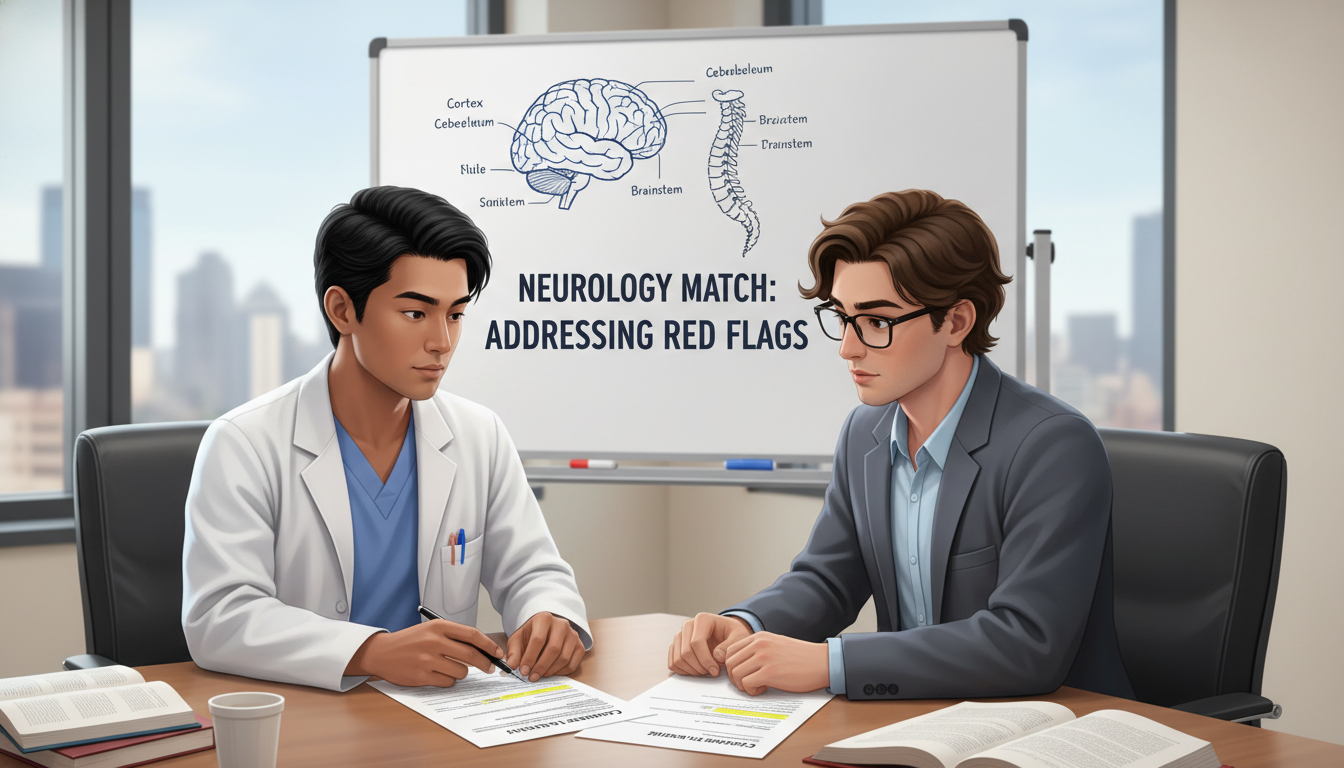
Application Strategy for Non‑US Citizen IMGs With Red Flags in Neurology
Once you understand and can narrate your red flags, the next step is to design a realistic and strategic neuro match plan.
1. Strengthen the Rest of Your Application Aggressively
The more red flags you have, the stronger your offsetting strengths need to be:
- Neurology-focused US clinical experience (ideally ≥ 2–3 months)
- Strong neurology letters from US faculty who:
- Comment on your clinical reasoning
- Highlight your work ethic and professionalism
- Explicitly state: “I would rank this applicant to match in our program.”
- Research, especially:
- Stroke
- Epilepsy
- Neuroimmunology / MS
- Neurocritical care
- Dementia, movement disorders
- Evidence of longitudinal interest:
- Neurology case presentations
- Poster presentations at AAN or local neurology meetings
- Neurology electives or sub-internships
2. Choose Programs and Tiers Wisely
For a non‑US citizen IMG with red flags:
- Apply broadly; 80–120 neurology programs is common, depending on resources.
- Focus on:
- Community-based or community/university-affiliated programs
- Programs with a history of interviewing and matching IMGs
- Use tools:
- Program websites: look at current residents’ medical schools and citizenship
- NRMP Charting Outcomes in the Match (for neurology and IMGs)
- Word-of-mouth from seniors and mentors
Be realistic: a foreign national medical graduate with multiple exam failures, long gaps, and minimal neurology exposure is unlikely to match at a top 10 academic neurology department, but may still succeed at well-structured community programs if the recent record is strong.
3. Use ERAS Sections Strategically
Additional Information Section:
Ideal for concise explanations of red flags:- One paragraph on a Step failure
- One paragraph on a significant gap
Avoid long emotional narratives; focus on facts and growth.
Personal Statement (PS):
Use mostly to:- Tell your neurology story (why neuro, not just why medicine)
- Highlight resilience briefly if central to your identity
Do not let red flags dominate your PS; 1–2 short paragraphs is enough.
CV / Experiences Section:
Emphasize:- Current and recent neurology-related work
- Leadership, teaching, and service that show maturity
4. Interview Day: How to Discuss Red Flags
You will almost certainly be asked about them. Prepare a clear, 2–3 sentence answer for each issue.
Structure for addressing failures or gaps:
- Briefly state what happened
- Acknowledge its significance
- Describe what you learned and changed
- End with evidence of improvement
Example:
“I did not pass Step 1 initially, which was difficult for me and raised legitimate questions about my preparation. It forced me to confront the way I studied and manage my time. Since then, I have adopted a more structured, question-based learning system that helped me succeed on Step 2 CK and in my neurology electives. I now see that experience as a turning point in how I approach complex material and personal challenges.”
Practice your answer aloud until it sounds calm, sincere, and confident.
5. When to Consider a “Bridge” Year
If your red flags are significant and your application is not competitive this cycle, consider a one-year bridge position before reapplying:
- Research fellowships in neurology
- Postdoctoral positions in neuroscience labs
- Neurology clinical research coordinator roles
- Non-ACGME clinical fellowships with neurology exposure (in rare circumstances)
A well-utilized bridge year can:
- Provide strong US neurology letters
- Add publications and conference presentations
- Demonstrate professionalism and reliability in a US academic system
Frequently Asked Questions (FAQ)
1. As a non‑US citizen IMG with a Step 1 failure, is neurology still realistic?
Yes, neurology can still be realistic, particularly if:
- Step 2 CK is clearly stronger and passed on the first attempt,
- You have meaningful neurology-focused US clinical experience,
- You obtain strong letters from US neurologists,
- You apply widely and target programs known to consider IMGs.
Programs vary in how they view red flags; some will screen out any failures, but others will look at the entire profile. Your job is to show clear improvement and a compelling neurology-specific story.
2. I have a 3-year gap since graduation with limited clinical work. How can I reduce its impact?
You must show that you are clinically current and motivated:
- Start now: obtain observerships or externships in neurology or internal medicine.
- Complete neurology-related CME or online courses and list them.
- Explain the gap honestly (family issues, immigration, exam preparation), and emphasize what you did to maintain knowledge.
- Seek mentors who can provide updated letters reflecting your present capabilities.
The more recent and intense your clinical neurology exposure, the less weight the earlier gap carries.
3. Should I directly mention my red flags in the personal statement or only in ERAS?
Use a balanced approach:
- Very brief mention in the personal statement if the event significantly shaped your path to neurology or your personal growth.
- More specific, factual explanation in the ERAS “Additional Information” section.
Do not let your personal statement become an essay about your failures; PDs want to read about your passion for neurology, your clinical experiences, and your future goals.
4. Do programs see red flags differently for US grads vs non‑US citizen IMGs?
Programs apply similar standards conceptually, but in practice they are often more cautious with foreign national medical graduates because they know less about your medical school’s rigor and clinical environment. That means:
- Objective metrics (scores, observership evaluations, research output) matter more.
- Consistency and recent performance are critical.
- Clear, honest, and mature explanations are essential.
However, many neurology programs have a strong tradition of welcoming IMGs and understand the challenges you face. With a strategic approach to addressing red flags and highlighting your strengths, a successful neuro match is still achievable.
By understanding how to explain gaps, addressing failures thoughtfully, and building a strong neurology-focused profile, you can transform red flags into evidence of resilience and readiness. As a non‑US citizen IMG, your path may be less linear, but with deliberate planning and honest reflection, you can still join the neurology residency that fits your skills and aspirations.