
Understanding Red Flags in the Plastic Surgery Residency Application
Red flags in a plastic surgery residency application do not necessarily end your chances of matching, but they absolutely change how you must prepare, explain, and advocate for yourself. As an MD graduate aiming for a highly competitive specialty, you need both insight and strategy.
In the context of an allopathic medical school match, a “red flag” is any concern that makes a program question your reliability, performance trajectory, professionalism, or fit. Programs are not looking for perfect people; they are looking for residents they can trust at 3 a.m. in the operating room, in clinic, and on call. Your job is to realistically identify your red flags, understand how programs perceive them, and then create a cohesive narrative that shows risk mitigation, growth, and readiness for plastic surgery training.
Why Red Flags Matter More in Plastic Surgery
Plastic surgery—especially the integrated plastics match—is among the most competitive residency pathways. Programs receive many applications from MD graduates with:
- Near-perfect board scores
- Outstanding letters from well-known plastic surgeons
- Multiple first-author publications
- Flawless academic records
In that context, any concern in your file can be amplified. That doesn’t mean you cannot match; it means you must:
- Demonstrate insight and maturity
- Show specific, documented improvement
- Provide strong, credible external validation (letters, grades, outcomes)
The good news: program directors are also looking for resilience, self-awareness, and professionalism. How you address red flags can actually become a strength if you handle it skillfully and consistently.
Common Red Flags for MD Graduates Applying to Plastic Surgery
Not all red flags are equal. Some are minor and easily explainable; others require more focused mitigation. Understanding where yours fits helps you prioritize your efforts.
1. Academic Performance Issues
Examples:
- Failing a preclinical course or clerkship
- Repeating a year of medical school
- Longitudinal pattern of low clinical evaluations
- Failing a sub-internship or core surgery rotation
Why programs worry:
- Concern about your ability to handle the volume and complexity of surgical training
- Fear that poor performance may repeat under pressure
- Question of whether deficits are knowledge-based, work-ethic related, or professionalism-related
What they want to see:
- Clear improvement over time (an “upward trajectory”)
- Recent strong performance in surgery and subspecialty rotations
- Documentation that you can function at or above expected level for an intern in a high-acuity surgical service
2. USMLE/COMLEX Failures or Low Scores
Even in the era of pass/fail Step 1 reporting, exams still matter, especially in plastic surgery.
Red flag patterns:
- Step 1 fail (on initial attempt)
- Step 2 CK fail
- Large discrepancy between Step 1 and Step 2 (decline instead of improvement)
- Barely passing scores on multiple exams
Why programs worry:
- Concern about your ability to pass in-training exams and boards
- Fear of remediation time and additional institutional resources
- Worry that knowledge gaps may compromise patient safety
Program perspective: A single exam failure with a strong subsequent record is much easier to accept than multiple failures or a declining trend.
3. Gaps in Training or Unexplained Time Off
Examples:
- Taking a year off with vague or no explanation
- Extended LOA (leave of absence) without documented purpose
- Unaccounted months between graduation and application cycle
Why programs worry:
- Concern about burnout, physical/mental health stability, or professionalism
- Fear of hidden issues: probation, disciplinary actions, or personal crises that could recur
- Question of whether you can sustain long, difficult training years
Gaps are not automatically negative when clearly explained (research year, serious health issue, family responsibility), but vague or inconsistent explanations raise concerns.
4. Professionalism and Conduct Concerns
This category is often the most serious type of red flag.
Examples:
- Formal professionalism write-ups
- Disciplinary actions or probation
- Academic integrity violations or cheating
- Boundary violations with patients or staff
- Unprofessional behavior documented in evaluations
Why programs worry:
- Professionalism problems often predict future issues: complaints, HR problems, liability risks
- Plastic surgery has high patient expectations and a strong emphasis on ethics, informed consent, and long-term patient relationships
- Surgical teams rely heavily on trust, reliability, and communication
Professionalism red flags require especially careful, candid, and humble explanation, along with documented change.
5. Weak or Problematic Letters of Recommendation
Red flag patterns:
- Only generic letters without strong advocacy
- Letters from non-surgeons for a plastic surgery residency
- Comments hinting at reliability or attitude issues
- Missing letter from your home program’s plastic surgery faculty (where such a program exists)
Why programs worry:
- Lack of strong support suggests reservations by faculty who know you best
- Generic letters in a highly competitive field may indicate you didn’t earn enthusiastic endorsements
Strong letters are one of the best ways to offset earlier concerns, especially for MD graduates with other red flags.
6. Multiple Application Cycles or Switching Specialties
Examples:
- Prior unsuccessful cycle in plastic surgery
- Previous applications in a different specialty (e.g., general surgery, internal medicine) now pivoting to plastics
- Applying to both integrated plastic surgery and another unrelated field in the same cycle (visible through ERAS data or faculty networks)
Why programs worry:
- Concern about your commitment to the field
- Worry that you might leave or transfer if the training environment gets difficult
- Doubt about whether your interest is genuine versus prestige-driven
For the integrated plastics match, clarity of motivation and consistent evidence of sustained interest are crucial.
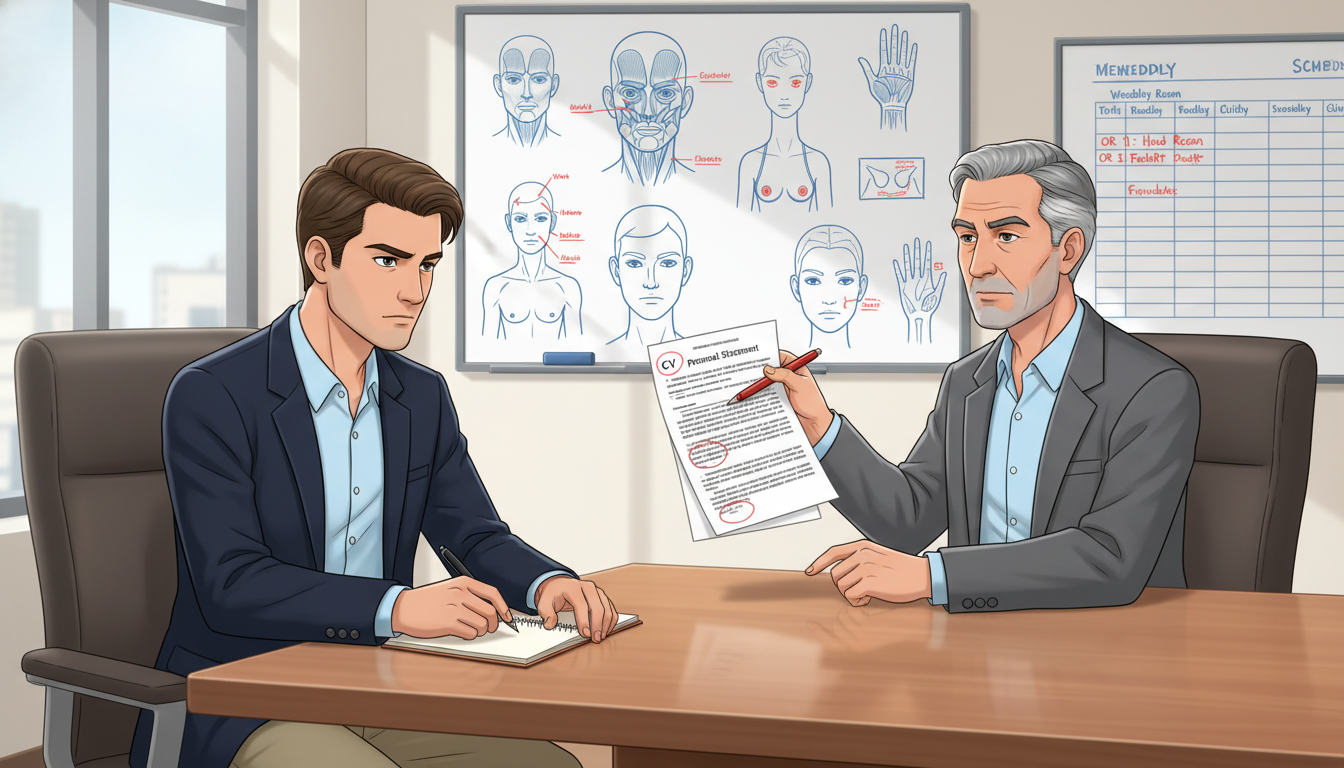
How Programs Evaluate and Weigh Red Flags
Understanding how program directors think helps you craft an effective strategy.
The Risk–Benefit Equation
Every applicant represents both potential and risk. Program directors mentally ask:
- “Can this person safely and reliably care for our patients?”
- “Will they pass boards and maintain our program’s reputation?”
- “Will they work well with our team under stress?”
A red flag increases perceived risk. To justify interviewing or ranking you, programs must see enough benefit and evidence of change to outweigh that risk.
Factors that can offset red flags:
- Strong, recent clinical performance in surgery or plastics rotations
- Compelling, specific letters from surgeons who directly observed you
- Clear upward trajectory in grades and exam scores
- Concrete achievements (research, leadership, quality improvement) after the red-flag event
Context and Trajectory Matter More Than the Event
A single failure early in medical school followed by years of excellence is very different from:
- Repeated failures without a clear turning point
- A pattern of last-minute rescues or borderline passes
- Continuing disorganization or professionalism concerns
Programs look at when the red flag occurred, what you did afterward, and how you talk about it now.
Consistency Across Your Application
Inconsistency is its own red flag. Program directors compare:
- ERAS entries
- Personal statement
- MSPE (Dean’s Letter)
- Letters of recommendation
- Your interview explanations
If your story changes, or details get glossed over, trust erodes. A straightforward, consistent narrative is safer than a heavily “polished” but inconsistent one.
Practical Strategies to Address Specific Red Flags
1. Addressing Exam Failures and Low Scores
Goal: Show mastery, improved study skills, and reliability under pressure.
Action steps:
Document improvement:
- Take and excel on Step 2 CK if still pending; aim for a robust, above-average score.
- If possible, complete relevant in-training or institutional exams and highlight strong performance in your CV or MSPE.
Be specific about what changed:
- New study methods (e.g., question banks, schedule design, group study)
- Addressed underlying issues (test anxiety, untreated ADHD, family stress)
- Time management and self-discipline improvements
Craft your explanation (concise):
- Own the failure clearly: no excuses, but provide context.
- Explain what you learned and how you changed your approach.
- Highlight subsequent evidence of success using these new strategies.
Example explanation (interview-ready):
“My Step 1 failure was a pivotal moment. I underestimated how differently I needed to study for a high-stakes exam. I met with academic support, created a structured daily schedule, and shifted to doing timed question blocks with thorough review. I also addressed sleep and stress by treating underlying anxiety with professional help. Since then, I passed Step 1 comfortably on my second attempt and scored a 245 on Step 2 CK. That experience taught me how to adapt under pressure, which I’ve carried into my surgical rotations.”
2. Explaining Academic or Clinical Failures
Goal: Demonstrate insight, remediation, and current competence.
Action steps:
- Clarify the failure: Was it due to exam performance, clinical evaluations, attendance, or professionalism?
- Describe your remediation: Additional rotations, repeated clerkships, faculty supervision.
- Show outcome: Subsequent honors, strong sub-internship performance, supportive letters from supervisors who observed your improvement.
Example framing:
“I failed my initial surgery clerkship primarily due to time management and documentation issues. I was not efficient with notes and occasionally fell behind on pre-rounding. During remediation, I worked closely with a faculty mentor who helped me structure my day and prioritize tasks. I repeated the rotation, received strong clinical evaluations, and later earned honors in my plastic surgery sub-internship. My recent evaluations reflect that I learned to anticipate team needs and deliver on my responsibilities reliably.”
3. How to Explain Gaps in Training
When thinking about how to explain gaps, focus on clarity and outcome, not on excessive personal detail.
Acceptable reasons for gaps:
- Dedicated research year (with tangible outputs: publications, presentations)
- Personal or family health issues (addressed and now stable)
- Family care responsibilities (with resolution or ongoing management plan)
- Immigration, visa, or administrative delays
- Personal medical leave for mental health (handled thoughtfully and discreetly)
Key principles:
- Be honest but not graphic: you do not need to share sensitive details.
- Emphasize what you did during the gap—skills, research, volunteering, coursework.
- Explicitly reassure them about current readiness and stability.
Example explanation (ERAS or interview):
“During my third year, I took a leave of absence for a serious family health issue that required my direct support. During this time, I remained academically engaged through independent reading and virtual grand rounds. The situation has since stabilized with long-term support in place, and I have successfully completed all subsequent rotations without any need for additional leave. The experience deepened my resilience and empathy, particularly when counseling patients facing major surgery.”
4. Addressing Professionalism Concerns
This is where humility, accountability, and clear change are critical.
Action steps:
- Acknowledge clearly:
- Name the issue (“I was placed on professionalism probation for tardiness and incomplete notes…”).
- Take responsibility:
- No blaming others or minimizing; explain factors, but don’t shift fault.
- Describe corrective steps:
- Meetings with advisors, formal remediation, time management training, therapy/coaching, feedback loops.
- Show objective evidence of improvement:
- Clean record since the event
- Explicit positive comments about reliability in later evaluations
- Strong letter from a supervisor who observed your growth
Example framing:
“In my second year, I was cited for professionalism concerns related to punctuality and late documentation. At the time, I struggled with overcommitting and poor time management. This resulted in real impact on my team, which I regret. The school placed me on a structured remediation plan with close mentorship. I implemented a detailed calendar, set earlier personal deadlines, and regularly reviewed expectations with my residents. Since then, I have had no further professionalism issues, and recent evaluations describe me as reliable and proactive. This experience changed how seriously I take my responsibilities to the team and to patients.”
5. Red Flags in Letters or Lack of Support
If you suspect (or know) that you have a lukewarm or negative letter:
Steps to mitigate:
- Seek out new, strong letters from faculty who can comment on your current performance—especially plastic surgeons or other surgical faculty.
- Prioritize sub-internships in plastic surgery or closely related fields where you can earn enthusiastic advocacy.
- Ask explicitly: “Do you feel you can write me a strong letter of recommendation for plastic surgery?” to avoid generic or negative letters.
- Demonstrate team value: be the student who shows up early, stays late, volunteers for cases, and keeps the service organized.

Rebuilding Your Application: Turning Red Flags into a Stronger Story
1. Use Time Strategically Before Applying (or Reapplying)
If you have a significant red flag, you may benefit from an additional year to strengthen your candidacy.
High-yield options:
- Dedicated plastic surgery research year
- Aim for tangible output: abstracts, posters, manuscripts, case reports.
- Seek mentorship from faculty who are well-connected and active in the field.
- Surgical or plastics-focused clinical year
- Work as a research fellow or clinical associate with direct OR and clinic exposure.
- Get strong letters from surgeons who see you functioning at near-resident level.
- Additional electives or sub-internships
- Especially at programs where you want to match.
- Ask for mid-rotation feedback and adjust in real time.
This extra time can show maturity, commitment, and a clear upward trajectory that compensates for earlier missteps.
2. Crafting a Cohesive Narrative in Your Personal Statement
Your personal statement is not the place to list your flaws, but it is the place to show insight and growth.
Guidelines:
- If your red flag is major and must be explained, address it briefly and maturely in the middle of the statement—not as the opening line and not as the closing note.
- Emphasize:
- How the experience shaped your professional identity
- Specific skills or habits you developed as a result
- How it affirmed rather than weakened your commitment to plastic surgery
Avoid:
- Overly dramatic or self-pitying language
- Blaming other people or systems
- Using the red flag as your sole identity in the essay
3. Aligning Application Components
Ensure your ERAS, personal statement, and letters are aligned:
- The same basic timeline and explanation for gaps and leaves
- No contradictions between your narrative and the MSPE
- Referees (letter writers) who can reinforce your story of growth and current readiness
Consider sharing your personal statement and a summary of your red flag with your letter writers so they can:
- Avoid unintentionally contradicting your explanation
- Highlight your improvement and reliability
4. Interview Strategy: Confident, Not Defensive
During interviews, you will likely be asked about notable red flags.
Best practices:
- Practice a 60–90 second answer: clear, honest, focused on learning and growth.
- Avoid lengthy justifications or oversharing sensitive details.
- Maintain a calm, professional tone; no visible embarrassment or anger.
- End with evidence: “Since then, I have…”
Example framework:
- Briefly state what happened.
- Acknowledge it was a problem.
- Explain what you changed.
- Give concrete evidence of sustained improvement.
- Connect it to how it makes you a better future plastic surgeon.
When to Seek Advice and Consider Alternative Pathways
1. Get Honest, Expert Feedback
As an MD graduate, you likely have access to:
- Your Dean’s office or student affairs advisors
- Plastic surgery or surgery faculty mentors
- Recent graduates who successfully matched integrated plastics
Ask them to:
- Review your full application objectively
- Compare your profile to successful applicants from your school
- Help you decide whether to apply this cycle, strengthen your profile, or consider alternative routes
2. Considering General Surgery or Other Pathways
For some applicants with multiple substantial red flags, a stepwise plan may be more realistic:
- Matching into a strong general surgery program
- Excelling clinically, building more research, and then applying to an independent plastic surgery residency later
Or:
- Exploring related fields such as hand surgery via orthopedic or plastic routes, facial plastics via ENT, or reconstructive options within other surgical specialties.
The integrated plastics match is not the only route to a fulfilling surgical career involving reconstruction and aesthetics.
3. Emotional Wellness and Resilience
Dealing with red flags can be emotionally taxing. It is normal to feel:
- Shame or embarrassment
- Anxiety about match outcomes
- Doubt about your future
Consider:
- Counseling or mental health support if this is weighing heavily on you
- Peer support groups or mentors who have overcome similar difficulties
- Setting realistic but hopeful goals each cycle
Programs value applicants who recognize their limits, care for their own wellbeing, and seek help appropriately—these are critical skills in a high-stress field like plastic surgery.
FAQs: Addressing Red Flags in Plastic Surgery Residency Applications
1. I’m an MD graduate with a Step 1 fail. Can I still match into plastic surgery?
Yes, it is possible, but your path is steeper. You will need:
- A strong Step 2 CK score to demonstrate academic recovery
- Excellent clinical performance, especially in surgery and plastic surgery rotations
- Robust research or scholarly activity in plastic surgery if possible
- Strong letters from plastic surgeons who can vouch for your current competence and reliability
Many programs may screen out for Step 1 failures, but not all. Strategic program selection and networking (audition rotations, research, conferences) become even more important.
2. How do I decide whether to mention my red flag in my personal statement?
Use this rule of thumb:
- If the red flag will clearly appear in your file (failure, LOA, professionalism note), you should briefly and directly address it somewhere—either in the personal statement, additional information section, or during interviews.
- Keep it concise and constructive; don’t center your whole statement around it.
- If the issue is minor and not obvious, and has since been resolved, you may choose not to highlight it proactively, but be prepared to discuss if asked.
Discuss this decision with a trusted advisor or mentor who has read your MSPE and knows how your school documented the issue.
3. What are the biggest red flags in a plastic surgery residency application?
Commonly cited major red flags include:
- Repeated exam failures (USMLE/COMLEX)
- Multiple course or clerkship failures without clear remediation
- Significant professionalism sanctions or probations
- Unexplained or inconsistently explained long gaps in training
- Very weak or problematic letters, especially from surgical or home plastic surgery faculty
- A clear pattern of poor clinical performance in surgical environments
Less severe red flags (single failure, minor delay, modest scores) can often be overcome with strong recent performance and compelling letters.
4. How can I show programs that I’ve genuinely grown from my mistakes?
Programs are persuaded by evidence, not just words. You can show growth by:
- Demonstrating a clear upward trend in performance (better grades, stronger evaluations, solid Step 2 CK)
- Obtaining letters that explicitly describe your reliability, professionalism, and improvement
- Taking on meaningful responsibility (research projects, leadership roles, QI initiatives) and completing them successfully
- Providing a consistent, honest explanation across your application and interviews that shows insight, accountability, and specific changes in behavior
When your explanation of growth matches the story told by your record and your recommenders, programs are much more likely to trust that you are ready for the demands of plastic surgery residency.
Addressing red flags as an MD graduate pursuing plastic surgery is not about erasing your past; it is about demonstrating who you have become since those challenges. With honest self-assessment, strategic application building, and clear communication, many applicants with imperfections still find their place in the allopathic medical school match—even in competitive fields like the integrated plastics match.