
Understanding Red Flags for Non-US Citizen IMGs in Preliminary Surgery
For a non-US citizen IMG, a preliminary surgery year can be a strategic entry point into the US residency system. However, the same things that push many applicants toward a prelim surgery residency—uneven test scores, gaps, visa issues, or attempts to reapply—are often viewed by programs as “red flags.”
In preliminary surgery, where programs receive hundreds of applications for a limited number of spots, those red flags can quickly move your file into the rejection pile if they are not addressed thoughtfully and proactively.
This article will walk you through:
- The most common red flags for a foreign national medical graduate applying to a prelim surgery residency
- How program directors think about those issues
- Practical, step-by-step strategies for addressing failures and explaining gaps in a way that shows growth, maturity, and readiness
- Special considerations for the non-US citizen IMG (visa, prior training, clinical exposure)
Throughout, we will focus on realistic, actionable advice you can implement in your next application cycle.
How Program Directors View Red Flags in Preliminary Surgery
Before you can address red flags, you need to understand how they are perceived in the context of a preliminary surgery year.
What Counts as a “Red Flag”?
Common red flags in a prelim surgery application include:
- USMLE or COMLEX failures or multiple attempts
- Significant gaps after graduation or between exams (more than 6–12 months)
- Low or marginal surgery-related clerkship evaluations
- Prior unmatched cycles or SOAP-only matches
- Disciplinary actions or professionalism concerns
- Frequent changes of career direction or multiple previous starts in other specialties
- Minimal or no recent US clinical experience (USCE)
- Weak or generic letters of recommendation
- Questionable motivation for surgery (“backup” or “placeholder” vibe)
For a non-US citizen IMG, additional perceived red flags can be:
- Lack of clarity about visa needs or prior visa rejections
- Long time since graduation without substantial clinical work
- Overly “exam-focused” CV without hands-on patient care or OR exposure
- Limited evidence of understanding US healthcare systems or team-based care
Why PDs Are Cautious About Red Flags in Prelim Surgery
Program directors know that:
- Prelim residents are heavily involved clinically from day one.
- They must be reliable, safe, and able to handle stress in critical settings.
- Many prelims will be reapplying or trying to switch to categorical positions, which adds stress.
Red flags raise doubts about:
- Reliability – will you show up, follow through, respond to feedback?
- Resilience – can you handle pressure, long hours, high-acuity patients?
- Integration – can you work on a team with clear communication and no drama?
- Trajectory – are you improving, or still struggling?
However, prelim surgery PDs also know that:
- Many strong future surgeons had non-linear paths.
- IMGs and foreign national medical graduates may face systemic barriers, not just personal shortcomings.
- A preliminary year can be a platform for rehabilitating an application if the applicant demonstrates maturity and sustained improvement.
Your mission is to reframe your red flags as evidence of growth—to make it easy for a PD to say, “This applicant has been through something challenging, learned from it, and is now safer, more committed, and more prepared.”
Strategy 1: Addressing Exam Failures and Low Scores
Exam failures and low scores are among the most obvious red flags residency application committees see. For a non-US citizen IMG, USMLE scores are often the first screening filter. If you have failures or multiple attempts, you can’t hide them—but you absolutely can contextualize and reframe them.
Step 1: Understand What Your Scores Signal
Program directors will ask:
- Can this applicant pass in-service exams and board exams?
- Are knowledge gaps addressed, or are they ongoing?
- Does this represent a one-time crisis or a pattern?
They’re not just judging the number; they’re assessing risk.
Step 2: Demonstrate Clear Upward Trajectory
If you had a failure on Step 1 or 2 CK, aim to show:
- Later score improvement on retake or subsequent exams
- Consistent performance in courses, clerkships, or in-training exams
- Completion of high-quality review courses or structured prep
In your personal statement and interviews, addressing failures should follow a simple framework:
Own it plainly
- “I failed Step 1 on my first attempt.”
Explain the context (briefly, not as an excuse)
- “At the time, I was managing a significant family health crisis and underestimated how much it would affect my concentration and schedule.”
Detail specific changes you made
- “I changed study strategies to a daily question-bank approach with weekly self-assessments, joined a structured study group, and implemented a strict schedule with accountability check-ins.”
Show evidence of success after changes
- “With this new approach, I passed on my second attempt and later scored [XX] on Step 2 CK, showing that I can learn from setbacks and meet high standards.”
Example: Strong “Failure Paragraph” for Personal Statement
During my third year of medical school, I failed Step 1 on my first attempt. This failure reflected not a lack of commitment, but an immature approach to time management while dealing with a serious family illness. I took responsibility immediately, reassessed my study methods, and built a structured schedule with weekly self-assessment exams and faculty mentoring. On my next attempt, I passed Step 1 and later improved my performance further with a [mention of improved Step 2 CK score or high in-service exam performance]. This experience taught me to anticipate challenges, seek help early, and build reliable systems—skills I now apply consistently in clinical settings.
Step 3: Back Up Your Narrative with Concrete Evidence
To make your explanation credible, pair it with:
- A recent high-effort activity: surgery research fellowship, observership, hands-on clinical role
- Strong letters that explicitly speak to your work ethic and knowledge base
- Evidence of lifelong learning: online surgical courses, simulation, ATLS/ACLS if appropriate
For a prelim surgery residency, PDs don’t just want test-takers; they want clinicians who can adjust to high-acuity environments. Connect your new study habits to how you stay prepared clinically:
“The disciplined study habits I developed after my exam failure are the same ones I use now to prepare for cases, review anatomy, and study postoperative complications.”

Strategy 2: How to Explain Gaps in Training or Employment
Unexplained gaps are common red flags residency application reviewers look for, especially for a foreign national medical graduate who may face visa delays, financial constraints, or limited US opportunities. The issue is not the gap itself—it’s how you explain it and what you did with that time.
Step 1: Identify and Categorize Your Gaps
List any time periods of 3+ months when you were not:
- In formal training
- Employed clinically
- In structured research or academic work
Typical gap causes for non-US citizen IMGs include:
- Visa processing delays or denials
- Family or caregiver responsibilities
- Financial barriers requiring non-medical work
- Health issues
- Transition time between countries or exams
- Unmatched cycles and reapplication periods
Step 2: Develop a Clear, Honest Explanation
When deciding how to explain gaps, follow these principles:
- Be honest but concise – no long emotional narratives.
- Avoid sounding defensive – focus on what you learned and did.
- Reframe the period as productive, even if not in a traditional way.
Example Explanations
Visa-related gap
“From July 2021 to March 2022, I was in my home country completing required documentation and waiting for visa processing. During this period, I worked as a part-time clinical assistant in a local hospital, continued USMLE preparation, and participated in an online surgical journal club.”Family caregiving gap
“In 2020, I took six months away from formal clinical work to provide full-time care for a critically ill parent. I maintained my medical engagement by completing online CME courses in perioperative care and assisting in research data collection remotely. Once my family situation stabilized, I returned to clinical work with renewed focus and perspective.”Unmatched application cycle gap
“After not matching in 2023, I deliberately used the year to strengthen my candidacy. I completed two US surgical observerships, produced a retrospective chart review project in trauma surgery, and worked as a clinical research coordinator. This year clarified my commitment to surgery and significantly improved my familiarity with US hospital systems.”
Step 3: Show Continuous Engagement with Medicine
For any gap, you should demonstrate some combination of:
- Clinical involvement: local hospital work, volunteering, telemedicine opportunities within your country’s regulations
- Academic activity: research, publications, conference presentations, journal clubs
- Professional development: ATLS/ACLS/BLS courses, simulation training, online surgical courses
- Exam preparation: structured USMLE or language exam study
Avoid describing a passive gap like: “I stayed at home and studied.” Instead:
“I enrolled in a structured online critical care course, created a study schedule for Step 2 CK, and volunteered 1–2 days per week at a rural clinic in my community.”
Step 4: Keep It Consistent Across Your Application
Consistency is critical:
- Dates on CV, ERAS, and personal statement must align.
- The explanation you give in an interview should match what’s in writing.
- Your references should not inadvertently contradict your timeline.
If you anticipate concern, you can preemptively address the gap in your personal statement:
“There is a six-month period in my CV in 2021 when I was not employed in a formal clinical position. I used this time to care for my ill grandparent while continuing my medical development through online courses and assisting with retrospective surgical outcomes research.”
This shows maturity, transparency, and intention—traits PDs value.
Strategy 3: Handling Professionalism Issues, Changing Paths, and Reapplications
Not all red flags are about exams or time away. Some of the most sensitive issues involve professionalism, shifting specialty interests, and prior failed applications. These require especially careful handling.
Professionalism Concerns or Program Dismissal
If you had a disciplinary action, dismissal, or significant professionalism issue, you must handle it with extreme honesty and reflection.
Program directors want to know:
- What exactly happened?
- Who takes responsibility?
- What behavior has changed since then?
- Who can vouch for you now?
How to Frame It
State the event clearly
“During my internship in my home country, I received a formal warning for repeated lateness to morning rounds.”Accept responsibility
“I did not manage my commute and rest schedule appropriately, and I take full responsibility for this.”Describe concrete changes
“Since then, I have implemented strict time management habits, including earlier wake-up times, contingency travel plans, and nightly preparation of my tasks. In my subsequent rotations, my evaluations consistently note punctuality and reliability.”Provide evidence of change
Encourage your letter writers to mention your current professionalism explicitly.
What you must avoid is blaming others, minimizing the incident, or hiding it if asked directly. For serious issues (e.g., program dismissal), it is often wise to discuss strategy with a trusted mentor or advisor who understands the US system.
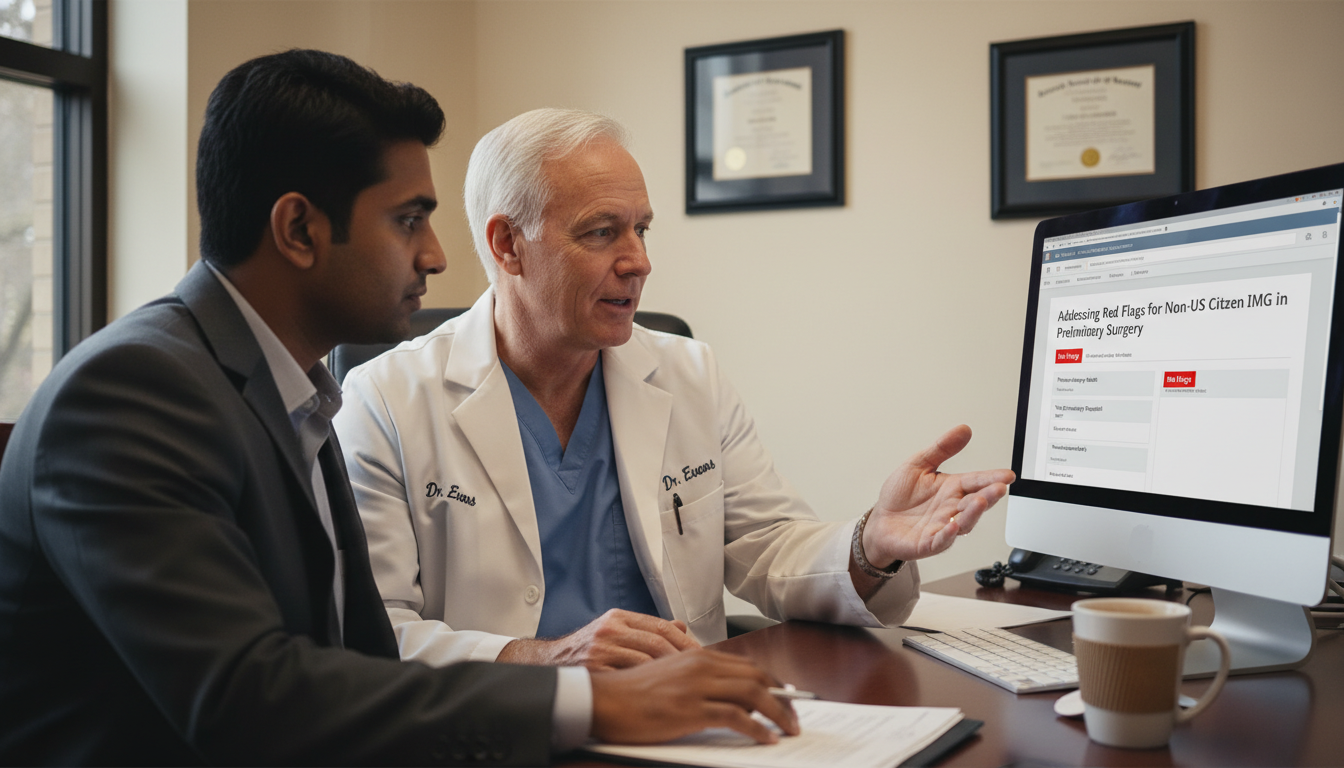
Changing Specialty or Multiple Prior Applications
Many non-US citizen IMGs apply to multiple specialties or reapply over several years. For a prelim surgery year, PDs especially want to know:
“Is this person genuinely interested in surgery, or just desperate for any position?”
If you previously pursued another specialty (e.g., internal medicine, radiology):
- Acknowledge the initial interest honestly.
- Explain why surgery is now clearly the right choice.
- Provide evidence of sustained surgical engagement (electives, research, observerships, OR time, mentorship).
Example: Changing Path to Surgery
In my early clinical years, I was drawn to internal medicine because of my interest in complex physiology and long-term patient care. However, after a required surgery rotation and later trauma observership in the US, I realized that I thrive in fast-paced, procedure-heavy, team-based environments. Over the last two years, I have focused my efforts on surgery through rotations, trauma research, and mentorship from attending surgeons. I am applying to a preliminary surgery year because it aligns with my current surgical goals and offers structured training while I further strengthen my candidacy for a categorical surgical position.
For reapplications, especially after going unmatched:
- Avoid sounding bitter or blaming the system.
- Show specific ways you strengthened your application (e.g., “I improved my USCE, obtained stronger letters, completed a research project in surgical outcomes.”).
- Clarify what you learned about the match process and about yourself.
Strategy 4: Optimizing the Application of a Non-US Citizen IMG for Prelim Surgery
Beyond addressing failures and explaining gaps, you can actively build positive signals that offset red flags. This is especially important for a non-US citizen IMG seeking a preliminary surgery residency, where overall competition and visa constraints compound each weakness.
Strengthening Clinical Credibility
Aim to have:
- Recent (within 1–2 years) surgery-focused USCE: sub-internships, observerships, or externships if available
- Exposure to:
- General surgery wards and clinics
- Operating rooms
- Trauma or emergency general surgery
- Evaluations highlighting:
- Work ethic (“stayed late to follow cases”)
- Teamwork and communication
- Responsiveness to feedback
- Reliability and punctuality
Strategic Letters of Recommendation
For prelim surgery, powerful letters often come from:
- US general surgeons or trauma surgeons
- Program directors or clerkship directors in surgery
- Research mentors in surgical departments who have seen you in clinical or semi-clinical settings
Ask your writers to:
- Address any concerns indirectly by emphasizing professionalism, humility, and resilience
- Comment on how you handle criticism
- Mention your improvement over time if they’ve seen your growth
Tailoring Your Personal Statement to Prelim Surgery
Your personal statement should:
Clearly state why you are choosing a preliminary surgery year
– not as a fallback, but as a purposeful step toward a surgical career (or another procedure-oriented path where a surgical prelim year is genuinely relevant).Acknowledge red flags briefly and constructively (not the entire essay).
Emphasize:
- Commitment to surgical training
- Comfort with hard work and long hours
- Specific experiences in the OR or trauma settings that shaped you
- How your background as a foreign national medical graduate brings diversity, language skills, and unique perspectives
Visa and Immigration Transparency
As a non-US citizen IMG, visa questions are unavoidable. Programs worry about:
- Whether they can sponsor your needed visa type
- Whether prior visa denials will complicate start dates
- Long-term feasibility of staying in their program
To reduce this concern:
- Be clear and honest on ERAS about your visa needs (J-1 vs H-1B).
- If you previously studied or worked in the US, show you complied with all rules.
- If you had a visa denial, prepare a simple, factual explanation if asked.
- Understand the typical visa pathways for surgical training so you can discuss them intelligently.
You do not need to write a long visa explanation in your personal statement unless it directly contributed to major gaps. But you should be ready with a confident, knowledgeable response in interviews.
Pulling It Together: Red Flag to Strength Story
When you apply, your goal is that each red flag becomes part of a coherent narrative:
- “I faced X challenge.”
- “I took responsibility.”
- “Here is how I changed my behavior and habits.”
- “Here are concrete results that show sustained improvement.”
- “This growth will make me a more reliable and effective prelim surgery resident.”
For example, you might summarize in an interview:
I am aware that my application has two major concerns: my initial Step 1 failure and a six-month gap during visa processing. I want to address both directly. After failing Step 1, I overhauled my study approach, sought mentorship, and later improved on Step 2 CK. During my visa-related gap, I remained engaged through local clinical work and research. These experiences have taught me to anticipate obstacles, communicate proactively, and continue moving forward even under uncertainty—qualities that I believe are essential for a preliminary surgery resident who must function reliably from day one.
If you can present your story with this level of clarity, honesty, and forward momentum, many programs will see you not as a risk—but as a candidate who has already demonstrated resilience and growth.
FAQs: Addressing Red Flags as a Non-US Citizen IMG in Preliminary Surgery
1. Should I mention every red flag directly in my personal statement?
No. Prioritize the issues most likely to worry PDs: exam failures, large unexplained gaps, or major professionalism events. Address them briefly and constructively. Minor concerns (e.g., a single low clerkship grade from years ago) can be left for interviews if asked. The statement should still primarily highlight your strengths, motivation for surgery, and what you bring to a program.
2. How much detail should I give about personal or family issues behind a failure or gap?
Provide enough context to make the situation understandable without oversharing. For example: “family health crisis,” “financial constraints,” or “personal health issue” is usually sufficient. Focus more on what you did to adapt and grow than on the dramatic details of the hardship.
3. Can a strong preliminary surgery year overcome earlier red flags if I aim for a categorical spot later?
Yes, a strong prelim year can be one of the most powerful ways to overcome red flags. Consistent clinical performance, strong in-service exam scores, and enthusiastic letters from your surgery faculty can significantly change how future PDs view your application. However, this requires excellent performance, reliability, and professionalism from day one. Treat a prelim year as an extended audition.
4. As a foreign national medical graduate, is it realistic to match into prelim surgery if I have both exam failures and gaps?
It is challenging but not impossible. Your chances improve if you:
- Show clear score improvement and recent strong clinical/academic activity
- Obtain strong, specific US-based letters of recommendation
- Demonstrate continuous engagement with surgery (research, observerships, OR exposure)
- Are transparent, reflective, and focused in how you explain your red flags
- Apply broadly and realistically to programs that have a track record of taking non-US citizen IMGs
Programs may still be cautious, but a well-prepared, honest, and growth-focused application can open doors—even with significant red flags.