From Rejection to Reflection: Turning Residency Setbacks into a Stronger Application
The residency application journey is one of the most challenging transitions in medical education. You invest years of training, countless hours of studying, and deep emotional energy into this process—so when you face rejection or fail to match, it can feel devastating.
Yet, for many successful physicians, a past rejection is not a red flag on their record—it’s a turning point in their career development. When approached deliberately, rejection can become one of the most powerful catalysts for personal growth, improved clinical readiness, and ultimately, a stronger, more competitive residency application.
This article will guide you through how to:
- Understand and process the emotional impact of rejection
- Reflect constructively on your previous application
- Identify realistic areas for improvement
- Create an actionable plan to enhance your candidacy
- Reframe your narrative to demonstrate resilience, maturity, and growth
Throughout, the focus remains on using reflection and strategy—not shame or self-blame—to rebuild a stronger application and move closer to the match outcome you want.
Understanding the Emotional Landscape of Residency Rejection
Handling rejection in the context of residency applications is not just about strategy; it’s also about your mental and emotional well-being. Without addressing the emotional fallout, it’s difficult to engage in clear, productive reflection.
Common Emotional Responses to Not Matching or Being Rejected
It’s normal to experience a range of intense reactions:
Disappointment and grief
You’ve worked toward this goal for years. Not matching—or receiving repeated rejections—can feel like a profound loss. That grief is real and valid.Self-doubt and shame
You may question your intelligence, clinical skills, or whether you “belong” in medicine at all. Thoughts like “Everyone else matched—what’s wrong with me?” are common but rarely accurate reflections of your potential.Isolation and comparison
Social media announcements and Match Day celebrations can amplify feelings of isolation. It may seem like you’re the only one facing this setback, even though many capable applicants quietly go unmatched each year.Anger or resentment
You might feel frustrated with the system, your school, mentors, or even yourself. These emotions can be uncomfortable, but acknowledging them is healthier than suppressing them.
Why Recognizing These Emotions Matters
Unrecognized emotions can quietly drive unhelpful decisions—such as impulsively changing specialties without good fit, rushing into any program that seems available, or abandoning medicine altogether without fully exploring your options.
Productive reflection begins only after you:
- Name what you’re feeling (e.g., “I feel ashamed and scared for the future.”)
- Allow yourself time to feel it without judgment
- Talk about it with someone you trust—advisor, mentor, therapist, or peer
Think of this step as treating an acute injury before focusing on rehabilitation. You need to stabilize emotionally before you can meaningfully analyze and improve your application.
Reflecting on Past Residency Applications with Structure and Honesty
Once the initial emotional shock has softened, you can begin a systematic review of your prior application. This is where rejection becomes a tool for career development rather than an endpoint.

Step 1: Analyze Each Component of Your Application
Break down your previous residency application into its key elements:
Personal Statement
Ask yourself:
- Did it tell a clear, cohesive story about who you are and why you chose this specialty?
- Did you demonstrate personal growth and insight, or just list achievements?
- Was your statement tailored to the specialty, or was it generic?
- Did it address potential red flags (e.g., exam failures, gaps) in a mature, constructive way?
A strong statement isn’t just well-written—it is aligned with your overall narrative and the kind of resident you aim to be.
Letters of Recommendation (LoRs)
Consider:
- Who wrote your letters—were they truly able to comment on your clinical performance and work ethic?
- Did you have at least one letter from someone in your chosen specialty?
- Were your letters likely personalized and specific, or more generic?
- Did your recommenders know your long-term goals and strengths?
If you’re unsure about the quality of your letters, ask a trusted advisor who has seen similar letters to give you feedback.
CV and Experiences Section
Evaluate:
- Did you clearly demonstrate progressive responsibility, leadership, and commitment over time?
- Were your clinical, research, and volunteer experiences clearly connected to your specialty interest and personal growth?
- Did you quantify your achievements where appropriate (e.g., “coordinated a team of 10 volunteers,” “enrolled 30 patients in a study”)?
Residency program directors are looking for patterns: sustained effort, reliability, and upward trajectory.
USMLE/COMLEX Scores and Academic Record
Reflect on:
- Were your scores within the typical range for your specialty and programs?
- Were there failed attempts or significant score gaps that weren’t contextualized or addressed?
- Did you have any course failures, professionalism concerns, or leaves of absence—if so, did you proactively and honestly explain them?
While scores are only one part of your file, they often influence interview offers. Understanding where you stand relative to specialty norms is essential.
Interview Performance
If you interviewed but did not match or received rejections post-interview:
- How did you feel during interviews—confident, authentic, anxious, or over-rehearsed?
- Were you able to clearly articulate: “Why this specialty?”, “Why our program?”, and “Why you?”
- Did you handle questions about weaknesses or red flags with maturity and ownership?
- Did you come prepared with meaningful questions that demonstrated insight and genuine interest?
Feedback from mock interviews or post-interview debriefs can be invaluable here.
Step 2: Identify Patterns and Possible Red Flags
Look for recurring themes:
Application strategy issues
- Too many “reach” programs and not enough realistic or safety options
- Applying late in the cycle
- Limited geographic flexibility
Gaps in experience or fit
- Minimal clinical exposure in your chosen specialty
- Lack of continuity in experiences (e.g., multiple short, unrelated activities)
- No clear demonstration of commitment to the specialty
Academic or professionalism concerns
- Failing or marginal scores on USMLE/COMLEX
- Difficulty in core clerkships, especially those related to your chosen field
Recognizing these patterns is not about blaming yourself—it’s about getting specific so you can create a targeted plan.
Step 3: Reflect on Personal Growth and Professional Identity
Rejection often pushes you to ask deeper questions:
What have I learned about myself from this process?
Maybe you discovered that you actually value outpatient continuity of care more than you realized, or that you thrive in high-acuity settings.How has this shaped my resilience?
Can you identify ways you’ve already adapted—sought help, pursued additional electives, or improved time management?Does my chosen specialty still feel right?
Sometimes, reflection confirms your original choice. Other times, it reveals that another field may be a better fit for your skills, values, and lifestyle preferences.
This introspective work is crucial not only for your next application but also for your long-term career satisfaction.
Step 4: Revisit and Clarify Your Short- and Long-Term Goals
After an honest review, ask:
- Do I still feel aligned with my current specialty choice, or should I explore alternative specialties more seriously?
- What kind of resident—and eventually attending—do I want to be, and what training environment will help me get there?
- What are my 1-year goals (e.g., improve Step 2 score, complete a research project, secure a strong sub-internship) and 3–5-year goals (e.g., academic medicine, community practice, fellowship)?
Write these down. A written plan clarifies your direction and makes it easier to evaluate opportunities and trade-offs.
Turning Reflection into Action: Building a Stronger Residency Application
Insight alone doesn’t change outcomes. You need a concrete, stepwise plan to address identified weaknesses and highlight your strengths.
1. Enhance and Target Your Clinical Experience
A robust clinical profile is foundational to a stronger application.
Strengthen Specialty-Specific Exposure
Depending on your goals and context, consider:
Sub-internships / Acting Internships (AIs)
Seek rotations at institutions you’re interested in. Perform at your highest level—timeliness, initiative, professionalism, and teachability are closely observed.Away Rotations (where appropriate)
Particularly useful in highly competitive specialties or if you’re from a less well-known medical school. They’re also a chance to demonstrate fit and secure a strong letter of recommendation.Post-graduate Clinical Positions
Such as preliminary years, transitional years, or non-designated positions, if recommended by your advisor and aligned with your long-term plan.
Broaden Clinical Exposure and Patient Contact
If you lack breadth or continuity:
- Volunteer in free clinics or community health initiatives
- Work as a clinical research coordinator, scribe, or in another patient-facing role
- Participate in quality improvement (QI) projects that show engagement with systems-based practice
These experiences can enrich both your CV and your interview talking points.
2. Optimize Your Academic Profile and Test Strategy
If your scores or grades were a limiting factor:
- Create a structured study plan with realistic timelines and daily goals
- Use NBME or COMSAE practice exams to identify weak content areas
- Consider professional tutoring or group study if independent efforts haven’t led to improvement
- Reflect on test-taking strategies (e.g., anxiety management, timing, approach to questions)
If tests are a recurring challenge, addressing them head-on is both a practical and personal growth step.
3. Craft a More Compelling, Growth-Oriented Personal Statement
Your new personal statement should:
Acknowledge growth without centering failure
You don’t need to detail every rejection. Instead, you can briefly reference obstacles and focus on what you learned and how you changed.Example focus:
“Through the challenges of my initial application cycle, I gained clearer insight into the type of physician I hope to become and the importance of [specific skill/attribute].”Demonstrate insight and maturity
Programs look favorably on applicants who can reflect, adapt, and improve—the same qualities required of residents who learn from feedback and complications.Align your story with the specialty and program values
For instance, in Family Medicine, highlight continuity of care and community engagement. In Surgery, emphasize teamwork, technical curiosity, and stamina.
Have at least two mentors—ideally including one in your specialty—review and critique your statement.
4. Strengthen Letters of Recommendation Through Relationship-Building
Better letters come from better relationships.
Be intentional about your clinical presence
Show up prepared, volunteer for responsibilities, and demonstrate reliability. Faculty notice patterns of behavior more than one-time efforts.Communicate your goals to potential letter writers
Share your CV, personal statement draft, and specialty interests. Ask if they feel they can write you a strong letter of recommendation.Diversify your letter sources
Ideal combinations often include:- At least one letter from a specialist in your desired field
- One from a core clerkship director or attending who can speak to your clinical fundamentals
- One from a research or QI mentor, if research is relevant to your goals
Remember that detailed, specific letters carry far more weight than generic “excellent student” summaries.
5. Deliberately Improve Your Interview Skills
Even a stellar written application can be undermined by weak interviews.
- Schedule mock interviews with career advisors, faculty, or residents
- Practice both traditional and behavioral questions (e.g., “Tell me about a time you made a mistake,” “Describe a conflict on a team and how you handled it.”)
- Record yourself if possible to evaluate body language, clarity, pacing, and tone
- Develop concise, authentic answers to:
- “Tell me about yourself”
- “Why this specialty?”
- “Why our program?”
- “Tell me about a challenge or failure and what you learned.”
Use your rejection experience wisely here—many programs will ask about it indirectly through questions about resilience and setbacks.
6. Attend to Self-Care, Support, and Resilience
Sustainable success in residency and beyond depends on your well-being.
Mental health support
Consider counseling, therapy, or support groups, especially if rejection has triggered anxiety, depression, or burnout symptoms.Peer and mentor networks
Connect with others who have re-applied or switched specialties. Hearing their stories normalizes your experience and may offer practical strategies.Balanced daily routines
Create habits that maintain your energy and focus: regular sleep, exercise, time away from medicine, and hobbies that recharge you.Reframing your narrative
Instead of “I failed to match,” practice thinking “I’m in a competitive process, and I’m investing this extra year to become a more prepared, resilient applicant and physician.”
Strategic Planning for Your Next Residency Application Cycle
To move from general ideas to action, build a structured plan.
Develop a Timeline
Create a month-by-month or quarter-by-quarter outline:
First 1–3 months:
- Emotional processing and debrief
- Detailed application review
- Advisor and mentor meetings
Next 3–6 months:
- Targeted clinical experiences or sub-internships
- Test preparation (if retaking or taking Step 3)
- Begin drafting personal statement and updating CV
Final 3–4 months before applications open:
- Finalize personal statement and program list
- Confirm and secure letters of recommendation
- Practice interviews
- Submit applications early in the cycle
Reassess Program Selection and Application Scope
Use objective data and advisor guidance to:
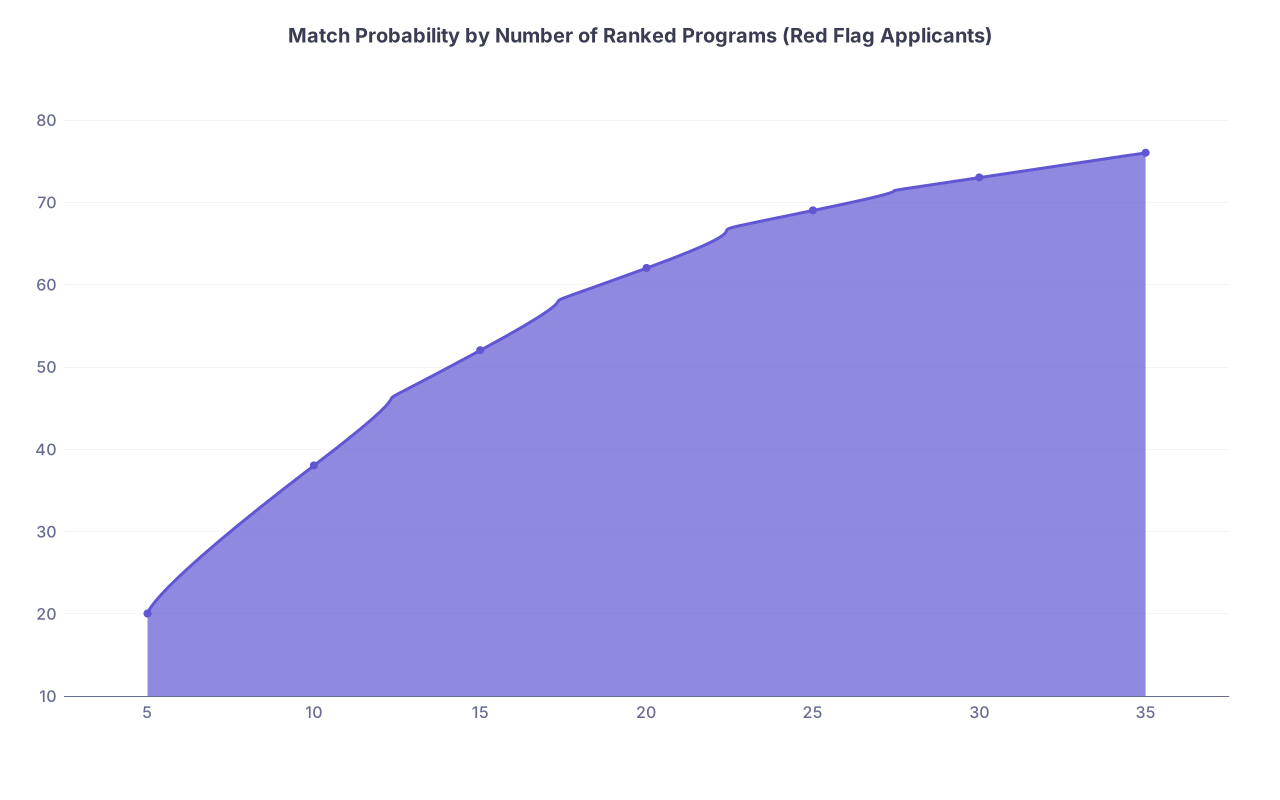
- Adjust the number and range of programs you apply to
- Ensure you have a mix of reach, realistic, and safety programs
- Consider geographic flexibility if feasible
- Identify programs historically open to non-traditional applicants, re-applicants, or IMGs (if applicable)
A well-calibrated application list can be the difference between silence and a robust interview season.

Embracing Rejection as a Stepping Stone in Your Medical Career
Residency rejection is painful, but it is not a final verdict on your worth or your future in medicine. Many highly respected physicians once stood exactly where you are now—disappointed, uncertain, and worried about what comes next.
What differentiates those who ultimately thrive is not a perfect first application, but their ability to:
- Confront reality with clarity instead of avoidance
- Seek honest feedback rather than reassurance alone
- Transform reflection into concrete, sustained action
- Maintain compassion for themselves while pushing for growth
By systematically analyzing your prior application, enhancing your experiences, refining your narrative, and caring for your mental health, you are not just becoming a stronger residency applicant—you are becoming the kind of physician who learns from adversity and advocates for their own growth.
Your story is still being written. This chapter may be titled “Setback,” but with intentional reflection and action, the next can be “Breakthrough.”
FAQ: Using Past Rejections to Strengthen Your Residency Application
1. Is it a red flag to reapply after not matching in residency?
Reapplying is not automatically a red flag. Many programs understand that the residency match is competitive and that strong candidates sometimes go unmatched. What matters is how you use the intervening time:
- Did you gain additional clinical experience, research, or quality improvement work?
- Did you address academic or test-related concerns?
- Can you clearly articulate what has changed and how you’ve grown?
When you can demonstrate clear progress and insight, reapplication can actually highlight your resilience and commitment—positive traits in any resident.
2. Should I mention my previous rejection in my personal statement or interviews?
You generally don’t need to explicitly describe “not matching” in your personal statement, but you can reference the period as a time of growth, reflection, or additional training. In interviews, if asked about gaps or previous attempts, be honest, concise, and growth-focused:
- Briefly acknowledge what happened
- Take responsibility where appropriate (without harsh self-criticism)
- Emphasize concrete steps you took to improve—new experiences, improved scores, mentorship, or reflection
- Conclude with what you learned and how it made you a stronger applicant and future resident
Programs are assessing your maturity and insight as much as the event itself.
3. How do I know if I should change specialties after a rejection?
Consider changing specialties if:
- Your interests, values, or preferred lifestyle align more clearly with another field
- Advisors in your current specialty consistently express concern about long-term fit or competitiveness, even with improvements
- You’ve explored another specialty through rotations or shadowing and found it more fulfilling
Before making a switch:
- Discuss options in depth with mentors, program directors, and career advisors
- Seek at least one clinical experience in the potential new field
- Reflect honestly: Are you changing because of fear and frustration, or because of genuine better fit?
A thoughtful change can lead to greater long-term satisfaction and success.
4. How can I maintain my mental health while preparing to reapply?
Some strategies include:
- Schedule regular check-ins with yourself and/or a therapist to monitor mood, anxiety, and burnout
- Maintain non-medical activities (hobbies, exercise, social time) that support your identity beyond “applicant” or “doctor”
- Connect with peers or alumni who have successfully navigated reapplication; hearing their stories can normalize your experience
- Set realistic, incremental goals for each month so the process feels manageable rather than overwhelming
Your well-being is not a luxury—it’s a prerequisite for sustained success in residency and your future career.
5. What if I improve my application and still don’t match?
This possibility is understandably frightening, especially in competitive specialties. If it happens:
- Meet promptly with career advisors and mentors for a post-cycle debrief
- Re-evaluate:
- Specialty choice and competitiveness
- Application strategy and program selection
- Alternative pathways (e.g., preliminary years, additional degrees, research fellowships)
Some applicants ultimately pivot to related fields, research-focused paths, or alternative careers in medical education, public health, or industry. While this may not be your current goal, know that a meaningful, impactful career in health and medicine can take many forms—even if the route looks different than you initially envisioned.
Transforming rejection into reflection, and reflection into action, is a powerful form of personal and professional growth. By doing this work thoughtfully and systematically, you position yourself not only for a stronger residency application, but for a more resilient and purpose-driven career in medicine.