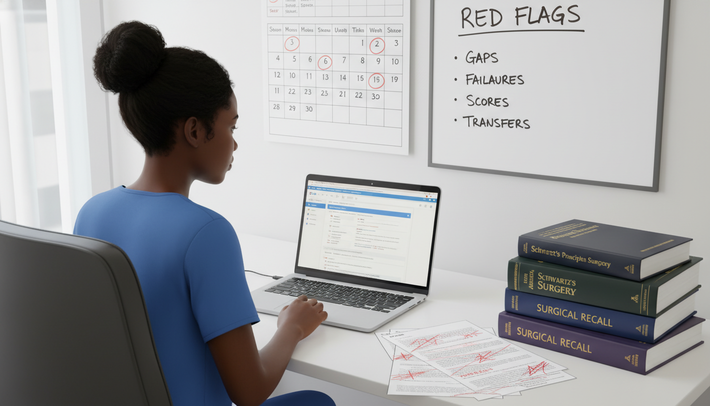
You know the feeling. You've spent weeks preparing. Your CV is pristine, your personal statement is heartfelt, and your letters of recommendation read like they were written by your biggest fan. Then you open your mouth on interview day, and something comes out that sounds like a cross between a customer service chatbot and a hostage reading a prepared statement.
I've sat on the other side of that Zoom screen, or conference table, more times than I can count. And I've watched program directors' eyes glaze over as a candidate with a 260 Step 2 and three first-author publications delivers answers so stiff and joyless that you wonder if they'd remember to smile during a patient encounter. That gap between the person on paper and the person in front of us is one of the fastest ways to tank an otherwise stellar application. Let's get into exactly why, and, far more importantly, what you do about it while you still have a shot.
To avoid falling into common traps, check out how to handle common interview answers that turn small red flags into big concerns.
The Scenario: The "Paper Tiger" Paradox
Picture this. You're interviewing a candidate who, on paper, looks like they've been personally groomed to run a residency program. High-impact publications. Glowing leadership roles. A Step score in the top decile. You're expecting someone with a spark, someone who walks in and owns the room.
If you are concerned about your interview performance, read how faculty quietly rank your residency interview performance to understand what they are looking for.
What you get instead is a person who sits bolt upright, eyes darting, voice monotone, delivering answers that sound as rehearsed as a campaign speech. When you ask, "Tell me about a time you resolved a conflict with a team member," they launch into a polished but hollow anecdote that somehow manages to use the phrase "I leveraged my communication skills" twice in 90 seconds. There's no warmth, no off-the-cuff laugh, no crack of genuine personality.
That's the Paper Tiger Paradox. The application screams "high-energy leader," but the interview performance screams "deer in headlights."
The problem isn't that you're nervous. Nervousness is expected, and good interviewers can see past it, partly. The real issue is cognitive dissonance. When the paper version of you and the in-person version don't line up, our brains interpret it as a red flag, not a scheduling mishap. We're wired to trust congruence. If a candidate's paperwork suggests they're an outgoing, assertive team player and they can't make eye contact or speak without glancing at their notes, we start mentally rewriting their file. "Maybe the letters were exaggerated. Maybe the research was just following a PI's directions. Maybe they're not who we thought we were getting."
And let's be clear: I'm not talking about introverts or quiet personalities. I'm talking about the specific, jarring disconnect that happens when someone has clearly over-prepared to the point of becoming robotic. It reads as scripted. Inauthentic. Clinically absent. In a job where you might need to break bad news to a family, talk down a volatile patient, or calmly guide a team through a code, that's not "shy", that's a potential liability.
What They Are Actually Thinking (Behind the Smile)
I've been in those post-interview debriefs. The committee member who lobbied hardest for you based on your paper says, "That... wasn't what I expected." Then someone else chimes in, "I'm not sure I'd trust them running a list overnight." Brutal, but it happens.
Here's the internal dialogue happening behind the interviewer's polite smile:
"Can I trust this person in a Code Blue or an angry patient encounter?" That's the baseline. If you can't muster the presence to connect with me in a low-stakes, structured interview, how will you handle a crashing patient, an unhinged surgeon, or a family screaming at you about a missed diagnosis? Your Step 2 score doesn't answer that question.
Now, not every mismatch is fatal. The interviewer is trying to figure out whether this is nerves or incompatibility. Nerves we can forgive, if we see enough of the real person when you finally relax. Incompatibility is more stubborn. It's the candidate who answers every behavioral question with a safe, rehearsed template rather than a messy human story. The one who can't deviate from their script. The one who smiles on cue but never laughs.
That's when we start digging. Behavioral questions become a probe. "Tell me about a time you failed to meet a deadline, and what you actually did, not what you learned." If your answer is still a polished, risk-free platitude, we've moved from "they're nervous" to "they're covering up a lack of real substance." The interview just became a credibility check, and you might be failing it without ever saying anything objectively wrong.
Let me show you the decision tree that runs through an interviewer's mind when they spot a gap.
If we think it's nerves, we'll poke at your clinical stories, the cases you love, the patients you remember, to see if genuine enthusiasm breaks through. That can salvage the interview. But if we decide the gap is a fundamental lack of fit or, worse, a sign of misrepresentation, the trust is gone. No amount of "What's your greatest strength?" pivoting will save you.
The Math of Compatibility: Why Scores Won't Save You
There's a stubborn myth in medical training that if you just outscore everyone, you're safe. You're not. In fact, once you've cleared a program's baseline filter, and most competitive applicants do, the things that get you hired or get you terminated have almost nothing to do with your USMLE transcript.
Have a look at this data. It's not pulled from some dusty journal study; it's the ugly reality PDs whisper about.
Roughly 75% of resident terminations and remediation cases boil down to some combination of communication breakdowns, failure to work well in a team, or an inability to read a room. Only about 10% are due to a genuine inability to master the clinical knowledge, something that's often fixable with extra reading and tutoring anyway. The rest is work ethic.
So when your interview persona doesn't match your paper, you suddenly look like someone who might become one of those 75% statistics. The program isn't just hiring a test-taker. They're hiring a teammate, a co-worker they'll share 80-hour weeks with, someone they'll depend on at 3 a.m. If your personality communicates "I will isolate, not ask for help, and crumble under pressure," your 270 isn't saving you. You've just become a high-risk draft pick.
And I want to be clear: low-key personalities aren't the problem. Some of the best residents I've ever worked with are quiet, reflective, and introverted. The difference? They still show up. They make eye contact. They admit uncertainty with grace. They don't fake extroversion, but they demonstrate sky-high Emotional Intelligence: self-awareness, active listening, the ability to acknowledge tension and defuse it. That's the key. The red flag isn't being introverted; it's being disengaged. The PD wants to see that you know who you are and you're secure in it, not that you're hiding behind a mask that's already slipping.
Strategy: How to Bridge the Gap Mid-Interview
If you're reading this before your interviews, you've got time. If you're in the middle of the season and you've already felt the gap, maybe you caught yourself sounding robotic and the interviewer's face dropped, there are still ways to pivot. Real-time. Not after you've logged off and sent a cringey thank-you email.
1. Acknowledge nerves, but don't apologize for existing.
Early in an interview that's going stiff, it's okay to say something like, "I'm going to pause here because I realize I'm sounding more rehearsed than I want to. I'm really excited about this program, and I think that's making me overthink. Let me try again." That level of self-awareness isn't a weakness. It's the kind of EQ that signals you can manage your own affect, you notice when communication isn't landing, and you're brave enough to call a reset. I've seen candidates turn a flat interview into a genuinely good one with one honest sentence like that. It disarms the room.
2. Stop memorizing; start being present.
The biggest trap is the pre-packaged answer. You know the ones: "As a physician, I believe medicine is a calling..." or "My greatest weakness is I care too much." Nuke those. Instead, prepare stories, not sentences. Before interview day, sit down and recall three or four specific patient encounters or team moments that shaped you. Not polished ones, real ones. The time you misdialed an attending's number and accidentally texted a crying emoji. The patient who taught you more about resilience than any textbook. The mistake you made on Sub-I that still makes you wince. When a question asks about a leadership role, you don't recite your CV; you say, "Actually, that reminds me of something that happened on my surgery rotation last fall..." and you tell the story. Messy details are your friend. They're the opposite of scripted.
3. Inject your values into factual answers.
They ask, "Tell me about your research." You could list the publication and the lab, the stuff already on paper. Or you could say, "The reason I stuck with that bench project for two years wasn't the publication. It was that I'd lost a cousin to that exact cancer when I was 16. That's not in my personal statement; never felt right. But it's why I cared." That's not a rehearsed line. That's a glimpse behind the curtain. It makes the interviewer connect a human to the stats.
4. For non-native speakers and introverts: use silence and pace, not volume.
You don't need to be the loudest person in the room to make an impact. If English is your second language, slowing down and leaving small pauses shows confidence, not hesitation. A quiet moment after a question gives you time to think and signals you're thoughtful, not unsure. And if you're introverted, lean into depth rather than breadth. One well-told, reflective story beats five fast-talking surface-level answers. Authenticity has nothing to do with being gregarious.

Summary: Authenticity as Your Safest Bet
If you're walking away from an interview feeling like there was a huge gap between who you are and what you showed them, the problem isn't usually a lack of preparation, it's that you prepared the wrong things. You polished the surface while neglecting the substance.
Vulnerability in an interview isn't unprofessional. It's strategic. Admitting you're nervous, sharing a moment that actually shaped you, laughing at your own awkwardness, these are what turn a flat applicant into a memorable human being. The programs that are right for you will value that. The ones that want a robot? You don't want them anyway.
Post-interview checklist to audit your own performance:
- Did I say something off-script that revealed genuine emotion or humor?
- Did I tell at least one story that isn't on my application?
- Did I feel like I had a real conversation rather than a Q&A interrogation?
- If I noticed a gap, did I attempt to pivot or just bulldoze through?
If the answer to most of those is no, adjust before the next one. It's never too late.
The match is a two-way street. You're looking for a program that fits who you actually are, not who you think you need to be. When you let that actual person into the room, the one who's a little tired, a little hopeful, maybe a little weird, you dramatically shrink the Paper Tiger Paradox. And you might just end up where you actually belong.
The match is about finding your people. Be the version of yourself that gives them a chance to find you.