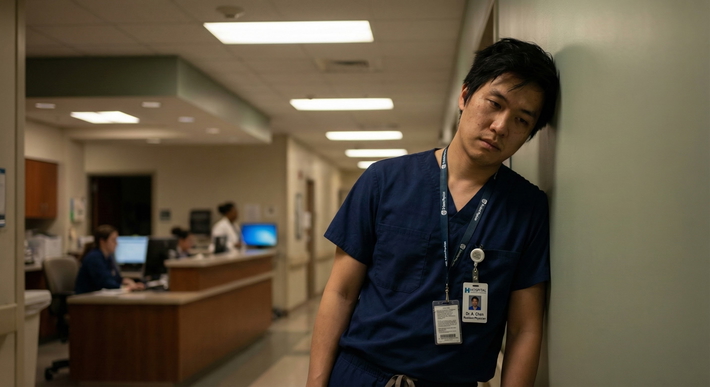
Your co-resident calls out sick. The list doesn't shrink. The pages don't slow down. And within about six minutes, you can feel the whole shift trying to slide from hard into dangerous.
This is the moment a lot of residents make the same mistake: they respond emotionally before they respond operationally. They feel bad for the sick colleague, guilty for being annoyed, then quietly decide to absorb the extra work and "just get through it." Bad plan. That's how you miss lunch, miss details, snap at nurses, and end the day feeling like your nervous system got sandblasted.
If you're in this situation, your first job is not to be noble. It's to keep the shift safe and stop your own burnout risk from spiking into the red.
1) First 10 Minutes: Stabilize Your Shift, Not Your Guilt
Start here: don't dramatize it, and don't minimize it. A sick call changes the day. Period. The schedule is tighter, the margin for error is smaller, and your bandwidth is not infinite. Pretending otherwise is how chaos sneaks in.
In the first 10 minutes, do a fast mental triage. Ask:
- Who is unstable right now?
- What orders or callbacks are time-sensitive?
- What absolutely has to happen in the next hour?
- What can wait until later rounds, later notes, or sign-out?
- What can be handed off, shared, or intentionally delayed without hurting patient care?
This isn't elegant. It's practical. I've seen residents lose 30 precious minutes trying to preserve the fantasy that the day will run normally. It won't. Re-map it early.
Also, watch your own internal warning signs in real time. They show up fast:
- irritability at small interruptions
- tunnel vision
- skipping water because "I'll do it after this page"
- refusing to sit down
- the sudden urge to power through without making a plan
That's not toughness. That's how people get sloppy.
Set one boundary for the next hour. Just one. Maybe it's: I am not promising turnaround times I can't control. Maybe it's: I am telling my senior now instead of silently resenting everyone. Maybe it's: I am not solving this alone.
That boundary matters. Because on these shifts, burnout doesn't arrive with a speech. It shows up as bad habits disguised as professionalism.
2) Step 1: Re-map the Workload So You Can See the Day Clearly
When coverage gets thin, the work starts to feel like one giant, hostile blob. Break it apart. That's how you get your brain back.
List the affected tasks in categories:
- Patient care: unstable patients, follow-ups, urgent reassessments
- Admissions/discharges: new admits, pending discharges, med rec, instructions
- Notes: progress notes, admit notes, discharge summaries
- Procedures: anything time-sensitive or requiring specific hands
- Cross-cover: pages, overnight issues, family updates
- Communication: consult calls, nursing concerns, sign-out prep
Once it's on paper, or at least in your head in a structured way, sort it into three buckets:
- Must do now
- Can be delayed
- Can be delegated or shared
Your highest-risk items go first. Always. Unstable patients. Time-sensitive orders. Bad sign-out gaps. Anything that could become a safety issue if it sits. Everything else gets ranked behind that, no matter how loud it feels.
A discharge summary may be annoying. An unchecked potassium of 2.8 is dangerous. Know the difference and act like it.
If the workload is too much for one resident to safely absorb, escalate early. Not after you're drowning. Early. Go to your chief, senior, or attending with a clean summary:
- one resident out sick
- current census or workload pressure
- immediate safety-sensitive tasks
- what specific support is needed
Not a monologue. Not a meltdown. A staffing problem statement.
Something like:
"We're down one resident, I have two unstable patients, three pending admissions, and discharge tasks stacking up. I need help deciding what gets redistributed now and who can take the next admit."
That's strong communication. Efficient. Useful.
And then do something residents often skip: reassess in an hour. The list changes. New fires appear. A plan that worked at 7:10 may be garbage by 8:15.
3) Step 2: Communicate Early, Briefly, and Without Apology
You do not get points for suffering quietly.
Tell the right person early. Depending on the service, that's your senior resident, chief, attending, or charge nurse. Not everyone needs the same message, but someone with operational control needs to know the shift just changed.
Use short, direct language. Here's the template:
- What happened: "We're down one resident."
- What it affects: "Cross-cover and admissions are already backing up."
- What you need: "I need help redistributing pages / delaying nonurgent tasks / identifying backup."
That's it.
You don't need to pad the message with apology. You didn't create the staffing problem. And overexplaining wastes time. This is one of those residency habits that needs to die: acting like asking for help is a moral failure. It's not. It's how adults run a service safely.
If you need help from nurses, unit clerks, or other team members, be specific enough that they can actually act. Bad ask: "I'm slammed." Good ask: "I'm covering an extra list—can you batch nonurgent pages for the next 20 minutes unless something is time-sensitive?"
Or: "If radiology calls back on bed 12, please secure chat me and I'll respond after I finish this admission."
Specific requests reduce friction. Vague distress just makes everyone tense.

And one more thing: don't confuse politeness with self-erasure. Be respectful. Be calm. But be plain. "I need backup for the next two admissions" is better than hinting for 45 minutes and hoping someone notices you're drowning.
4) Step 3: Protect Your Energy Like It Is Part of Patient Safety
Because it is.
When the schedule tightens, basic self-maintenance starts feeling optional. It isn't. The resident who hasn't eaten since 5:30 a.m., hasn't peed in five hours, and is running on adrenaline is not more dedicated. They're less reliable.
Pick one concrete self-protection move for the shift:
- drink water after each admission
- eat a snack before rounds
- take five minutes seated after a major wave of pages
- do a bathroom break before starting the next task block
Tiny. Boring. Effective.
I've watched residents make dumb errors because their body was waving red flags and they treated that as background noise. Headache. Shakiness. Feeling weirdly detached. Reading the same chart line three times. That's not something to "push through." That's your cue to pause for two minutes and reset before you make your next decision.
Also watch for overfunctioning. It looks noble and it's actually destructive. Things like:
- taking every loose task personally
- saying yes before checking capacity
- working through lunch automatically
- volunteering for extra work just to avoid appearing difficult
That behavior gets praised in broken systems. It still burns you down.
You're allowed to say, "I can take this, but something else will need to wait." That's not laziness. That's prioritization.

If you want a rule to remember on shifts like this, use this one: if protecting your body feels inconvenient, that's probably when you need it most.
5) Step 4: Use the After-Shift Debrief to Prevent the Next Burnout Spike
Don't just collapse after the shift and call it resilience. That's how the same bad day repeats next week.
Take five minutes after sign-out or before you leave the parking lot and debrief the shift. Not a dramatic postmortem. Just a clean review:
- What went wrong?
- What actually went well?
- Where did the workload bottleneck?
- What should be escalated next time sooner?
- What support was missing?
This matters because repeated sick-call strain becomes invisible when everyone treats it like an individual endurance contest. It isn't. If the same coverage gap keeps happening, that's a systems issue. Name it like one.
Document recurring patterns. Short and factual:
- down one resident every Friday night
- no clear backup for admissions after 5 p.m.
- discharge tasks stacked on one person
- repeated delays because task ownership is unclear
Leadership can ignore vague frustration. Concrete examples are harder to brush off.
And be honest about your own state. If one rough shift wrecked you, fine. Recover. But if you're noticing persistent dread before work, sleep getting shredded, emotional numbness, snapping at people you actually like, or thoughts of quitting every week, that's not "just residency." That's a sign you may need real support. Talk to a chief you trust. Use employee assistance. See your own doctor or therapist. Loop in your program if needed.
A good night's sleep helps a bad day. It does not fix a pattern of burnout.
6) Step 5: Build a Small Backup Plan Before the Next Sick Call Happens
The best time to make your plan is not during the page storm.
Build a personal backup plan now. Keep it simple enough that you'll actually use it. Mine would include:
- key contacts in order: senior, chief, attending, charge nurse
- what I escalate immediately: unstable patients, unsafe admit volume, unclear task ownership
- what I can usually absorb safely
- what I should not absorb without redistribution
- one boundary statement for high-stress moments
That's your mini playbook.
Also, talk with your team about coverage norms when nobody is actively drowning. This is where a lot of programs are weirdly bad. Everyone pretends the expectations are obvious until a sick call happens, and then people improvise under stress. Dumb. Clarify it ahead of time.
Questions worth asking:
- Who takes first backup if one resident is out?
- How are admissions redistributed?
- What tasks can be delayed without drama?
- Who communicates changes to nursing and support staff?
- When should the attending be looped in?
You don't need a giant policy memo. You need clarity.
Practice one boundary sentence so you can use it when your brain is fried. Examples:
- "I can cover the urgent pages, but I need the next admission reassigned."
- "I can do this procedure, but discharge paperwork will be delayed."
- "I need help prioritizing because the current workload isn't safely absorbable by one person."
Those statements are gold because they are calm, specific, and hard to argue with.
And here's the part I want you to remember: you do not need to be the heroic fix for every staffing failure. Heroics are overrated. Repeatable systems are better. Your goal is not to prove how much suffering you can tolerate. Your goal is to work safely, communicate clearly, and leave with enough of yourself intact to come back tomorrow.
If this keeps happening on your service, don't just adapt silently. Bring it up. Track it. Push for better backup norms. That's not complaining. That's how broken workflows get exposed.
Key takeaways
- When a co-resident is out sick, your fastest burnout-prevention move is to triage the workload and communicate early instead of absorbing everything yourself.
- Protecting your energy during a staffing shortage isn't indulgent. It's part of staying safe, effective, and less likely to crash later.
If you're staring down one of these shifts this week, make your backup script now. Write down your escalation order. Decide your boundary sentence before you need it. Small plan. Big difference.