
Conflict between co-residents is not a side issue; it is one of the fastest ways to burn out an otherwise solid team.
Most programs pretend the main burnout drivers are hours, notes, and call. Those matter. But the thing that pushes residents over the edge more often than anything else? Working every day with people they resent, do not trust, or actively avoid.
You are not going to change the call schedule this month. You absolutely can change how your team handles conflict.
This is the practical guide I wish more chiefs and PDs would hand out on day one. I will walk you through concrete steps, scripts, and micro-habits that turn conflict from a burnout accelerant into something closer to a pressure release valve.
1. See Conflict For What It Actually Is
Before fixing anything, you need to label the problem correctly. Residents usually misclassify conflict in two unhelpful ways:
- “It is just personalities.” Translation: no one will touch it.
- “They are toxic.” Translation: I am done trying.
Both are lazy diagnoses.
Most co-resident conflict falls into a few predictable buckets:
Workload and fairness
- “I am always the one staying late to dispo patients.”
- “She disappears during admissions and reappears at sign-out.”
Communication and tone
- Short, clipped responses.
- Sarcasm on rounds.
- Public corrections that feel like humiliation.
Role confusion
- “Who actually writes the H&Ps?”
- “Am I cross-covering their patients or not?”
Values clash
- One resident is hyper-efficient, borderline brusque.
- Another is meticulous and slower, more risk-averse.
- They both think the other is “wrong” rather than “different.”
Unaddressed past injury
- A single bad call night where someone felt abandoned.
- A comment they never got over.
- A negative eval that felt like a betrayal.
You burn out when these pile up and no one has a clean way to deal with them.
So first move: call it what it is. Not “they are toxic” but:
- “We have an unresolved issue about work distribution.”
- “I am reacting to how they talk to me in front of attendings.”
- “We never clarified roles, and now everyone feels taken advantage of.”
Once you frame it that way, you can actually work the problem instead of just stewing.
2. Use a 10-Minute Daily Huddle to Prevent 80% of Conflict
If you only implement one habit from this guide, make it this one.
A structured, 10-minute daily team huddle is the cheapest, highest-yield intervention for conflict prevention and burnout protection.
The 10-Minute Huddle Template
Do it:
- At a consistent time (e.g., right after morning sign-out, before rounds).
- With everyone present: senior, juniors, med students, sometimes the NP/PA if you work closely.
- Standing, in a quiet corner or workroom. No computers. No phones.
Script (you can literally read this):
Yesterday reality check (2–3 minutes)
Each person answers two quick questions:- What went well yesterday?
- What sucked or felt unfair / unsustainable?
The senior goes first to model honesty:
- “What went well: Discharges were efficient. What sucked: I realized I dumped too many calls on you, sorry—will balance better today.”
Today’s plan and roles (4–5 minutes)
- Clarify admits, procedures, discharges.
- Assign clear owners:
- “Alex owns all ED new admits until 3 pm.”
- “Priya owns discharges and follow-up calls.”
- “I will handle all difficult family meetings, loop me in early.”
Red flags and help requests (2 minutes)
Ask explicitly:- “What is going to overwhelm you today if we do not plan for it?”
- “Who needs a buffer or backup at any time today?”
Example:
- “I have continuity clinic this afternoon and I am already at 100%—I will need help finishing notes if we get slammed.”
Micro-communication rule of the day (1 minute)
One sentence ground rule to reduce friction, chosen by the senior:- “Today: no venting in front of students; take it to me first.”
- “Today: if you are drowning, say ‘I am red’—that is a non-negotiable help signal.”
You have just:
- Surfaced simmering resentment before it explodes.
- Made expectations explicit.
- Normalized asking for and offering help.
Run this for 2 weeks and watch the “I feel alone” and “no one helps” complaints drop sharply.
3. When Conflict Hits: A Simple 4-Step Protocol
You will still have blowups. Or cold wars. Or passive-aggressive charting comments. Fine.
Here is the protocol I use and teach. It is not therapy. It is a field manual.
Step 1: Triage — Is This “Now” or “Later”?
Ask yourself three questions:
- Is patient safety at risk right now?
- Is someone being openly abusive, discriminatory, or harassing?
- Is the situation escalating in front of patients or staff?
If yes to any of the above, you intervene now and directly:
- “Time out. This conversation is not safe / productive. Let us step out and talk.”
- Redirect focus to patient care: “For now we are going to do X for the patient; we can debrief after rounds.”
If no to all, you mark it for a “later” conversation the same day:
- “We should talk about how this morning went. I have a few concerns. Can we grab 10 minutes after sign-out?”
Do not let it slide more than 24 hours. That is how resentment calcifies.
Step 2: Separate Facts, Impact, and Story
If you go into a conflict conversation with “they always” and “they never,” you will fail.
Before you talk to them, write down three lines:
Facts (neutral, observable):
- “Yesterday between 4–7 pm, I admitted four patients while you were in the workroom documenting.”
- “On rounds, when I presented, you corrected me twice in front of the attending without talking to me first.”
Impact (on you, the team, or patients):
- “I felt like I was drowning and alone.”
- “I felt undermined and less confident to speak up.”
Story you are telling yourself (this is key):
- “The story I am telling myself is that you do not think I am competent.”
- “The story I am telling myself is that you did not care how exhausted I was.”
This gives you language that is specific and ownable, instead of accusatory.
Step 3: Use the 3-Sentence Confrontation Script
You do not need a 30-minute speech. You need three clean sentences.
Observation (fact):
- “Yesterday evening, I admitted four patients while you stayed at the station finishing notes.”
Impact + story:
- “I felt overwhelmed and honestly a bit abandoned—the story I told myself was that you were not interested in splitting the work.”
Request / invitation:
- “Can we talk about how to handle admits on nights like that so it feels more balanced?”
Then shut up. Let them respond. Do not fill the silence. You are adults, not PGY-0s.
Step 4: Negotiate a Behavior Change, Not a Personality Makeover
Your goal is not “they become a different person.” Your goal is one or two concrete behavior changes.
Bad outcome:
- “I just need you to be more supportive.”
Vague. No one knows what this means.
Good outcome:
- “On nights with more than three admits, we will alternate every other admit.”
- “If you see something in my presentation that is off, tell me privately after rounds unless it is a critical patient safety issue.”
- “If you are behind on notes and cannot help with tasks, say ‘I am note-locked’ so I know what to expect.”
You decide together, you say it out loud, and ideally you repeat it at the next day’s huddle to cement it.
4. Scripts For Common Conflict Scenarios
Let us get specific. These are real-world scenarios I have seen, with language that works.
Scenario 1: The Vanishing Co-Resident
Pattern: During busy admits, one resident is always “somewhere else.” Calls, bathroom, “checking on a patient.” You do the bulk of the grunt work.
What to say (private, same day):
- “Last night between 5 and 8, we got five admits. I went down to the ED for four of them while you were up on the floor.”
- “I felt like I was carrying the bulk of it, and I ended the night angry and exhausted.”
- “Next time we get slammed like that, can we agree to alternate ED trips or clearly say if one of us is tied up with something else?”
If they say “I was handling cross-cover,” ask for specifics:
- “That is helpful to know. Next time, can you say ‘I am stuck cross-covering 7W, I cannot do ED admits for the next hour’ so I understand the full picture?”
Scenario 2: Undermining on Rounds
Pattern: Co-resident interrupts, corrects, or re-presents your work in front of the attending.
What to say:
- “On rounds this morning, when I presented Mr. Jones, you jumped in twice to correct me before I finished.”
- “I left rounds feeling embarrassed and less confident presenting in front of the attending.”
- “If you see something off in my plan, can you either let me finish first and then add on, or talk to me right after that patient? I will absolutely listen; I just want a chance to get through my part.”
If they insist “I was just trying to help,” you can say:
- “I get that. I am asking for a different way of helping that does not shut me down. Can we try that tomorrow and see how it feels?”
Scenario 3: Chronic Negativity and Complaining
Pattern: One person drags the emotional tone of the team down every day. Everything sucks. Every attending is “terrible.” Every patient is “a disaster.”
This is a burnout multiplier.
What to say (senior to junior or peer-to-peer):
- “I have noticed that on most days, a lot of your comments about the team and attendings are pretty negative—like ‘they are useless’ or ‘this is stupid.’”
- “After a while it makes the whole workroom feel heavier and more miserable, including for me.”
- “I am not saying you cannot vent. I am asking if we can keep the constant bashing out of the team space and maybe set aside 5 minutes after sign-out if you need to unload. I will listen then.”
You are not policing feelings. You are protecting the work environment.
5. Use Micro-Agreements to Burnout-Proof the Team
Teams burn out when everything is implicit, and everyone is guessing. You fix that with micro-agreements: small, explicit rules you create together.
These are not institutional policies. These are “our team, this month” rules.
Examples of High-Yield Micro-Agreements
| Area | Example Agreement |
|---|---|
| Pages/Calls | Dayfloat picks up pages 8-10 am while night signs out |
| Breaks | Each person gets one protected 20-min break per shift |
| Notes | Interns pre-chart by 9, seniors review by noon |
| Help Signaling | “Red/Yellow/Green” status at midday check-in |
| Feedback | 5-minute debrief on Fridays after rounds |
You build these in three steps:
Ask: “What keeps biting us?”
- Missed pages, delayed discharges, resentment around breaks, etc.
Propose a simple rule:
- “From now on, 11–11:20, one person is on pager, everyone else eats. Then we rotate.”
Test for one week. Then adjust at the next Monday huddle.
The point is not perfection. The point is that you are no longer winging it every day.
6. A Simple Framework For When To Escalate
Sometimes you have tried the scripts, the huddles, the micro-agreements. Nothing changes. Or the behavior crosses a line on day one.
Here is how I think about escalation. You are not “snitching.” You are protecting patients and your own sanity.
Red, Yellow, Green
Green – Annoying but manageable.
- Eye rolls, mild tone issues, occasional lateness.
- Solution: direct 1:1 conversation, huddle tweaks.
Yellow – Repeated or impactful behavior.
- Chronic dumping of work, repeated undermining, refusal to follow team agreements.
- Solution: 1:1 conversation + involve senior or chief for coaching if no change within 1–2 weeks.
Red – Safety, discrimination, or harassment.
- Racial or sexist comments, retaliation, bullying, patient-endangering shortcuts.
- Solution: escalate immediately to chief, PD, or GME. Document specifics. This is non-negotiable.
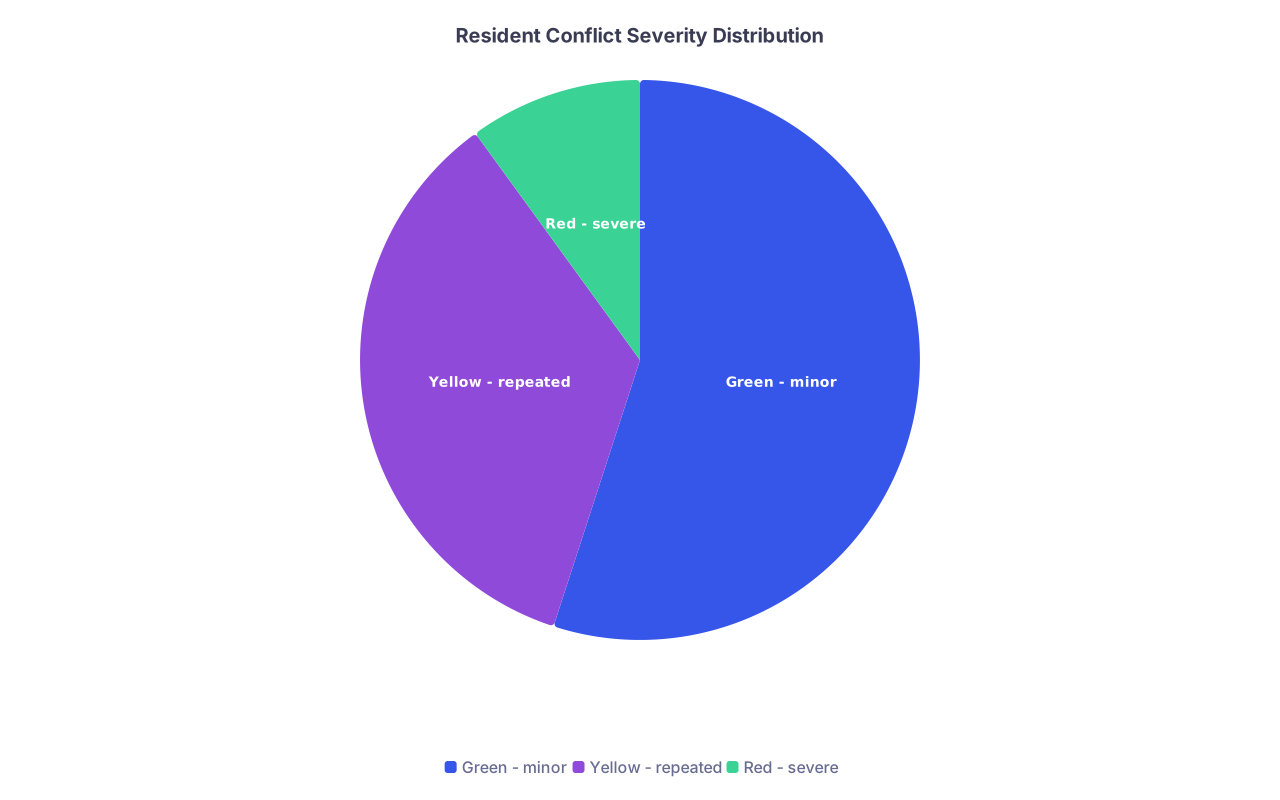
| Category | Value |
|---|---|
| Green - minor | 55 |
| Yellow - repeated | 35 |
| Red - severe | 10 |
If you are worried about retaliation, use:
- Program ombudsperson (many places have one, residents often forget).
- GME office.
- Anonymous reporting channels if real safety issues are present.
When you escalate, stick to:
- Specific behaviors: “On July 3, he did X…”
- Frequency: “This happened 5 times in the last 2 weeks.”
- Impact: “Patients were not seen until 3 pm; I was charting until 1 am.”
This is not gossip. This is data.
7. Protect Yourself While You Fix The Team
You cannot control your co-resident’s personality. You can control how much of your mental fuel you pour into them.
Burnout comes from chronic mismatch between load and resources. Conflict eats resources. So you must deliberately rebuild capacity in parallel.
A. Set Mental Boundaries
Two simple rules I give residents:
No re-litigating the day after you leave.
- Once you hit your car / bus / front door, you are done running the “they said / I should have said” tape.
- When it shows up, you say (internally), “Work thoughts are off duty now,” and redirect to something sensory and non-medical: music, shower, walk, cooking.
Limit venting to time-boxed windows.
- “I get 10 minutes to vent with my co-resident / partner, then we switch topics.”
- Venting beyond that stops being release and becomes rumination.
B. Tactical Communication Shortcuts
You are tired. You do not have the bandwidth for full diplomatic phrasing at 2 am. Use shorthand phrases that keep you humane without requiring poetry.
Examples:
- “I am at cognitive capacity right now—can you take the next admit?”
- “I am not trying to be short, I am just exhausted. We can talk more after I finish this note.”
- “I hear you. I disagree, but I am ok going with your plan if we monitor X and Y closely.”
These keep conflict from escalating because of tone alone.
8. Build a “Conflict-Resistant” Team Culture Over a Block
If you are a senior, chief, or even just the unofficial emotional center of your team, you can set things up so burnout and conflict have less oxygen.
Here is a 4-week template you can actually run on your next rotation.
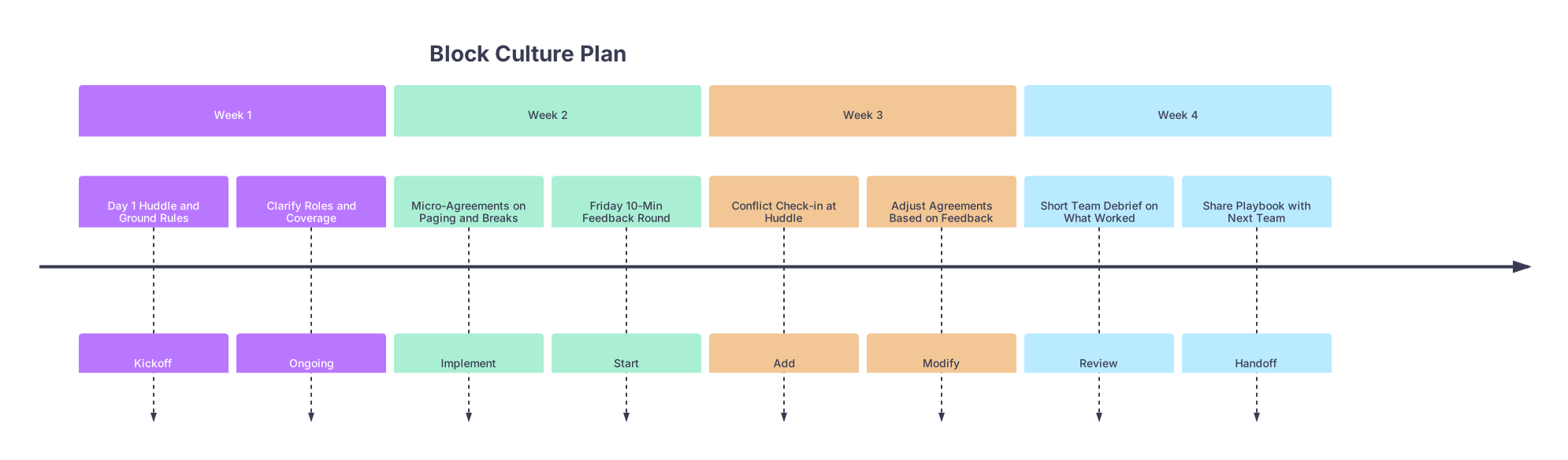
| Period | Event |
|---|---|
| Week 1 - Day 1 Huddle and Ground Rules | Kickoff |
| Week 1 - Clarify Roles and Coverage | Ongoing |
| Week 2 - Micro-Agreements on Paging and Breaks | Implement |
| Week 2 - Friday 10-Min Feedback Round | Start |
| Week 3 - Conflict Check-in at Huddle | Add |
| Week 3 - Adjust Agreements Based on Feedback | Modify |
| Week 4 - Short Team Debrief on What Worked | Review |
| Week 4 - Share Playbook with Next Team | Handoff |
Week 1: Foundation
- Day 1: Run the 10-minute huddle and explicitly say, “My goal this month is zero festering conflicts. We will talk early and directly.”
- Clarify roles for:
- Admissions
- Discharges
- Procedures
- Pages
Week 2: Micro-Agreements
- Ask: “What is draining us the most?” Then build 2–3 micro-agreements around it.
- Start a 5-minute Friday “feedback + fix”:
- One thing that worked this week.
- One thing to change next week.
Week 3: Normalize Conflict Conversations
Twice that week, add to the huddle:
- “Anyone have lingering tension with anything I did or another team member did that we need to clear up?”
- If someone mentions something small, model how to handle it in 2 minutes. Show that conflict is discussable, not taboo.
Week 4: Capture The Playbook
- Before the rotation ends, ask:
- “What are 2–3 agreements or habits we should recommend to the next team?”
- Write them down. Hand them off to the incoming senior or the chief.
You are building a small culture precedent. That matters more than a wellness lecture.
9. What To Do If You Are The Difficult One (And Know It)
Sometimes the honest answer is: “The conflict follows me.”
If you are noticing the same fight on multiple rotations—different people, same dynamic—you owe it to yourself to look in the mirror. Not with shame. With clinical curiosity.
Ask one trusted person (a co-resident, chief, or attending):
- “I want honest feedback. When conflicts happen with me, what patterns do you see? What is it like to be on a team with me on a bad day?”
Then do three things:
Pick one behavior to work on, not your entire personality.
- Interrupting.
- Sarcasm.
- Not answering pages promptly.
- Venting publicly.
Tell your next team what you are working on.
- “I have gotten feedback that when I am stressed, I can be really blunt. I am working on that. If I do it, please flag it in the moment—it helps me course-correct.”
Ask for follow-up feedback mid-rotation.
- “How has my communication been this block compared to before? Anything I should tweak?”
This is uncomfortable. It is also how you stop being the accidental burnout engine on your team.
10. When Conflict Is Chronic: Protect Your Long Game
Some programs have deeper cultural problems. Cliques, bullying, or cynical seniors who proudly “eat their young.” You are not fixing that in one block.
You still have options.
A. Build Your Micro-Community
Identify 3–5 people who are not disasters. They become your sanity anchors.
- A co-resident one year above you.
- A fellow who is decent and likes teaching.
- A nurse who has seen 20 years of residents and can read a room.
Use them for:
- Quick reality checks: “Am I overreacting to this?”
- Strategic advice: “How would you handle this attending?”
- Emotional support that does not live on social media.
B. Document Patterns For Yourself
You do not need a legal dossier, but a simple log helps:
- Date / rotation
- What happened (1–2 lines)
- Who was involved
- Impact (on patient care / on you)
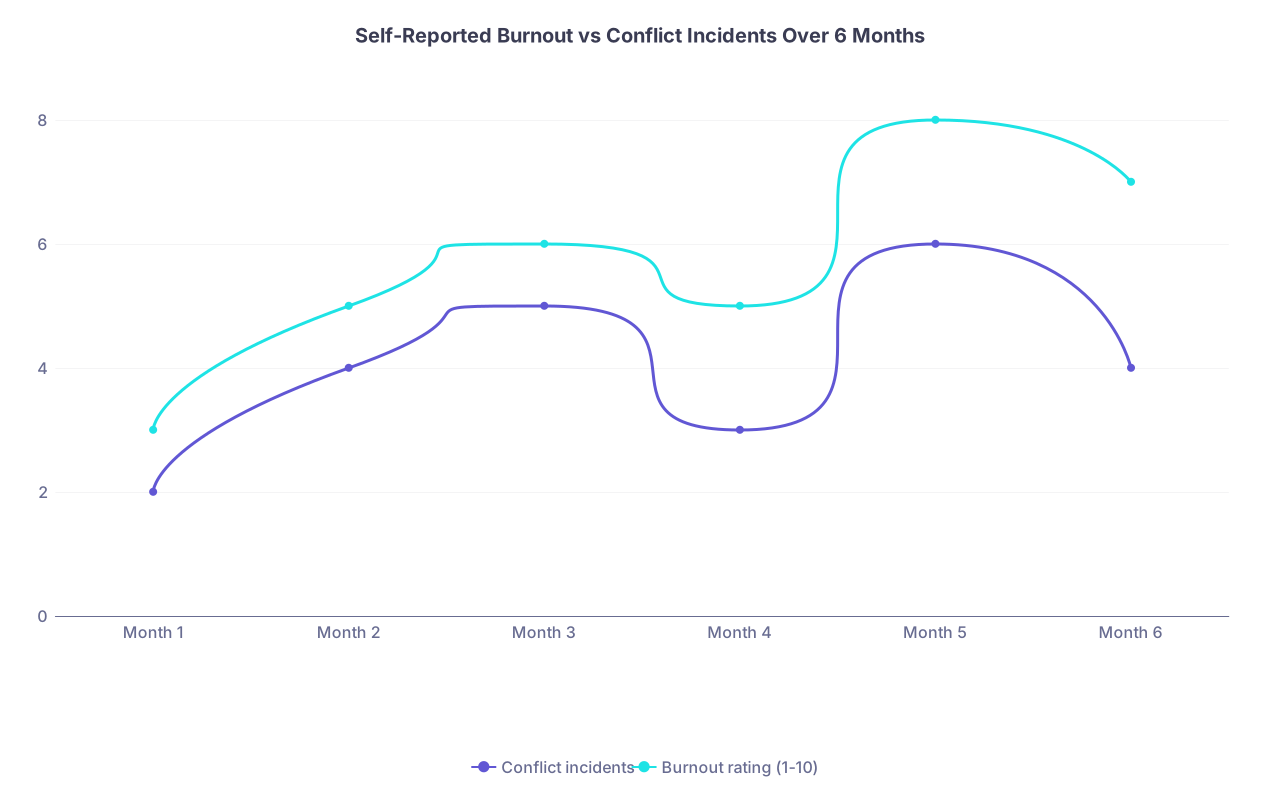
| Category | Conflict incidents | Burnout rating (1-10) |
|---|---|---|
| Month 1 | 2 | 3 |
| Month 2 | 4 | 5 |
| Month 3 | 5 | 6 |
| Month 4 | 3 | 5 |
| Month 5 | 6 | 8 |
| Month 6 | 4 | 7 |
This log is mainly for:
- Your own clarity: “No, this is not in my head.”
- Grounding conversations with chiefs/PDs in specifics if you ever need to.
C. Decide What You Will Not Sacrifice
You cannot control the program’s culture, but you can set personal non-negotiables.
Examples:
- “I will not accept being yelled at or insulted in front of patients.”
- “I will always escalate clear safety issues, even if it makes me unpopular.”
- “I will not sacrifice sleep below X hours for more than Y weeks without asking for help.”
Write them down. When a conflict pushes you against one of these, that is your signal to seek higher-level help, not just endure.
11. Pulling It Together
Conflict with co-residents is not a side quest. It is central to whether you walk out of residency intact or hollowed out.
If you want a burnout-resistant team, focus on three moves:
Make conflict discussable early and often.
- Daily 10-minute huddles.
- Clear roles and micro-agreements.
- Quick, direct, fact + impact conversations.
Aim for small, concrete behavior changes, not personality overhauls.
- “Alternate admits.”
- “Critique in private.”
- “Name when you cannot help.”
Protect your own capacity while you improve the system.
- Boundaries on rumination and venting.
- Tactical escalation when needed.
- A small, trustworthy inner circle.
You will not eliminate conflict. You do not need to. You just need to keep it from turning your team into a constant source of threat. Do that, and you dramatically cut your risk of burning out long before graduation.

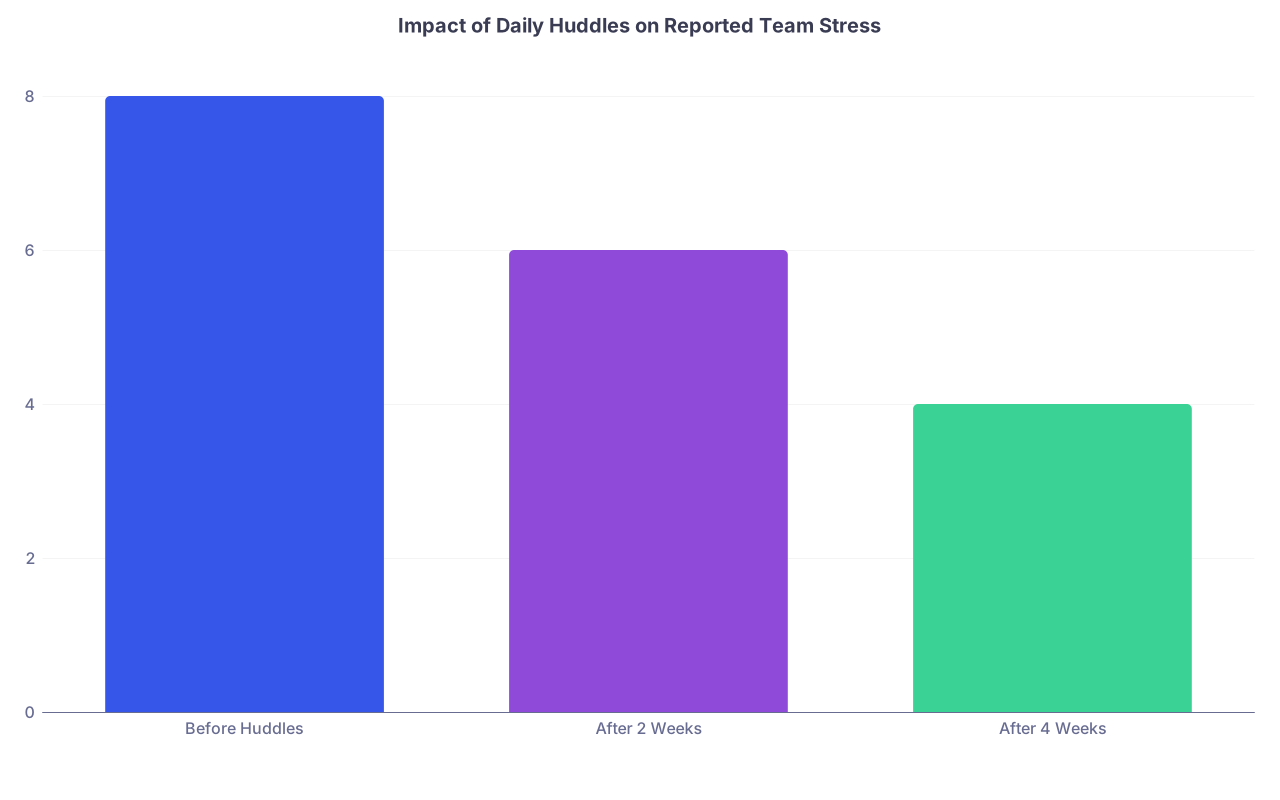
| Category | Value |
|---|---|
| Before Huddles | 8 |
| After 2 Weeks | 6 |
| After 4 Weeks | 4 |


| Step | Description |
|---|---|
| Step 1 | Conflict Event |
| Step 2 | Escalate to chief or PD now |
| Step 3 | 1 -1 conversation within 24 hours |
| Step 4 | 1 -1 plus senior or chief coaching |
| Step 5 | Continue micro-agreements |
| Step 6 | Patient or personal safety risk |
| Step 7 | Repeated pattern or one time |
| Step 8 | Improvement |