

You drag yourself into another week of nights. You are not technically “burned out” yet, but things are fraying.
You snap at a nurse over a page that would not have annoyed you a year ago. You chart from home because you are too fried to finish at the hospital. You wake up with your jaw clenched and feel oddly blank when a patient crashes. Not devastated. Not even scared. Just… flat.
You tell yourself: “Everyone is tired. This is residency.”
That is how people slide from early warning signs into full-blown burnout.
Let me be blunt: hoping things “calm down after this rotation” is not a plan. You need a standing system that pulls you back toward baseline every week, even during bad blocks. That system is what I will call a Weekly Recovery Block.
This is not self-care fluff. It is a practical, time-bounded, scheduled block designed to:
- Lower physiological stress load
- Protect sleep just enough
- Reconnect you to meaning and people
- Stop the slow leak of your energy and attention
You will not get extra hours. So we are going to reallocate and defend the ones you already have.
Step 1: Diagnose Your Early Burnout Pattern
Before you build anything, you need to know what you are trying to fix. “Burnout” is too vague. Your pattern is specific.
Look at the past 2–3 weeks. Which of these have been true more days than not?
- You feel emotionally flat with patients or colleagues
- You are irritable over small things you used to tolerate
- You dread going in, even on reasonable days
- You scroll your phone in bed instead of sleeping, even when exhausted
- You feel guilt on days off for not studying, not seeing family, not exercising
- You wake with a sense of heaviness rather than simple fatigue
Now be precise. Write down answers to these:
- What time do you usually wake up and actually fall asleep on workdays?
- How many minutes of real downtime (not charting, not chores) did you have most days?
- When did you last have:
- 60+ minutes of exercise?
- A meal without rushing or charting?
- A real conversation not about medicine?
You are not doing this for insight. You are collecting constraints.
Because your Weekly Recovery Block has to fit inside those constraints, not some fantasy schedule.
Step 2: Accept Your Time Reality (Then Carve Space Anyway)
You probably think you have “no time.” That is rarely accurate. You have time that is:
- Fragmented
- Unprotected
- Spent reactively
We are going to turn a small, realistic slice of that into a non-negotiable block.
The Minimum Viable Recovery Block
On brutal rotations, your Weekly Recovery Block might only be:
- 90 minutes once per week, plus
- Two 10–15 minute micro-blocks on workdays
If you are on a lighter block, you can stretch it. But plan for worst case first. Because if your template only works on electives, it is useless.
You are aiming to protect, per week:
- 60 minutes – body repair
- 30 minutes – brain and meaning reset
- 15–30 minutes – connection with someone who knows you outside of “doctor”
- Daily 5–15 minutes – mini-decompression
That is all. Not a spa weekend. Not a perfect morning routine. A small, ruthless reset protocol.
Step 3: Set Your Weekly Recovery Block Structure
Your Weekly Recovery Block has three core elements:
- Body Reset – unclench your physiology
- Mind & Meaning Reset – stop the cognitive spiral
- Connection Reset – remind your brain it is part of a tribe
Let us make this practical.
| Element | Time (min) | Goal |
|---|---|---|
| Body Reset | 40–60 | Lower physical stress load |
| Mind & Meaning | 20–30 | Clarify, reorient, de-ruminate |
| Connection Reset | 20–30 | Feel seen by someone safe |
1. Body Reset (40–60 minutes)
You are not training for a marathon. You are fixing a nervous system that has been in a low-grade fight-or-flight state for weeks.
Pick one of these formats (do not try to do all):
Option A – Movement + Breath (45–60 min)
- 20–30 min light-to-moderate cardio
- Brisk walk, easy jog, cycling, elliptical
- 10–15 min light strength or mobility
- Bodyweight squats, pushups against a wall, band work
- 5–10 min down-regulation breathing
- 4 seconds inhale, 6 seconds exhale, or
- Physiologic sighs (two small inhales, long exhale), 5–10 rounds
- 20–30 min light-to-moderate cardio
Option B – Long Walk + No Phone (40–60 min)
- Walk outside with phone on airplane mode
- No podcasts, no calls, no learning
- Just let your brain wander
Option C – Yoga / Guided Mobility (40–60 min)
- Use one specific video or app
- Keep it low intensity. The goal is joint movement and parasympathetic activation, not “crushing it.”
If you are so tired that this feels impossible, your “movement” may be a 25-minute slow walk around the block and 5 minutes of stretching, and that is acceptable. The rule: your heart rate and breathing should go up a bit, then come down. That’s the physiologic reset.
2. Mind & Meaning Reset (20–30 minutes)
Early burnout feeds on mental noise: “I am behind. I am failing. I am not cut out for this.” You need a systematic way to quiet and reorient.
One template that works consistently:
5–10 min brain dump
- On paper, not on your phone
- Write everything bouncing around:
- Angry moments from the week
- Things you regret
- Things you are dreading
10–15 min structured reflection
- Use 3 prompts (yes, the same ones every week):
- What actually went well this week, however small?
- When did I feel most like a doctor I want to be?
- What is one thing that bothered me that I can either address or consciously accept?
- Use 3 prompts (yes, the same ones every week):
5 min micro-plan
- Answer:
- What is one thing I will do differently next week to make my days 5% more livable?
- Example: batch pages at the top of each hour, eat something solid before noon, say “no” to extra committee this month
- What is one thing I will let go of for now (perfect notes, reading every article, extra project)?
- What is one thing I will do differently next week to make my days 5% more livable?
- Answer:
You are not writing a wellness essay. You are correcting the skewed narrative in your head and making one small operational change per week.
3. Connection Reset (20–30 minutes)
Burnout is amplified by isolation. Residents are surrounded by people and still lonely.
Your reset needs one dose of real contact with someone who knows you beyond “intern who writes good notes.”
Options that count:
- 20–30 min call or video with:
- Old friend from college
- Sibling or cousin
- Partner where you actually talk (not just watch Netflix)
Rules:
- You must say out loud at least one honest sentence about how you are doing. Example: “I am not at the breaking point, but I feel like I am on a treadmill that never stops.”
- Avoid turning it into a full vent session that spirals. Give it 5–10 minutes of honesty, then shift: “Ok, tell me what is going on in your life.”
If you live with your partner or close friend, this can be:
- 20 minutes sitting on the couch, phones away, asking each other:
- “What was one good thing, one hard thing this week?”
That is it. Scheduled humanity.
Step 4: Micro-Blocks – Your Daily “Pressure Release Valves”
Weekly is not enough. If you are white-knuckling 6 days then having one big recovery session, you will not reverse anything. You will just crash and re-start.
You need 2–3 micro-blocks across the week, 5–15 minutes each, baked into your work rhythm.
Think of them as extremely small, repeatable interventions. Not optional. Protocol.
Examples of Effective Micro-Blocks
Post-shift decompression (7–10 min) before going home
- Sit in your car or on a bench
- 2 minutes of slow breathing
- 3–5 minutes writing:
- One thing that went okay
- One thing that sucked (then close the notebook)
- This helps your brain shift out of “hospital mode” before you walk into your home.
Mid-shift bathroom break (3–5 min)
- Yes, in the bathroom stall if needed
- 10 slow inhales / long exhales
- Quick body scan: unclench jaw, relax shoulders, release belly
- You are telling your nervous system: “We are not in immediate danger.”
Pre-sleep phone cutoff (10–15 min)
- Set an alarm labeled “Put phone across room”
- After it rings:
- Put phone on charger away from bed
- 5 min light stretching or lying on the floor with legs on bed
- Then bed. No scrolling.
These micro-blocks are what make the weekly block work. Without them, the stress curve never actually dips.
Step 5: Put the Block on Your Calendar Like a Consult
If you do not schedule it explicitly, it will not happen. Residency naturally expands to fill every unscheduled moment.
You need to treat this like any other standing obligation.
Pick Your Default Weekly Slot
Choose one:
- Post-call afternoon (common and effective)
- First half of your golden day (day off)
- A weekend morning before social plans
Criteria:
- You are not already a zombie (e.g., immediately after 27h call may be too far gone – use post-nap)
- Low chance of being preempted by mandatory events
- You can consistently defend it 3 weeks out of 4
Then block it:
- Title it in your calendar: “Weekly Recovery Block – not movable”
- Duration: 90–120 minutes depending on rotation
- If your program uses shared calendars, you do not need to label it as “Recovery,” you can use “Personal” or “Appointment.”
You are allowed to reschedule it within the same week. You are not allowed to delete it.
Step 6: Build Two Versions – Light Week vs Heavy Week
You will not have the same capacity on wards vs elective. So stop pretending you can run the same script.
Make two explicit templates:
Light Week Template (Example)
- 90–120 minutes total
- Body Reset – 45–60 min
- 30 min jog
- 15–20 min light strength or yoga
- Mind & Meaning Reset – 25–30 min
- 10 min brain dump
- 10–15 min reflection and micro-plan
- Connection Reset – 20–30 min
- Call friend / family
Micro-blocks:
- 10 min post-shift decompression x 3 days
- 10–15 min pre-sleep phone cutoff x 4–5 nights
Heavy Week Template (ICU, nights, Q4)
- 60–90 minutes total
- Body Reset – 30–40 min
- 25 min slow walk outside
- 5–10 min stretching
- Mind & Meaning Reset – 15–20 min
- 5 min brain dump
- 10–15 min reflection with just one change for next week
- Connection Reset – 10–15 min
- Voice memo or quick call to one person
Micro-blocks:
- 5–7 min post-shift decompression x 2–3 shifts
- 3–5 min mid-shift breathing / body scan x 3 shifts
- 10 min pre-sleep phone cutoff when possible
Your job is not to meet an ideal. It is to hold something in place even during heavy weeks so you do not unravel.
Step 7: Decide What You Will Sacrifice (Because You Will Sacrifice Something)
You cannot add a Weekly Recovery Block without dropping something. If you pretend otherwise, you will fail by week two.
Here is the uncomfortable truth: that “something” is often one of these:
- Extra studying beyond what is required to stay safe and functional
- Saying yes to extra QI projects, research, or leadership right now
- Social obligations that leave you more drained than restored
You need to consciously choose what you will give up for the next 4–8 weeks while you implement this.
Common trade-offs that work:
- Cut one low-yield social outing per week (that you dread anyway)
- Scale back to bare-minimum studying on your worst rotation and accept less-than-perfect in-training exam scores in exchange for not falling apart
- Pause new non-essential projects until a lighter block
If this feels like “slacking,” remember: burned-out residents do worse clinically and academically. Protecting your functionality is not selfish. It is professional.
Step 8: Monitor Your Burnout Markers Weekly
You do not need a survey. You need a quick, brutally honest self-check.
Each week, after your block, rate each on a 0–10 scale:
- Emotional exhaustion
- Cynicism / detachment
- Sense of personal effectiveness
0 = best, 10 = worst.
Write these in the same notebook where you do your brain dump. Date them.
Over 4–6 weeks, you should see at least one of the following:
- Emotional exhaustion score drops by 1–3 points
- Cynicism / detachment softens – you feel small moments of actual caring again
- Your sense of effectiveness improves slightly, or at least stops falling
If all three scores are getting worse week after week despite you doing the block, that is a red flag. That is when you escalate: talk to program leadership, confidential counseling, or occupational health. This is the “do not ignore this” threshold.
Step 9: Build a Simple “Crisis Variant” for When Everything Blows Up
Some weeks will implode. Family emergencies. Program drama. Malignant rotation. You will be tempted to skip your block entirely.
Instead, you run the 20-minute crisis variant:
- 5 min: Brain dump of “everything terrible”
- 10 min: Outside walk or slow stretching + deep breathing
- 5 min: Text or voice memo to one human with: “Week from hell. Not dying, but not okay. Can we talk this weekend?”
That is it. That tiny investment keeps the habit alive and prevents complete collapse.
If you can do nothing else, do this.
Example: How This Looks for a Real Resident
PGY-2, Internal Medicine, on a busy wards month. Six-day weeks, one golden day.
Saturday (Golden Day)
- 09:00–10:00 – Sleep in
- 10:00–10:15 – Coffee, light breakfast
- 10:15–11:30 – Weekly Recovery Block
- 10:15–10:55 – 40 min walk around neighborhood, phone on airplane mode
- 10:55–11:15 – 10 min brain dump, 10 min reflection & micro-plan
- 11:15–11:30 – 15 min call to sibling
Micro-blocks during the week:
- 3 evenings: 10 min post-shift car decompression
- 4 nights: 10 min pre-sleep phone cutoff
- 3 shifts: 3 min bathroom breathing / unclench routine
The micro-plan for the week might be:
- “I will eat something before 10 a.m. even if it is a protein bar.”
- “I will not start any new research tasks; I will just fulfill existing commitments.”
This is not glamorous. It is just precise enough to work.
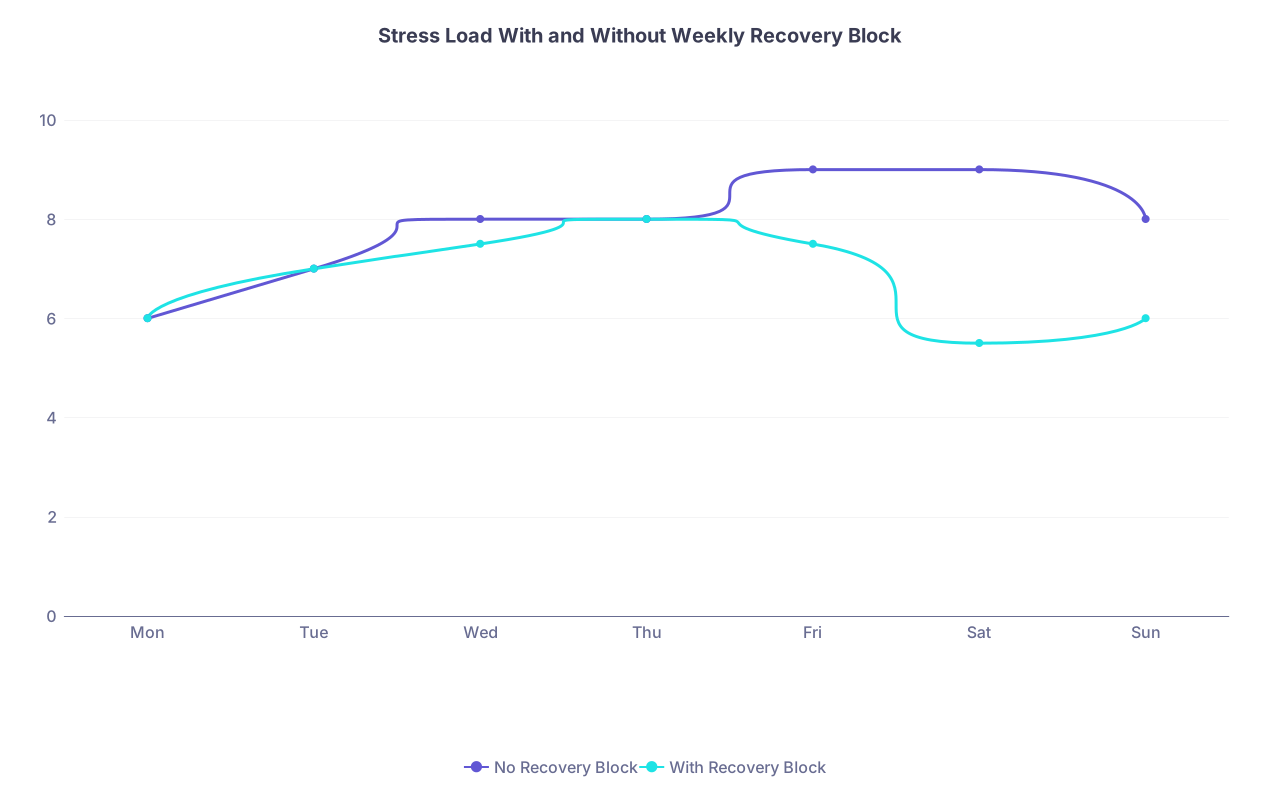
Visual: How Recovery Blocks Flatten the Burnout Curve
| Category | No Recovery Block | With Recovery Block |
|---|---|---|
| Mon | 6 | 6 |
| Tue | 7 | 7 |
| Wed | 8 | 7.5 |
| Thu | 8 | 8 |
| Fri | 9 | 7.5 |
| Sat | 9 | 5.5 |
| Sun | 8 | 6 |
You are not eliminating stress. You are adding a recurring dip that stops the line from trending relentlessly upward.
Implementation Checklist (4-Week Trial)
Set yourself a 4-week experiment. Not forever. Just 4 weeks to see if this changes anything.
This Week (Today or Tomorrow)
Choose:
- Your default Weekly Recovery Block day and time
- Your Light Week and Heavy Week templates
Decide your non-negotiable:
- Movement choice
- Reflection prompts
- Person(s) you will contact
Put it into your calendar:
- “Weekly Recovery Block (90 min)”
- Add three 10-min micro-blocks as calendar reminders
Decide what you will sacrifice:
- Name the specific thing you are reducing or pausing
Weeks 1–4
- Protect the block. Adapt duration if needed but keep the structure.
- Do at least two micro-blocks per week, even in chaos.
- Record your 0–10 burnout markers after each weekly block.
After 4 weeks, look at your data and your gut:
- Are you slightly less numb?
- Do you recover from bad shifts faster?
- Do you feel even 10% more like yourself on your days off?
If yes, you keep the system and refine it. If no change and you followed it honestly, that is not failure. That is diagnostic. It means you need additional help beyond what schedule tweaks can fix.
FAQs
1. What if my schedule is so unpredictable I cannot commit to a specific day?
Then you commit to a time rule instead of a day rule. For example:
- “My Weekly Recovery Block will happen within 24 hours of my first day off each week.”
- At the start of the week, when you get your call schedule, you pick the first viable 90-minute window and immediately drop it into your calendar.
- If the attending moves conference or something intrudes, you reschedule within the same week, not cancel.
Unpredictable does not mean uncontrollable. It means you plan later and more flexibly, but you still plan.
2. My partner or family does not get why I need time “alone” instead of with them. How do I handle that?
You explain it as maintenance, not avoidance:
- “If I do not take this 60–90 minutes once a week, I show up to you as a zombie. This is like charging my battery so I can actually be present with you.”
- Offer a trade: “I will do my recovery block from 10–11:30, then from 12–2 I am all yours and not checking my email/charting.”
- Involve them when possible: they can join your walk (with the agreement that you keep it low-stimulation) or respect that the first 30 minutes are solo.
You are not choosing between them and you. You are choosing between a slightly restored version of you and the shell of you they will get otherwise.
3. What if exercise makes me more exhausted instead of better?
Then you are doing too much or the wrong kind. The goal is activation then downshift, not training.
Adjust:
- Shorten to 15–25 minutes.
- Keep intensity low enough that you can talk in full sentences.
- Prioritize walking, gentle cycling, light yoga over running or heavy lifting during your worst weeks.
If you are still wiped out, your body might be signaling sleep deprivation or anemia / other medical issues. In that case:
- Get basic labs (CBC, TSH, iron studies) if symptoms are significant.
- Consider that your primary “body reset” for a few weeks might be: 60–90-minute nap + 10 minutes of stretching instead of exercise.
4. Is this just another thing I will feel guilty about not doing perfectly?
Only if you set it up that way. Do not.
You define success as:
- “Did I do any version of my Weekly Recovery Block this week?”
- “Did I do at least two micro-blocks?”
Not “Did I nail a perfect 120-minute protocol?” Some weeks your block will be messy, shortened, interrupted. You still count it. Because the habit you care about is: I regularly assign time to my own recovery and defend it.
Open your calendar right now and block off a 90-minute window in the next 7 days. Title it “Weekly Recovery Block.” That is your first move. The structure you just read only matters if it exists on your schedule, not just in your head.


