

Most residents are talking about burnout everywhere except where it actually counts: with their program director. That is backwards.
You can talk to your PD about burnout without blowing up your reputation, your schedule, or your future fellowship chances. You just need a script, a structure, and a bit of strategy.
That is what I am going to give you.
Not vague encouragement. A stepwise conversation plan you can essentially rehearse, adapt, and then use tomorrow.
Step 0: Get Your Mind Straight Before You Walk In
If you walk into your PD’s office raw, exhausted, and unstructured, you increase the chance that:
- You cry and lose your train of thought
- You sound like you are just complaining
- The real problem gets buried in emotion
You need a 15–20 minute pre-brief with yourself.
1. Name what is actually happening
Do not go in with “I am burned out” as your only line. That word is overloaded and vague.
Write down, in plain language, 3–5 concrete problems you are experiencing:
- “I am making charting errors at 3 a.m. because I am too tired to think clearly.”
- “I am dreading coming to work and cannot shut off racing thoughts at night.”
- “I find myself snapping at nurses and co-residents. I have never done that before.”
- “I am thinking about quitting medicine multiple times per week.”
Then add duration: “For the last 6 weeks…” or “Since starting the ICU month…”
That specificity does two things:
- It sounds like a clinical presentation, not a vibe.
- It helps your PD understand severity and timeline.
2. Decide what you actually want from the conversation
This is critical. You are not just “sharing” for catharsis. You are asking for specific help.
Common realistic goals:
- Temporary schedule modification (1–2 lighter weeks, swapping a brutal rotation, reduced calls)
- Concrete support (counseling referral, wellness resources, protected appointments)
- Clarification on expectations (what is mandatory, what can be adjusted, what is negotiable)
- A documented plan if things worsen (who to contact, what options exist short of quitting/LOA)
Write down 1–2 specific asks. For example:
- “I would like a lighter rotation next month instead of another ICU month.”
- “I need protected time to see a therapist without being made to feel unreliable.”
- “I would like help exploring a short leave of absence or part-time for 2–4 weeks.”
If you go in knowing your realistic goal, you can drive the conversation instead of reacting.
3. Reality check your fear
Residents usually fear three things:
- “They will think I am weak / lazy.”
- “They will retaliate on my evals.”
- “They will push me out of the program.”
Could that happen with a truly toxic PD? Yes. But most PDs are much more afraid of an impaired or crashing resident than an honest one. I have heard PDs say:
- “If they had just told me three months earlier, we could have avoided this disaster.”
- “The problem was not the burnout. The problem was the secrecy and sudden breakdown.”
Your goal: be the resident who speaks early, clearly, and with a plan.
Step 1: Time, Place, and Setup – Do Not Wing This
Walking up after sign-out with “Do you have five minutes?” is a bad idea. Burnout is not a five-minute hallway issue.
1. How to ask for the meeting (template)
Use email if possible. Keep it short and neutral.
Script:
Subject: Brief check-in
Hi Dr. [PD Last Name],
I was hoping to schedule a brief check-in with you sometime this week or next. I have been having some challenges with workload and well-being that I would like to discuss and get your guidance on.
I expect it would take about 20–30 minutes. I am happy to work around your schedule.
Thank you,
[Your Name], PGY-[X]
Notice what this email does:
- Signals this is not about a single patient or small logistics issue
- Frames it as “challenges with workload and well-being” (neutral, professional)
- Mentions guidance, not just complaining
If your program culture is more casual, you can say this in person or via message, but keep the same structure.
2. Choose your moment
Aim for:
- Middle of the week, not post-call delirium day
- Not during the chaos of July if avoidable
- Earlier in the day when both of you have more bandwidth
If there is a coordinator, loop them in to schedule.
3. Bring a one-page cheat sheet
Do not read off a script like a robot, but having a single sheet can anchor you:
- Top third: 3–4 concrete symptoms / issues
- Middle third: duration + impact on patient care and functioning
- Bottom third: two specific requests / ideas
You may never show this to them, but it will keep you from freezing.
Step 2: The Opening – 60–90 Seconds That Set the Tone
You want to sound like a clinician presenting a patient, not a student begging for mercy.
Here is your opening script you can modify. Say it slowly.
“Thank you for making time to meet. I wanted to talk to you because over the past [X weeks/months] I have been experiencing significant burnout symptoms that are starting to affect my functioning at work and at home.
I care a lot about this program and about being a safe, reliable resident, and I am noticing warning signs that I do not want to ignore. I was hoping we could talk about what is going on and what adjustments or resources might help stabilize things before they get worse.”
That does several things:
- Names the problem (“burnout symptoms”)
- Places it in time (“over the past X weeks”)
- Connects it to professionalism (“affect my functioning,” “safe, reliable resident”)
- Signals you are proactive (“before they get worse”)
Pause. Let them respond. Many PDs will say something like “I am glad you came in. Tell me more.”
If they jump straight to “Are you safe?” or “Are you thinking of hurting yourself?” answer directly and honestly. That is them doing their job.
Step 3: The Core – How to Describe Burnout Without Sounding Weak or Vague
You need structure. Use a simple 3-part frame:
- Symptoms
- Impact
- Context (what has been going on in your rotation/life)
1. Symptoms
Pick 3–5 that matter. Script examples you can adapt:
“Lately I have been:
– Struggling to fall asleep and stay asleep, even on nights off.
– Feeling emotionally drained by noon on most shifts.
– Having a hard time concentrating on notes and orders, double and triple checking everything because I do not trust my focus.
– Losing my usual patience with staff and co-residents.”
This is not oversharing. It is data.
2. Impact
This is where the PD’s ears really perk up.
You say:
“In terms of impact on work:
– I have not had any serious patient safety events, but I have caught myself about to place incorrect orders twice in the last month because I was distracted and exhausted.
– Tasks that used to feel manageable now feel overwhelming. I am staying 1–2 hours later consistently just to keep up.
– I am more irritable on rounds and I worry it affects team dynamics.”
You are not confessing to malpractice. You are showing insight and risk awareness.
3. Context
Anchor it to something real: rotations, call frequency, personal factors.
“This really escalated during the last two months with back-to-back ICU and night float. I did not give myself time to recover between them, and my baseline anxiety and sleep issues have flared. I do not drink or use substances, but I am clearly not coping well with the current workload.”
If there are personal stressors (family illness, breakup, health issue), you share what you are comfortable sharing. You are not obligated to disclose every detail, but more context usually helps.
Step 4: Your Asks – Specific, Reasonable, and Framed as Patient-Safety Oriented
Now the part most residents screw up: they either ask for nothing (“I just wanted you to know”) or ask for something so vague it is unusable (“I need better work-life balance”).
You will do better.
1. Use the “options, not ultimatums” approach
You present 2–3 possible adjustments you would consider, not a single demand.
Example script:
“I have been thinking about what might help me recover and get back to my usual functioning. I know the program has constraints, but some options that might make a difference include:
– Swapping my upcoming [X month] in ICU for a lighter rotation, like [Y], to give me a chance to stabilize.
– Protecting time for weekly therapy or counseling over the next 6–8 weeks, with coverage for that appointment time.
– If needed, exploring a brief leave of absence or reduced call schedule for a defined period.”“I am open to your guidance on what is realistic within program policy, and I want to find a solution that keeps patients safe and allows me to complete training successfully.”
What this communicates:
- You have already thought about realistic interventions
- You respect program constraints
- You tie the requests to patient safety and long-term success, not comfort
2. Be clear on what you are not asking for
You can preempt misunderstandings.
“I am not asking to avoid hard rotations completely or to cut corners. I want to keep doing the work and progressing, but I can see that my current trajectory is not sustainable.”
This calms their “are you trying to get out of everything?” reflex.
3. If they ask, “What do you think you need most?”
Have one priority ready.
- “Top priority for me would be a lighter month next, rather than another high-intensity service. I think that would give me enough space to engage in therapy and reset my sleep.”
- “Top priority would be protected weekly therapy time, even if that means a small, temporary schedule reshuffle.”
Step 5: Handling Common PD Reactions – With Scripts
PDs are human. They have their own stress, biases, and blind spots. You cannot script them, but you can prepare for patterns.
Common Reaction 1: Supportive and practical
They say things like:
- “I am glad you came in.”
- “This is more common than people think.”
- “Let us look at your upcoming schedule.”
Your move:
- Stay organized.
- Take notes.
- Ask clarifying questions.
Script:
“I really appreciate you working through this with me. I will follow up with an email summarizing what we discussed so we are on the same page.”
You will write that email. Two short paragraphs. Cement the plan.
Common Reaction 2: Minimizing / generic reassurance
They say:
- “Everyone feels tired on ICU.”
- “This is just residency.”
- “We all went through this.”
You push back respectfully, with facts.
“I agree residency is demanding, and I expect long hours and tough rotations. What I am describing feels beyond my usual level of being tired or stressed. The key difference for me has been [examples you gave: near-miss errors, insomnia, intrusive thoughts about quitting]. That is why I wanted to bring it to you early, before it becomes a bigger safety or performance issue.”
Then repeat your main ask:
“Given that, I think a temporary adjustment like [X] could make a real difference.”
You are not seeking validation that it is “bad enough.” You are presenting risk and a plan.
Common Reaction 3: Defensive – “We cannot change the schedule” / “Others will complain”
You do not argue with constraints. You pivot to collaboration.
“I get that the schedule is tight and that any change has ripple effects. My goal is not to create extra work for the program or my co-residents. My concern is that if we do not make some adjustment, my functioning may worsen and that will cause bigger problems later for everyone, including patients.”
“Are there any levers we can pull, even small ones? For example, swapping just the next block, adjusting my call distribution for a month, or building in protected appointments?”
You are basically saying: small change now to avoid big problem later.
Common Reaction 4: “Have you talked to a therapist / wellness / your PCP?”
Good. That is reasonable.
If you have, say so:
“Yes, I started seeing a therapist two weeks ago. We agree that some schedule relief would really help the interventions work.”
If you have not:
“Not yet. This conversation is part of my first steps. I would like to, and I am hoping we can coordinate protected time so that I am not forced to cancel or feel like I am abandoning the team.”
Then ask directly:
“Are there mental health or employee assistance resources the program recommends that are truly confidential and separate from evaluation?”
Step 6: Protecting Yourself – Documentation and Boundaries
You are not suing anyone. You are just being smart.
1. Send a brief summary email after the meeting
24 hours later, send something like:
Subject: Follow up from our check-in
Hi Dr. [Last Name],
Thank you again for meeting with me yesterday to discuss the burnout symptoms and work-related stress I have been experiencing. I appreciate your openness and guidance.
My understanding of our plan is:
– [Example: Swap upcoming ICU block in March with elective in May, pending chief confirmation.]
– [Example: I will contact [counseling service] and you are supportive of me having protected time on [day/time] for appointments.]
– [Example: We will touch base again in 4 weeks to reassess.]Please let me know if I have misunderstood anything.
Thank you again,
[Your Name]
This:
- Creates a paper trail of the conversation
- Gives them a chance to correct misunderstandings
- Shows professionalism
2. Keep your own brief record
In a private document (not on hospital servers), note:
- Date of meeting
- Main symptoms you discussed
- PD’s response and any specific commitments
- Your own follow-up actions (called therapy, emailed chiefs, etc.)
If you later need GME, HR, or an ombuds office, this matters.
3. Boundaries about disclosure
You control how much detail goes to:
- Chiefs
- Co-residents
- Attendings
If your PD wants to inform chiefs about schedule changes, you can request how it is framed:
“I am comfortable with you telling the chiefs I am dealing with a health issue that requires some temporary schedule adjustment. I would prefer not to have the specifics shared widely.”
Most reasonable PDs will respect that.
Step 7: If the Conversation Goes Badly – Escalation Options
Sometimes the PD is the problem. Or they are burnt out themselves and cannot handle yours. Then what?
You still have options.
1. GME / DIO / Ombuds
Every ACGME-accredited program has:
- A Designated Institutional Official (DIO)
- A GME office
- Often an ombuds or some neutral resource
You can reach out directly and say:
“I had a conversation with my PD about significant burnout symptoms and concerns about my ability to function safely. I did not feel my concerns were adequately addressed. I would like to speak confidentially with someone about my options.”
You are not “going over their head” for fun. You are addressing a safety and training issue.
2. Employee Assistance / Counseling first
If talking to the PD feels too risky initially, you can:
- Start with a therapist or EAP
- Get their read on your severity
- Ask them to help you plan the PD conversation
Sometimes having an outside clinician say, “Your symptoms and concerns are valid; you do need modifications,” gives you the backbone to insist.
3. Leave of Absence (LOA) as a real option, not a failure
If you are at the point of:
- Near-constant suicidal ideation
- Major functional impairment
- Serious errors or near-misses related to exhaustion or depression
Then short-term leave is not career suicide. It is responsible medical practice.
Your PD conversation in that case might sound like:
“Based on my symptoms and discussion with my therapist, I believe I need a brief leave of absence to safely recover and return to competent functioning. I am committed to completing this residency. I would like your help understanding the logistics and implications of a 4–8 week leave.”
If your PD dismisses this out of hand, that is when GME or HR steps in.
Practical Tools: Quick Reference Scripts and Comparison
| Situation | Script Starter |
|---|---|
| Requesting meeting | "I was hoping to schedule a brief check-in… challenges with workload and well-being…" |
| Opening the talk | "Over the past X weeks I have been experiencing burnout symptoms that are affecting my functioning…" |
| Describing impact | "I have not had serious events, but I have noticed near-misses and changes in my behavior such as…" |
| Making an ask | "Options that might help me stabilize include swapping X rotation, protected time for therapy, or exploring brief LOA…" |
| Pushing back respectfully | "I understand residency is demanding. What I am describing feels beyond typical fatigue because…" |
Visualizing the Conversation Flow

| Step | Description |
|---|---|
| Step 1 | Decide to seek help |
| Step 2 | Clarify symptoms and goals |
| Step 3 | Request meeting with PD |
| Step 4 | Prepare notes and key asks |
| Step 5 | Open with clear statement |
| Step 6 | Describe symptoms and impact |
| Step 7 | Propose options for support |
| Step 8 | Agree on plan and follow up email |
| Step 9 | Clarify severity and restate asks |
| Step 10 | Focus on safety and seek small levers |
| Step 11 | Contact GME or other resources |
| Step 12 | PD response |
What You Can Do Today – A Simple 3-Day Micro-Plan
Do not turn this into a six-week “I should talk to them” loop. Here is a tight execution plan.
Day 1 – 20 minutes
- Sit down with a blank page.
- Write:
- “Symptoms:” (list 3–5)
- “Duration:” (how long)
- “Impact:” (concrete at work + home)
- “What I want:” (2 realistic asks)
Then send the meeting request email.
Day 2–3 – Prep and rehearse
- Read your opening script out loud twice.
- Pick your top-priority ask.
- Decide who you might loop in if this goes badly (therapist, trusted faculty, GME).
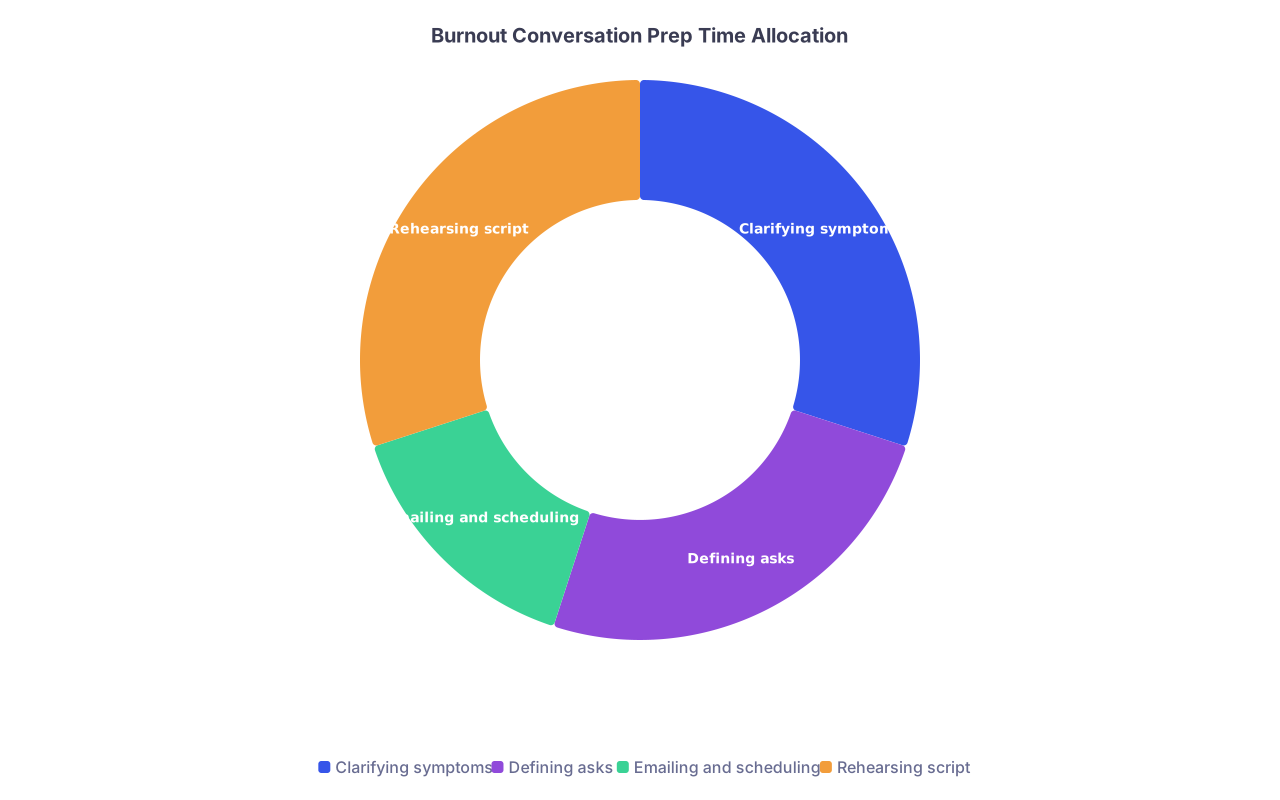
| Category | Value |
|---|---|
| Clarifying symptoms | 30 |
| Defining asks | 25 |
| Emailing and scheduling | 15 |
| Rehearsing script | 30 |
Meeting day
- Bring your one-page notes.
- Use the opening script.
- Hit the Symptoms → Impact → Context → Asks sequence.
- Take notes.
- Send the follow-up email that night or the next day.

A Quick Reality Check About Fear and Power
Your fear is not crazy. PDs sign off on promotion, board eligibility, letters. They hold power.
But there is another reality: ACGME and hospital lawyers are terrified of:
- Resident suicide
- Major patient harm from an impaired trainee
- Documented reports of ignored wellbeing concerns
When you raise burnout in a structured, professional way, you are not just asking for help. You are offering them a chance to fix a risk before it explodes. Good PDs understand that. Mediocre ones at least respond to self-preservation.
The resident who says nothing until they implode in spectacular fashion? That is the one who truly scares PDs.
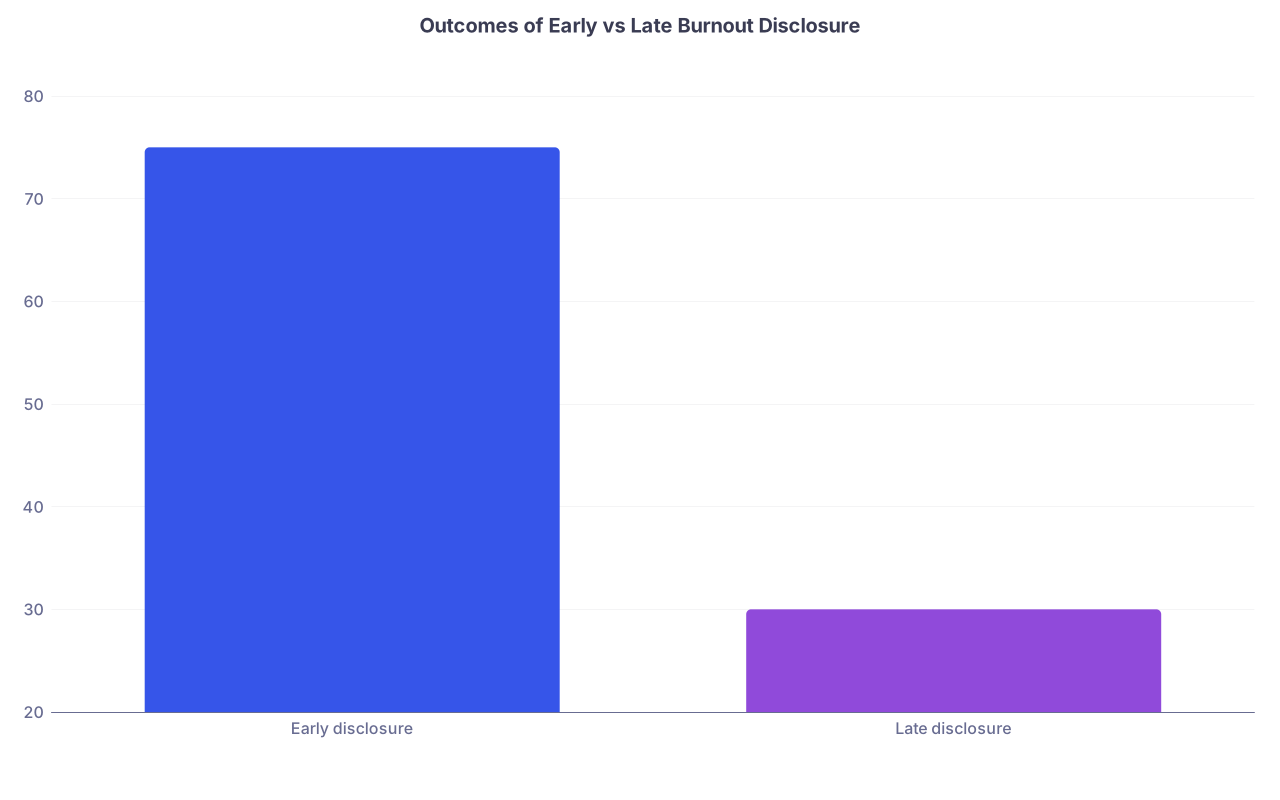
| Category | Value |
|---|---|
| Early disclosure | 75 |
| Late disclosure | 30 |
(Think of those values as percentage of cases where residents ultimately improved and remained in training. Early beats late by a mile.)
FAQ – Exactly 3 Questions
1. Should I tell my PD if I am having suicidal thoughts, or will that end my career?
If you are having active suicidal thoughts, that is a medical emergency, not a career issue. You tell someone: PD, attending, ER, therapist, suicide hotline. Yes, the PD may be obligated to involve occupational health, GME, or require treatment before you return fully to duty. That is not career-ending. Programs keep residents who took short leaves for depression or suicidality and came back stable. What programs and boards cannot defend is allowing a clearly suicidal trainee to work without intervention.
2. What if my PD is known to be unsympathetic or even hostile about wellness?
You still protect yourself, but you adjust the path. Start by talking to a neutral party: trusted faculty, chief you trust, therapist, GME office, or an ombuds. Get advice on your specific program culture. Sometimes it is better to speak with associate PDs or chief residents first, then approach the PD with an ally already aware. If your PD behaves inappropriately (mocking, threatening, dismissive in a way that jeopardizes safety), document it and bring that to GME or the DIO. You are not trapped in a single person’s worldview.
3. Will talking about burnout hurt my fellowship chances if my PD writes my letters?
Handled badly, yes. Handled well, usually not. PDs worry about residents who are unsafe, unprofessional, or dishonest, not about those who hit a rough patch and dealt with it responsibly. If you approach them early, articulate the problem, engage in treatment, and improve, you actually give them a narrative of resilience and maturity. Months later, what matters is your performance and evaluations, not that you once asked for a lighter month and therapy time. Silence and sudden collapse are far more damaging than a documented, successfully managed period of burnout.
Key points:
- Walk into your PD’s office with a clear structure: Symptoms → Impact → Context → Specific Asks.
- Use concrete scripts and follow-up emails to keep the conversation professional and documented.
- If your PD will not help, you still have leverage and options through GME, mental health resources, and, when necessary, a temporary step back to protect both you and your patients.


