

You are on hour 11 of a 12‑hour night shift. It is 5:12 AM.
Your brain feels like wet cardboard.
You are staring at a potassium of 6.3, trying to remember whether you already ordered insulin and dextrose… or just thought about ordering it. Your pager has not stopped. The code pager is on your hip. Someone wants melatonin. Someone else is hypotensive.
And in the back of your mind:
“I have to drive home after this. Then maybe get 4 hours of sleep. Then clinic this afternoon.”
This is exactly how people slide into burnout. Not from one bad shift, but from months of chronic sleep debt, circadian chaos, and never actually recovering.
You do not need another vague “practice self-care” lecture. You need a playbook. Concrete, step-by-step systems that make nights survivable and keep you functional month after month.
That is what this is: a survival playbook to prevent sleep-driven burnout from night shifts.
1. Understand What Nights Are Doing To You (So You Can Fight Back)
First, you need to stop pretending you are superhuman. You are not. I have watched incredibly sharp residents make ridiculous mistakes at 4 AM that they would never make at 2 PM. Same brain, different circadian state.
Here is what nights really do:
- Impair reaction time (yes, including your drive home)
- Wreck working memory and clinical reasoning
- Blunt empathy and patience (hello, snappiness)
- Alter appetite hormones: you crave junk and overeat
- Increase risk of depression and long-term burnout
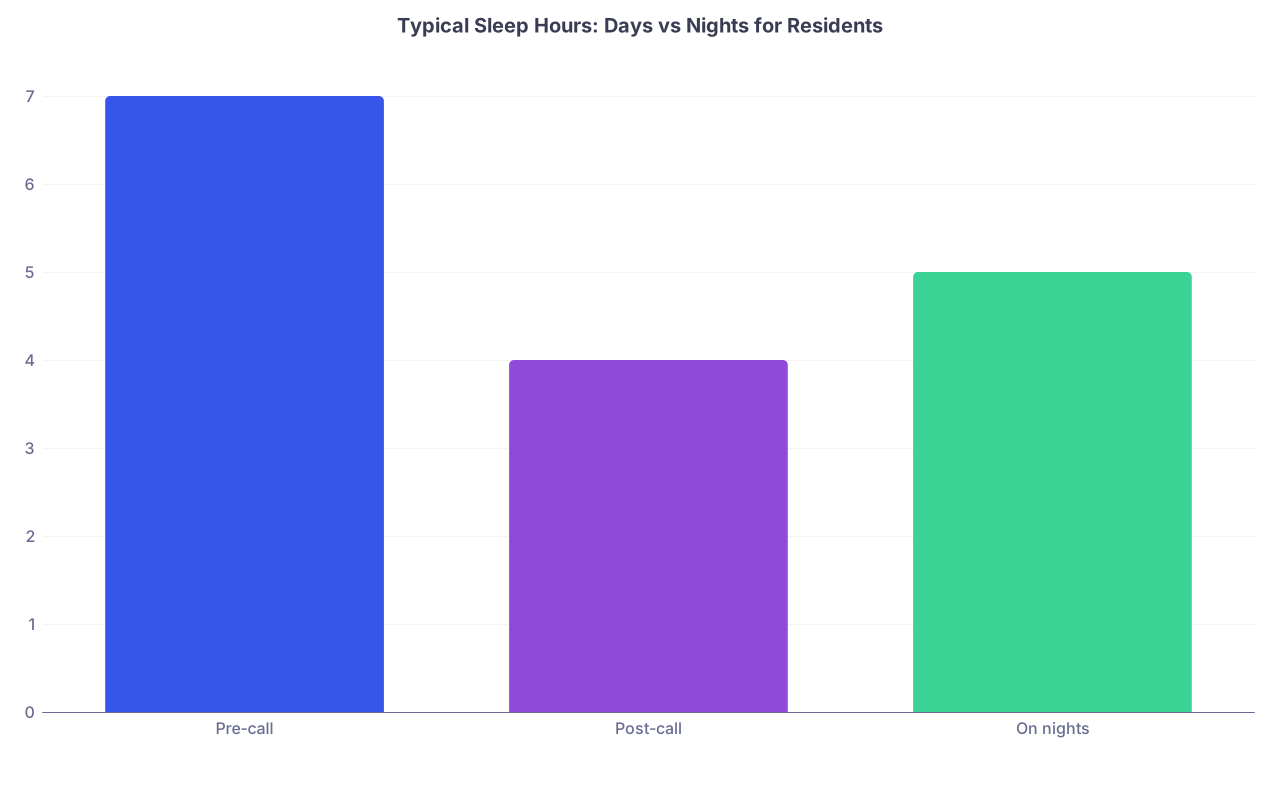
| Category | Value |
|---|---|
| Pre-call | 7 |
| Post-call | 4 |
| On nights | 5 |
If you treat night shifts like a slightly later day shift, you lose. The job is hard enough; doing it in a chronobiologic headwind with no strategy is asking for burnout.
So the mindset shift:
- Nights are a physiologic stressor, not just a scheduling annoyance.
- You need protocols, not vibes.
- Your goal is damage control and functional recovery, not perfection.
Everything that follows is built around that.
2. The 72-Hour Game Plan: Before, During, After Your Night Block
You do not “wing” nights. The preparation window is about 72 hours: how you land in and out of the block is as important as what you do during.
A. The Day Before Your First Night
Your goal: Start the first night with a semi-functional brain, not 20 hours into wakefulness.
If you are coming off a normal day schedule:
Anchor wake time (don’t sleep in until noon).
- Wake close to your usual time (e.g., 07:00–08:00).
- Staying in bed until 11:00 sounds nice, but it destroys your ability to get a long nap later.
Strategic “anchor nap” in the afternoon.
- Nap 14:00–17:00 (set an alarm!).
- Dark, cool room. Eye mask. White noise. Phone on airplane mode.
- Aim for 1.5–3 hours. Less than an hour and you will drag at 03:00. More than 3–4 hours and you may struggle to fully wake.
Caffeine cut-off by ~14:00.
- Yes, even though you are working overnight. The caffeine you drink at 16:00 will haunt your 17:00 nap.
- You will make up for it with caffeine at the start of the night, which is exactly when you want it.
Front-load real food.
- Protein-heavy lunch. Minimal sugar.
- Example: chicken, rice, vegetables; or lentils and eggs.
- The idea is to stabilize blood sugar, not spike and crash at 22:00.
Plan your gear for the block.
Pack like you are going to war:- Eye mask + earplugs or white noise
- Blue-light blocking glasses (for the way home)
- Healthy-ish snacks (nuts, yogurt, cheese, pre-cut veggies, protein bar)
- Water bottle
- Extra socks / light sweater (night workrooms are often freezing)
- Small notebook – your brain will forget things at 04:00
B. During the Night Shift: A Routine That Protects Your Brain
Nights feel chaotic, but you can still run a structure in the background.
Here is a simple, repeatable framework:

| Step | Description |
|---|---|
| Step 1 | Start of Shift |
| Step 2 | First caffeine + healthy snack |
| Step 3 | High-focus tasks first |
| Step 4 | Mini-break every 60-90 min |
| Step 5 | Light snack if hungry |
| Step 6 | Back to clinical work |
| Step 7 | No caffeine after 04 00 |
| Step 8 | Pre-handoff checklist |
| Step 9 | Blue light glasses on |
| Step 10 | Drive home safely |
1. First 2 hours: Spend Your Best Brainpower
From roughly 19:00–21:00 (or first two hours of your shift):
- Have your first intentional caffeine dose (coffee/tea/energy drink – pick one; do not chain them mindlessly).
- Knock out:
- New admissions that require real thinking
- Higher-risk cross-cover issues
- Complex notes or orders
Do not waste this window perfectly formatting discharge summaries for the patient leaving tomorrow at 15:00. Use your best brain when you have it.
2. The 60–90-minute “micro-reset” rule
Every 60–90 minutes, do a micro-reset, 2–5 minutes:
- Stand up, walk the hall
- Fill your water bottle
- 5 deep, slow breaths – literally 4 seconds in, 6–8 seconds out
- Quick stretch (neck, shoulders, back)
This is not wellness fluff. It is to keep you from sliding into zombie autopilot where errors live.
If someone gives you side-eye for walking a loop every 90 minutes, ignore them. I have watched too many residents mess up basic insulin doses at 03:30 because they had been glued to their chair for six straight hours.
3. Caffeine timing: treat it like a medication
If you slam coffee all night, your sleep will be trash and your burnout risk goes up. You want targeted dosing.
Use this model:
- Dose 1: Start of shift (19:00–21:00).
- Dose 2 (optional): Around 00:00–01:00 if you are struggling.
- Absolute cutoff: No caffeine after 04:00. Non-negotiable if you want to sleep before noon.
A rough comparison to keep in mind:
| Source | Approx Caffeine (mg) |
|---|---|
| Small coffee (8 oz) | 80–100 |
| Large coffee (16 oz) | 160–200 |
| Energy drink (16 oz) | 150–240 |
| Black tea (8 oz) | 40–60 |
| Green tea (8 oz) | 25–40 |
Cap your total at roughly 200–300 mg per night if you can. More than that and people start getting palpitations, anxiety, and terrible post-shift sleep.
4. Food strategy: Prevent the 03:00 junk spiral
You are not “weak” if you crush the leftover pizza at 02:30. That is physiology pushing you toward quick sugar and fat.
So pre-empt it:
- Eat a real meal early in the shift (19:00–21:00). Protein + complex carbs + some fat.
- Then treat the rest of the night as snack maintenance, not meals:
- Handful of nuts
- String cheese or Greek yogurt
- Apple/banana with peanut butter
- Hummus and carrots
Avoid:
- Huge carb-dense meals (pasta, big burrito) right before your circadian trough (02:00–04:00). They will sedate you and then spike your blood sugar.
- Excess sugar (cookies, candy, soda) – brief high, then a worse crash.
C. The Morning After: Turn Off the “Daytime” Brain
You know what destroys residents on nights? Not the 12-hour shift. The extra 3–5 hours of “pretend I am a day person” afterward.
Your post-shift protocol should be almost automatic:
Finish on time (or close).
- Ruthlessly prioritize your sign-out list.
- If you are doing elective-level tasks at 07:45 after a 12-hour night, your system is broken. Fix it with your team.
Light control when leaving.
- Put on sunglasses/blue-light blocking glasses before you walk out of the building.
- You are trying not to blast your retinas with “wake up, it is daytime” signals before your main sleep.
No “quick errands” on the way home.
- No groceries, no pharmacy, no “I will just drop this off”.
- Drive straight home. The crash hits fast.
Safe drive home protocol.
- Window cracked, mild stimulation (podcast or music), no zoned-out silence.
- If you are doing the “microsleep head jerk” at a red light, pull over and 10–15 minute nap in the car. I am not kidding. Falling asleep at 60 mph will end your career permanently, not just your rotation.
3. The Sleep Playbook: How to Actually Sleep in the Day
“They told me to sleep during the day.”
Sure. And did they hand you construction earplugs, blackout curtains, and a roommate who never slams doors? Probably not.
You need to make daytime sleep a protected medical intervention, not an afterthought.
A. Build a Sleep Cave
Your room needs to hit 3 things: dark, quiet, cool.
- Blackout curtains – not optional if you do more than a handful of night blocks per year.
- Eye mask – cheap, high ROI.
- White noise – fan or app. Drowns out roommates, garbage trucks, daytime chaos.
- Cool temperature – ideal around 65–68°F (18–20°C). Warm rooms destroy sleep depth.
Tell your people (partner, roommates, family):
“These 4 hours are protected. Pretend I am in the OR and unreachable unless the house is on fire.”
If they ignore this, have the uncomfortable conversation once. Not every week.
B. Sleep Schedule Templates for Night Blocks
You do not need perfection; you need something consistent enough to keep you functional.
Here are practical templates:
| Pattern Type | Sleep Schedule Example | When To Use |
|---|---|---|
| Long core + nap | 09:00–14:00 sleep + 18:00–18:45 nap | Most people, standard nights |
| Split sleep | 09:00–12:00 + 16:00–19:00 | Parents / daytime obligations |
| Post-call anchor only | 09:00–12:00, early bedtime at 21:00 | Single or 1–2 isolated night shifts |
Most residents do best with “long core + nap”:
- Sleep 09:00–14:00 (5 hours)
- Short “anchor nap” 18:00–18:45 before leaving for work
That gives you roughly 5.75–6 hours. Not ideal, but far better than 3 hours + nothing.
C. Sleep Aids: What Actually Helps (And What Hurts)
I am not your personal doctor, so talk to one if you are on meds or have sleep disorders. But in general:
Usually helpful:
- Melatonin, low dose (0.5–3 mg)
- Take 30–60 minutes before desired sleep time on night blocks.
- Especially useful when flipping to nights or back to days.
- Very short-acting sleep aids (if prescribed, e.g., zolpidem 5 mg for a few nights only).
- Can help for truly brutal rotations, but this should be planned with your PCP, not stolen from a roommate’s bottle.
Usually harmful:
- Benadryl or other sedating antihistamines nightly – anticholinergic, hangover effect, and terrible long-term plan.
- “Just one beer” to knock yourself out – fragments sleep and worsens recovery.
If you are routinely getting less than 4–5 hours despite doing everything above, that is a medical problem. Not a moral failing. You need to bring it to your program leadership and probably an actual sleep specialist.
4. Protecting Your Brain on Shift: Error-Proofing When You Are Tired
Night shifts are when errors happen. You are tired, nursing is tired, everyone is rushed. Yet the expectation of safety is unchanged.
So you build systems that catch you when your brain misfires.
A. Hard Rules for Yourself
No verbal orders for high-risk meds without repeat-back.
- Insulin, heparin, drips, KCl, opiates.
- You say: “Please read that back to me: insulin 10 units IV push now with D50.”
Double-check “never events” even when tired:
- Potassium replacement if K > 4.5 already
- Anticoagulation in someone with GI bleed or fall
- Opiates in known OSA without monitoring
- Any weight-based pediatric dose (if you are in peds)
Admit you are tired. Out loud.
- “It is 4 AM and I am fried; can we double check this together?”
- Nurses will respect this more than pretending you are sharp when you are not.
B. Externalize Your Working Memory
At 03:00, your brain will not reliably hold a 5-step plan. So do not ask it to.
Keep a running to-do list on paper or in your notes:
- Recheck lactate 02:30
- Follow up CT head result
- Reassess hypotensive patient in 1 hour
Use timers/alarms for critical re-checks:
- 1-hr post-bolus BP recheck
- 30 min recheck after IV labetalol
- 2-hr glucose after insulin treatment of hyperkalemia
If you think “I will remember,” you are wrong on nights. Build a system that assumes you will forget.
5. The “Block” Level: How to Survive Multiple Nights in a Row
One brutal night is rough. A 6–14 night block is what builds or breaks your resilience.
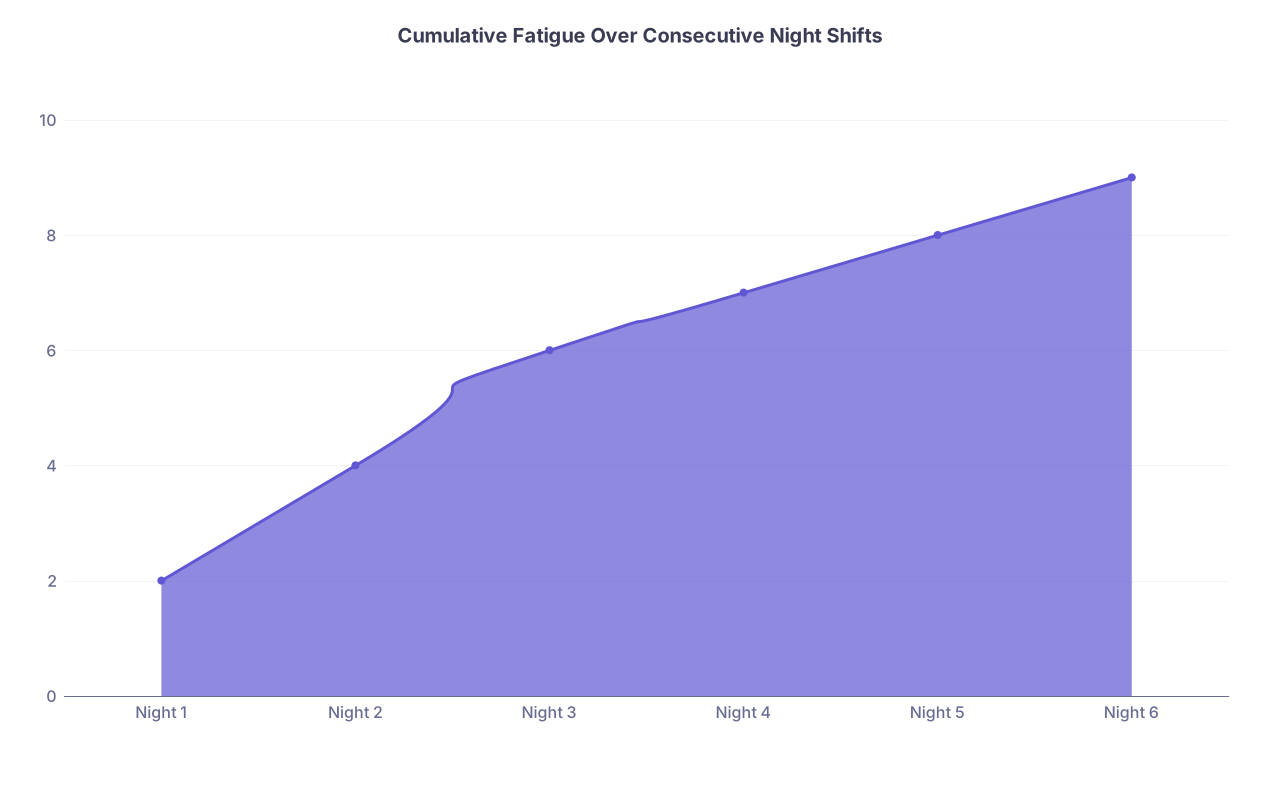
| Category | Value |
|---|---|
| Night 1 | 2 |
| Night 2 | 4 |
| Night 3 | 6 |
| Night 4 | 7 |
| Night 5 | 8 |
| Night 6 | 9 |
(Think of that line as subjective fatigue on a 0–10 scale. This is what residents report, anecdotally and in studies.)
A. Pick a Strategy: Flip Completely vs Half-Flip
For a week of nights:
Strategy 1 – Full flip (recommended for 5+ nights)
- Stay on a night-oriented schedule for the entire block:
- Awake most of the night on off-days, sleep late morning/early afternoon.
- Socially inconvenient. Physiologically easier.
- Stay on a night-oriented schedule for the entire block:
Strategy 2 – Half-flip (for 2–3 night strings)
- You stay semi-aligned with day schedule:
- Post-night: short recovery nap (09:00–12:00)
- Early evening sleep the night before returning to days.
- You stay semi-aligned with day schedule:
Programs often ignore this, but you can choose within the rules. Pick the one that actually lets you function rather than trying to live a normal daytime life on a night block. That fantasy is how people end up in tears in stairwells at 04:00.
B. Protect Your “Anchor Recovery” Days
On a 7-night block, you must clearly defend:
- 1 “anchor sleep day” mid-block where you do nothing but sleep, eat, reset.
- The 24–36 hours after the block where you flip back to days.
Your post-block flip might look like this:
- Last night ends 07:00
- Sleep 09:00–13:00 (partial, not full)
- Stay awake the rest of the day with no nap after 17:00
- Aim for 22:00–23:00 bedtime that night
This hurts a bit. But you land back on a functional day rhythm by the second post-block day instead of feeling zombie-like for four days.
6. Burnout Prevention: Building a Sustainable Mindset About Nights
Let me be blunt. Nights can ruin you if:
- You decide you must “tough it out” with no accommodations.
- You equate suffering with virtue.
- You ignore every sign that your system is failing.
Burnout is not just “I am tired.” It is:
- Emotional exhaustion (“I have nothing left for patients.”)
- Depersonalization (“These are just tasks / numbers / annoying people.”)
- Reduced efficacy (“I am bad at this. I cannot do medicine well anymore.”)
Night work accelerates all three if you do not manage it.
A. Know Your Personal Red Flags
Typical early warning signs during night-heavy months:
- Dreading every incoming page, even benign ones.
- Snapping at nurses for basic questions.
- Feeling numb during serious family meetings.
- Making uncharacteristic errors or near misses.
- Inability to recover even after 2 full days off.
When you start to notice these patterns, that is not a time to push harder. That is a time to do a reality check.
B. Use Your Support Systems Proactively, Not After You Break
You are not special for suffering silently. You are just more likely to break.
Here is a practical escalation ladder:
-
- Tell a co-resident: “This night block is crushing me; I feel off.”
- Often, they will share something that normalizes it or offer a concrete fix (swap one shift, take a note burden, share an admission load).
Chief / scheduling leadership.
- If nights are stacked in a way that is wrecking your health (e.g., repeated quick flips, 6 nights, then 1 day off, then 6 more nights), bring specific, constructive feedback:
- “I am averaging 3–4 hours of sleep. Here is my pattern. Can we adjust the schedule or my roles on shift?”
- If nights are stacked in a way that is wrecking your health (e.g., repeated quick flips, 6 nights, then 1 day off, then 6 more nights), bring specific, constructive feedback:
Program leadership / wellness / GME.
- If you are hitting true burnout: crying spells, severe anxiety, major errors, unsafe drives home – you need institutional support.
- That may mean temporary duty modifications, formal time off, or mental health support.
Is this easy? No. Does it make you “weak”? No. It makes you more likely to be a safe physician 10 years from now instead of someone who left medicine bitter and exhausted at 35.
7. The 10-Minute Pre-Shift and Post-Shift Rituals That Change Everything
You do not have an hour for yoga. I get it. You do have 10 minutes at each end of the shift. Those 20 minutes, done consistently, are high-yield.
A. 10-Minute Pre-Shift Ritual
Goal: Prime your body and mind for a demanding, upside-down shift.
- 3 minutes: light movement (walk, stairs, stretching)
- 2 minutes: check-in
- “What are the 2–3 main things I must focus on today?” (e.g., sepsis early escalation, safe handoffs, med reconciliation)
- 2 minutes: caffeine + small snack
- 3 minutes: skim the census / sign-out with a pen in hand to mark:
- Sickest patients
- Time-sensitive tasks
This prevents you from walking in cold and immediately drowning.
B. 10-Minute Post-Shift Ritual
Goal: Turn off “work brain” so you can actually recover.
- 2 minutes: final chart check – no lingering “did I sign that?” anxiety.
- 3 minutes: jot down any “open loops” for tomorrow (follow-up labs, things you want to learn about).
- 2 minutes: micro-reflection:
- 1 thing you did well
- 1 thing you would handle differently next time
- 3 minutes: very short decompression before leaving:
- Deep breathing, brief chat with co-resident, or literally standing outside and having a few quiet breaths.
Then you leave the building. You do not scroll your EMR inbox for 20 minutes after sign-out. That is how you bleed your recovery time dry.
8. Putting It Together: A Sample Week on Nights
To make this concrete, here is what a 5-night block might look like with this playbook.
Day before first night (D0):
- 08:00 – Wake
- 14:00–17:00 – Nap (dark, cool room)
- 18:30 – Healthy meal + pack night bag
- 19:30 – First caffeine at start of shift
Night 1 (N1):
- 19:30–21:30 – High-focus tasks, new admits
- 22:30 – Micro-break
- 00:30 – Second caffeine if needed, light snack
- 03:00 – Snack only if hungry, no caffeine
- 06:30 – Handoff prep
- 07:30 – Leave with sunglasses, drive home
Post N1:
- 08:30 – Home
- 09:00–14:00 – Sleep (blackout room)
- 14:00–18:00 – Groceries, low-stress tasks
- 18:00–18:45 – Nap
- 19:30 – Start N2, repeat pattern
You repeat that skeleton through N5, with one mid-block day where you protect slightly longer core sleep (e.g., 09:00–15:00).
After N5:
- 08:00 – Off shift
- 09:00–13:00 – Short recovery sleep
- 13:00–22:00 – Stay awake, outside light, light activity
- 22:00 – Sleep, aiming to wake 07:00–08:00 next day
Is it perfect? No. Is it miles better than “collapse whenever, drink coffee constantly, hope for the best”? Yes.
Key Takeaways
- Night shifts are a physiologic assault; treating them like “just another rotation” is how you slide into burnout. Use protocols: pre-shift nap, targeted caffeine, structured micro-breaks, and non-negotiable daytime sleep protection.
- Build systems that assume your tired brain will fail—external to-do lists, alarms for time-sensitive tasks, double-check rules for high-risk orders, and a safe drive-home plan.
- Think in blocks, not shifts. Protect mid-block recovery, plan your flip back to days, and use early burnout signs as triggers to loop in peers and leadership before you crash.


