

The way residency handles burnout is broken. Waiting until someone implodes and then handing them an EAP brochure is malpractice.
You need an emergency plan. Like an ACLS algorithm, but for your life. That is what this 14‑day stabilization protocol is.
You are not trying to “optimize wellness.” You are trying to stop the slide, stabilize, and buy yourself time to think clearly again. You can work on long‑term fixes later. Right now, you need to get out of the danger zone without blowing up your residency or your health.
Step 0: Know If You Are In The Red Zone
Let me be blunt. If you recognize yourself in this list, you are not “just tired.” You are in an active burnout emergency.
Burnout red flags:
- Dread before every shift that feels almost physical
- Crying in the stairwell / bathroom more days than not
- Fantasizing about walking out mid‑shift or quitting medicine entirely
- Numbness toward patients (“I do not care what happens to you anymore”)
- Sleeping 4–6 hours on days off and still waking up exhausted
- Escalating snap responses to nurses, co‑residents, or family
- Passive thoughts like “If I got in a car crash and could be out for 3 months, that would be a relief”
If any of these are mixed with:
- Persistent thoughts of self‑harm
- Making specific plans or rehearsals
- Using alcohol, benzos, or other substances to knock yourself out daily
Then this stops being a solo protocol and becomes a joint operation: you + a professional, starting today.
| Situation | Action Within 24 Hours |
|---|---|
| Active self-harm thoughts with a plan | Go to ED or call crisis line |
| Using substances daily to cope | Contact physician health program |
| Cannot safely complete basic tasks at work | Tell chief / PD you need urgent support |
| Panic attacks multiple times per shift | Urgent visit with PCP / mental health |
This protocol assumes you are safe enough to work with structure and support. If you are uncertain, err on the side of over‑escalating, not under‑reacting.
The Core Framework: 14 Days, 3 Priorities
For the next 14 days, your life shrinks to three priorities:
- Safety – You stay alive, medically stable, and out of catastrophic trouble.
- Sleep – You protect 6+ hours per 24h like it is a code stroke.
- Support – You stop white‑knuckling alone and bring in at least 2 human safety nets.
Everything else is negotiable. Your “perfect resident” image. Your inbox zero. Your guilt over saying no. Not relevant right now.
We will run this as a protocol:
- Day 1–2: Triage and containment
- Day 3–7: Stabilization
- Day 8–14: Consolidation and decision‑making
You will not fix years of systemic abuse in 2 weeks. You can absolutely move from “I am barely functioning” to “I can think, choose, and plan again.”
Day 1–2: Triage, Containment, and Minimum Viable Function
Your job for 48 hours is not to be impressive. It is to stop the bleed.
1. Run a Brutal Self‑Assessment (30–45 Minutes)
Sit down alone. No phone. Ask yourself, and write down:
- On a 0–10 scale, how close am I to:
- Walking out of residency
- Hurting myself
- Hurting someone else (verbally or worse)
- What 3 situations at work are pushing me closest to the edge?
- How many hours did I actually sleep each of the last 3 days?
- How much caffeine / alcohol / meds am I using to function?
You are not journaling for catharsis. You are gathering data for intervention.
2. Establish a Non‑Negotiable Safety Plan
If your distress spikes at 2 a.m., you cannot rely on “future me will handle it.”
Write down, clearly, on a piece of paper and in your phone:
- 3 people you can contact if you are in trouble
- 1 co‑resident or friend who “gets it”
- 1 family member or person outside medicine
- 1 professional resource (therapist, program mental health, or crisis line)
- Specific actions if suicidal thoughts escalate:
- “If I start making a plan → I will call X or go to Y ED.”
- “I will not be alone with access to [guns, large pill supplies, etc.].”
You know safety plans from psych rotations. Make one for yourself with the same seriousness.

| Step | Description |
|---|---|
| Step 1 | Feel Overwhelmed |
| Step 2 | Call crisis line or go to ED |
| Step 3 | Contact chief or PD now |
| Step 4 | Start 14 day protocol |
| Step 5 | Protect sleep |
| Step 6 | Reduce optional tasks |
| Step 7 | Schedule support and follow up |
| Step 8 | Suicidal intent? |
| Step 9 | Can function at work? |
3. Cut Non‑Critical Load Immediately
For 14 days, you are in emergency mode. That means:
- Pause or step back from:
- Extra QI projects, research, subcommittees
- Optional teaching, volunteerism, anything unpaid and uncredited
- Social obligations you dread
- Keep only:
- Required clinical duties
- Essential family responsibilities (childcare, elder care)
- Medical and mental health appointments
You do not ask “Is this good for my career?” You ask “Will I be alive and sane in 3 weeks if I keep doing this?” If the answer is questionable, it goes.
Sleep Protection: Your First Hard Reset
If you fix nothing else except sleep over 14 days, your brain will come back online by 20–30 percent. That is often enough to stop disaster.
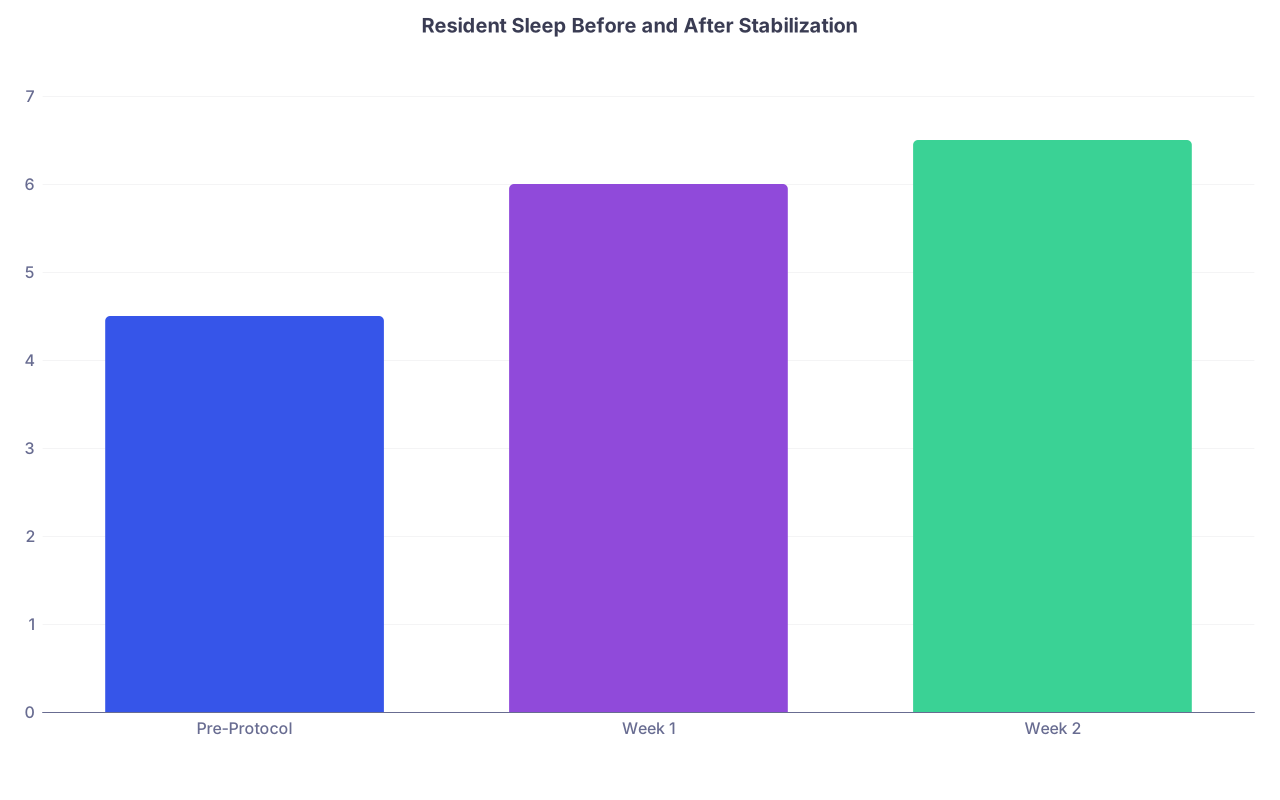
| Category | Value |
|---|---|
| Pre-Protocol | 4.5 |
| Week 1 | 6 |
| Week 2 | 6.5 |
4. Build the “No Negotiation” Sleep Window
For the next 14 days, you must carve out:
- At least 6 hours in bed per 24 hours
- Preferably in one block, but split sleep after nights is acceptable
Concrete rules:
- Leave the hospital as soon as your actual responsibilities are done. Not after you fix the whole system.
- No starting new notes in the last 30 minutes of your shift. You defer unless genuinely urgent.
- 90 minutes before your target sleep time:
- No EMR. No email. No “quick literature search.”
- Minimal screen light. Put your phone on Do Not Disturb for everyone except your call team and one safety contact.
5. Taper the Surge Inputs
You cannot keep pouring gasoline on your nervous system and expect calm.
For 14 days, set:
- Caffeine cap: Last caffeine 8 hours before planned sleep. Aim for ≤ 2 regular coffees per day or equivalent.
- Alcohol rule: None on nights before work. Period. If that feels impossible, that is data; raise this with a professional.
- Avoid random OTC sedatives or your co‑resident’s leftover benzos. You know why. Do not become your own “interesting case.”
If sleep is utterly broken (lying awake for 2+ hours most nights), you talk to your PCP or a trusted attending about a short‑term, supervised intervention. Not Reddit. Not your co‑resident’s stash.
Day 3–7: Stabilization – Create Space To Breathe
Now that you have cut some load and started basic sleep protection, the goal for this week is to get your nervous system out of constant fight‑or‑flight.
6. Implement “Micro‑Decompression” During Shifts
You do not need an hour. You need consistent 90–180 second resets.
On every shift, commit to:
- Three 2‑minute pauses:
- Alone in a bathroom, stairwell, empty room
- Slow exhale 4–6 seconds, pause, regular inhale. Repeat 8–10 times.
- No phone. No doom scroll. Just lowering sympathetic tone.
Call it whatever you want: breathing exercise, “panic drill,” whatever. I have watched residents go from shaking to functional after 90 seconds of deliberate breathing done properly. It is clinical, not fluffy.
7. Use a 3‑Bucket Task System
Your overwhelmed brain cannot triage. So create a simple on‑shift algorithm:
Bucket A – Must Do Now
- STAT orders, critical labs, unstable patients, pages from nurses about safety issues.
Bucket B – Must Do Today
- Discharge summaries for same‑day discharges
- High‑priority family updates
- Key documentation for billing / legal safety
Bucket C – Can Wait (24–72 Hours)
- Non‑urgent sign‑offs, optimization notes, tidying problem lists
- Extra, thorough documentation that is more about anxiety or perfectionism than safety
Throughout the day, ask: “Which bucket is this actually in?” If it belongs in C, park it on a list to revisit later, or hand it off if appropriate.
Social Support: You Cannot White‑Knuckle Out Of This
Burnout thrives in isolation. Most residents hide until they are in pieces, because the culture is toxic about weakness. Ignore that.
8. Recruit Two Allies In 7 Days
You need at least:
One inside‑medicine ally
- Co‑resident, chief, or attending who has shown they are human
- Script the conversation:
- “I am getting close to a wall. I am following a 14‑day stabilization plan to get back on track, but I need backup. Can I check in with you twice over the next week?”
One outside‑medicine ally
- Friend, partner, sibling, anyone who sees you as more than your productivity
- Explain:
- “If I text ‘red,’ that just means: remind me that quitting residency this second is not the only option, and stay on the phone with me for 10 minutes.”
You are not asking them to fix you. You are asking them to be present.

9. Inform Leadership Strategically (Optional but Powerful)
This is where residents hesitate. “If I tell my PD I am struggling, I am done.” Sometimes true, often not.
You do not need a full confession. You need to create room.
A measured script for a chief or APD:
“I want to stay safe and effective, and the current load is pushing me toward burnout. I am working on specific strategies to stabilize over the next two weeks. I want to keep caring for patients, but I need some help protecting sleep and limiting non‑clinical extras during this period.”
Concrete ask examples:
- Delay or redistribute one low‑priority project
- Swap a single brutal call shift
- Get permission for a mental health appointment during a clinic block
If your program leadership is abusive or dismissive, fine. Get what you can from coresidents / friends and focus on personal boundaries. But at least test the system once before you decide everyone is an enemy.
Day 8–14: Consolidation, Boundaries, and Decisions
If you have followed even 60–70 percent of this protocol so far, by the second week you should notice:
- Slightly less dread before shifts
- Fewer moments of “I am about to lose it”
- Enough mental bandwidth to think about next month, not just next hour
Now we solidify gains and set up what happens after Day 14.
10. Run a 7‑Day Reality Check
Look back at the last week. Ask:
- How many nights did I get ≥ 6 hours in bed?
- How many shifts did I use at least one 2‑minute reset?
- What were the worst 3 moments, and what triggered them?
- What, specifically, became slightly more tolerable?
You are looking for patterns:
- Is it one attending who detonates your day?
- Is it overnight cross‑coverage chaos?
- Is it 4 consult services paging you about nonsense?
You cannot fix everything. You can target the biggest landmines.
Micro‑Boundaries That Actually Work In Residency
You are not going to magically “just say no” to everything. But you can place smart, small boundaries that dramatically reduce bleed.
11. Three Work Boundaries For the Next 30 Days
Pick two or three of these and implement them hard for 30 days:
Email boundary
- No checking or responding to non‑urgent email after 8 p.m. or on post‑call days until after you have slept.
Documentation boundary
- Limit progress notes to what is clinically and legally necessary. No “beautiful” notes while you are drowning.
Paging boundary
- If you are in the middle of a critical task, let non‑urgent pages go to voicemail for 10–15 minutes, then batch responses.
Teaching boundary
- When exhausted, say: “I want to teach this properly when I am sharper—let us schedule 10 minutes tomorrow,” instead of forcing it at 3 a.m.
You will get some eye‑rolling. Fine. Residents who survive long enough to become attendings with a life are the ones who set boundaries, not the ones who die on every hill.
Decide: Stay, Adjust, Or Exit (At Least On Paper)
By Day 14, you should be just clear enough to answer a hard question:
If nothing changed in this program for the next 6–12 months, could I continue without destroying myself?
Use a simple 3‑path model:
Path A – Stay as is, but with new supports
- Program tolerable
- Distress trending down with sleep + boundaries
- You can see a realistic way through remaining years
Path B – Stay, but with major changes
- You need schedule modifications, leave, or a track switch
- Or you need formal mental health treatment and workplace accommodations
Path C – Plan an exit
- The environment is toxic beyond repair
- Staying feels like choosing slow self‑destruction
| Path | Signal Features | Next Step In 30 Days |
|---|---|---|
| A | Moderate distress, improving | Maintain protocol, add therapy |
| B | High distress, partial response | Negotiate changes, consider leave |
| C | Severe distress, hostile environment | Explore transfer or exit plan |
You do not have to implement the decision tomorrow. But you do need to admit to yourself which path you are on, so your actions line up.
A Concrete 14‑Day Schedule (Template)
Use this as a skeleton and adapt to your rotation. The goal is structure, not perfection.

| Task Category | Daily Minimum Action |
|---|---|
| Sleep | 6 hours in bed in 24 hours |
| Safety | Carry safety plan; 1 brief self check-in |
| Decompression | 2 breathing breaks during shift |
| Social Support | 1 contact (text/call) every 48 hours |
| Load Management | No new optional commitments accepted |
Example Day (On‑Service, 6 a.m. to 6 p.m.)
Morning (4:45–5:45 a.m.)
- Wake, 5 minutes stretching or quiet sitting
- Light snack / coffee (first and maybe only caffeine)
- Quick review of “buckets” mindset (A/B/C)
Workday
- First breathing pause: after pre‑rounding, before seeing first patient
- Second breathing pause: mid‑day after signout or conference
- Third breathing pause: before final note sprint
Post‑shift
- Leave on time unless it is truly unsafe for patients
- 30 minutes of decompression at home (shower, change clothes, non‑medical podcast, etc.)
- 10–15 minute call / text with one ally
Evening
- Stop email / EMR 90 minutes before sleep
- Light dinner, no heavy new tasks
- Aim for sleep by fixed time that allows 6 hours before next alarm
Repeat. You will mess it up some days. You do not throw away the protocol because one post‑call day went sideways.
What If You Are On Nights?
You do the same protocol, but you respect your sleep window during daytime like it is anticoagulation.
- Dark, cold room. Eye mask. White noise if needed.
- No errands, no “just a quick workout,” no social visits invading your main sleep block.
- Caffeine only in the first half of the night shift.
Your friends and family will not like this. Explain: “For two weeks, this is how I stay safe enough to keep doing this job. I am not available at 10 a.m. after a night shift. That is my 2 a.m.”
When To Pull Bigger Levers
Sometimes the 14‑day protocol helps, but does not touch the core poison:
- Chronic bullying from a specific attending
- Systemic unsafe staffing that is not being fixed
- A program that punishes sick days or mental health care
Under those conditions, you look at:
- Medical leave – Usually via employee health or a physician health program
- Formal accommodations – Through GME office, especially for diagnosed mental health conditions
- Transfer options – Quietly explore via trusted mentors outside your program
- Exit strategy – Planning life and career if you decide residency in that specialty or institution is not survivable
These are not failures. They are signs you are taking responsibility for your only life instead of surrendering it to a broken system.
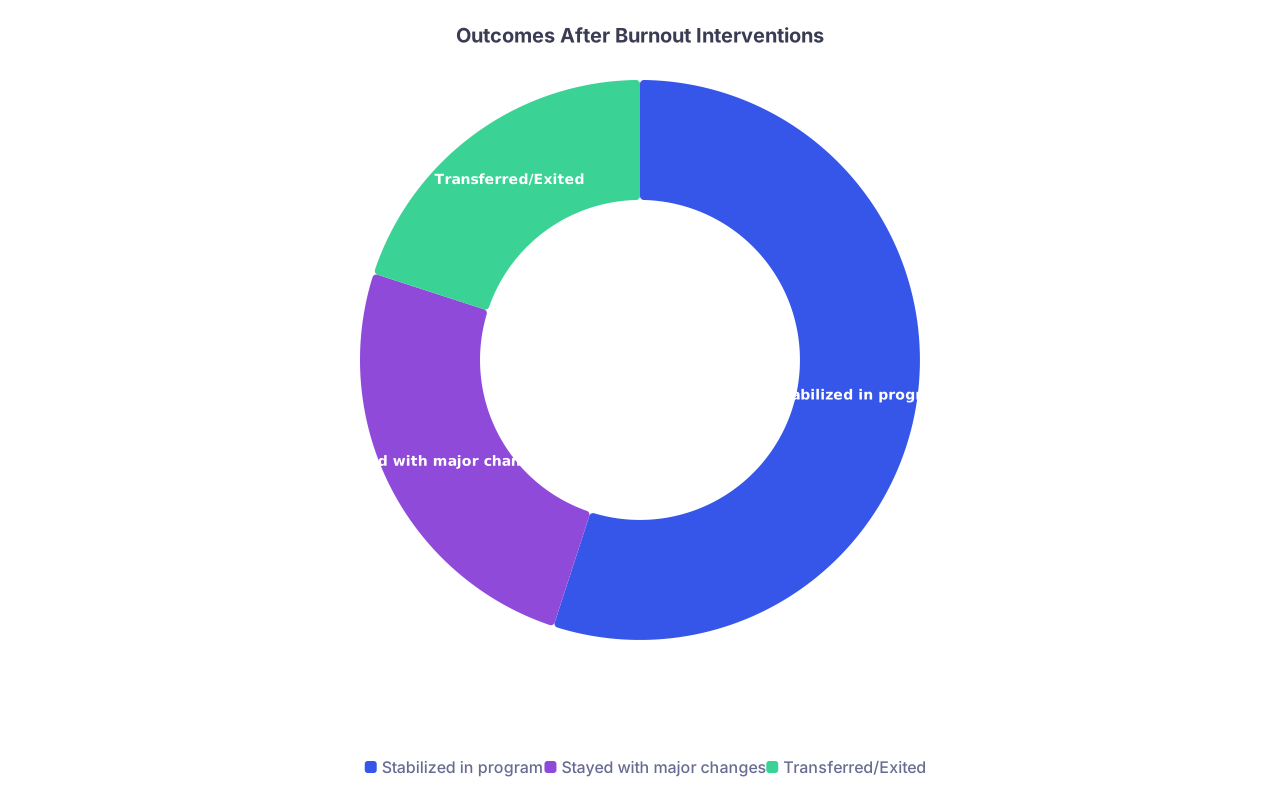
| Category | Value |
|---|---|
| Stabilized in program | 55 |
| Stayed with major changes | 25 |
| Transferred/Exited | 20 |
Numbers above are representative of what I have seen anecdotally across multiple programs: most stabilize with internal changes; a minority need structural changes or a different program entirely.
Two Things You Must Stop Believing
“Everyone else is handling this; I am just weak.”
I have sat in call rooms where the superstar chief admitted they fantasized about being admitted to psych just to get rest. You are not the outlier. You are just telling the truth.“If I just push through this month, it will get better.”
Sometimes it will. Often it will not, because the problem is not just the rotation. It is the way you have been taught to erase your own needs. Pushing through without a plan is how you end up as a cautionary story at M&M.
How To Use This Protocol Without Making It Another Burden
Print or write down:
- The 3 priorities: Safety, Sleep, Support
- The 5 daily non‑negotiables from the table
- Your safety plan and 2 allies’ names
Then give yourself one rule:
Even on my worst day, I will do at least two things from this plan. Not zero.
Some days that might be 6 hours of sleep and one 2‑minute breathing break. Fine. That still moves you away from the cliff instead of closer.


