

It is 4:37 AM. Your alarm has gone off three times. You are staring at the ceiling doing the same math you did yesterday: “If I call in, will they hate me? Can I survive another 28 hours of this? Why does my chest feel like there is a brick on it?”
You are not just tired. You are dreading the entire day before it even starts. And that feeling is starting to happen before every shift.
This is the residency burnout red flag. Not “I had a bad call.” Not “I am tired post-nights.” This is the pattern: anticipation dread + shift + emotional hangover. On repeat.
Here is the playbook for what to do next. Not theory. Not wellness-poster fluff. Steps, scripts, and decisions.
Step 1: Separate “Normal Hard” From “Danger Zone”
First job: figure out whether you are facing normal residency misery or something that is about to wreck you.
Quick self-check: 5 questions
If you answer “yes” to 3 or more, you are not just “a little stressed.” You are in the danger zone and you need an actual plan, not grit.
- Do you feel a knot in your stomach or dread most days before work, not just on call or ICU weeks?
- Do small, normal tasks (finishing notes, calling a consultant, answering your pager) feel overwhelming regularly?
- Have you stopped doing things you used to enjoy even on your days off?
- Are you more cynical/snappy with patients, nurses, or co-residents than your baseline?
- Do you catch yourself thinking: “I hate this. I made a mistake. I just need to survive and escape”?
If this is you, stop telling yourself “everyone else is handling it better.” I have watched some of the strongest, most competent residents crumble because they ignored this phase.
You are not weak. You are overloaded.
Now we build a response.
Step 2: Stabilize Today – A 24-Hour Survival Protocol
You have a shift coming up. You still have to go. You need a plan for today, not next month.
1. Set a micro-goal for this shift
When you dread an entire 12–28 hours, the day feels impossible. Shrink it.
Pick one clear, realistic goal for this shift:
- “My notes will be done by 3 pm.”
- “I will ask for help early if I am drowning.”
- “I will eat something with protein before 10 am.”
- “I will leave on time unless there is a true emergency.”
Write it down in your phone. Hold yourself to that, not perfection.
2. Use the 10-minute pre-shift reset
You are about to walk in. You feel the wave of anxiety and resentment. Here is the 10-minute reset I have given to multiple interns on the verge of walking out:
- Sit alone for 2 minutes (in your car, stairwell, bathroom stall).
- Box breathing – 3 minutes
- Inhale for 4
- Hold for 4
- Exhale for 4
- Hold for 4
Repeat. This is not “mindfulness fluff.” It actually downshifts your sympathetic tone.
- Name 3 tasks you will do in the first 30 minutes
Example:- Log in and check sign-out.
- See room 12 and 14 first.
- Put in morning lab orders.
- Say out loud (quietly): “I do not have to fix everything today. I just have to get through the next 2 hours.”
Then stand up and walk in. Not inspired. Just slightly less flooded.
3. Take control of the first 30 minutes
Chaos early = dread all day. Take back some control:
- Get sign-out, then resist the urge to sprint in all directions.
- Prioritize 3 tasks. Do not open every chart and halfway start everything.
- If census is insane, say one sentence to your senior right away:
“Our list is huge. I am worried about getting notes done. Can we prioritize what actually matters this morning?”
You do not need a TED talk. Just that one direct statement.
4. Build in two non-negotiable reset points
On brutal rotations, I tell residents to treat a 12-hour shift like three 4-hour blocks. Between each block, you get a micro-reset:
- Reset 1 – Mid-morning:
- 5-minute bathroom break, even if you feel guilty.
- Water. Something with calories.
- Reset 2 – Late afternoon:
- Step into the hallway or stairwell.
- 10 slow breaths.
- Ask: “What must be done before sign-out and what can safely wait?”
No one is going to hand you this time. You take it.
Step 3: Diagnose the Source of the Dread
You cannot fix dread if you mislabel it. “I hate residency” is too vague. Your brain hates a specific pattern.
Here is a simple diagnostic breakdown I use:
| Source of Dread | What It Feels Like | Typical Fix Focus |
|---|---|---|
| Workload / systems | Always behind, drowning in tasks | Workflow + boundaries |
| Toxic team / culture | Fear, anxiety about specific people | Escalation + transfer |
| Loss of meaning | “What is the point?” | Reconnecting with purpose |
| Burnout / depression | Flat, hopeless, dreading *everything* | Professional help + time off |
| Mismatch with specialty | “Did I choose wrong?” | Career clarity + mentoring |
Let us go through each, briefly.
A. Workload / systems problem
Signs:
- You dread the chaos, not specific people.
- You are constantly staying 1–3 hours late.
- You cannot keep up with notes, pages, and orders.
This is not a character flaw. It is almost always:
- Bad workflows
- Poor delegation
- A service that is perpetually understaffed
You fix this with process changes and boundaries, not more “resilience.”
B. Toxic team / culture problem
Signs:
- Your heart rate spikes thinking about one attending or senior.
- You replay their comments in your head at 2 AM: “Do you even care?” “How did you not know that?”
- You feel safer with any other team.
Here, the problem is interpersonal and systemic. It needs escalation and documentation. We will get to how.
C. Loss of meaning
Signs:
- You can do the work, but you feel numb.
- You used to care. Now it all feels transactional and empty.
- You catch yourself thinking: “I am just a cog. This is pointless.”
This needs reconnection to the parts of medicine you still value, even in tiny doses.
D. Burnout, anxiety, or depression
Signs:
- You dread shifts, but also feel flat on days off.
- Sleep is bad even when you have time to sleep.
- Appetite, mood, energy are off.
- You have dark thoughts: “If I got hit by a bus and did not have to go in, it would be a relief.”
This is a medical issue. It needs treatment, not “try yoga.”
E. Specialty mismatch
Signs:
- You are capable, but the actual day-to-day work of your field feels wrong.
- You fantasize about what it would be like in peds / psych / radiology / outpatient.
- You are counting years until you “escape” rather than looking for ways to make practice sustainable.
This needs honest career evaluation and strategic planning.
Circle which one (or two) hit the hardest. That becomes your primary target.
Step 4: Fix What You Can Control Inside the Shift
You cannot change ACGME overnight. You can change how you run your day more than you think.
A. Streamline your workflow
On high-volume services, poor structure will crush you. Use a basic daily operations template:
- Morning
- Pre-round with a focused checklist (overnight events, vitals, labs, dispo).
- Write problem-based plans as you pre-round → drop them straight into notes.
- Late morning
- Hard stop: 30–60 minutes to blast through notes.
- Close Epic/EMR tabs unrelated to your current note. No “chart surfing.”
- Afternoon
- Focus on 3 categories only:
- Time-sensitive orders / consults
- Discharges
- Unstable patients
- Focus on 3 categories only:
- Last hour
- Clean up orders.
- Check tasks inbox once.
- Update sign-out before your brain is fried.
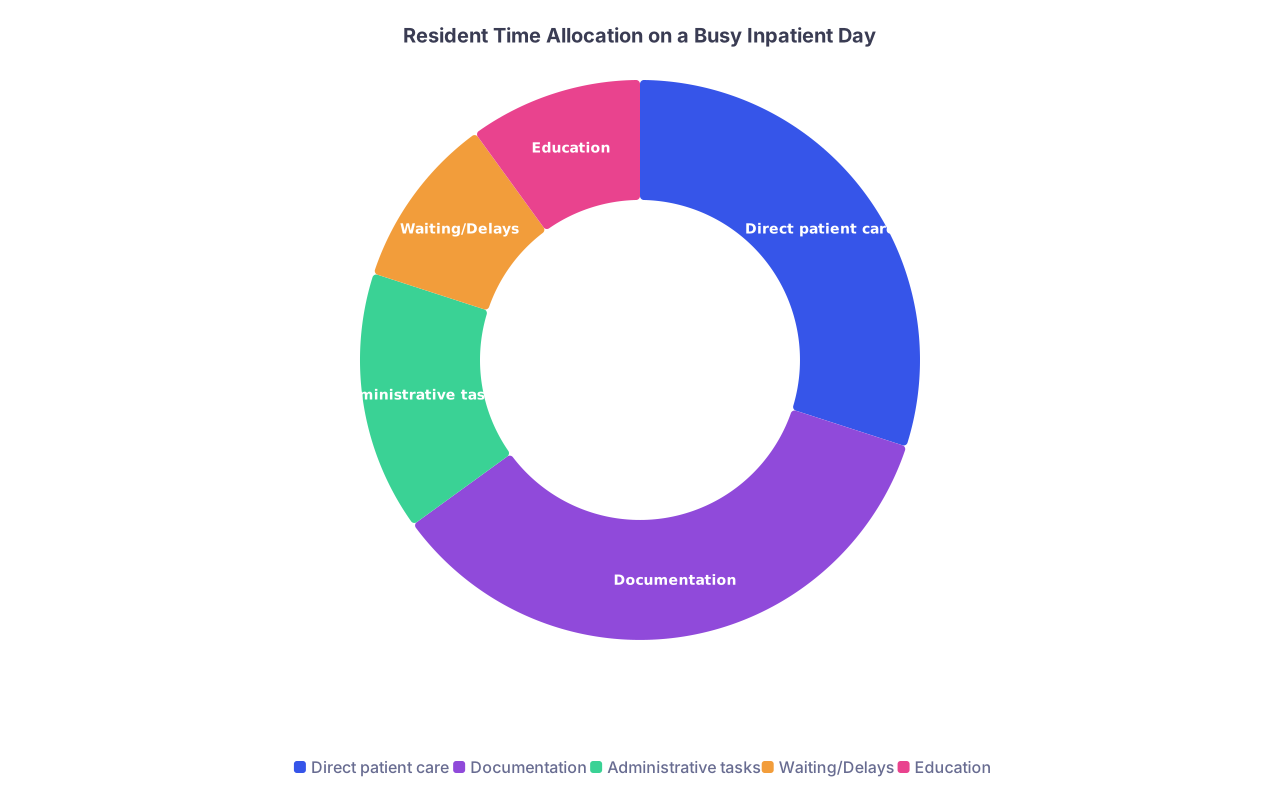
| Category | Value |
|---|---|
| Direct patient care | 30 |
| Documentation | 35 |
| Administrative tasks | 15 |
| Waiting/Delays | 10 |
| Education | 10 |
If your day is 60% documentation and busywork, no wonder you dread going in. You cannot fix institutional problems alone, but you can get ruthless about what actually requires you versus what can be streamlined or delegated.
B. Use scripts to ask for help early
Many residents drown silently because they do not know how to say “I am overwhelmed” without sounding incompetent.
Use these phrases. Word-for-word if you like.
To your senior:
- “I am worried I will not get all my notes and discharges done. Can we prioritize what is most important for me to do personally versus what can wait or be redistributed?”
- “I am hitting capacity. I want to be safe. Can you help me decide what to drop?”
To your attending:
- “The workload today is exceeding what I can safely handle. I need your help to adjust expectations or redistribute tasks.”
If you get mocked or dismissed for that, that is not a “you” problem. That is data about your program’s culture.
C. Set hard boundaries where you still can
Boundaries in residency are limited. They are not zero.
Pick 1–2 hard boundaries to implement this week:
Examples:
- “I will not stay more than 30 minutes past my scheduled sign-out unless it is a true emergency.”
- “I will not respond to non-urgent messages on my day off.”
- “I will eat something solid before noon. Non-negotiable.”
Boundary enforcement is simple, not easy:
- When asked to stay late on non-emergent tasks:
“I have to leave by 6:15 because of duty hours. I can finish X, but Y will need to be picked up by the cross-cover.”
Say it calm. No apology paragraph.
Step 5: Deal Directly With Toxic People and Unsafe Situations
If your dread is linked to specific individuals or a specific rotation, you do not “toughen up” your way out of that. You act.
A. Start a factual log
Not a vent diary. A log.
Include:
- Date / time
- Who was there
- Exact words or behaviors
- Impact (patient safety, public humiliation, discrimination, etc.)
Why:
- Patterns are harder to dismiss than one-off complaints.
- You may need this if things escalate.
B. Use clear language in real time when possible
If someone crosses a line:
- “I am open to feedback, but please speak to me respectfully.”
- “I am concerned that speaking to me this way, especially in front of patients/staff, undermines the team.”
- “I felt uncomfortable with that comment.”
No, it will not always go well. But saying nothing never changes the pattern.
C. Escalate strategically
Start with the lowest level that has some power and is not directly causing the problem.
Hierarchy (rough template):
- Trusted senior / chief resident.
- Associate program director.
- Program director.
- GME office / ombuds / institutional well-being office.
When talking to them, skip vague language like “The rotation is rough.” Use clear statements:
- “I dread this rotation because of repeated public shaming and yelling from Dr X.”
- “I am worried about patient safety because I feel afraid to ask clarifying questions.”
- “Here are three specific examples from my log.”
If you are thinking, “If I do this, they will label me as difficult,” remember: you already wake up dreading every shift. That is not a sustainable baseline. Silence has a cost too.
Step 6: Get Professional Help Before You Break
If you are waking up every day with dread, and especially if you have any of the following:
- Frequent thoughts of quitting medicine
- Passive death wishes (“If I did not wake up, it would be easier”)
- Panic symptoms (palpitations, shortness of breath, chest tightness) most mornings
then waiting for “vacation to fix it” is reckless. You need an outside professional.
A. Use your institutional resources
Most residencies have:
- Confidential counseling through GME or employee assistance programs.
- Mental health services for trainees, often off-site or via telehealth.
- Some form of wellness or ombuds office.
Call. Email. Today.
- “I am a resident and I am experiencing significant work-related distress and dread before every shift. I would like to schedule a confidential mental health appointment as soon as possible.”
You do not need to write a novel. Just that.
B. Consider FMLA, leave, or schedule adjustments
If you are truly burned out or depressed, a week of “staycation” between rotations is not going to cut it.
I have watched residents:
- Take 4–12 weeks of medical leave.
- Come back functioning better, with a plan, and still finish residency.
- Go on to have solid careers.
Conversation starter with PD:
- “My mental health has deteriorated to the point that I dread every shift and I am concerned about patient safety and my own well-being. I am working with a mental health professional, and we believe I may need a defined period of leave or schedule modification.”
Yes, it is scary. But finishing residency while completely broken is not a win.
Step 7: Rebuild a Tiny Sense of Meaning and Control
Even if you get help, adjust your schedule, and fix your workflows, you still need something positive to move toward, not just a list of things to avoid.
A. Protect one small thing you enjoy outside work
Not “self-care.” I mean one activity each week that reminds you you are a human being, not just a walking EMR login.
Examples:
- 45 minutes of pickup basketball once a week.
- One dinner with a non-medical friend.
- 30 minutes of guitar, sketching, or writing on your post-call afternoon (before you crash).
If you are thinking “I do not have time,” that is part of the burnout trap. Residency will take 100% of whatever you offer it. You have to actively hold back 5%.
B. Find one thing inside medicine that still feels like yours
On even the worst rotations, there is usually some part of the job that still matters to you.
Could be:
- Teaching interns/med students.
- Palliative conversations done well.
- Procedures.
- Streamlining discharges so patients get home faster.
Pick one. Make it a deliberate focus once per shift.
For example:
- “Today, I will take 5 extra minutes with one family to explain the plan clearly.”
- “I will teach the med student one high-yield clinical pearl.”
Small, yes. But this is how you rebuild meaning atom by atom.
C. Start tracking your distress like a vital sign
Burnout feels vague. Make it concrete.
Rate your:
- Dread before shift: 1–10
- Misery during shift: 1–10
- Recovery time after: hours until you feel semi-normal
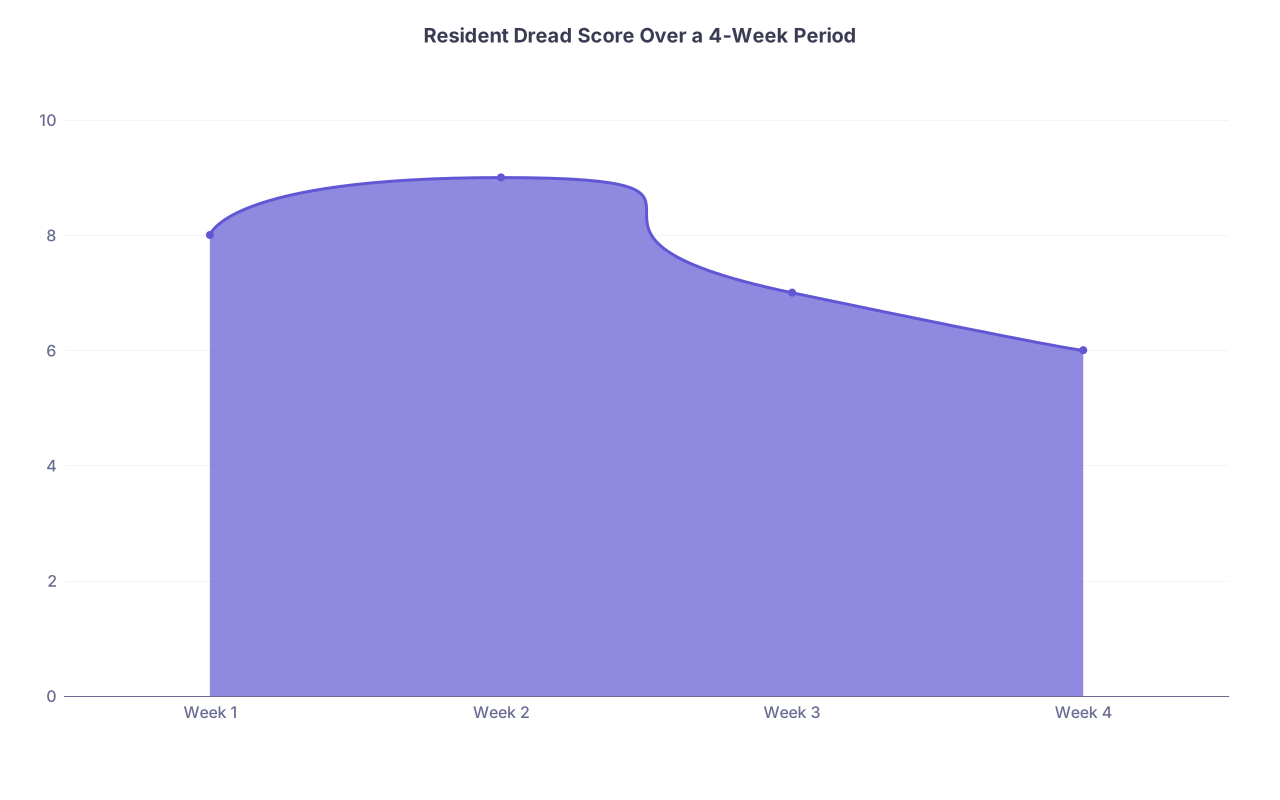
| Category | Value |
|---|---|
| Week 1 | 8 |
| Week 2 | 9 |
| Week 3 | 7 |
| Week 4 | 6 |
Why track?
- You will see whether interventions are doing anything.
- You will have data to bring to your therapist, PD, or GME.
If your numbers stay at 8–10 for weeks despite trying changes, that is another signal you need stronger action (leave, rotation change, more intensive treatment).
Step 8: If You Think You Picked the Wrong Specialty
This is more common than anyone admits. I have watched surgical interns envy psychiatry residents, internists dream about derm, and EM residents fantasize about outpatient lifestyle.
The dread here is different. You do not just hate residency. You hate the idea of doing this work for 30 years.
Here is how to approach it without blowing up your life impulsively.
A. Reality check the situation
Ask yourself:
- Did I ever enjoy this specialty? (MS3, early PGY-1)
- Is it all rotations, or specific ones?
- Do I like the doctoring but hate the environment / schedule?
If you have never liked the day-to-day and only liked the idea, that is a strong sign of mismatch.
B. Quietly explore alternatives
You do not need to announce a specialty crisis to your PD on day one of doubting.
You do need data:
- Talk (confidentially) to:
- A trusted faculty member outside your program.
- A mentor in another specialty you are considering.
- Ask specific questions:
- “What does your worst day look like?”
- “If you had to go back, would you choose this again?”
- “What are the hidden downsides?”
C. Build an exit or pivot plan if needed
If you become convinced you are in the wrong field, you have options:
- Transfer to another specialty (hard, but not impossible).
- Finish and practice in a niche that minimizes what you hate.
- Finish and pivot to non-clinical work (admin, industry, informatics, etc.).

| Step | Description |
|---|---|
| Step 1 | Daily shift dread |
| Step 2 | Fix workflow and boundaries |
| Step 3 | Document and escalate |
| Step 4 | Seek professional help |
| Step 5 | Explore alternatives |
| Step 6 | Track dread scores |
| Step 7 | Maintain and adjust |
| Step 8 | Consider leave or structural change |
| Step 9 | Source identified |
| Step 10 | Improving over 4-8 weeks? |
Do not torch everything at once. Get stable, then make moves.
Step 9: When You Are Right at the Edge
If you are reading this thinking, “I am beyond dread. I am barely holding on,” then the priority is not optimization. It is safety.
Signs you are at or near the edge:
- You have active thoughts of self-harm.
- You are using alcohol, benzos, or other substances just to get through shifts or fall asleep.
- You are making clinical errors you would never have made a year ago.
- Someone close to you has said, “You are not okay.”
Here is the protocol:
Tell one person today.
- A co-resident you trust.
- A partner/friend.
- A therapist / counselor / doctor.
Words you can use:
- “I am not safe. I am having thoughts that scare me.”
Do not do this alone.
If thoughts are active, or you have a plan:- Go to the nearest ED.
- Or use emergency mental health resources in your region.
- If available, call your institution's on-call mental health line.
Residency can pause. Your brain cannot.
People take leave. Programs adjust. Licenses are not automatically destroyed because you needed help. That is paranoia fueled by stigma and half-truths.
You cannot doctor others while you are actively breaking.
Frequently Asked Questions
1. How do I know if what I am feeling is “normal” residency stress or true burnout?
Use three lenses:
- Duration: Everyone has awful weeks. If dread has been your baseline for more than a month, especially across different rotations, that is not just “a bad block.”
- Spillover: Normal stress lifts on days off. Burnout and depression follow you home. If your off days feel flat, anxious, or you are just lying in bed scrolling, that is a warning sign.
- Function: If your ability to think clearly, empathize, and recover after shifts has dropped significantly from a year ago, you are likely in burnout territory.
When in doubt, assume it is more serious and seek help. No one has ever been harmed by talking to a therapist “too early.” Plenty have been harmed by waiting too long.
2. Will asking for help or taking leave ruin my career?
If a program punishes people for seeking mental health care or for taking legitimate medical leave, that program is the problem. Not you.
Real-world outcomes I have seen:
- Residents who took 6–12 weeks of leave for severe burnout or depression:
- Returned to residency.
- Graduated.
- Got jobs or fellowships.
- Residents who hid their condition:
- Made serious errors.
- Had breakdowns on call.
- Ended up needing longer leaves under worse conditions.
You may have to disclose treatment or leave on certain forms. But that is not an automatic career death sentence. You know what is worse on those forms? Documented impairment or patient harm.
3. What is one thing I can do today that will actually change something?
Do this, now:
- Text or message one person you trust and say:
“I have been waking up dreading every shift and I am not doing well. Can we talk for 10–15 minutes sometime this week?” - Then open your next schedule block and pick:
- One specific boundary you will hold (time, tasks, or days off).
- One institutional resource you will contact (counseling, GME, wellness).
Put both on your calendar. With actual dates and times.
You are still here, reading this, which tells me something: you have not given up on yourself yet, even if part of you wants to.
So make one concrete move today. Not a grand plan. One email. One call. One boundary.
Open your phone right now and schedule a 30-minute slot—within the next 72 hours—to contact a mental health resource or trusted mentor. Put it in as an actual event. Name it what it is: “Stop pretending I am fine.”


