

The way most residents “deal” with burnout is passive and ineffective. You push through, vent in the workroom, scroll your phone on call, crash when you get home, and repeat. That cycle does not defuse burnout. It feeds it.
You need a structured reflection routine. Not vague “self-care,” not occasional journaling when things are awful. A short, repeatable protocol you can run on autopilot that:
- Bleeds off emotional pressure
- Keeps you from turning one bad shift into a global identity crisis
- Flags real problems early enough to fix them
I am going to give you that routine. Step‑by‑step. No fluff, no “find your why” monologues. Something you can do in 10 minutes a day, even on call, without needing a therapist, a retreat, or a wellness committee.
Why Reflection (Done Right) Actually Defuses Burnout
Burnout in residency is not just “too many hours.” If that were the whole story, every resident would be equally wrecked. They are not.
What pushes people over the edge is the combination of:
- High workload
- No sense of control
- Moral injury (doing things that feel wrong or futile)
- Isolation with your own thoughts
- Zero structured way to process any of it
Unprocessed experience turns into:
- Cynicism: “Patients do not change. Admin does not care. Nothing matters.”
- Imposter syndrome: “Everyone else is handling this. I am the weak one.”
- Emotional numbness or volatility: snapping over minor things, feeling nothing over major ones
Structured reflection hits these points directly:
- It gives you control over at least one part of your day.
- It lets you name what is draining you (naming reduces intensity, consistently).
- It separates what is yours to own from what is systemic garbage.
- It creates micro‑learning loops so you actually get better instead of repeating the same painful mistakes.
No, reflection does not fix unsafe staffing ratios. It will not magically make your PD competent. But it radically changes how much of that toxicity you absorb.
Think of it as emotional decontamination after each shift.
The Core Routine: 10–Minute “Defuse the Shift” Protocol
This is the base protocol. If you do nothing else, do this.
Timing and Setup
- Frequency: Daily, after your shift or before sleep.
- Duration: 10 minutes. Hard cap.
- Medium: Paper notebook or a simple notes app. Not your EMR. Not email.
- Rule: Phone on Do Not Disturb. No multitasking. You deserve 10 minutes.
You will run through the same five steps every time:
- Snapshot
- Decompress
- Distill
- Decide
- Close
Let’s break each one down.
Step 1: Snapshot (2 minutes)
Goal: Capture the day briefly so your brain stops spinning on it.
Write 4 short lines. Literally:
- Shift type: “Long call – MICU”, “Clinic – continuity”, “Night float floor”.
- Energy (0–10): “Energy: 3/10”
- Stress (0–10): “Stress: 8/10”
- One‑line summary: “Two decompensations, one angry family, feeling behind all day.”
Keep it factual and short. You are not writing a novel. Just:
“Days: 12‑hr trauma, Energy 4, Stress 7, constant pages, one CPR, left late.”
Why this works: it creates a mental “box” for the day. The brain likes closure. Snapshotting limits the replay.
Step 2: Decompress (3 minutes)
Goal: Dump the emotional charge without analyzing it to death.
Set a 3‑minute timer. Free‑write about the most emotionally charged moment of the shift. One. Not ten. The one that keeps coming back when you try not to think about work.
Use this simple prompt:
“The moment that is still stuck with me is…”
Examples:
- “The family conference with Mr. J’s daughter when she called us ‘cold’ for suggesting hospice.”
- “Arguing with the ED attending who wanted to turf an unsafe patient upstairs.”
- “Missing that elevated lactate until 3 pm and feeling like I failed that patient.”
Write exactly what runs through your head. No editing. No making it sound reasonable.
- If you are furious, write furious.
- If you are ashamed, write ashamed.
- If you think, “I hate this place,” write it.
You are not submitting this to your program director. You are flushing the system.
After the timer ends, stop. Even mid‑sentence. That cutoff matters: it keeps this from turning into a 45‑minute spiral.
Step 3: Distill (2 minutes)
Goal: Pull 1–2 clear insights from the chaos.
You will do this in a very structured way so it does not become rumination.
Under your decompression writing, answer exactly three short prompts:
What actually happened?
- One or two sentences, factual, like a case note.
- Example: “I did not see Mr. R for 4 hours after admission because I was stuck on a rapid response. When I saw him, he was more hypoxic and I realized he was sicker than I thought.”
What was under my control vs not?
Draw two dashes and separate:- “Under my control: _____”
- “Not under my control: _____”
Examples:
- Under my control: Called RT earlier, asked senior for help sooner, double‑checked labs.
- Not under my control: ED holding 10 admits, no free ICU beds, understaffed nursing.
What did this tell me about my current limits?
One blunt sentence.- “I cannot safely manage 18 patients at this level of acuity without help.”
- “I get overwhelmed when three people cry at once and I shut down.”
- “I am not as comfortable with fluids in cirrhotics as I thought.”
Do not philosophize. Keep it sharp and concrete.
Step 4: Decide (2 minutes)
Goal: Turn reflection into one micro‑action. Otherwise this is just emotional journaling.
You pick one of two tracks:
- Micro‑skill improvement
- Boundary/protection move
Track A: Micro‑Skill Improvement
Ask: “What is one tiny, learnable skill or habit that would have made today 5% easier?”
Examples:
- “Look up ‘approach to suspected sepsis in cirrhosis’ on UpToDate tomorrow at lunch.”
- “Ask my senior how they handle angry families without getting defensive.”
- “Make a one‑page checklist for new admits overnight.”
Then write it as a Next Action:
“Next skill move: Tomorrow on pre‑rounds, ask my senior to watch me consent for a high‑risk procedure and give feedback.”
Track B: Boundary/Protection Move
Ask: “What is one small thing that would have protected my sanity today?”
Examples:
- “Tell the nurse manager I need 10 minutes without pages to call a family.”
- “Stop saying yes to last‑minute add‑on clinic patients when I am already an hour behind.”
- “Use a stock phrase to end conversations that are going in circles: ‘Let me check on that and circle back.’”
Write it as:
“Next boundary move: Tomorrow, I will tell charge ‘I need two uninterrupted minutes to update this family, then I am yours again.’”
Pick ONE move. Skill or boundary. Not both. You are building a chain of small wins, not redesigning your personality.
Step 5: Close (1 minute)
Goal: Give your brain permission to stand down from “work mode.”
Two quick things:
Gratitude or Grounding – One Line
Not toxic positivity. Just something true.- “Grateful my co‑resident stayed late to help with discharges.”
- “Glad Mr. T’s pain was actually controlled before I left.”
- “Thankful for coffee. Honestly.”
Verbal Close‑out Phrase
Say out loud, quietly:“This shift is done. I did what I could with what I had. Tomorrow is separate.”
Feels cheesy. Works anyway. Your nervous system likes these rituals; they signal “off duty.”
That is the 10‑minute protocol. Snapshot → Decompress → Distill → Decide → Close.
You can run it in the resident workroom, on the bus, in bed, even at 2 a.m. on night float.
Weekly Deep‑Clean: 20–Minute “Pattern Scan” Session
Daily reflection drains pressure. Weekly reflection fixes plumbing.
One time a week – pick a stable time (Sunday afternoon, post‑call morning) – run this longer routine.
Step 1: Quick Data Scan (5 minutes)
Open your notes from the week. Skim only the Snapshot lines and the Energy/Stress scores.
Build a simple mini‑table in your head or on paper:
| Day | Shift Type | Energy/10 | Stress/10 |
|---|---|---|---|
| Mon | Wards Day | 6 | 6 |
| Tue | Wards Day | 4 | 8 |
| Wed | Night Float | 3 | 9 |
| Thu | Night Float | 2 | 8 |
| Fri | Clinic | 5 | 5 |
Look for:
- Any day with stress ≥ 8
- Any streak of energy ≤ 4 for more than 3 days
Those are your “red dots.”
Now ask: “What do these red dots have in common?”
- Same attending?
- Same rotation?
- Same type of patient problem (addictions, code status, discharges)?
- Same personal factor (post‑call, sleep‑deprived, back‑to‑back nights)?
Write one line:
“Pattern: My worst stress is on night float with high admit volume and no senior on‑site.”
or
“Pattern: Stress spikes with emotionally heavy family conversations and conflicting goals of care.”
Step 2: Emotion Clusters (5 minutes)
Next, skim the Decompress sections of the week. Do not read every word deeply. You are just scanning for repeated emotional themes.
Common clusters I see:
- “I am incompetent / I am going to hurt someone.”
- “No one listens to me / I have no voice.”
- “This system is broken / This is pointless.”
- “I am alone / No one has my back.”
Pick the top two themes that show up the most. Write them down:
- “Theme 1: Feeling incompetent when I miss evolving instability.”
- “Theme 2: Feeling powerless and angry dealing with families who blame me for systemic delays.”
Do not argue with the feelings yet. Just name them.
Step 3: Separate System Problems from Self‑Blame (5 minutes)
This is where most residents go wrong. You swallow systemic failures as personal failures.
Draw a line down the middle of a page:
- Left: “System / Environment”
- Right: “Me / My skills / My behavior”
Take your top emotional themes and break them apart.
Example:
Theme: Feeling incompetent when patients deteriorate unexpectedly.
System / Environment:
- High patient ratios
- No step‑down unit
- Slow lab turnaround overnight
- Fragmented sign‑out
Me / My skills / My behavior:
- Did not reassess sickest patients early enough
- Hesitate to wake the attending at night
- Still weak on reading ABGs
Do the same for the second theme.
This step matters. If you dump everything into “I suck,” burnout accelerates. If you dump everything into “The system sucks,” you become chronically bitter and helpless. You need a realistic split.
Step 4: Choose Two Concrete Adjustments (5 minutes)
From your lists, you will choose:
- One skill/behavior change you can own.
- One system‑facing action you will at least attempt.
A. Skill/Behavior Change
Examples:
- “For the next week, I will pick my two sickest patients and reassess them personally at 10 a.m., no matter what.”
- “I will look up one ABG interpretation case each night on nights.”
- “I will practice one boundary phrase daily: ‘I hear your frustration; I also need to be honest about what we can actually do tonight.’”
Make it:
- Specific
- Low‑friction
- Measurable
Not: “Be more confident.” That is not a behavior.
B. System‑Facing Action
This is not “fix the hospital.” It is “apply pressure where it might move 5%.”
Examples:
- Email chief residents: “On nights, lab turn‑around for lactates > 3 hours. This is unsafe. Can this be escalated?”
- Bring a pattern to your PD: “On our rotation, average census is 20+ with 2 interns. Residents are leaving 2–3 hours late daily. Can we review staffing?”
- Suggest a micro‑process change: “Can we standardize that EHR sign‑outs include a ‘sickest two’ highlight line?”
You might think, “They will ignore me.” Often they will. That is not the full point.
The point is giving your brain evidence that you are not completely powerless. That you act when you see patterns. That matters psychologically.
Monthly Reset: Burnout Gauge and Course Correction
Once a month, you do a 15‑minute higher‑level check. This is where you prevent “low‑grade simmering” from becoming full collapse.
Step 1: Burnout Quick Screen (5 minutes)
Use a simple 0–10 scale for three questions:
- Emotional exhaustion: “How emotionally drained have I felt this month?”
- Depersonalization: “How much have I found myself not caring about patients as people?”
- Sense of efficacy: “How competent and effective do I feel most days?”
Score each 0–10. You get something like:
- Exhaustion: 8
- Depersonalization: 6
- Efficacy: 3
Now apply a blunt rule:
- Any Exhaustion ≥ 8 or Depersonalization ≥ 7 → high‑risk zone.
- Any Efficacy ≤ 3 → serious concern.
If you hit those, this is not “just push through.” That is the point where residents either:
- Start fantasizing about quitting medicine
- Make big mistakes
- Get clinically depressed
You treat it as a clinical finding, not a moral judgment.
Step 2: Decision Tree – What Needs to Change?
Here is where I want you to be explicit. Use this simple flow.

| Step | Description |
|---|---|
| Step 1 | Monthly Burnout Check |
| Step 2 | Talk to someone in authority (chief, PD, mentor) |
| Step 3 | Target skill gaps with plan |
| Step 4 | Maintain routine Small adjustments only |
| Step 5 | Seek professional help Employee health or therapist |
| Step 6 | Negotiate change in schedule or responsibilities |
| Step 7 | Exhaustion 8 or more or Depersonalization 7 or more? |
| Step 8 | Efficacy 3 or less? |
| Step 9 | Safety concerns or severe symptoms? |
If you are in the high‑risk zone, you pick at least one of:
- Talk to a trusted senior/chief about adjusting a rotation, clinic load, or schedule.
- Book an appointment with employee health or a therapist who sees residents.
- Loop in someone you trust at home that you are not okay.
If you are in the moderate zone, aim your changes at your biggest leverage point:
- If exhaustion is the main issue: protect one true day off, implement hard cutoffs on work from home.
- If depersonalization dominates: deliberately schedule one patient interaction daily where you slow down and connect for 2 minutes.
- If low efficacy dominates: create a micro‑curriculum for your biggest knowledge gap (e.g., “one EKG a day before sign‑out”).
Write down one concrete change you will test this month. Not twenty.
How to Fit This Routine Into a Real Resident Schedule
This all sounds reasonable sitting at a computer. It feels different post‑call after a 28‑hour MICU shift. So let us be practical.
The “Bare Minimum” Version for Brutal Rotations
On the worst rotations (nights, ICU, trauma), you drop to a stripped‑down version:
Daily (3–5 minutes total):
- Snapshot: 1 minute
- One‑sentence Decompress: “The thing that is stuck is…”
- One‑sentence Decide: “Tomorrow, I will…”
That is it. No weekly pattern scan during a 2‑week ICU block if you are barely functional. Resume the full thing on a lighter rotation.
Stack It to Existing Habits
Humans actually follow routines when they attach them to things they already do.
Pick a trigger you never miss:
- After brushing your teeth at night
- Right after handing off at sign‑out and before leaving the hospital
- After your commute, before you unlock your front door
Tell yourself: “When I [trigger], I do 10 minutes of reflection before anything else.”
First week, it will feel forced. By week three, it will feel like leaving the OR without washing your hands if you skip it.
Use a Simple Visual Tracker
You are a resident. You like data.
Print a one‑page calendar. Each day you do the full 10‑minute protocol, put an X. When you do the minimal 3‑minute version, put a dot.
After a month, you want more days marked than blank. That is all. Not perfection. Momentum.
What This Is Not (So You Do Not Misuse It)
This routine is powerful, but it is not magic. Be clear about its limits.
It is not:
- A replacement for therapy if you are clinically depressed or traumatized.
- A cure for toxic leadership or abusive attendings.
- A justification for programs to ignore chronic understaffing.
- A way to turn you into a robot who “copes” with anything.
You should not use this to:
- Excuse unsafe environments: “If I just reflect more, I can tolerate 110‑hour weeks.”
- Blame yourself for systemic garbage: “If I were more resilient, 30 patients would be fine.”
- Avoid asking for help.
You use this to:
- Lower your baseline burnout levels.
- Spot patterns earlier.
- Arrive at difficult conversations (with chiefs, PDs, partners) with data and insight, not just raw emotion.
A Quick Glimpse: What Changes After 4–6 Weeks
When residents actually stick with a structured routine like this, here is what I have seen change:
- Less mental replay at night. You still think about work, but the volume is dialed down.
- Fewer global self‑attacks. Instead of “I am a terrible doctor,” you catch yourself saying, “I mishandled that code; next time I am calling anesthesia earlier.”
- Earlier detection. Instead of waking up three months later hating everything, you notice “My energy has been 3/10 for a week. Something needs to shift now.”
- Better learning. You stop re‑living the same awful scenario without growth. Codes, bad news discussions, conflict with consultants – they turn into specific skill projects, not trauma loops.
You will not suddenly love every rotation. You are still in residency. Some days will be ugly no matter what you do.
But you will not be completely at the mercy of those days. That is the difference.
Optional Add‑Ons (Only After the Core Is Solid)
If you find yourself wanting more after a month of consistency, you can layer in one or two extras.
1. “Win Log” for Efficacy (2 minutes extra)
At the end of your daily routine, add:
“One thing I did well today was…”
Examples:
- “I caught that med error before it hurt anyone.”
- “I actually explained DKA to that patient in normal language.”
- “I asked for help early instead of drowning.”
Sounds small. Over time, this builds a counterweight to the constant emphasis on what went wrong.
2. Peer Reflection Once a Week
Pick one co‑resident who is not toxic and not constantly one‑upping your misery.
Once a week, share:
- Each person’s “hardest moment” of the week (2 minutes each).
- One pattern they noticed.
- One action they are testing next week.
That is it. No 2‑hour vent sessions that go nowhere.

3. Simple Emotional Label Chart
If you are someone who just feels “bad” or “fine” and nothing in between, use a tiny label list next to your notebook: angry, ashamed, sad, scared, numb, proud, relieved.
During Decompress, circle one or two. That alone can reduce intensity.
Visualizing Your Burnout Metrics Over Time
If you track Energy and Stress daily, you can literally see trends. For data‑oriented brains, this helps make burnout feel less like a vague mood and more like something you can monitor and adjust.
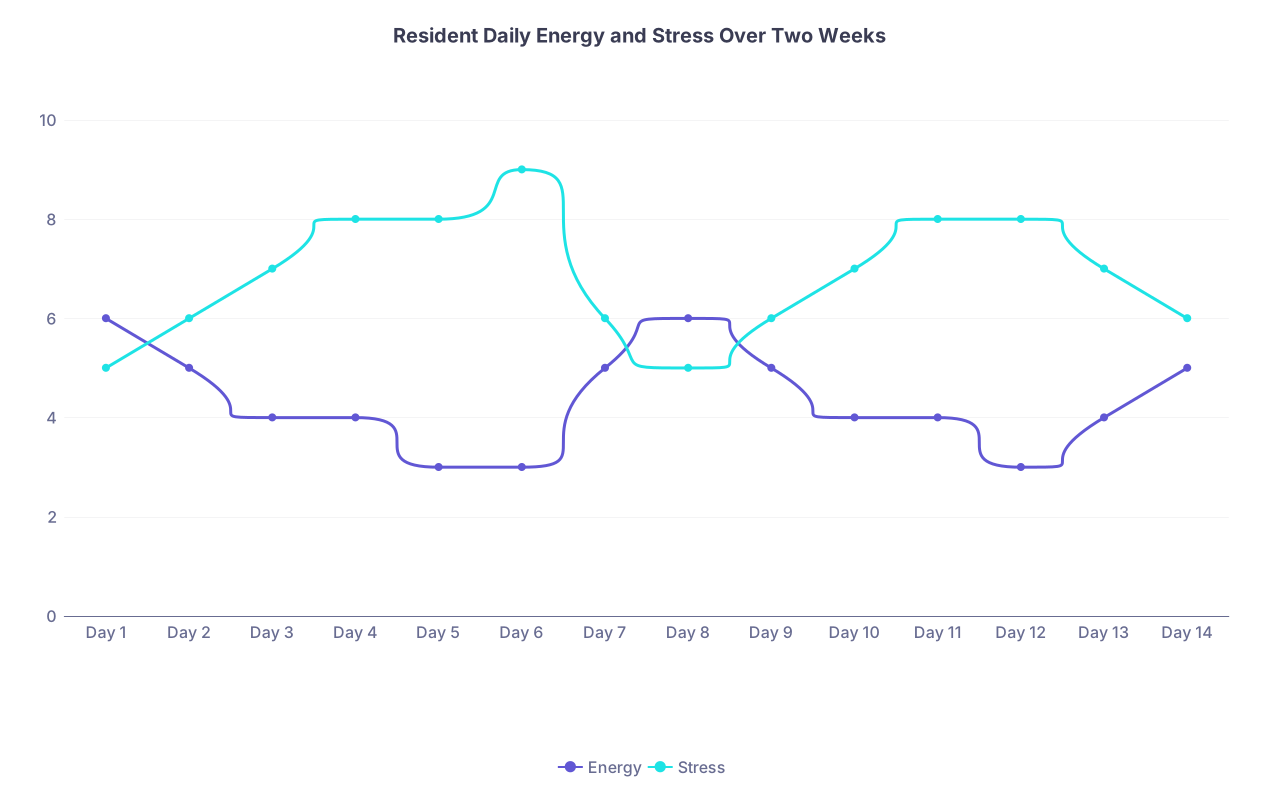
| Category | Energy | Stress |
|---|---|---|
| Day 1 | 6 | 5 |
| Day 2 | 5 | 6 |
| Day 3 | 4 | 7 |
| Day 4 | 4 | 8 |
| Day 5 | 3 | 8 |
| Day 6 | 3 | 9 |
| Day 7 | 5 | 6 |
| Day 8 | 6 | 5 |
| Day 9 | 5 | 6 |
| Day 10 | 4 | 7 |
| Day 11 | 4 | 8 |
| Day 12 | 3 | 8 |
| Day 13 | 4 | 7 |
| Day 14 | 5 | 6 |
You do not need fancy software. Even seeing on paper, “Every time I am on nights, my stress line spikes,” gives you leverage for conversations with chiefs and for planning true recovery between blocks.
A Small, Critical Warning
You will be tempted to skip reflection on the days you feel the worst. “Too tired.” “Too much to process.” “I will do it tomorrow.”
Those are the days that matter most.
So cut the protocol to 3 minutes if you must. But do not skip entirely. That is how the backlog builds. Then you wake up three months later and the idea of reflection just makes you more tired.
Be ruthless about one thing: frequency over depth. A shallow routine done daily beats a perfect one done twice a month.
How to Start Tonight
You do not need a special journal. Or perfect timing. Or a day off.
Do this:
- Pick a physical notebook or open a new note titled “Defuse Burnout – [Your Name].”
- Set a 5–10 minute timer.
- Run through: Snapshot → Decompress → Distill → Decide → Close.
- Put tomorrow’s time in your calendar as a repeating event.
That is it. You are not fixing residency. You are training your brain that every shift has an exit ramp.

Key Takeaways
- Burnout is fueled less by hours alone and more by unprocessed experience. A short, structured reflection routine acts like daily emotional decontamination.
- The core 10‑minute protocol – Snapshot, Decompress, Distill, Decide, Close – gives you control, clarity, and concrete micro‑actions after each shift.
- Weekly and monthly check‑ins turn scattered bad days into visible patterns, so you can target skill gaps, push back on system problems, and ask for help before you hit the wall.


