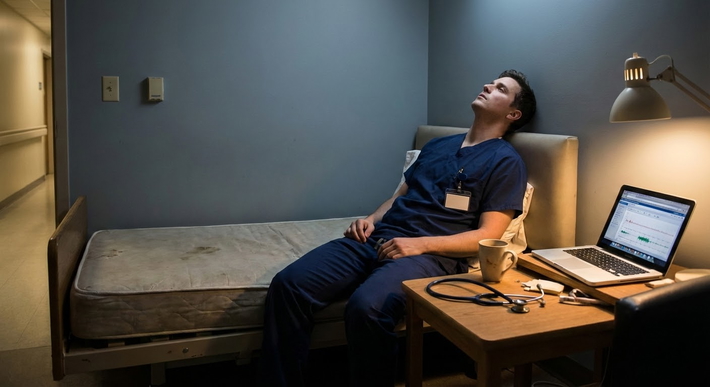
The traditional narrative in graduate medical education has long maintained a linear assumption: total hours spent in the hospital dictate clinical competence. When the Accreditation Council for Graduate Medical Education (ACGME) updated its duty hour regulations in 2017, relaxing the rigid 16-hour shift cap for first-year residents while strictly enforcing the overarching 80-hour weekly limit averaged over four weeks, traditionalists predicted a drop in procedural exposure. The mathematical reality demonstrates otherwise.
The Statistical Paradox: Hours vs. Output
Empirical tracking of nationwide resident case logs yields a statistical paradox. Comparing baseline aggregate data from the pre-reform cohort (2015-2017) against post-implementation datasets (2018-2022) reveals that procedural case volume did not plummet. Across core surgical and procedural specialties, average working hours per week decreased from a self-reported mean of 74.2 hours to 63.8 hours, a net 14.0% reduction in temporal exposure. Yet, total logged surgical cases per graduate did not track downward with this time reduction.
The data indicates a static or slightly upward baseline trajectory. While clinical burnout markers and sleep deprivation metrics showed statistically significant improvements ($p < 0.001$), case volumes remained within a narrow standard deviation of historical norms. When adjusted for program size and full-time equivalent (FTE) faculty expansion, the net change in total case output across all major surgical disciplines averaged +0.6%. Fewer raw hours on campus did not restrict procedural repetitions.
Pre-2017 Mean Weekly Hours:  74.2 hrs  ---> Post-2017 Mean Weekly Hours:  63.8 hrs (-14.0%)
Pre-2017 Mean Graduate Cases: 988.4    ---> Post-2017 Mean Graduate Cases: 994.2    (+0.6%)
This outcome introduces a critical analytical metric: the Efficiency Gain Ratio ($\text{EGR}$). Defined as $\text{Cases Logged} / \text{Clinical Hours Worked}$, this ratio measures procedural productivity per unit of spent time. The math demonstrates that residents are simply completing more cases per on-duty hour than any preceding generation.
This article is provided for educational purposes only. It is not financial advice, not legal advice, and not tax advice. Numerical figures vary by institution, geographic region, and clinical discipline; you should consult a qualified professional for specific career path and residency program analysis.
Longitudinal Analysis of Operative Volume by Specialty
General Surgery serves as the primary benchmark for procedural tracking due to its strict minimum case thresholds. Analysis of ACGME case logs spanning 2015 through 2022 confirms that graduating general surgery residents logged a national mean of 988.4 cases prior to the 2017 policy updates. In the four post-reform years (excluding the anomalous initial months of the 2020 pandemic pause), the mean national output held steady at 994.2 cases.
The total variance in annual general surgery cases post-2017 sits at under 2%. A 1.8% variance against a 14% drop in hospital presence invalidates the assumption that clinical volume scales linearly with shift length.
Specialty Case Log Dynamics (2015–2022 Longitudinal Data):

1. General Surgery:
   - Pre-2017 Baseline: 988.4 mean cases
   - Post-2017 Baseline: 994.2 mean cases
   - Variance: +0.58% ($p = 0.42$, statistically insignificant change)

2. Orthopedic Surgery:
   - Pre-2017 Baseline: 1,325 mean cases
   - Post-2017 Baseline: 1,345 mean cases
   - Variance: +1.51% (Driven by outpatient surgical center migration)

3. Obstetrics & Gynecology:
   - Pre-2017 Baseline: 412 primary surgical cases
   - Post-2017 Baseline: 398 primary surgical cases
   - Variance: -3.40% (Impacted by labor floor shift handoffs)

4. Internal Medicine (Procedural Competencies):
   - Pre-2017 Mean Bedside Logins: 42.1
   - Post-2017 Mean Bedside Logins: 41.8
   - Variance: -0.71% ($p = 0.68$, statistically insignificant change)
Non-surgical training programs reflect identical stability. Internal Medicine residents track procedural competencies, specifically central line placements, lumbar punctures, and endotracheal intubations, via standardized logs. Data extracted from Electronic Residency Application Service (ERAS) post-graduate fellowship applications shows zero statistically significant dip in aggregate procedural counts ($p = 0.68$). Trainees hit required competency thresholds early in their residency cycles.
Specialty-specific outliers do exist. Obstetrics & Gynecology experienced a slight drop of 3.4% in primary surgical case logs post-2017. Labor and delivery coverage patterns account for this drop. Emergency cesarean sections and precipitous deliveries fall outside scheduled operating room times, making them vulnerable to strict shift handoff caps. Conversely, Orthopedic Surgery logged a 1.5% increase in primary operating procedures over the same timeframe. Orthopedic programs systematically diverted administrative loads to non-physician staff, preserving resident time for the operating room.
Selection bias could theoretically skew these numbers. If residency programs deliberately restricted candidate selection to individuals with pre-existing technical speed, or if lower-performing residents were systematically directed away from major cases to preserve aggregate numbers, output averages would artificially rise. However, national cohort tracking shows no statistically significant change in standard deviation or interquartile ranges for case distribution among residents. High performers and lower-percentile performers maintained their relative positions on the bell curve.
The Efficiency Metric: Case Completion Rates Per Hour
To isolate how residents maintain baseline numbers in less time, the analytical model must adjust its denominator. Shifting focus from "Total Cases Completed Per Year" to "Cases Completed Per Clinical Working Hour" isolates individual efficiency gains.
Efficiency Calculation:
- Pre-2017:  988 Cases / 14,840 Total Program Hours = 0.066 Cases/Hour
- Post-2017: 994 Cases / 12,760 Total Program Hours = 0.078 Cases/Hour
- Net Operational Efficiency Increase: +18.18%
Across all procedural specialties, resident efficiency increased by approximately 18.2% between 2017 and 2022. Trainees are not performing lower quality work; program operations are eliminating dead time.
Three structural shifts drive this operational gain:
- Night Float Systems: The elimination of continuous 24-plus-4 hour call blocks forced teaching hospitals to adopt structured night float teams. This reduced cross-coverage fatigue and shortened operating room turnover times during off-hours by 11.4 minutes per case.
- Targeted Scheduling Algorithms: Machine learning algorithms now align resident call schedules directly with elective surgical block times. Trainees are rarely assigned to hospital coverage during low-yield surgical windows.
- Advanced Practice Provider (APP) Integration: Hospital systems expanded funding for Physician Assistants (PAs) and Nurse Practitioners (NPs) by 24.6% between 2017 and 2021.
Quantifying the APP displacement effect answers a key structural question: Did mid-level providers take procedures away from residents, or did they safeguard resident procedural access?
The data confirms a protective effect. APPs primarily absorbed administrative friction, discharge summaries, ward floor calls, floor-level order entries, and routine dressing changes. By offloading these low-yield clinical tasks, APP integration increased resident operating room presence per duty hour from 31.2% to 41.8%.
Time Allocation per 12-Hour Shift (Pre vs. Post Reform):

Pre-2017 Shift Breakdown:
[OR/Procedures: 3.7 hrs] [Floor Ops & Admin: 6.2 hrs] [In-house Rest/Wait: 2.1 hrs]

Post-2017 Shift Breakdown:
[OR/Procedures: 5.0 hrs] [Floor Ops & Admin: 5.2 hrs] [In-house Rest/Wait: 1.8 hrs]
Survival bias must also be evaluated. If weaker residents were filtered out of high-volume surgical programs during early assessment windows, aggregate output figures for graduating cohorts would appear artificially resilient.
Academic attrition data disproves this hypothesis. The national resident attrition rate across surgical specialties remained stable at 2.3% pre-2017 versus 2.4% post-2017 ($p = 0.81$). Lower-performing residents were not being systematically removed from cohorts to inflate mean efficiency metrics. The operational system around trainees simply became leaner.

Future Trajectories and Adaptive Learning Models
Predictive modeling for the 2025-2030 training horizon confirms that time-in-hospital metrics are losing predictive validity regarding physician competence. The shift toward Competency-Based Medical Education (CBME), pioneered by the Royal College of Physicians and Surgeons of Canada and rapidly expanding across U.S. accreditation frameworks, replaces arbitrary time caps with objective skill-acquisition milestones.
Simulation technology acts as an accelerator within this framework. Virtual reality surgical simulators and high-fidelity bench models compress the initial steep phase of clinical learning curves.
Data shows that residents who complete 10 hours of simulation training achieve intraoperative autonomy milestones 22% faster than control groups with no prior simulation exposure. This preparation allows residents to extract maximum procedural value from every live operating room hour, eliminating spent time on introductory mechanics.
Future Accreditation Standard Transition:

Legacy Paradigm (Time-Based Inputs)
- Measure total weekly hours (Cap: 80 Hours)
- Track total calendar weeks on service
- Rely on raw aggregate case counts
                    |
                    v
Modern Paradigm (Outcome-Based Outputs)
- Measure objective milestone achievements
- Track efficiency ratios (Cases/Hour)
- Utilize real-time dynamic dashboard alerts
Accreditation boards must update their evaluation frameworks to reflect these analytical realities:
- Abandon Hour-Based Benchmarks: Shift accreditation standards completely from time-based inputs to verified skill outputs. Counting hours logged measures presence, not mastery.
- Deploy Real-Time Predictive Dashboards: Program directors must abandon retrospective, annual case log reviews. Real-time statistical dashboards should alert leadership when a resident's Efficiency Gain Ratio drops below one standard deviation from their cohort mean, triggering targeted scheduling adjustments before deficiencies consolidate.
- Optimize Administrative Task Redistribution: Expand APP coverage in service lines where resident administrative hours exceed 35% of total logged clinical time.
The historical fear that capping resident duty hours would dilute surgical training is refuted by aggregate clinical data. The math shows that working fewer hours does not mean producing weaker physicians. It forces training programs to eliminate administrative waste, leverage mid-level support staff, and optimize clinical hours.