

It’s July 5th. You’ve survived orientation, your pager finally stopped screaming overnight, and you just discovered you were in the hospital for 14 hours yesterday even though it was a “short” call day.
This is the moment when people quietly decide:
“I guess this is just what internship is. I’m always here.”
Wrong.
Your first month of internship is exactly when you either build sustainable work hour habits… or you slide into being that resident who’s always staying 2–3 hours late and calling it “dedication.” I’ve watched both trajectories. The difference starts now, week by week, even day by day.
Let’s map it out.
Week 0–1: Orientation + First Real Shifts
At this point you should be:
- Learning the actual schedule (not the pretty PDF)
- Figuring out where your hours are leaking
- Setting a baseline for how long things really take you
Days 1–3: Reality Check and Baseline
Do this from day one:
Track your hours, not your feelings.
For the first week, write down:- Time you badge in or step onto the ward
- Time you leave the building
- Rough breakdown: prerounds, rounds, notes, orders, admissions, sign-out
Use something simple: Notes app, Google Sheet, or a tiny index card in your pocket.
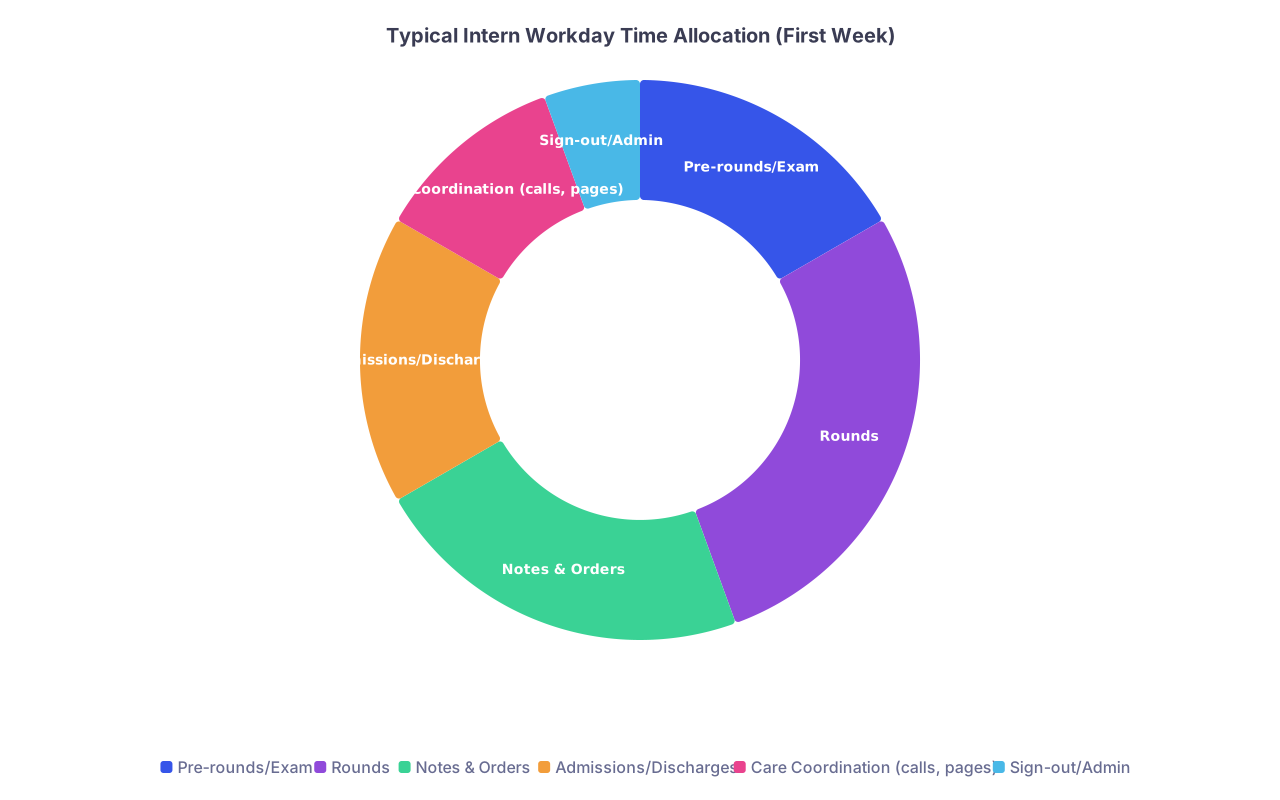
Typical Intern Workday Time Allocation (First Week) Category Value Pre-rounds/Exam 90 Rounds 150 Notes & Orders 120 Admissions/Discharges 90 Care Coordination (calls, pages) 60 Sign-out/Admin 30 Your perception of “I was here forever” is useless without numbers. I’ve seen interns swear they were there 16 hours when it was 11. Misery warps time.
Ask the senior: “What’s the expected out time?”
Not the theoretical ACGME max. The real team norm.- “On non-call days, when do interns usually leave?”
- “On long call, when do you expect we’re walking out?”
Get hard numbers. 5:30 pm. 7:00 pm. That’s your target.
Identify your chronic overstay risk.
In these first days, notice:- What are you still doing 60–90 minutes after everyone else is done?
- Are you rewriting notes 3 times?
- Are you chasing minor lab abnormalities at 6:15 pm?
At this point you should recognize: your instincts about what is “urgent” are probably wrong. Ask the senior:
“I stayed late yesterday following up X—was that necessary, or should I have handed it off?”
Days 4–7: Build Hard Stop Awareness
You are not yet trying to be “efficient.” That comes later. First, you’re building hour awareness and hard stops.
Daily checklist for the last 2 hours of your shift:
- 2 hours before expected out:
- Scan list: who is unstable? Who might crump? Prioritize those tasks now.
- Finish orders that actually change something today.
- 1 hour before expected out:
- Start drafting sign-out. Not at 6:59. At 5 or 6 pm.
- Message your senior: “Anything you want prioritized before I leave?”
- 30 minutes before:
- Commit to what gets handed off. You’ll fight the urge to “just finish that one more thing.” That urge is how you become a chronic late-stayer.
You’re learning a skill: protect the out time unless there is genuinely good reason not to. Emergencies, new critical admits, disasters? Yes. Reordering home vitamins at 6:45? No.
Week 2: Tightening the Workday Structure
By now, you know roughly when you’re arriving and leaving. At this point you should start building reliable routines around the hours so your work fits into the day instead of leaking over the edges.

Morning: Guard the Front End
Goal this week: be prepared for rounds without coming in an unnecessary hour early every single day.
Concrete steps:
Time your prerounds.
For 2–3 days, note:- Start time
- End time
- Number of patients
Then calculate your actual average: maybe 6–8 minutes/patient, not 20 like it feels on day 1.
Set a reasonable arrival time.
If rounds are at 8:30, and you need 45 minutes to preround and 15 minutes to scrub results:- You don’t need to be there at 6:15.
- 7:20–7:30 might be enough once you’re a bit faster.
Ask explicitly:
“Do you expect interns to see every patient before rounds, or is it OK if one or two are chart check only on busy mornings?”
Some attendings don’t care as long as you know the data. Others want eyeballs on everyone. Knowing this prevents “I got here at 6am because that’s what I did on my sub-I.”
Midday: Build a Work Block
This is where most people bleed hours: between 11 am and 4 pm.
Do this:
Create a post-rounds checklist. On a scrap of paper or your sign-out:
- Time-sensitive orders (pressors, diuresis, transfusions)
- Consults that affect same-day decisions
- Discharge tasks
- Notes
- “Nice-to-do” tasks
The order matters. You want the attending-level priorities done by early afternoon, not at 5 pm.
Set a “note finish” goal.
By week 2, you should aim to have:- Most daily notes done by 3–4 pm on standard ward days,
- Not start your first note at 4:30 pm.
If notes are always creeping to the end of the day, your hours will creep right with them.
End of Day: Install a Shutdown Ritual
You need a 15–20 minute shutdown routine that you trigger when you’re ~60 minutes from expected out time.
It should look like:
- Check vitals + labs on your sickest 2–3 patients.
- Make sure active orders for tonight are correct: PRNs, parameters, critical labs.
- Update sign-out in real time.
- Physically look at the clock and say (quietly, to yourself is fine), “I’m leaving at 6:30 unless someone is crashing.”
If your senior or attending constantly “finds” new tasks for you at 6:10, ask them earlier:
“At around 5:30, I’m going to start closing the loop—anything you know we’ll need before I go?”
You’re training everyone that your time actually ends.
Week 3: Using Systems to Protect Your Hours
By now you know the basics. Now it is about systems and boundaries, not “working harder.”
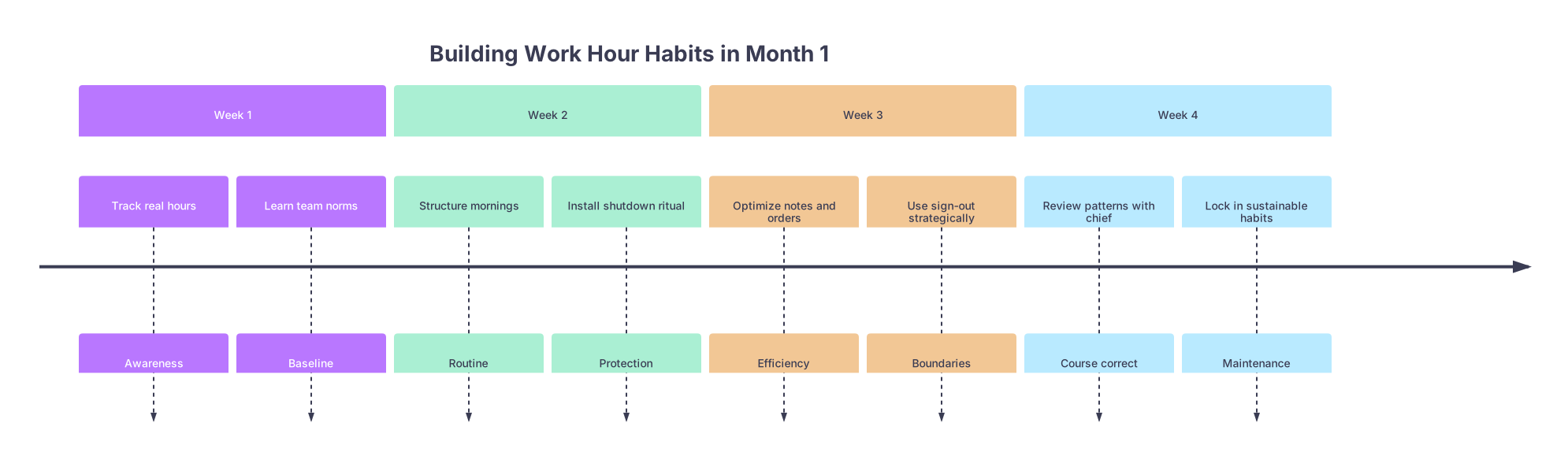
| Period | Event |
|---|---|
| Week 1 - Track real hours | Awareness |
| Week 1 - Learn team norms | Baseline |
| Week 2 - Structure mornings | Routine |
| Week 2 - Install shutdown ritual | Protection |
| Week 3 - Optimize notes and orders | Efficiency |
| Week 3 - Use sign-out strategically | Boundaries |
| Week 4 - Review patterns with chief | Course correct |
| Week 4 - Lock in sustainable habits | Maintenance |
Notes and Orders: Where Time Actually Goes to Die
At this point you should be aggressively cutting fluff.
Use templates ruthlessly.
- Ask co-interns or seniors to send you their smartphrases.
- Create a “minimal safe” H&P and daily note template—no novels.
Timebox each note.
Put a clock in front of your face.- Goal: Daily note in 7–10 minutes once data collected.
- H&P in 15–20 minutes tops (not hour-long epics).
If your attending is obsessed with long narrative notes, fine, but know that’s rare and often unnecessary. Ask:
“Is it OK if I use more problem-based notes to be faster as long as all info is there?”
Most will say yes.Batch similar tasks.
- Enter all med recs at once.
- Do all discharge med reconciliation in a single 20–30 minute block.
- Call all consults back-to-back.
This avoids mental context-switching, which is what turns 90 minutes of work into 3 hours.
Sign-Out: Your Boundary Tool
Bad sign-out means you can’t leave. Simple as that.
Improve it this week:
Write sign-out as you go. Not at 6:25 pm in a panic.
- After a major plan change: quick update in the sign-out.
- After a new admission: skeleton sign-out right away.
Hand off aggressively but safely.
Your job isn’t to preempt every hypothetical thing that could happen overnight. Your job is to:- Document the real concerns
- Give clear “if X, then Y” plans
- Make sure important studies/consults that will result overnight are flagged
If you regularly find yourself staying “just to see what that CT shows,” stop. That’s a classic intern trap. If it doesn’t change management right now, it belongs in sign-out.
Week 4: Course Correction + Protecting Yourself From Bad Cultures
By week 4, your patterns are forming. At this point you should step back and ask: are your current work hour habits sustainable or are you already sliding into “I live here”?
| Pattern Type | Healthy Example (By Week 4) | Unhealthy Example (By Week 4) |
|---|---|---|
| Arrival Time | Arrives 45–60 min before rounds most days | Arrives 2 hours early “just in case” every day |
| Departure Time | Leaves within 30–45 min of team norm on ≥4 days/week | Regularly 1–2 hours later than peers “finishing up” |
| Notes | Majority done by 3–4 pm | Starts notes after 4:30 pm several days/week |
| Sign-out | Updated throughout day, takes 10–15 min | Written from scratch at day’s end, takes 30–45 min |
| Hours Awareness | Knows weekly totals, logs outliers | Has no idea actual hours, just “always tired” |
End of Month: Talk to Someone Who Can Actually Fix Things
If your hours are terrible despite you being reasonably efficient, this may be a system problem, not a “you’re slow” problem.
By the end of week 4:
Look at your actual numbers.
- Average daily hours on wards
- Any >16 hour days
- Any 7-day stretches with no day off
Compare to duty hour rules (yes, really).
- Max 80 hours/week, averaged over 4 weeks
- 1 day off in 7, averaged over 4 weeks
- Max 24+4 hours for in-house call, etc.
If it’s off, escalate—professionally.
Start with:- Chief resident
- Program coordinator or PD if needed
The script is straightforward:
“I’ve been tracking my hours this month. On wards I’ve averaged about X hours/week, with Y days over Z hours. I’m doing my best to work efficiently, but I think the structure of the rotation is pushing us over duty hour limits. Can we talk about ways to fix this?”
That’s not whining. That’s doing your job as a physician who is supposed to be safe and rested enough to take care of actual human beings.
Install One Non-Negotiable Off-Duty Habit
This is the part people roll their eyes at until they’re crying in their car post-call.
Pick one non-work hour habit this month that’s non-negotiable on >80% of your non-call days. Just one. Examples that actually work:
- 20-minute walk outside before or after each shift
- Sitting down to eat one real meal without your phone
- 10–15 minutes of stretching before bed on post-call days
- Weekly therapy session or check-in with a non-med friend
If you can’t protect even one small off-duty thing in month one, you will not magically protect anything when fellowship applications, ICU rotations, and boards studying hit.
Daily Micro-Habits: What You Should Be Doing Each Day Now
To make this painfully concrete, here’s what a “good enough” intern day looks like from a work hour habit standpoint by the end of month one.
Morning (First 2–3 Hours)
- Arrive with a planned list: overnight events you’ll ask about, labs you’ll check first
- Preround in a predictable amount of time per patient (not wildly variable)
- Have at least a rough to-do list by the end of rounds, prioritized by:
- Sickest patients
- Time-sensitive actions
- Discharges
- Notes
- Deferrable tasks
Midday (11 am–4 pm)
- Knock out time-sensitive orders and consults before noon whenever possible
- Start or complete at least some notes before 2 pm
- Update sign-out after any big plan changes or new admissions
End of Day (Last 1–2 Hours)
- Begin shutdown ritual about 60 minutes before you expect to leave
- Hand off anything that can safely be done by cross-cover
- Actually leave when work is done, not linger to “look committed”
If you do those three pieces consistently, your hours will almost always be within reason on standard rotations.
One Visual to Keep in Your Head
Here’s the pattern I’ve seen over and over in interns who end up burning out vs those who make it through in one piece:
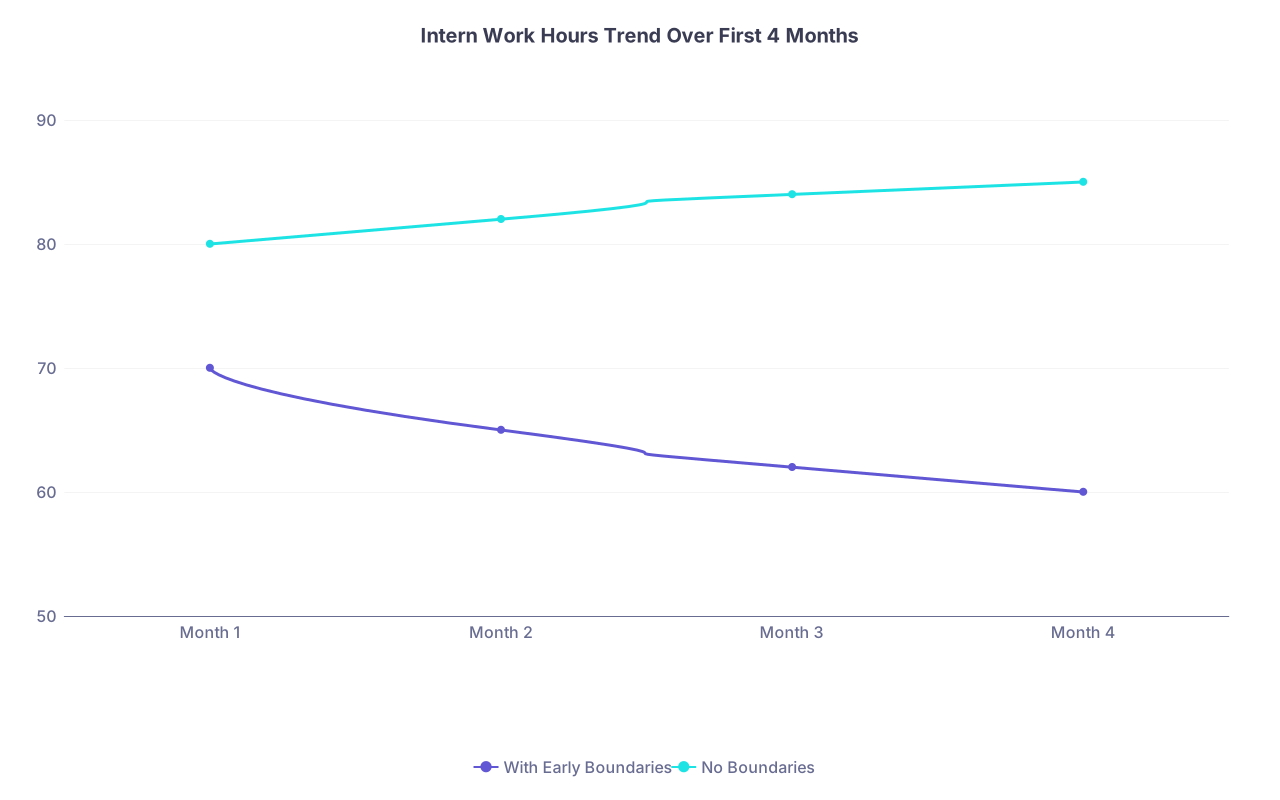
| Category | With Early Boundaries | No Boundaries |
|---|---|---|
| Month 1 | 70 | 80 |
| Month 2 | 65 | 82 |
| Month 3 | 62 | 84 |
| Month 4 | 60 | 85 |
Those are real patterns, not fantasies. The interns who get to 60–65 hours and stay there aren’t magically smarter. They just respected their own time from week one.
Key Takeaways
- Your first month of internship is when work hour habits harden. Track your actual hours from day one and learn the real team norms, not the brochure version.
- Protect your out time with structure: prioritized tasks, notes started early, sign-out written throughout the day, and a consistent shutdown ritual in the last hour.
- If you’re chronically over duty hours despite working efficiently, escalate early and professionally. Fixing broken rotation design in month one is easier than crawling out of burnout in month ten.


