

The most dangerous month of residency is not your first. It is somewhere around month 18, when work hours and burnout finally collide—and you stop even noticing.
You are not brand‑new anymore. You are not near the end. You are in the long middle. This is where good residents quietly start to crack.
Let me walk you through this point in training, chronologically, and tell you exactly what you should be doing week by week to keep your career—and your sanity—intact.
Where You Are At Month 18
At this point you should be:
- PGY‑2 in a 3‑year program (IM, Peds, FM, Psych)
- Or mid‑PGY‑2/early PGY‑3 in longer programs (Surgery, OB/GYN, EM, Neuro, Anesthesia)
Your reality:
- You know the system well enough to function fast.
- You get more responsibility, but not more sleep.
- The novelty is gone; the grind is not.
- You are smart enough to compensate for fatigue—until you are not.
Here is the rough trajectory that brings you to month 18:
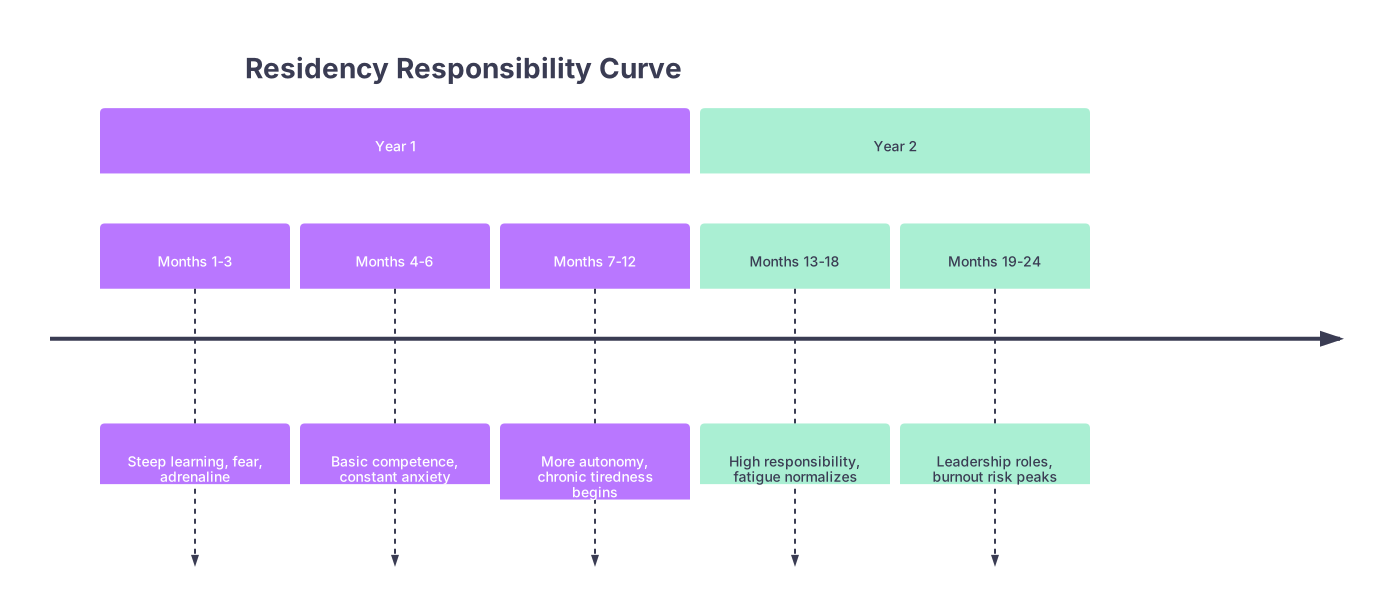
| Period | Event |
|---|---|
| Year 1 - Months 1-3 | Steep learning, fear, adrenaline |
| Year 1 - Months 4-6 | Basic competence, constant anxiety |
| Year 1 - Months 7-12 | More autonomy, chronic tiredness begins |
| Year 2 - Months 13-18 | High responsibility, fatigue normalizes |
| Year 2 - Months 19-24 | Leadership roles, burnout risk peaks |
By month 18, your baseline is:
- 60–80 hours some weeks, “better” 50–60 others
- Response times like: “Yes I can stay late,” “No problem, I will pick up that admit,” said on autopilot
- A weird sense that days off are for catching up on chores, not resting
The collision happens when:
- Your work hours plateau at “barely ACGME compliant on paper”
- Your emotional reserves have been drained for over a year
- Your coping strategies from PGY‑1 no longer work
So we build a timeline around this month—month 18—and treat it like a pivot point.
The 3‑Month Window Around Month 18 (Months 16–18–20)
At this point you should zoom out from “today’s call” and think in 3‑month blocks. Burnout does not appear in a day; it creeps over quarters.
Months 16–17: Early Warning Phase
If you are around months 16–17, here is what you should be doing.
1. Audit your work hours vs. energy, not just the duty hour log.
Once per week, for 4–6 weeks, write down:
- Actual hours in hospital
- Time from leaving work to lying in bed
- How many true days off you had (no charting, no emails, no call)
- One word for your energy level that week (e.g., “fried,” “ok,” “numb”)
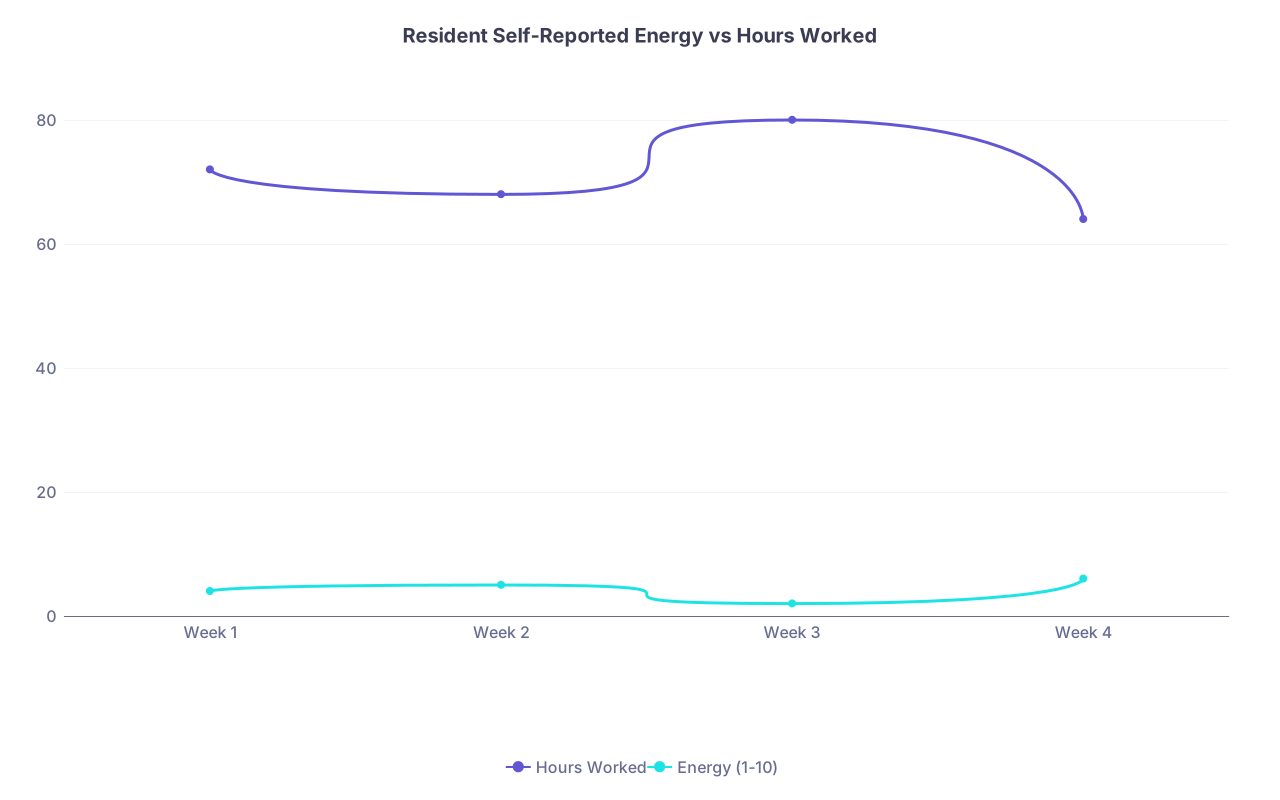
| Category | Hours Worked | Energy (1-10) |
|---|---|---|
| Week 1 | 72 | 4 |
| Week 2 | 68 | 5 |
| Week 3 | 80 | 2 |
| Week 4 | 64 | 6 |
If your hours fluctuate but your energy never really recovers, that is not “being a good sport.” That is early burnout.
2. Identify your worst month 18 rotations now.
Look at your schedule for months 16–20.
- ICU? Night float? ED? Busy surgical rotations?
- Are any of them back‑to‑back?
- Is there a “black hole” month everyone complains about?
You should:
- Flag those months on a calendar (physically, not just mentally)
- Plan time off around them, not during an easier block
- Warn your close people: “This month I will be less available—please do not take it personally.”
3. Put non‑negotiable basics on “auto‑schedule.”
At months 16–17, build habits that will protect you when month 18 hits and you stop caring.
Pick 3–4 things and automate them:
- A recurring 20–30 minute weekly call with someone who knows you outside medicine
- Pre‑planned grocery delivery or simple meal prep every off‑call day
- One physical activity you can do half‑asleep (walk, bike, yoga) scheduled twice per week
- Therapy or coaching if you have even a whisper of “I might be burning out”
If you wait until you feel horrible, you will not set any of this up. Do it now.
Month 18: The Collision Month
This is the month we are talking about. The one where work hours feel “normal,” but you are not.
Here is how to structure this month week by week.

Week 1: Reality Check and Baseline
At this point you should:
- Document a 7‑day snapshot honestly.
For one full week, track:
- Start and end time of every shift
- Number of new admissions / consults per shift
- Time you ate your first real meal each day
- Sleep hours per 24‑hour period
- Number of times you woke up thinking about work
Do not “make it pretty” for duty hour reporting. This snapshot is for you.
- Screen yourself using quick tools.
Take 10–15 minutes and run through:
- A brief burnout inventory (e.g., Oldenburg Burnout Inventory items you can find publicly)
- 2‑item depression screen: “Little interest or pleasure? Feeling down, depressed, or hopeless?” nearly every day = red flag
- A quick anxiety or substance use check if relevant
If your scores are bad and your internal response is “Yeah but everyone here is like that,” that is exactly the problem.
Week 2: Structural Moves, Not Just Self‑Care
This week you should stop pretending that better coffee and a new water bottle will solve systemic overload.
Focus on three structural levers:
- Schedule and protect one true day off.
Not a day “off” that you fill with:
- Charting
- Research that you hate
- Committee meetings
A real day off means:
- No EHR logins
- No email responses
- No work‑related tasks except an emergency page that only you can handle (and those are rare)
Protect this like an OR block.
- Fix the worst 90 minutes of your day.
Every resident has a daily horror zone:
- 5–6 p.m. sign‑out chaos
- 3–4 a.m. admits that crush you
- 11 a.m.–1 p.m. overlapping rounds/consults/notes
Ask: “If I changed just 90 minutes, where would it matter most?”
Then:
- Renegotiate sign‑out so it starts 10–15 minutes earlier or with a call structure
- Pre‑chart 30 minutes on patients while waiting for labs
- Batch pages: ask nurses to cluster non‑urgent calls during a 15‑minute window instead of random all night
Tiny structural changes in the worst 90 minutes often buy you sanity far out of proportion to the time.
- Have a blunt check‑in with one trusted senior or attending.
Say it clearly:
“I am about 18 months in. My hours are technically within limits, but my burnout is getting worse, not better. I want to fix this before it breaks me. Can we look at my schedule and options?”
Someone in your program knows where the bodies are buried. They know:
- Which rotations consistently violate work hour spirit, if not letter
- Which attendings run decent services vs chaos
- Where you can realistically ask for help or swaps
Use that.
Week 3: Protect Cognitive Function
At this point you should stop pretending you are immune to fatigue‑related error.
There is good data that:
- After ~16 hours awake, your performance is like being legally drunk
- Residents underestimate impairment after night shifts consistently
Your Week 3 tasks:
- Create hard rules for yourself around sleep and safety.
Design 2–3 non‑negotiables. Examples:
- “No driving home post‑24h call if I am nodding off in the workroom—Uber or call a co‑resident.”
- “No major life decisions (quitting, switching specialties, breaking up with significant other) made post‑call.”
- “If I have had <4 hours of actual sleep in 24 hours, I will double‑check all orders with one backup system (pharmacist, co‑resident, or re‑reading).”
- Standardize your handoff process.
Handoff is where tired brains drop things.
Use a consistent scaffolding (I do not care if it is I‑PASS or your own variant), but at this point you should:
- Keep a running list of “must‑to‑do before sign‑out” and not rely on memory
- Identify 1–2 chronic high‑risk patients per shift and flag them clearly in your sign‑out
- Never say “They are fine” about a patient you have not laid eyes on in 6–8 hours
- Notice when apathy replaces concern.
Burnout often shows up as “I just do not care anymore” rather than dramatic tears.
If you catch yourself thinking:
- “If they bounce back to the ED, whatever.”
- “If I miss something, that is just how it is.”
- “I am too tired to call the family back, they will manage.”
That is emotional exhaustion talking, not the real you. That thought pattern is a clinical sign. Treat it like a symptom.
Week 4: Recalibrate and Renegotiate
End of month 18, you reassess.
At this point you should:
- Compare Week 1 snapshot with now. Any improvement? Worse? Same?
- Decide what is tolerable and what is not.
Then do three things:
- Talk to leadership with data, not vibes.
Program directors take you more seriously when you come with:
- Concrete weeks with >80 hours
- Specific cases where handoff or fatigue nearly caused harm
- Clear requests: “I need X,” not just “This is bad.”
- Plan your next 3‑month sustainability block.
Look ahead to months 19–21:
- Identify rotations where you can “rebuild” (clinic‑heavy, consults with less call)
- If you have vacation, anchor it between two hard blocks, not in the middle of an easy month
- Pre‑block time for Step/boards study so it does not cannibalize your only rest days later
- Decide one big thing you will not do.
At this stage, overcommitting is how residents burn completely out:
- Extra research project you secretly hate
- Another committee
- Teaching session every week on your only lighter afternoon
You should pick one thing and say: “No. Not this year.”
A Typical “Bad” Month 18 Week vs “Adjusted” Week
Use this comparison to see where you stand.
| Aspect | Unchecked Week (Burnout Path) | Adjusted Week (Protected Path) |
|---|---|---|
| Work hours | 75–80 logged as 65–70 | 65–70 logged accurately |
| Post‑call time | Stay 2–3 hrs past sign‑out | Out within 60–90 minutes |
| Days off | 0 true days, 1 “admin” day | 1 true day, 1 admin half‑day |
| Sleep per 24 hrs | 4–5 hours, fragmented | 6–7 hours on at least 3 nights |
| Exercise/movement | 0 sessions | 2 short sessions (20–30 min) |
| Social contact | Random texts only | 1 planned call/meet |
| Emotional state | Numb, irritable, detached | Tired but engaged, recoverable |
If your actual week looks like the first column, do not gaslight yourself. That is not “normal.” That is a setup.
Day‑By‑Day Micro‑Habits During Hard Rotations
Let us zoom further: what you should do each day during a brutal month 18 rotation.
On Call Days
At this point you should:
- Front‑load food and hydration by noon. After that, chaos wins.
- Pick 1–2 “non‑negotiable” tasks and ignore the rest of your personal list.
Minimum viable self‑care on a call day:
Drink water early (12–16 oz by mid‑morning).
Eat something with protein before 2 p.m.
Take one 5‑minute “no pager” bathroom reset where you:
- Sit
- Breathe slowly
- Do not scroll your phone
That is it. Heroic routines will fail. Small ones will stick.
Post‑Call Days
Stop treating post‑call as a bonus workday.
At this point you should:
- Go home. Directly. No bargain of “I will just finish these 8 notes.”
- Sleep early, not just long.
Sample structure:
- Hour 0–1: Get home, shower, snack, blackout curtains.
- Hour 1–4: Core sleep block.
- Hour 4–5: Light food, short walk, no screens if possible.
- Evening: In bed early (9–10 p.m.), protect circadian rhythm.
Post‑call is not where you “catch up” on everything. It is where you avoid digging the sleep debt crater deeper.
Golden Days (Actual Days Off)
Use a simple rule: 1/3–1/3–1/3.
- 1/3 rest (sleep, lounging, low‑key)
- 1/3 life maintenance (laundry, groceries, bills)
- 1/3 something that reminds you you’re a person (hobby, friends, nature, whatever your version is)
If you let chores expand to fill the entire day off, you will go back to work Monday already empty.
When Work Hours Are Officially “Fine” but You Are Not
Here is the quiet trap of month 18: your duty hours may look compliant.
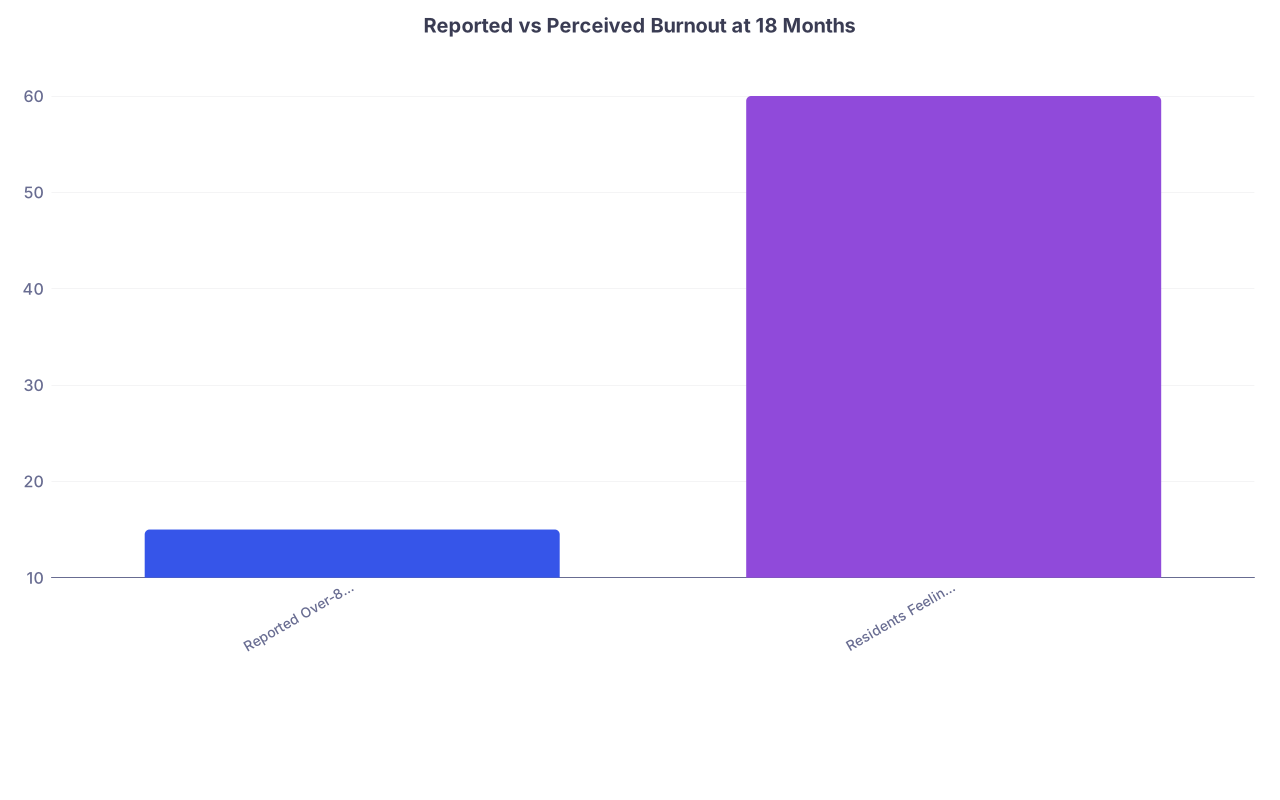
| Category | Value |
|---|---|
| Reported Over-80h Weeks | 15 |
| Residents Feeling Burned Out | 60 |
This is what I see often:
- Only 10–20% of residents report frequent >80‑hour weeks.
- 50–70% still report high burnout.
Because the problem is:
- Rotations that are 75 hours of unrelenting intensity
- Nights with zero sleep built into a “72‑hour” week that technically passes
- Emotional load: codes, deaths, endless bad news conversations
At this point you should separate two questions:
- “Are the numbers legal?”
- “Is this sustainably human?”
If question 2 is a clear no, you have three levels of action:
- Personal: Improve your habits, boundaries, support.
- Programmatic: Bring data, propose realistic fixes (extra night float coverage, redistribute admissions, improve cross‑coverage rules).
- Systemic: Use anonymous reporting if you are truly unsafe and ignored.
You cannot fix the entire system at month 18. You can refuse to silently self‑destruct in it.
FAQ (Exactly 3 Questions)
1. How do I know if what I am feeling at month 18 is “normal tired” or actual burnout?
Look beyond feeling tired. Red flags for burnout include: dread before every shift (not just the hard ones), persistent cynicism (“nothing I do matters”), emotional blunting (no joy in things you used to like), and a sense that your work is detached from your values. If these have been present most days for >2–3 weeks, that is not just normal residency fatigue. It is burnout, and you should treat it like a real medical problem—talk to someone (trusted attending, PD, mental health professional) and adjust something concrete in your schedule or commitments.
2. What if I am afraid to report duty hour violations because of retaliation?
Then you document everything for yourself first: dates, hours, specific incidents where you were told to stay late or under‑report. Use the most anonymous route available (anonymous surveys, ombuds office, GME office separate from your program). Talk to senior residents who have already graduated if possible; they often know which channels are safe. If your program culture punishes honest reporting, that is a program problem, not a you problem—and it is exactly what institutional oversight is supposed to address.
3. I am at month 18 and already fantasizing about quitting. Is that a sign I picked the wrong specialty?
Not necessarily. I have seen excellent future internists, surgeons, and psychiatrists all hit that wall around month 18. Intrusive “what if I just walked out” thoughts are often a symptom of exhaustion and loss of control, not proof you chose wrong. Before you blow everything up, change what you can: improve sleep, drop optional commitments, get support, adjust your hardest rotations if possible. If, after 2–3 months of targeted changes and one relatively lighter rotation, you still feel absolute dread at the thought of doing this work long term, then it is time to seriously reassess fit—with mentors who know you and the specialty well.
Open your schedule for the next 4 weeks right now and block off one true day off each week—then message whoever you need to so those days stay protected.


