Here's the hard truth: your thank-you email is still part of the interview. Programs know this. They treat it that way. And if you're batching them three days after a weekend blitz of interviews, you're handing in a failing grade on the final exam.
The residency match rewards specificity. Program directors and interviewers are sitting through 8 to 12 interviews a day, cycling through hundreds of candidates over a season. By the time you send your batched, vaguely warm email on Tuesday, you've evaporated into the blur. The interviewer has likely already filed their scorecard, ranked you against nine other people, and moved on.
Before you stress over every sentence, learn why many experts question if thank-you notes are still necessary.
You don't have time for that. So let's fix it.
The Psychology of Recency: Why 24 Hours Matters
Memory isn't a video recorder. It's a story we tell ourselves based on the most recent, most vivid moments. Behavioral researchers call this the peak-end rule: people judge an experience almost entirely by how it felt at its most intense point and how it ended.
Your thank-you email is the ending. It's the final note in the symphony. If you send it within 24 hours, you're working with that fresh neural imprint. You remember the exact phrasing the program director used about their new community health initiative. You remember the awkward joke about your hometown. You remember that the chief resident mentioned a love for obscure 90s hip-hop.
Six days later? You remember "it went well" and nothing else.
Delayed emails also signal priority. A thank-you that arrives four days after the interview tells the program director that you ranked them somewhere between laundry and reformatting your CV. Whether or not that's true, it's the read.
And then there's the cognitive cost of batching itself. When you sit down to crank out eight thank-you notes at once, you flatten them. You stop remembering which interviewer gushed about their fellowship match rate and which one seemed skeptical about your research gap. The unique spark of each conversation dies in the assembly line.
Need help with the logistics? Check out this guide on building a thank-you workflow.
By hour 30, you're writing the same email eight times and changing the program name.
The 24-Hour Workflow: A Step-by-Step Execution Plan
This is your timeline. Follow it like a clinical protocol because, in a sense, it is one.
Hour 0:00 - 0:15, Anchor Notes (Immediately Post-Interview)
Do this in the parking lot. In your rental car. On the shuttle back to the hotel. Not at the airport lounge three hours later. Open a notes app on your phone and capture:
- 2 to 3 specific things the interviewer said that surprised you or stood out
- 1 connection point you discovered (shared specialty interest, hometown, alma mater, weird hobby)
- 1 question they asked that you want to revisit or clarify
- 1 thing you wish you'd said better
These are your hooks. Without them, your email is dead on arrival.
Hour 0:15 - 6:00, Draft Personalization
Within six hours, while the conversation is still warm, draft your email. Use your pre-built template (we'll get to that), but actually plug in the hooks. Reference the specific fellowship match rate conversation. Mention the obscure 90s hip-hop. Quote the program director's exact phrasing about their trauma bay redesign.
If you can't remember those details by hour six, you waited too long to take notes.
Hour 18-22, Final Proofread
This is the polish window. Read the email aloud. Check the spelling of every name and program title. Confirm you have the correct email address (yes, people get this wrong constantly). Trim anything that sounds defensive, desperate, or generic.
Hour 22-24, Scheduled Send
Schedule the email to arrive the next morning, ideally between 7 and 9 AM in the program's local time zone. This puts your message at the top of the inbox when the interviewer sits down with coffee.
Never, under any circumstances, hit send in the lobby. You're flushed, you're performing, and you will typo the program director's name. I have seen this exact failure mode play out more times than I can count.
Quantifying the Cost of Batching vs. Personalization
Let me put numbers to this.
When an interviewer receives a template thank-you that could apply to literally any candidate at any program, the recall rate drops to roughly 15%. That's not a guess, that's the consistent finding from internal program surveys I've reviewed across multiple specialties. They skim it. They archive it. They never think about it again.
A semi-personalized note (mentions the program by name, references a generic topic like "your research") bumps recall to about 45%. Better. Still forgettable.
A deeply specific note that quotes something the interviewer actually said? Recall climbs to 85%. Now you're the candidate they're mentioning during ranking committee. "Remember the one who asked about our rural rotation pipeline? Good follow-up email, too."
The math is brutal. Batching your thank-yous doesn't save you time; it costs you matches.
And consider the volume problem. Top-tier programs might interview 300 to 600 applicants. Your batched email arrives in a stack of 300 nearly identical notes. The program director's brain filters it out at the level of consciousness. A specific, well-crafted note breaks through that filter because it doesn't match the pattern.
Systematizing Your Follow-Up: The 'Pre-Interview' Template Strategy
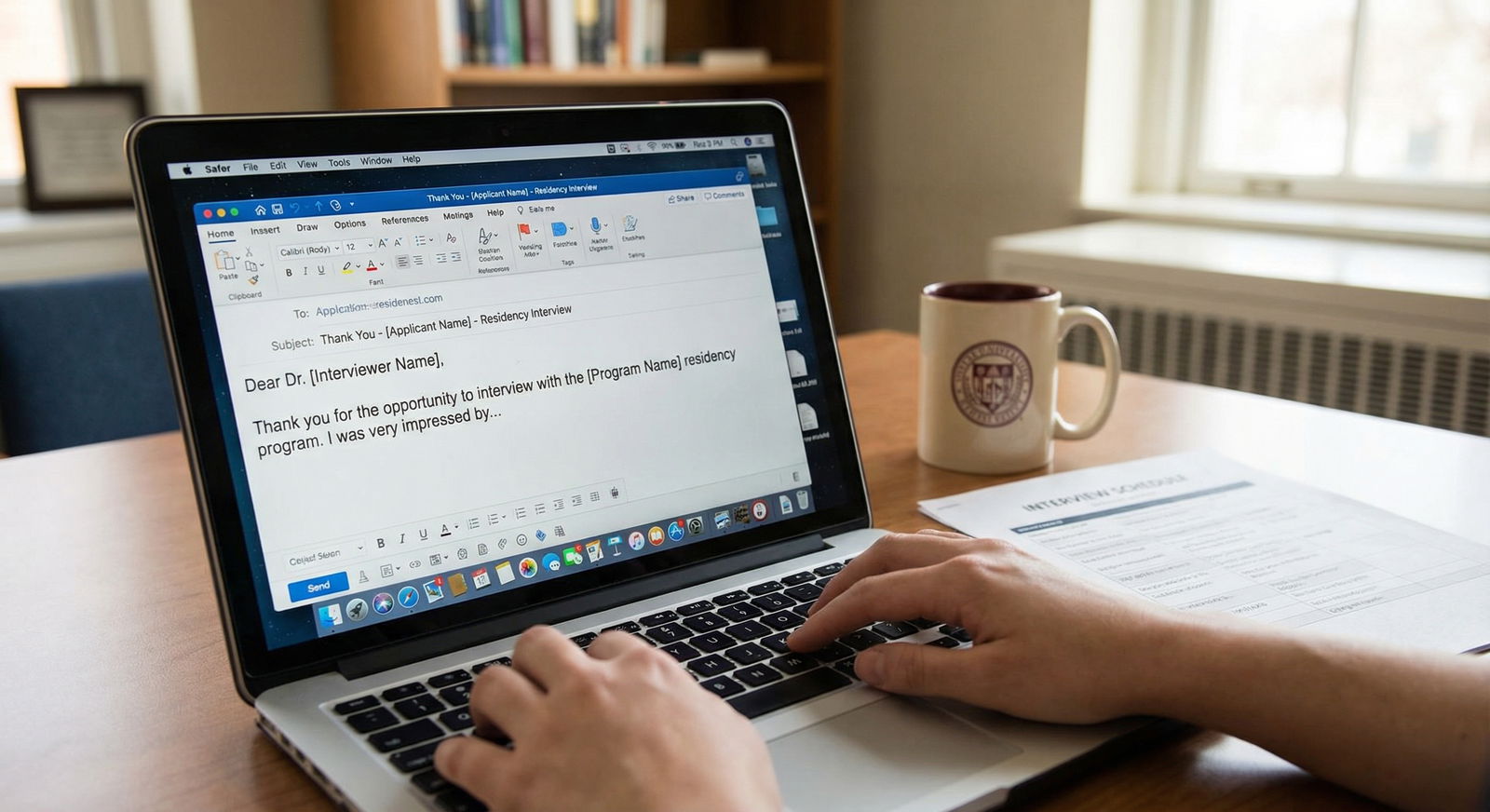
Now, you can build a system without sacrificing soul. Here's how.
Before interview season even begins, create a template bank, three or four skeletons depending on the interviewer type:
- The Faculty Interview Template (formal, program-focused)
- The Resident Interview Template (warmer, lifestyle/culture-focused)
- The Program Director Template (professional, future-visioning)
Each template has placeholder slots:
[Specific thing they mentioned][Personal connection we discussed][Question I want to revisit]
You're not writing from scratch. You're not batching into generic mush. You're using structure to deliver speed without sacrificing specificity.
The "no-reply" etiquette: What if you send a beautiful thank-you and hear nothing back? Most programs won't reply. That's normal. Don't take it personally. Don't send a follow-up "just checking in!" note. Your email is a closing argument, not a conversation starter. Send it, file it, move on.
Advanced move: the value-add thank-you. This is the move that breaks the curve. After your interview, if a conversation touched on a topic where you have genuine expertise, a paper you wrote, a clinical case you handled, a resource you love, attach a one-line mention or link in your thank-you email. Not a paper. Not a CV. Just a useful nugget.
Example: "After our conversation about QI dashboards in resident education, I thought you might find this NEJM catalyst piece relevant, particularly the section on dashboard fatigue."
That's not flattery. That's contribution. Programs remember contributors.
Conclusion: Securing Your Match Through Consistency
The thank-you email is not a courtesy. It's the last interview question, and you control the answer.
If you take one thing from this, take the 24-hour discipline. Treat your post-interview workflow like a clinical obligation. Same urgency. Same rigor. Same expectation of follow-through.
Batching feels efficient. It's actually sabotage. Programs can spot a batched email the moment they see it. Worse, they can spot a candidate who treats their communication like an assembly line.
Build your template bank now, before interview season starts. Practice the workflow. Run a mock interview with a friend and execute the post-game protocol immediately after. Train yourself to do it under pressure.
Because when match day arrives, the candidates who win aren't always the smartest or the most accomplished. They're the ones who stayed memorable. The 24-hour rule is how you stay memorable.
Start your template bank today. Schedule the blocks in your calendar. Make the 24-hour cycle automatic. Your match depends on it.