The belief that thank-you notes can rescue—or ruin—your residency application is wildly overblown.
You’ve probably heard some version of this: “If you don’t send a thank-you note after every residency interview, programs will think you’re not interested and you’ll drop on their rank list.” This kind of advice gets repeated on Reddit, in group chats, and sometimes even by well-meaning deans who have not actually sat on a rank committee in years.
Let me be blunt: thank-you notes are mostly noise in the residency match. They’re not nothing, but they are nowhere near the lever students think they are.
Here’s what the data and real-world program behavior actually show—and how you should handle thank-you notes without wasting your time or sabotaging yourself.
What Programs Really Do With Thank-You Notes
Most applicants imagine some super granular process: every note gets read, filed, and factored into ranking with precision. Reality is more boring and way less romantic.
I’ve sat in rooms where 50–70 interviewees are discussed for 10–15 spots. Here’s how much time was spent on thank-you emails:
Almost none.
We’re talking seconds. Maybe a comment like: “She sent a really thoughtful follow-up about that project we discussed, seems genuinely interested.” Then right back to clinical performance, letters, and interview impressions.
The NRMP Program Director Survey (pre- and post-Step 1 pass/fail) has consistently shown the big levers for getting ranked:
- Clinical grades (especially core clerkships and sub-I performance)
- Letters of recommendation (especially from known faculty in the specialty)
- Interview day performance and interpersonal skills
- USMLE/COMLEX scores, Step 2 in particular now
- Perceived fit and commitment to the specialty
You know what doesn’t show up anywhere near the top of those lists?
Thank-you notes.
Some PDs explicitly tell applicants in the pre-interview webinar: “We don’t use thank-you notes or post-interview communication in ranking.” And they mean it. Many programs lock their rank lists quickly after the last interview day and don’t touch them again.
Are there programs or individual faculty who glance at thank-you notes and silently bump someone up one or two spots because they liked the vibe? Yes. Human beings are not robots. But if you’re applying to 40–60 programs, banking on that is like planning your finances around lottery tickets.
What the Evidence (and Patterns) Actually Suggest
We don’t have a randomized controlled trial of “thank-you vs no thank-you” in residency hiring. But we have enough patterns, surveys, and insider accounts to say a few things with confidence.
1. Thank-you notes rarely create interest
Programs don’t fall in love with you because you wrote, “Thank you for your time.” If you were mediocre or awkward in the interview, no email is going to erase that.
What thank-you notes sometimes do is confirm existing interest:
- You were already flagged as strong and a good fit
- You send a short, specific note that shows you paid attention
- The faculty member thinks, “Yeah, they really might come here”
At best, that solidifies—rather than creates—a positive impression.
2. No thank-you note is almost never a disqualifier
There’s a persistent myth: “If you don’t send a thank-you, they assume you’re not interested and drop you.” That might be true for a tiny minority of old-school faculty in very small programs where they know every applicant intimately.
But in most mid-to-large programs with dozens of interviewees per spot, the reality:
- Many faculty do not track who sent notes and who didn’t
- Some never even see the notes because they go to an admin inbox
- A non-trivial portion of applicants don’t send them at all
Nobody is maintaining a spreadsheet labeled “Ungrateful Applicants – Drop in Rank.”
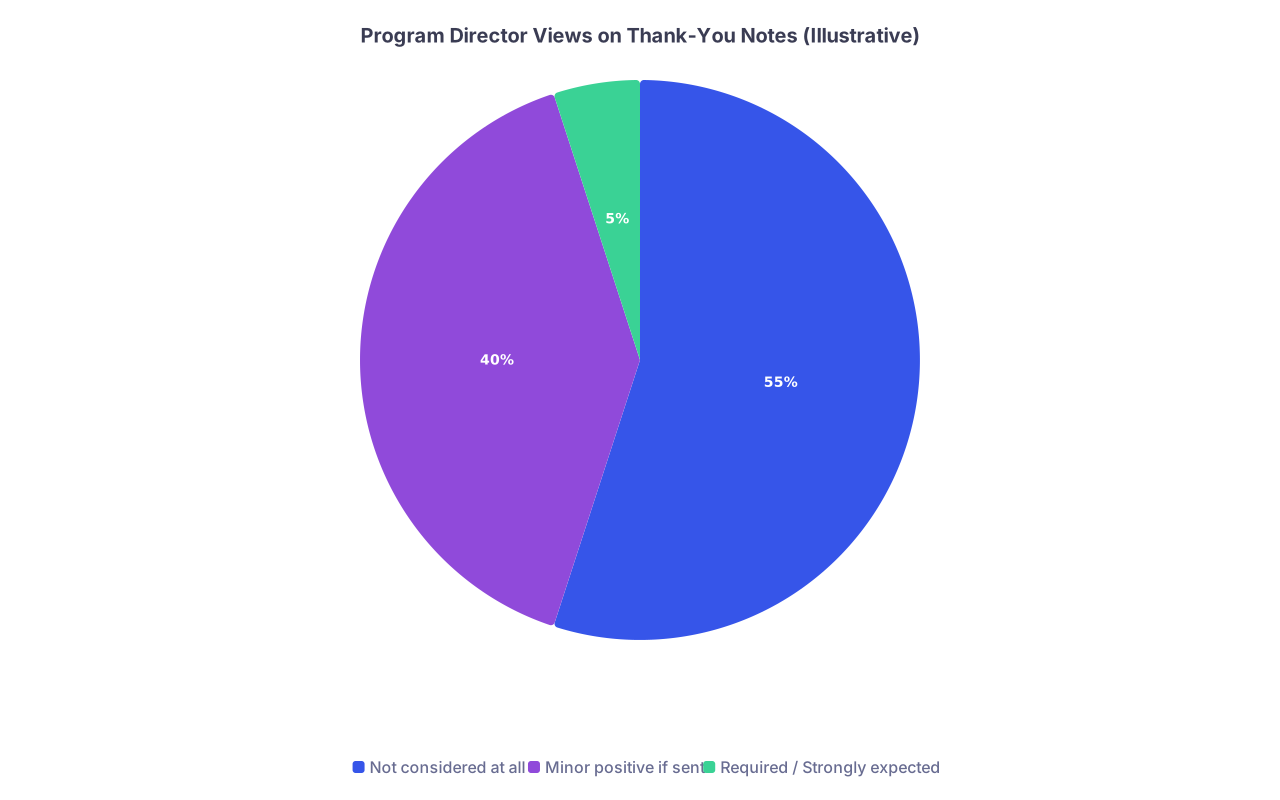
| Category | Value |
|---|---|
| Not considered at all | 55 |
| Minor positive if sent | 40 |
| Required / Strongly expected | 5 |
Those numbers are approximate, but they match what you hear when PDs are honest off the record: most don’t care, some mildly appreciate them, a tiny fraction fetishize them.
You shouldn’t build your whole application strategy around that 5%.
3. Some programs explicitly ban or neutralize them
Plenty of programs now say:
- “We do not expect thank-you notes.”
- “Thank-you emails are not reviewed as part of ranking.”
- “Please don’t send follow-up communication; we cannot answer preference questions.”
They’re trying to avoid ERAS turning into a post-interview arms race of love letters and promises.
If a program says “no thank-you notes needed,” believe them. At best, your note is ignored. At worst, you look like you can’t follow instructions.
When Thank-You Notes Can Actually Matter (A Little)
Here’s where I’m not contrarian: thank-you notes are not totally useless. They can have small, targeted benefits if you use them the right way.
Scenario 1: Clarifying an important point or correcting a miss
Let’s say you blanked on a question or realized later you misrepresented something:
- You misunderstood a research question and gave a confused answer
- You forgot to mention a key experience relevant to the program
- You misstated a date, role, or outcome that actually matters
In that case, a follow-up email disguised as a thank-you is useful:
“Thank you again for speaking with me about the ultrasound curriculum. I realized after our conversation that I didn’t fully answer your question about quality improvement projects. In my sub-I, I actually helped implement…”
That’s not an etiquette move. That’s damage control plus additional data.
Scenario 2: Expressing specific, credible interest
Not vague: “I would be honored to train at your excellent program.” Everyone says that.
Specific, credible interest sounds like:
- “Your 4+2 schedule and dedicated ambulatory block are exactly what I’m looking for.”
- “The chance to work with Dr. X on Y aligns directly with my prior work on Z.”
- “Your robust global health track with protected time and funding fits my long-term goal of…”
If you might realistically rank this program highly, a brief, specific note to the PD or a key faculty can put you in the mental box of “more likely to come here.” For borderline decisions, that can sometimes help.
Scenario 3: Niche programs, small specialties, or very small classes
If you’re applying to:
- Highly competitive small specialties (like derm, plastics)
- Very small programs taking 1–3 residents per year
- Programs where you’ve done an away rotation and know people personally
Then individual perception matters more. In that setting, a sincere, personalized thank-you can carry slightly more weight because the signal-to-noise ratio is higher and they know you better.
Still not a magic trick. Still not going to rescue a weak file. But here it goes from “almost irrelevant” to “mildly relevant.”
How to Write a Thank-You Note Without Wasting Time
Let me cut through the performative nonsense. You do not need paragraphs of flowery gratitude. You do not need to send 10 unique essays after every multi-interviewer day.
Here’s a simple structure that works, takes 3–5 minutes, and doesn’t make you sound like ChatGPT’s cousin.
Who to email
- If the program explicitly says “send to a central email only” → do that.
- If not restricted, you can send to:
- Program director
- Program coordinator
- Individual faculty you had meaningful conversations with
- Chief residents who clearly took time with you
You don’t need to email every single interviewer if you had a big panel. Target the ones where there was actual engagement.

Timing
- Within 24–72 hours of the interview is ideal
- After that, it’s still acceptable but loses punch
- Do not obsess over “exact timing” like it’s a Step score; nobody is timestamp-scoring you
Length and content
Keep it to 3–5 sentences. Something like:
- A clear thank you for their time.
- One specific reference to your conversation or the program.
- A brief line reinforcing your interest or what you’d bring.
- Optional: clarification/additional info if needed.
Example:
Dear Dr. Lee,
Thank you for taking the time to speak with me during my interview day at City Medical Center. I really appreciated our conversation about the program’s commitment to resident autonomy in the ICU and your description of how interns gradually take on more responsibility. Training in a setting where I can both learn from high-acuity patients and grow into independent decision-making is exactly what I’m looking for, and our discussion reinforced my strong interest in your program.
Best regards,
[Name]
That does more for you than three paragraphs of generic admiration.
Common Myths About Residency Thank-You Notes
Let’s kill a few of the worst offenders.
| Myth | Reality |
|---|---|
| Programs rank you lower if you do not send a note | Most programs do not systematically track them; lack of note is typically neutral |
| A powerful thank-you email can fix a mediocre interview | At best it slightly reinforces a good impression; it does not erase red flags |
| You must send individual, long, unique emails to every interviewer | Short, targeted, semi-templated emails are fine and often preferable |
| Programs expect handwritten cards | Email is the norm; physical cards are rare and unnecessary |
| Thank-you notes are your main tool to signal interest | Your interview behavior, questions, and rank order list do much more |
My favorite ridiculous myth: handwritten cards are “more professional.” No. They’re slower, outdated, and easy to lose. This is medicine, not Victorian courtship.
Strategic Reality: What Actually Deserves Your Energy
Here’s the uncomfortable truth: most applicants over-invest mental energy in thank-you notes and under-invest in the things that actually move the needle.
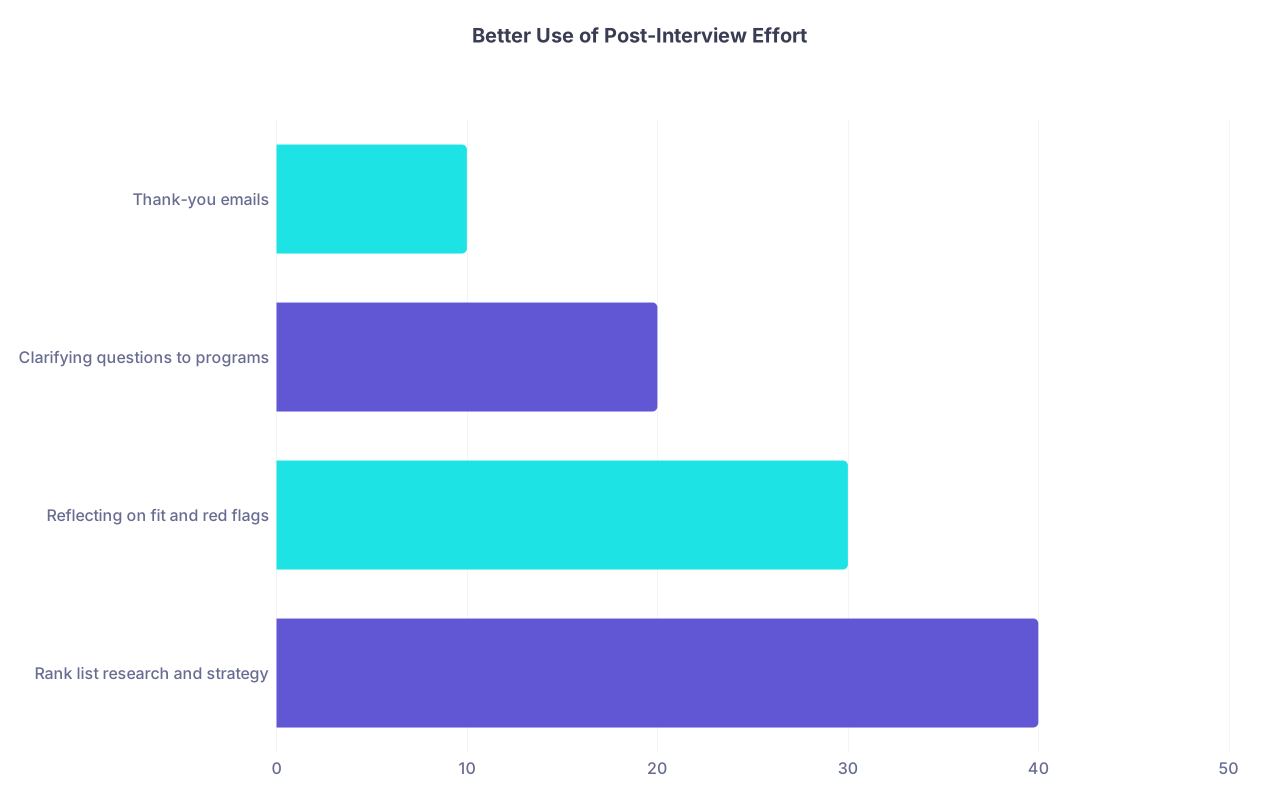
If you have 5 hours of bandwidth post-interview season, splitting that time like this is smarter:
| Category | Value |
|---|---|
| Rank list research and strategy | 40 |
| Reflecting on fit and red flags | 30 |
| Clarifying questions to programs | 20 |
| Thank-you emails | 10 |
Where those “thank-you emails” hours go:
- Drafting a clean 3–4 sentence template
- Personalizing 1–2 lines per email
- Sending to PDs or key faculty at programs you genuinely care about
Not writing an essay to every single person you met on Zoom.
Also: your behavior during the interview is a stronger “thank you” signal than any post-hoc note. Showing up prepared, asking specific questions, and engaging like an adult → that’s what programs remember. The email is just a tiny echo of that.
How Programs Actually Decide Between Similar Applicants
The only time a thank-you note might matter is when two applicants are extremely close in committee’s eyes. But even then, what tends to break ties?
- Stronger letters
- Slightly better Step 2 or clerkship narrative
- Consistency between application, interview, and references
- Perceived reliability and professionalism
- Whether someone expressed clear, in-person enthusiasm
Post-interview emails sometimes come up in conversations like:
“He seemed kind of lukewarm in the interview, but he did follow up later and seemed more interested.”
or
“She wrote a thoughtful note about the diversity curriculum that matched what she talked about on interview day.”
Notice the pattern: the email confirms or clarifies existing impressions. It doesn’t create them from scratch.
So… Are Thank-You Notes Still Necessary?
Necessary? No.
Pointless? Also no.
Overhyped? Absolutely.
Here’s the distilled version:
Thank-you notes are optional, not mandatory. Most programs will not punish you for skipping them, and their impact on your rank position is usually tiny to nonexistent.
Short, specific, rule-following emails can give you a small edge at programs you truly care about. Not a magic edge, not a Step-score-level edge, but a mild, positive signal—especially when they clarify interest or fix a miscommunication.
Your interview performance, clinical record, and letters matter exponentially more than your post-interview etiquette. If you’re going to stress about something, stress about preparing well for interviews and building an honest, thoughtful rank list—not crafting the perfect paragraph of digital gratitude.
So send thank-you notes if you want. Ignore them if a program says not to. But stop pretending they’re the hinge on which your match outcome swings. They aren’t.